
Ink DetectiveAn interactive paper chromatography and Rf values simulation for ages 11 to 14
Separate the inks of five pens with chromatography and find out which one wrote the ransom note.
Part of Thinkodile Plus · about 34 minutes · plays in the browser
The mystery
The science fair trophy is gone. In its place: a note in black ink. Five suspects each own a black pen, and every ink looks exactly the same. How could you tell which pen wrote the note?
Every quest starts with a prediction. Lock yours in, then run the experiments to find out who was right.
What you’ll learn
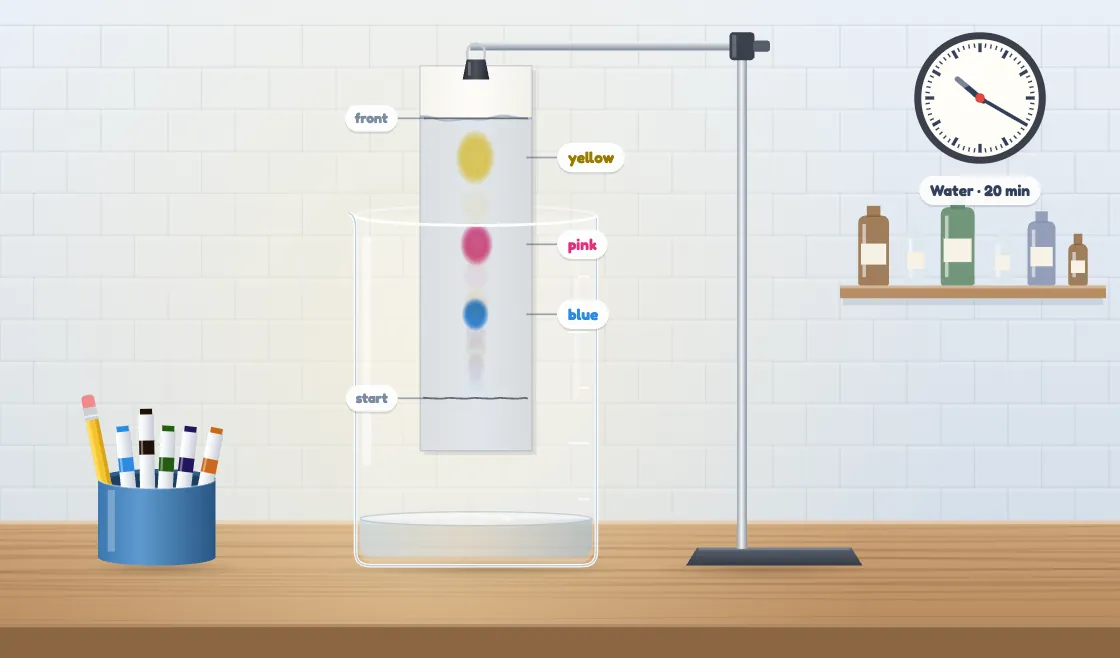
Inks are mixtures
Most inks are a mixture of dyes: a black felt-tip can hide blue, pink and yellow dyes. Chromatography separates the dyes in a mixture so you can see each one.
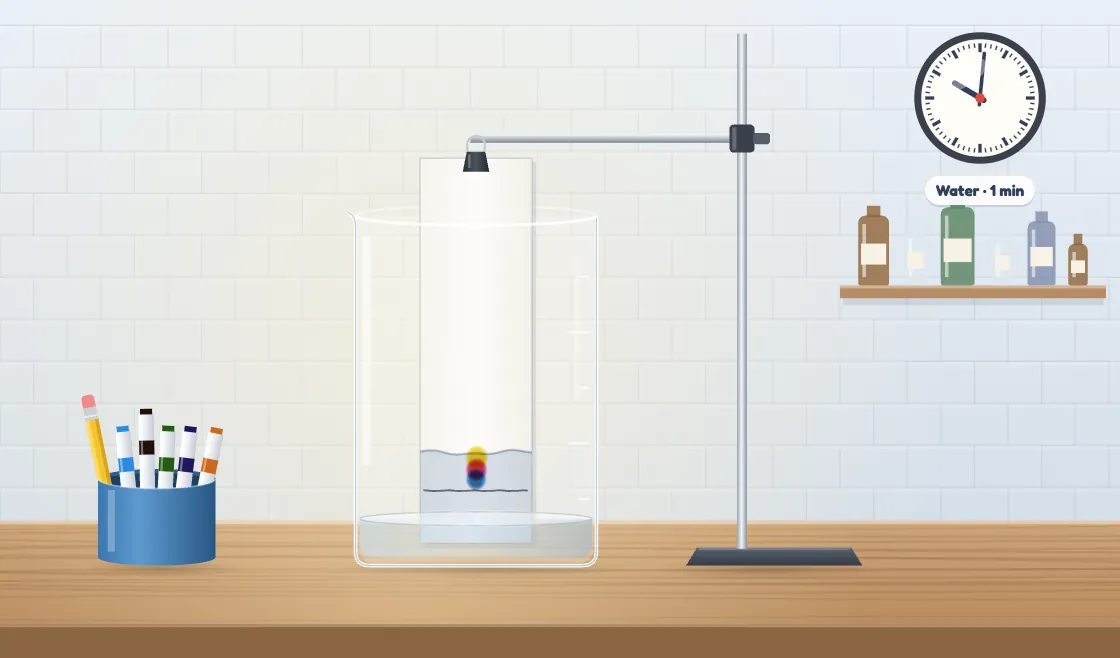
Setting it up
Draw a start line in pencil near the bottom of the paper, and put a small spot of ink on it. Dip the bottom in the solvent, with the line above the solvent's surface. Pencil doesn't dissolve, so it stays put.
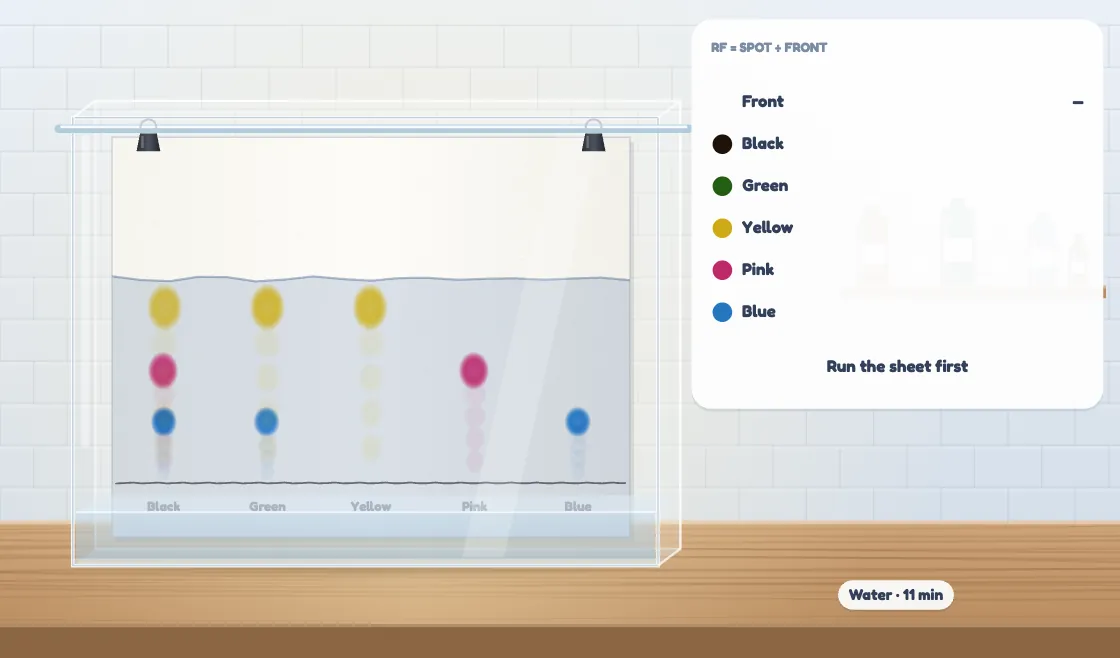
Why the dyes separate
The solvent soaks up the paper and carries the dyes with it. A dye that dissolves well and sticks less to the paper travels further. The paper is the stationary phase; the moving solvent is the mobile phase.
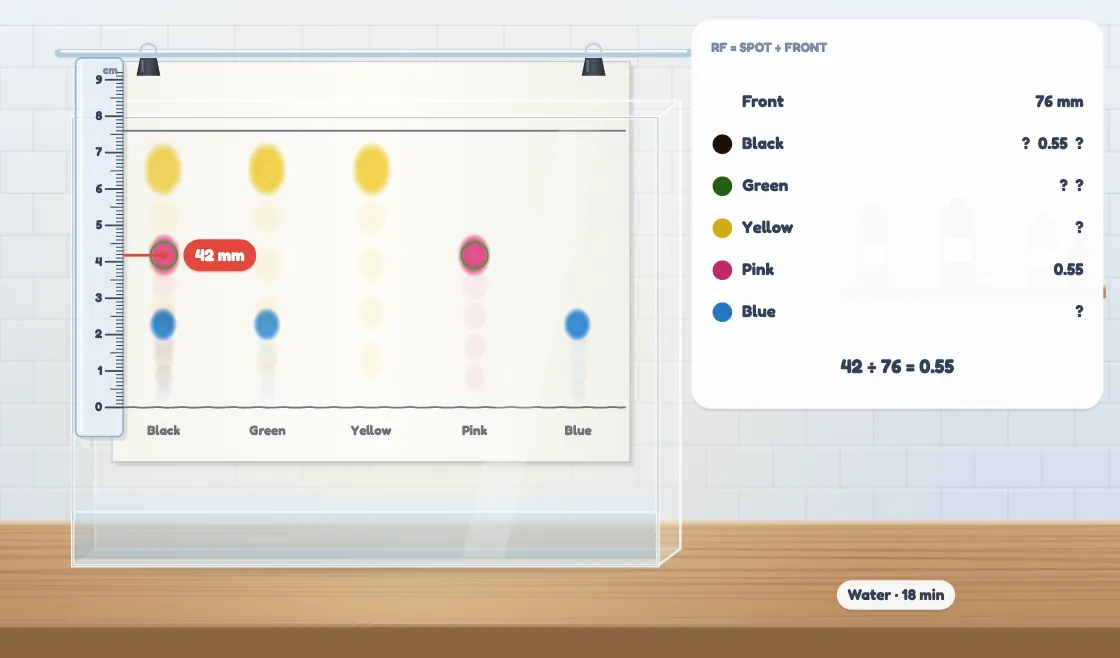
Rf values
Measure from the start line to the middle of a spot, and to the solvent front. The same dye in the same solvent always has the same Rf, so Rf values can name a dye.
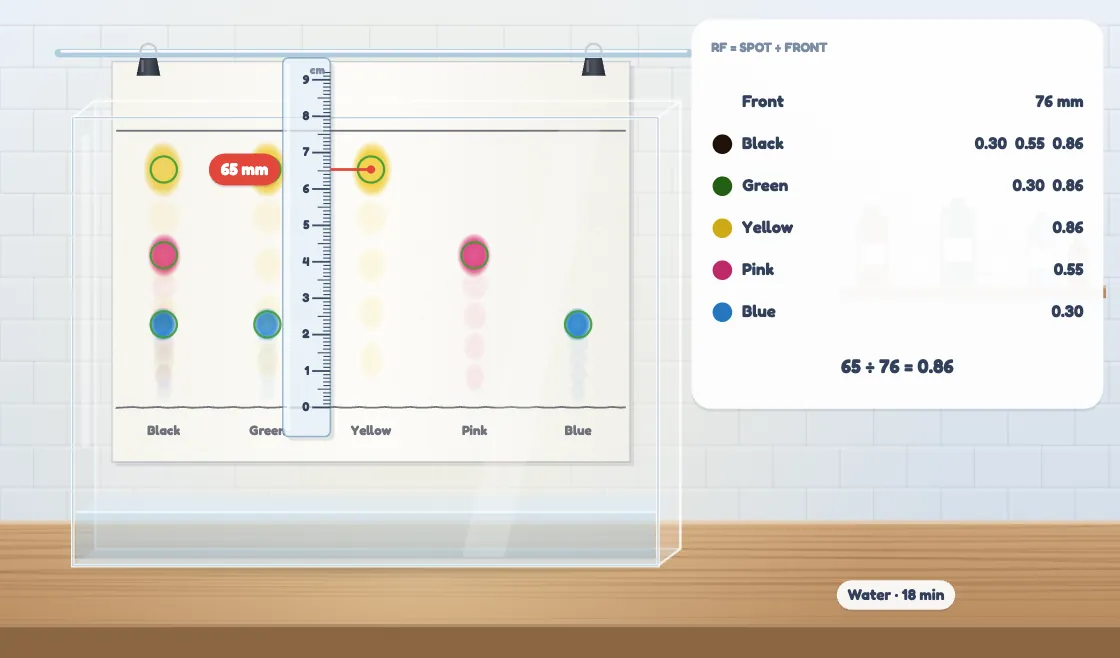
Pure or a mixture?
A pure substance makes one spot. A mixture makes several. Run pure dyes beside an ink: a spot level with a pure dye's spot, at the same Rf, is very likely that dye.
Choosing the solvent
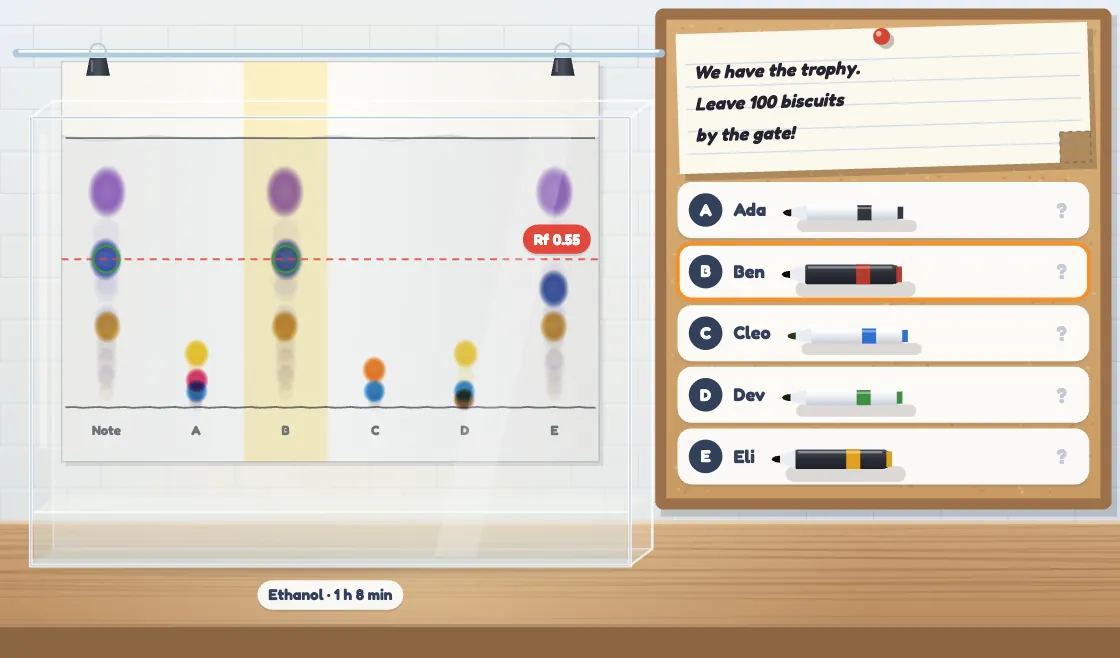
A dye that doesn't dissolve in the solvent stays on the start line. Permanent-marker dyes don't dissolve in water, but they do in ethanol. Forensic scientists use chromatography to compare inks, dyes and drugs.
Inside the lab
8 missions in 4 parts: Split an ink, Measure Rf, The case, Bonus. Each one is something to try for yourself, with the science behind it once you’ve done it.
- Black isn't blackRun black felt-tip ink in water, with a pencil start line above the water.The black ink was blue, pink and yellow dyes mixed together. Water carried each dye up the paper a different distance, so they came apart.
- Why pencil?Draw the start line in felt-tip pen instead of pencil, and run the strip.Pencil marks are graphite, which doesn't dissolve, so the line stays put. A felt-tip line dissolves and runs up the paper, mixed in with your dyes.
- Measure an RfRun the sheet, then measure the solvent front and one spot with the ruler.Rf = distance moved by the spot ÷ distance moved by the solvent front. A spot can never pass the solvent, so Rf is always between 0 and 1.
- Same dye, same RfMeasure a spot in one of the inks, and the pure dye with the same Rf.In the same solvent, a dye always has the same Rf. Each pure dye made one spot. The inks made several, so they're mixtures.
- Stuck on the lineRun the note and all five pens side by side in water.Ben's and Eli's markers are permanent: their dyes don't dissolve in water, so they can't climb. The note's ink behaves just like them.
- Case closedFind a solvent that moves the note's ink, then accuse the one pen that matches it.In ethanol the note split into three spots. Only Ben's marker made the same three, at the same Rf values. Eli's dark blue spot sat lower: a different dye.
- Too deepPut the water above the start line, and run a strip.The start line must sit above the solvent. Under it, the dyes dissolve into the beaker instead of climbing the paper.
- Every spotMeasure every spot on the Rf sheet.In this model, black ink is blue (0.30), pink (0.55) and yellow (0.86). Green ink: the same blue and yellow. Matching Rf values tell you which dyes are in a mixture.
How the quest works
- Predict. Coco asks the mystery and you lock in an answer.
- Learn. A short, picture-led story of the big ideas (6 slides).
- Experiment. 8 missions in the lab, each one yours to try.
- Final Challenge. 8 questions that check you can use what you found, then the mystery’s answer.
For teachers
Present it live on the board while your class follows on their own screens. It fits one class period: about 6 minutes of Learn, 21 in the lab and 7 for the Final Challenge.
Students can
- set up a paper chromatogram: a pencil start line, a small spot of ink, and the solvent's surface below the line, and say why each matters.
- explain that a dye which dissolves well in the solvent and sticks less to the paper travels further, so the dyes in a mixture separate.
- measure a spot and the solvent front from the start line and calculate Rf = distance moved by the spot ÷ distance moved by the solvent front.
- use the number of spots and their Rf values to tell a pure substance from a mixture, match an unknown to known samples, and choose a different solvent when a substance doesn't move.
NGSS: MS-PS1-2. NCERT: Class 8, ch. 8 Nature of Matter: Elements, Compounds, and Mixtures.
Teacher notes for Ink DetectiveQuestions people ask
What is Ink Detective?
Ink Detective is an interactive paper chromatography and Rf values simulation from Thinkodile for ages 11 to 14. Separate the inks of five pens with chromatography and find out which one wrote the ransom note. It opens with a mystery to predict, explains the big ideas in a short Learn story, lets you run the experiments yourself in the lab, and ends with a Final Challenge.
Is Ink Detective free?
Ink Detective is part of Thinkodile Plus for families and Teacher Pro for teachers. A free account includes 6 quests: Photosynthesis, Build a Cell, Build an Electromagnet, Particles in Motion, Dissolving, Moon Phases Explorer. A parent or teacher creates the account; children never sign up themselves.
How long does Ink Detective take?
About 34 minutes for a class working through it together: around 6 minutes for the Learn story, 21 in the lab and 7 for the Final Challenge. At home you can stop and pick it up again later.
Which curriculum does Ink Detective cover?
In the US it supports the Next Generation Science Standards MS-PS1-2. In India it matches NCERT Class 8 Science, chapter 8: Nature of Matter: Elements, Compounds, and Mixtures. It's organised by topic, not by grade, so it fits other syllabuses too.
Does Ink Detective work on phones, tablets and Chromebooks?
Yes. It runs in the web browser on laptops, Chromebooks, tablets and phones, with nothing to install. On a phone the lab plays sideways, so turn the phone on its side.
Keep exploring Elements, Compounds & Mixtures
- Separate It!: Mix iron and sulfur and heat them into a compound, pull iron, sand and salt apart, and sort out rice, grain and tea.
- All of Elements, Compounds & Mixtures