
Melt, Boil, FreezeAn interactive heating curve simulation for ages 11 to 14
Heat ice from −20 °C to steam and watch the thermometer stall while the particles break free, then freeze sea water and boil an egg on Everest.
Part of Thinkodile Plus · about 39 minutes · plays in the browser
The mystery
Coco heats a beaker of ice at −20 °C on a steady flame. The thermometer climbs to 0 °C, and the ice starts to melt. What does the thermometer do next?
Every quest starts with a prediction. Lock yours in, then run the experiments to find out who was right.
What you’ll learn
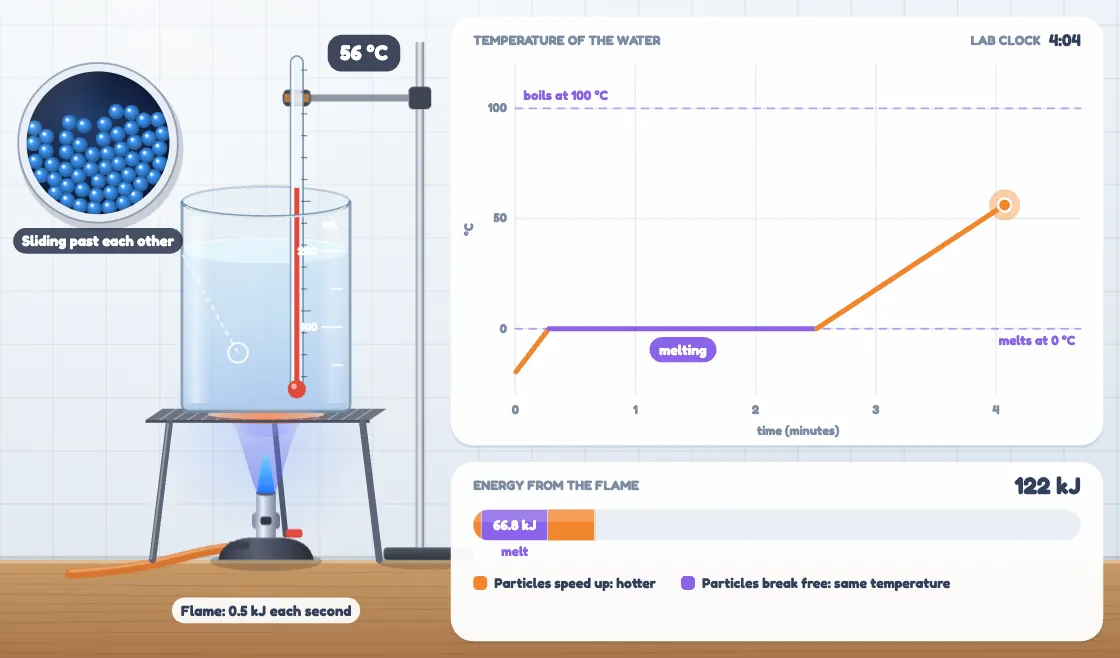
Heat in, temperature up
Heating gives particles energy: they shake or move faster, and the temperature rises. Some things take more energy to warm than others. This is their specific heat capacity: the energy to warm 1 g by 1 °C.
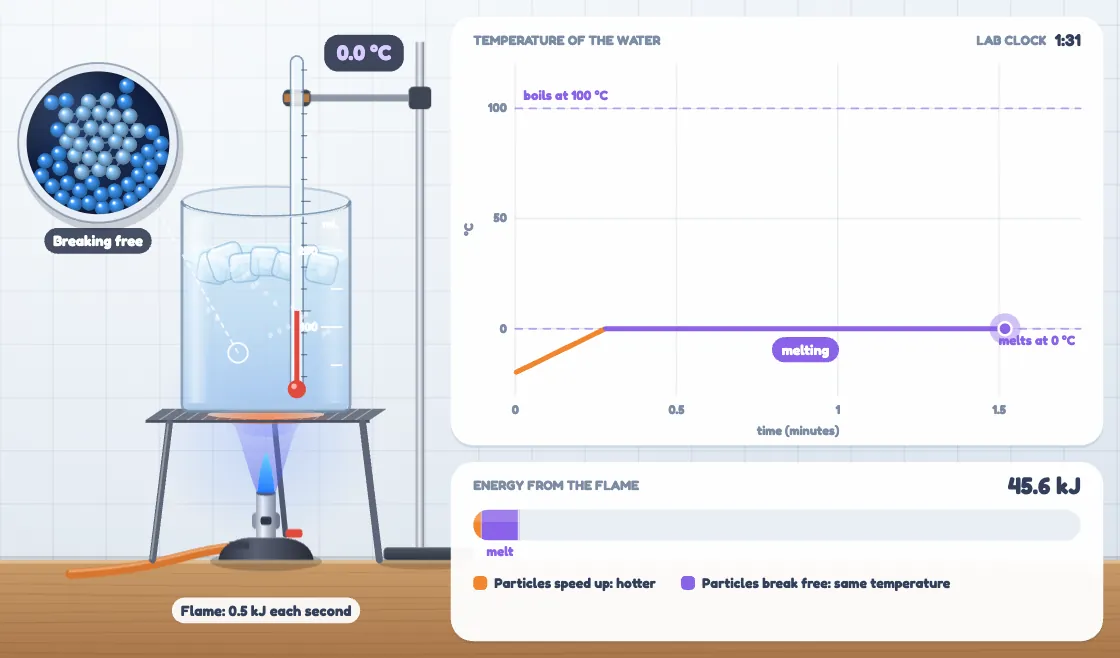
The flat parts
While ice melts, the thermometer stays at 0 °C however long you heat it. The energy is freeing the particles from their fixed places, not making them faster. Melting 1 g of ice takes 334 J: its latent heat of melting.
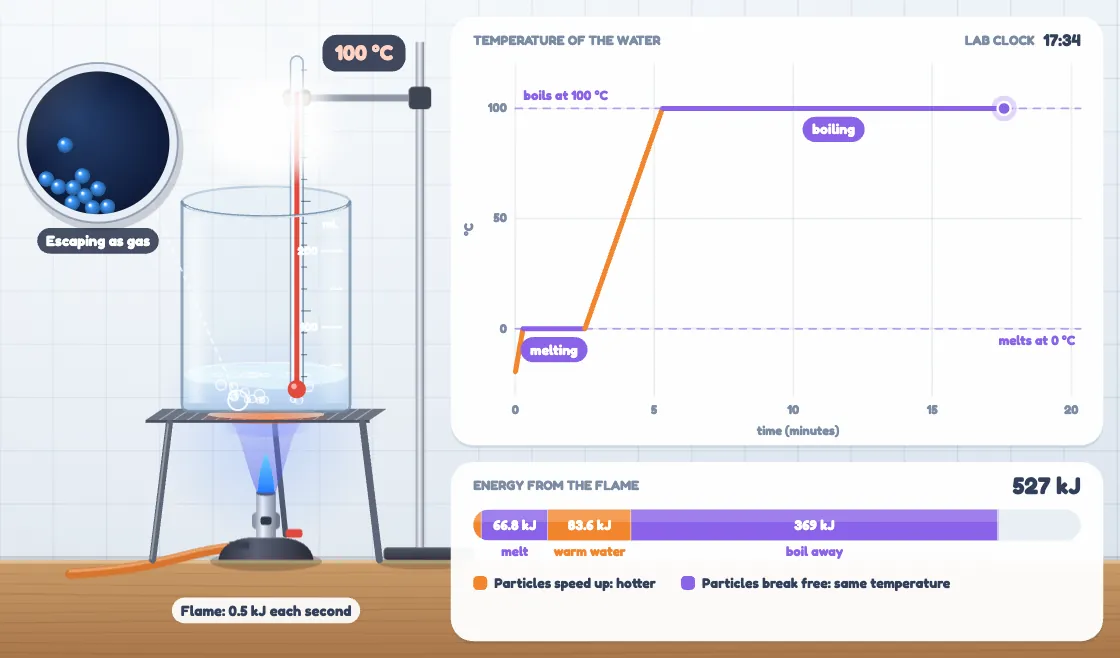
Boiling takes the most
Boiling pulls the particles right apart, so it takes far more energy: 2,260 J for each gram. With a steady flame, the boiling part of the graph is the longest by far.
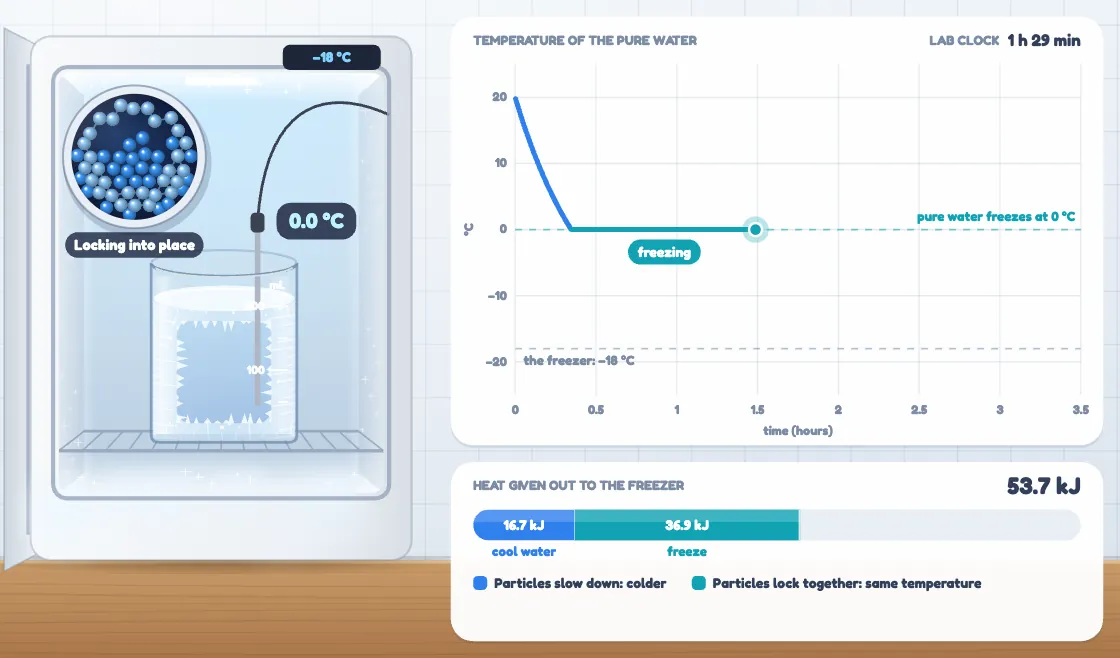
Freezing gives heat out
Cool water and it slows down to 0 °C, then stays there while it freezes. Particles locking into place give out heat, 334 J for each gram: the same as melting took in. A pure substance melts and freezes at one sharp temperature.
Salt lowers the freezing point
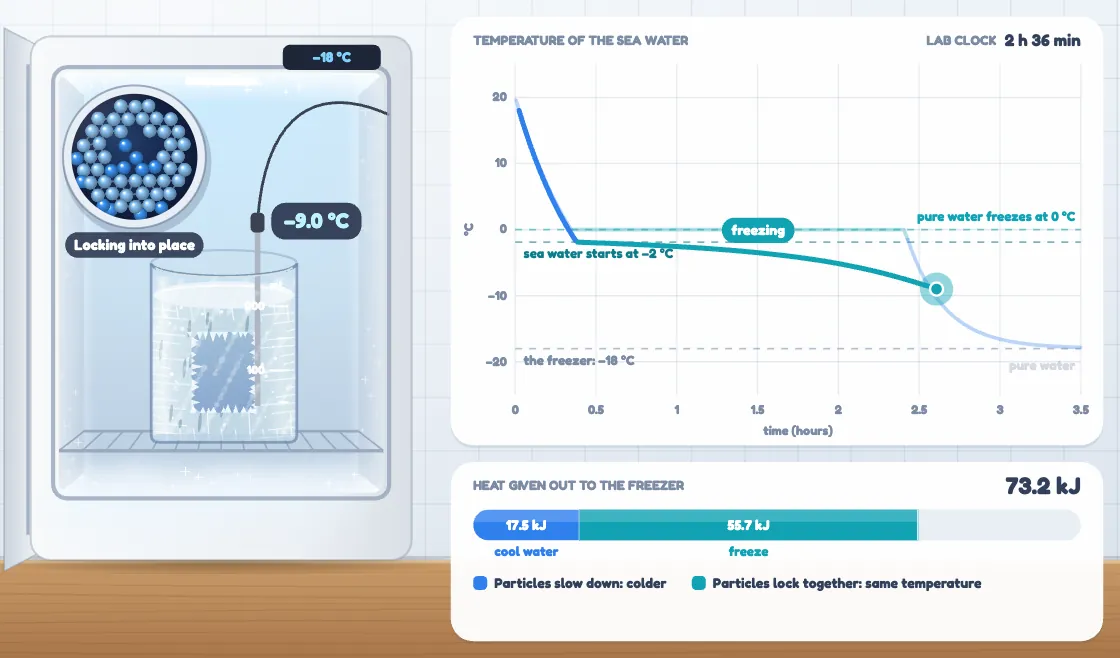
Sea water starts to freeze at about −2 °C. The salt gets in the way of the particles locking together, and the water left behind gets saltier, so it freezes lower and lower. That's why salt is spread on icy roads.
Pressure moves the boiling point
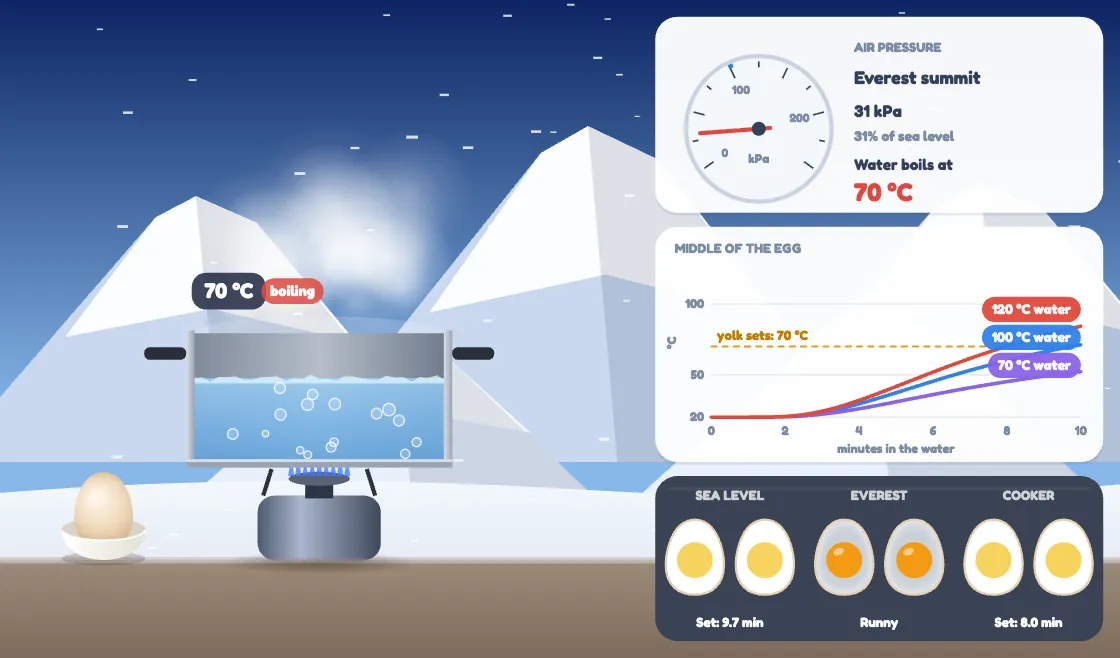
Water boils when its particles can escape against the air pressing down on it. On top of Everest the air pressure is about a third of sea level's, so water boils at only about 70 °C. A pressure cooker traps the steam and raises it to about 120 °C.
Inside the lab
8 missions in 4 parts: The heating curve, Freezing, Boiling somewhere else, Bonus. Each one is something to try for yourself, with the science behind it once you’ve done it.
- Stuck at 0 °CLight the burner under the ice and keep heating until it has all melted.Melting takes energy without warming anything: 334 J for every gram of ice. The energy frees the particles from their fixed places. Only when all the ice has gone does the temperature rise again.
- The long boilKeep heating until all the water has boiled away.Boiling needs 2,260 J for every gram, because the particles have to be pulled right apart. Boiling 200 g away takes 452 kJ; warming it from 0 °C to 100 °C took only 84 kJ.
- A bigger flameStart again with fresh ice and a high flame, and melt it all. Does it melt at a higher temperature?A bigger flame gives energy faster, so the flat parts get shorter. They stay at the same temperatures: ice melts at 0 °C and water boils at 100 °C at sea level, however hard you heat it.
- Frozen solidPut a beaker of pure water in the freezer and watch until it has frozen solid.Freezing gives out exactly the energy melting took in: 334 J for each gram. Until every particle has locked into place, that heat holds the water at 0 °C.
- Sea waterNow freeze sea water for three and a half hours. Where does it start to freeze?Salt gets in the way of the water particles locking together, so sea water starts to freeze at about −2 °C. As ice forms, the water left gets saltier and freezes lower still. That's why salt is spread on icy roads.
- Three eggsCook an egg for 10 minutes at sea level, on the summit of Everest and in a pressure cooker.Water boils when its particles can push back against the air pressing on it. With less air pressure it boils cooler: about 70 °C on Everest. A pressure cooker traps the steam, so its water boils at about 120 °C and food cooks faster.
- Half the iceMelt 100 g of ice on the same flame as a 200 g run, and compare the flat parts.Half the ice needs half the energy to melt: 33.4 kJ instead of 66.8 kJ. The energy to melt anything is its mass × its latent heat (334 J/g for ice).
- Mountain kitchenClimb the mountain and find the height where water boils at 90 °C.Water boils at about 90 °C at 3,000 m: roughly 1 °C lower for every 300 m you climb. Climbers' food takes longer to cook.
How the quest works
- Predict. Coco asks the mystery and you lock in an answer.
- Learn. A short, picture-led story of the big ideas (6 slides).
- Experiment. 8 missions in the lab, each one yours to try.
- Final Challenge. 8 questions that check you can use what you found, then the mystery’s answer.
For teachers
Present it live on the board while your class follows on their own screens. It fits one class period: about 6 minutes of Learn, 26 in the lab and 7 for the Final Challenge.
Students can
- draw and read a heating curve for water from −20 °C to steam, and explain that the sloping parts are particles speeding up (the temperature rises) while the flat parts at 0 °C and 100 °C are changes of state, where energy frees particles without raising the temperature.
- use specific heat capacity and specific latent heat to compare energies (334 J to melt 1 g of ice, 2,260 J to boil away 1 g of water) and explain why the boiling part of the curve is the longest.
- describe a cooling curve, explain that freezing gives out the same energy that melting takes in, and explain why salt water starts to freeze below 0 °C.
- explain why water boils at a lower temperature where the air pressure is lower (about 70 °C on Everest) and a higher one in a pressure cooker (about 120 °C), and what that means for cooking.
NGSS: MS-PS1-4. NCERT: Class 8, ch. 7 Particulate Nature of Matter.
Teacher notes for Melt, Boil, FreezeQuestions people ask
What is Melt, Boil, Freeze?
Melt, Boil, Freeze is an interactive heating curve simulation from Thinkodile for ages 11 to 14. Heat ice from −20 °C to steam and watch the thermometer stall while the particles break free, then freeze sea water and boil an egg on Everest. It opens with a mystery to predict, explains the big ideas in a short Learn story, lets you run the experiments yourself in the lab, and ends with a Final Challenge.
Is Melt, Boil, Freeze free?
Melt, Boil, Freeze is part of Thinkodile Plus for families and Teacher Pro for teachers. A free account includes 6 quests: Photosynthesis, Build a Cell, Build an Electromagnet, Particles in Motion, Dissolving, Moon Phases Explorer. A parent or teacher creates the account; children never sign up themselves.
How long does Melt, Boil, Freeze take?
About 39 minutes for a class working through it together: around 6 minutes for the Learn story, 26 in the lab and 7 for the Final Challenge. At home you can stop and pick it up again later.
Which curriculum does Melt, Boil, Freeze cover?
In the US it supports the Next Generation Science Standards MS-PS1-4. In India it matches NCERT Class 8 Science, chapter 7: Particulate Nature of Matter. It's organised by topic, not by grade, so it fits other syllabuses too.
Does Melt, Boil, Freeze work on phones, tablets and Chromebooks?
Yes. It runs in the web browser on laptops, Chromebooks, tablets and phones, with nothing to install. On a phone the lab plays sideways, so turn the phone on its side.
Keep exploring Matter & Particles
- Particles in Motion: Zoom inside matter, freeze it, melt it, boil it and watch diffusion happen.
- Squeeze a Gas: Push on air, water and sand, squash a gas in a cylinder, and blow up a balloon with hot water.
- All of Matter & Particles