
Reactivity RaceAn interactive reactivity series and displacement reactions simulation for ages 11 to 14
Race metals in acid and drop them into each other's solutions, then rank them by who steals from whom.
Part of Thinkodile Plus · about 37 minutes · plays in the browser
The mystery
About a thousand years ago, Chinese miners dropped scrap iron into the blue water that ran out of copper mines. Days later they scraped real copper off it! Where did the copper come from?
Every quest starts with a prediction. Lock yours in, then run the experiments to find out who was right.
What you’ll learn
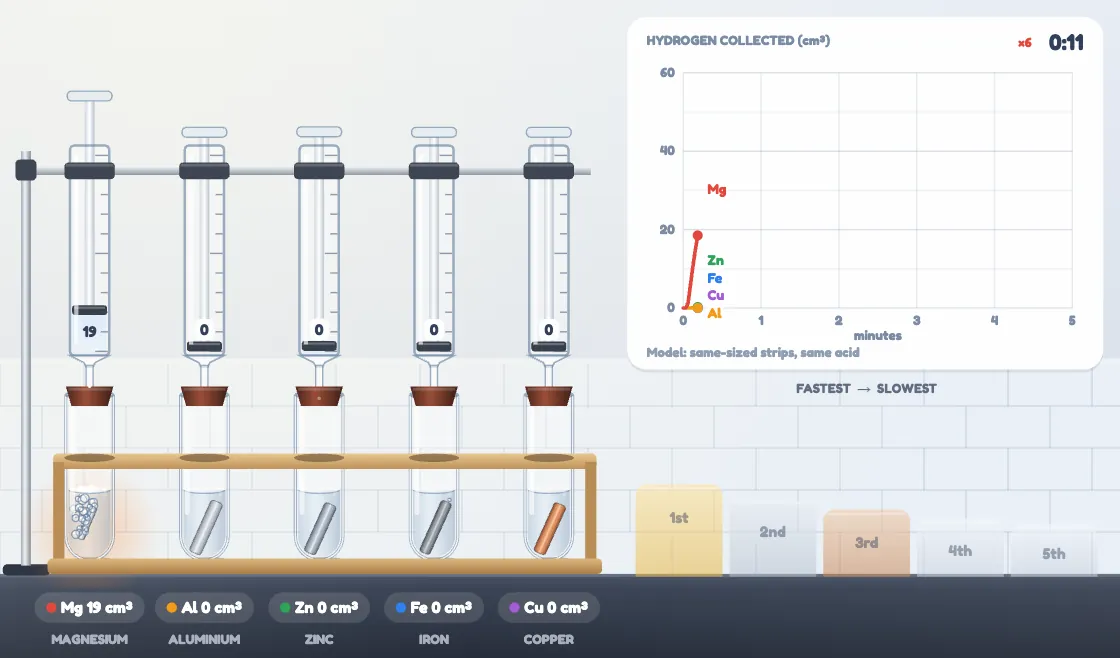
Metals and acids
Many metals react with dilute acids to make a salt and hydrogen gas: magnesium + hydrochloric acid → magnesium chloride + hydrogen. The faster the bubbles come, the more reactive the metal. Copper doesn't react at all.
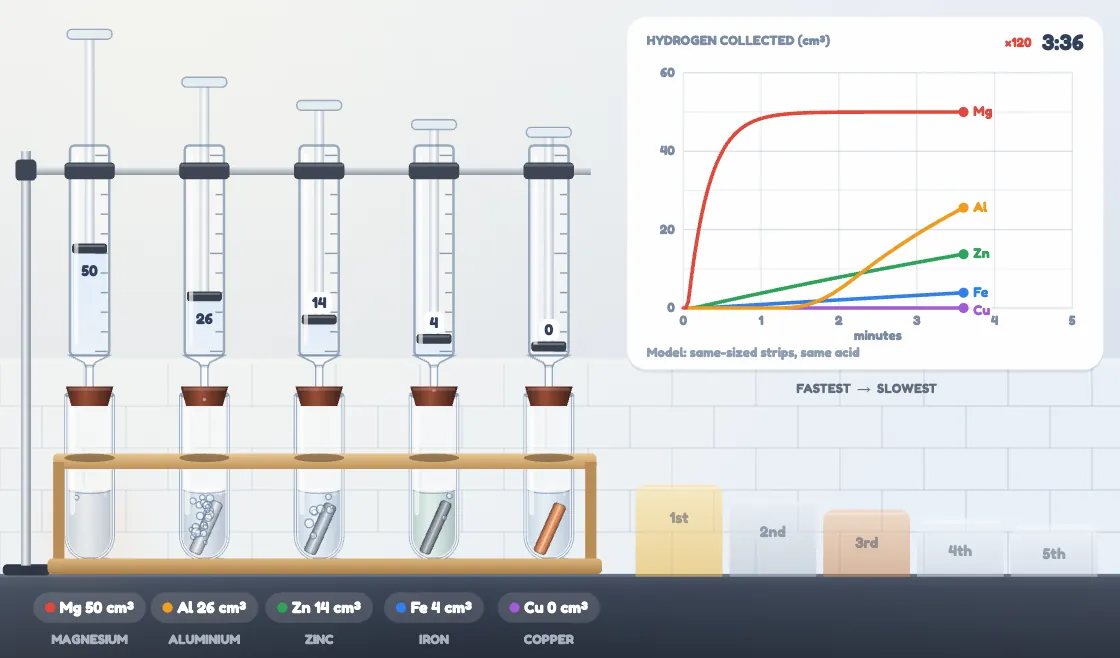
The oxide skin
Aluminium is more reactive than zinc, but a thin, tough layer of aluminium oxide covers it and keeps the acid out at first. That skin is why aluminium window frames and pans last for years.
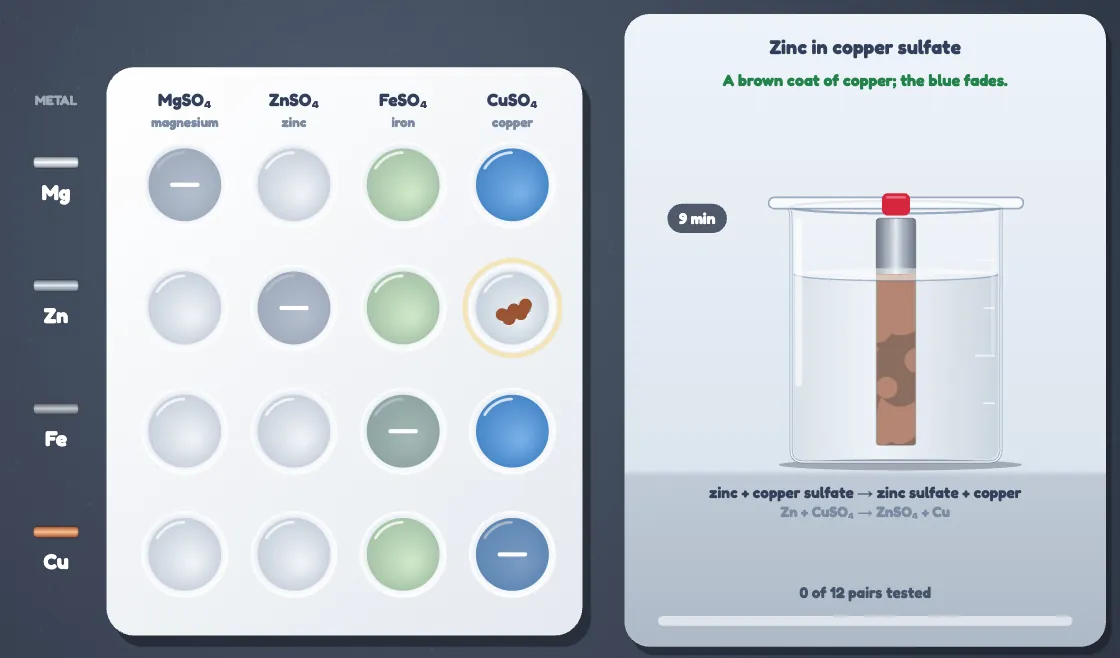
Displacement
A more reactive metal pushes a less reactive one out of its compound. Zinc in blue copper sulfate grows a brown coat of copper, and the blue fades: zinc + copper sulfate → zinc sulfate + copper.
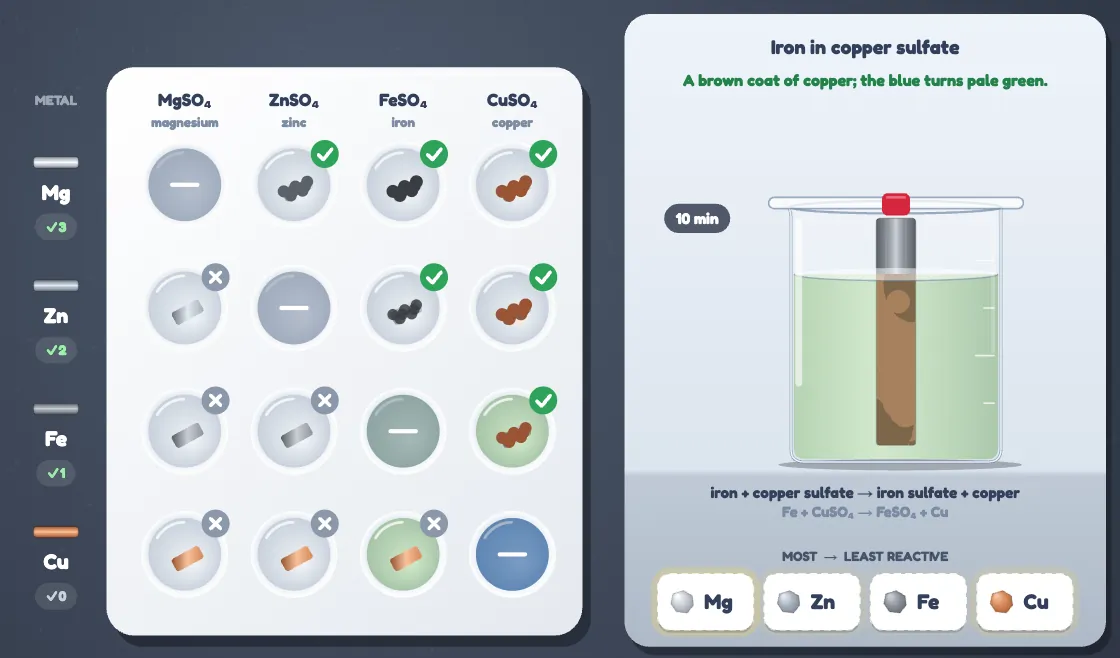
Who steals from whom
Put each metal in each other's solution and count. Magnesium pushes out zinc, iron and copper; copper pushes out none of them. A less reactive metal can never push out a more reactive one.
The reactivity series
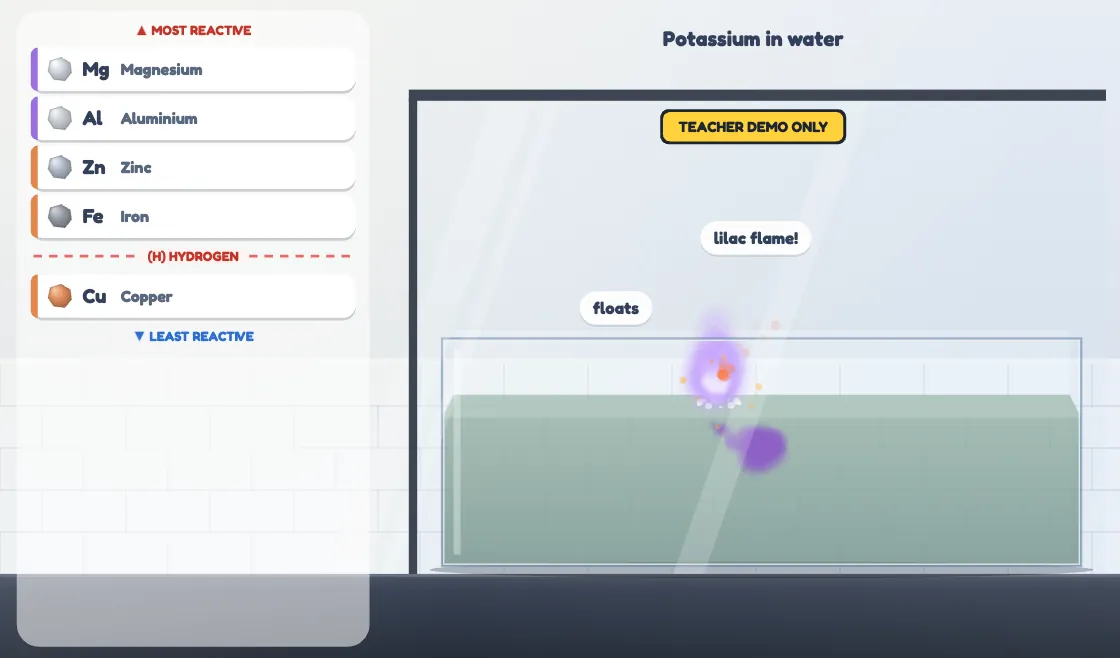
K > Na > Ca > Mg > Al > Zn > Fe > Pb > (H) > Cu > Ag > Au. The top three react with cold water; potassium so fast its hydrogen bursts into a lilac flame. Metals above hydrogen fizz with dilute acid.
Using the series
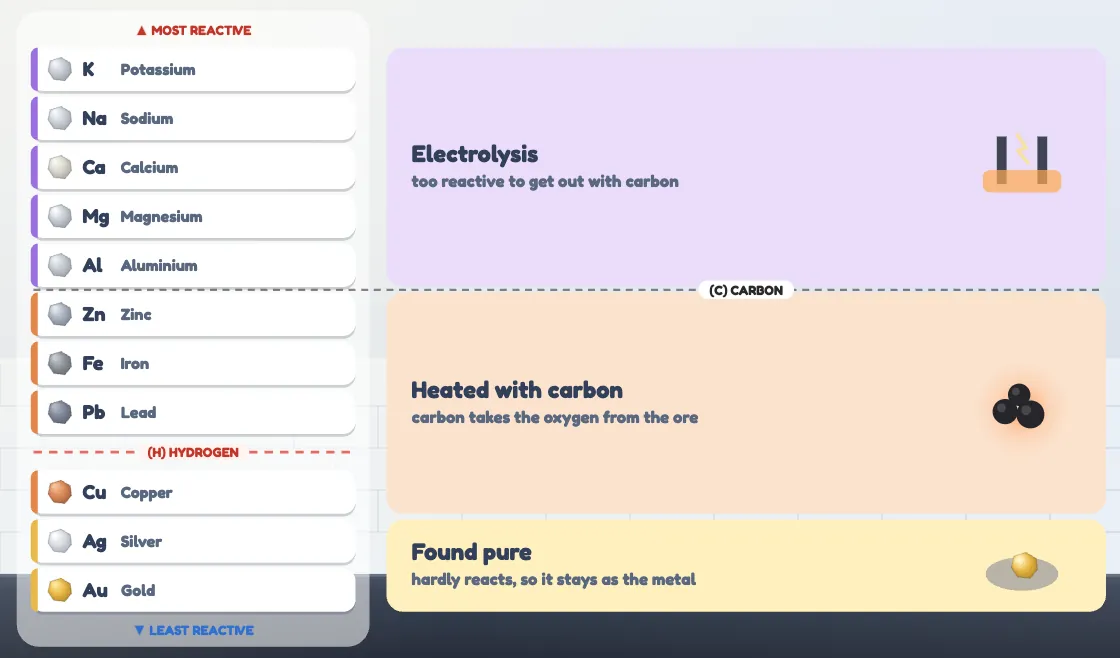
Gold hardly reacts, so it's found pure. Metals below carbon are got from their ores by heating with carbon; the most reactive need electrolysis. Zinc is above iron, so it corrodes first and protects it: steel ships carry zinc blocks.
Inside the lab
8 missions in 4 parts: The acid race, Who steals from whom?, The full series, Bonus. Each one is something to try for yourself, with the science behind it once you’ve done it.
- And they're off!Drop five metals into acid at the same time and watch the race to the end.Magnesium fizzed hardest and got warm. Zinc fizzed steadily, iron slowly, copper not at all. The gas is hydrogen: metal + acid → salt + hydrogen.
- The podiumPut the five metals on the podium, fastest first.Magnesium, aluminium, zinc, iron, copper: the faster a metal makes hydrogen with an acid, the more reactive it is.
- Copper thiefDrop zinc into blue copper sulfate solution.Zinc is more reactive than copper, so it pushes the copper out: zinc + copper sulfate → zinc sulfate + copper. This is a displacement reaction.
- Rank from the gridTest all twelve pairs, then rank the four metals from the grid.Magnesium pushes out all three others, zinc two, iron one, copper none. The more it steals, the more reactive it is.
- Teacher demosWatch potassium, sodium and calcium go into water.All three react with cold water to make hydrogen and an alkali. Potassium is the most violent, then sodium, then calcium, so they go at the very top.
- All elevenTest lead, silver and gold too, to complete the series.K, Na, Ca, Mg, Al, Zn, Fe, Pb, Cu, Ag, Au. Metals above hydrogen fizz with dilute acid; those below don't.
- A clean startSand the strips clean and race them again. Watch the aluminium.Sanding scrapes off most of aluminium's oxide skin, so the acid reaches the metal sooner. The skin grows back in air, which is why aluminium doesn't corrode away.
- Silver treeHang a copper wire in silver nitrate solution.Copper is more reactive than silver, so it pushes silver out: copper + silver nitrate → copper nitrate + silver. The silver grows as crystals, and the copper turns the liquid blue.
How the quest works
- Predict. Coco asks the mystery and you lock in an answer.
- Learn. A short, picture-led story of the big ideas (6 slides).
- Experiment. 8 missions in the lab, each one yours to try.
- Final Challenge. 8 questions that check you can use what you found, then the mystery’s answer.
For teachers
Present it live on the board while your class follows on their own screens. It fits one class period: about 6 minutes of Learn, 25 in the lab and 6 for the Final Challenge.
Students can
- describe how metals react with dilute acids to make a salt and hydrogen, and rank metals by how fast they make hydrogen in a fair test (same acid, same-sized strips).
- explain why aluminium reacts slowly at first (its oxide layer) even though it is more reactive than zinc.
- predict and explain displacement reactions: a more reactive metal pushes a less reactive one out of a solution of its compound (zinc + copper sulfate → zinc sulfate + copper), and use a results grid to put metals in order.
- recall the reactivity series (K, Na, Ca, Mg, Al, Zn, Fe, Pb, (H), Cu, Ag, Au) and use it to explain why gold is found pure, how metals are extracted, and why zinc protects iron.
NGSS: HS-PS1-2.
Teacher notes for Reactivity RaceQuestions people ask
What is Reactivity Race?
Reactivity Race is an interactive reactivity series and displacement reactions simulation from Thinkodile for ages 11 to 14. Race metals in acid and drop them into each other's solutions, then rank them by who steals from whom. It opens with a mystery to predict, explains the big ideas in a short Learn story, lets you run the experiments yourself in the lab, and ends with a Final Challenge.
Is Reactivity Race free?
Reactivity Race is part of Thinkodile Plus for families and Teacher Pro for teachers. A free account includes 6 quests: Photosynthesis, Build a Cell, Build an Electromagnet, Particles in Motion, Dissolving, Moon Phases Explorer. A parent or teacher creates the account; children never sign up themselves.
How long does Reactivity Race take?
About 37 minutes for a class working through it together: around 6 minutes for the Learn story, 25 in the lab and 6 for the Final Challenge. At home you can stop and pick it up again later.
Which curriculum does Reactivity Race cover?
In the US it supports the Next Generation Science Standards HS-PS1-2. It's organised by topic, not by grade, so it fits other syllabuses too.
Does Reactivity Race work on phones, tablets and Chromebooks?
Yes. It runs in the web browser on laptops, Chromebooks, tablets and phones, with nothing to install. On a phone the lab plays sideways, so turn the phone on its side.