
Tissue ExplorerAn interactive plant and animal tissues simulation for ages 11 to 14
Slice a leaf, a muscle and a bone under the microscope and match each tissue to its job.
Part of Thinkodile Plus · about 36 minutes · plays in the browser
The mystery
Your heart beats about 100,000 times a day and never gets tired. Your arms would ache after a few hundred push-ups. Both are muscle. What's different about the heart?
Every quest starts with a prediction. Lock yours in, then run the experiments to find out who was right.
What you’ll learn
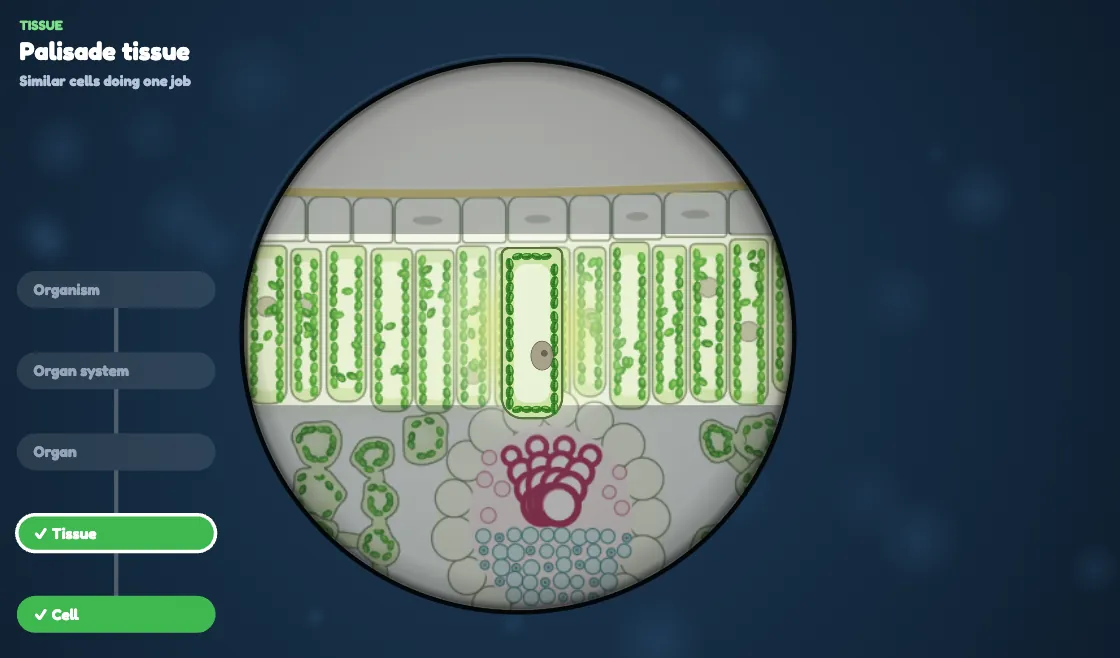
Teams of cells
A tissue is a group of similar cells working together to do one job. Plants and animals are built from many kinds of tissue, and each kind has cells shaped for its job.
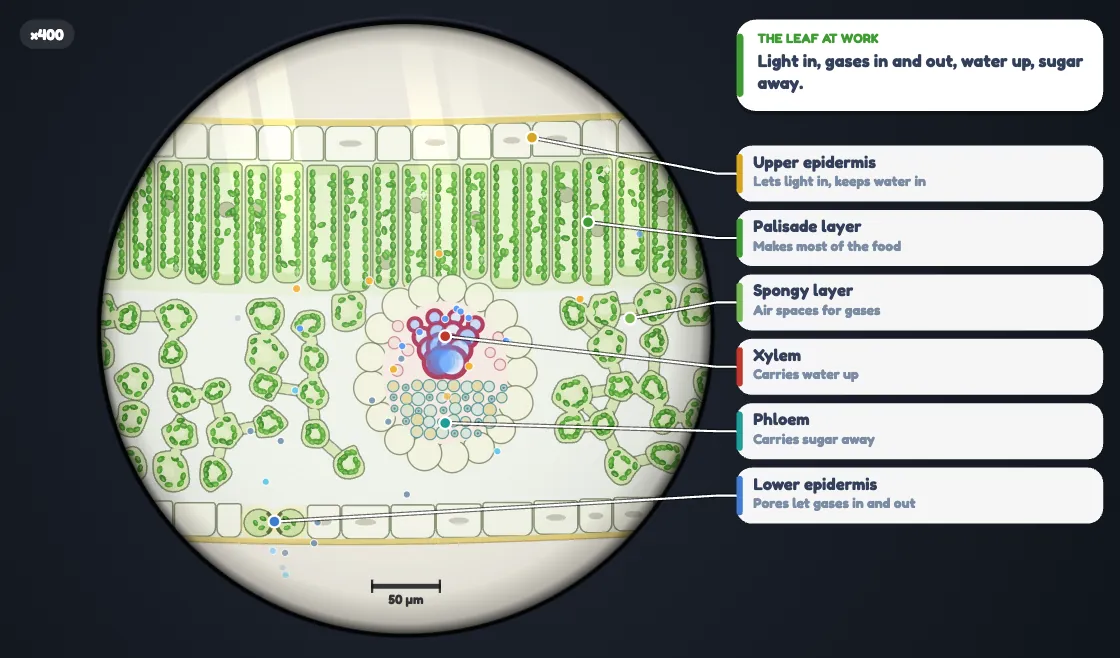
Inside a leaf
A leaf is only about 0.3 mm thick, yet it has six tissues. A waxy cuticle and a clear upper epidermis let light in. Tall palisade cells, packed with chloroplasts, make most of the food. The spongy layer's air spaces let gases reach every cell.
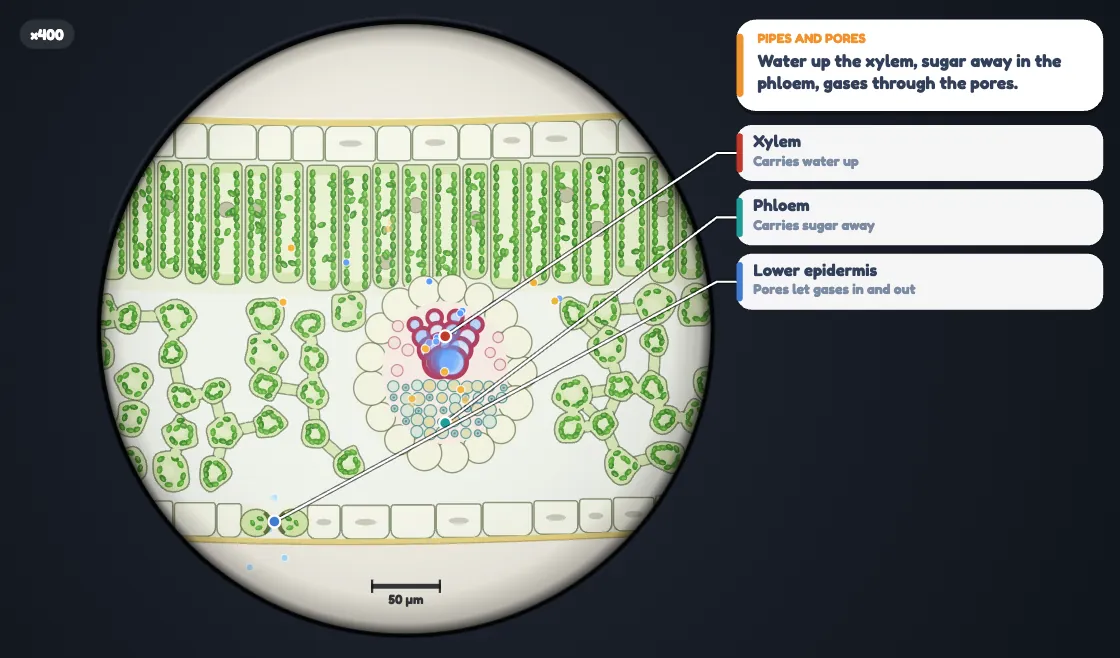
Pipes and pores
In every vein, xylem carries water up from the roots, and phloem carries sugar to the rest of the plant. In the lower epidermis, pairs of guard cells open and close the stomata to let gases in and out.
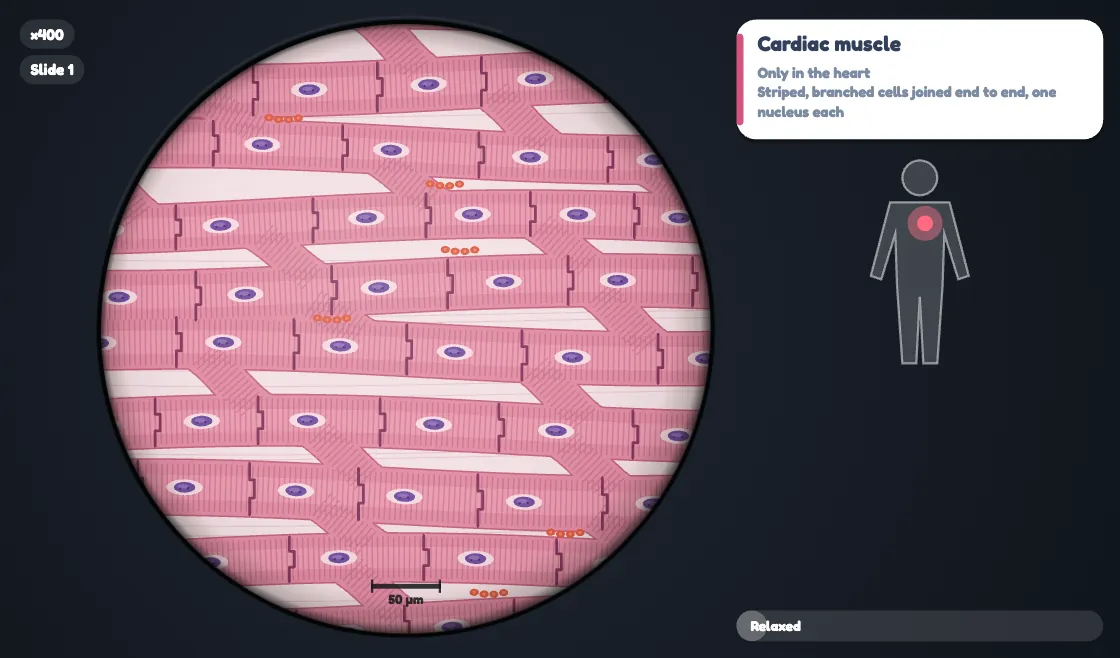
Three kinds of muscle
Skeletal muscle has long striped fibres and moves your bones when you decide. Smooth muscle, in the gut and blood vessels, has spindle-shaped cells and works by itself. Cardiac muscle, only in the heart, has striped, branched cells and beats all your life.
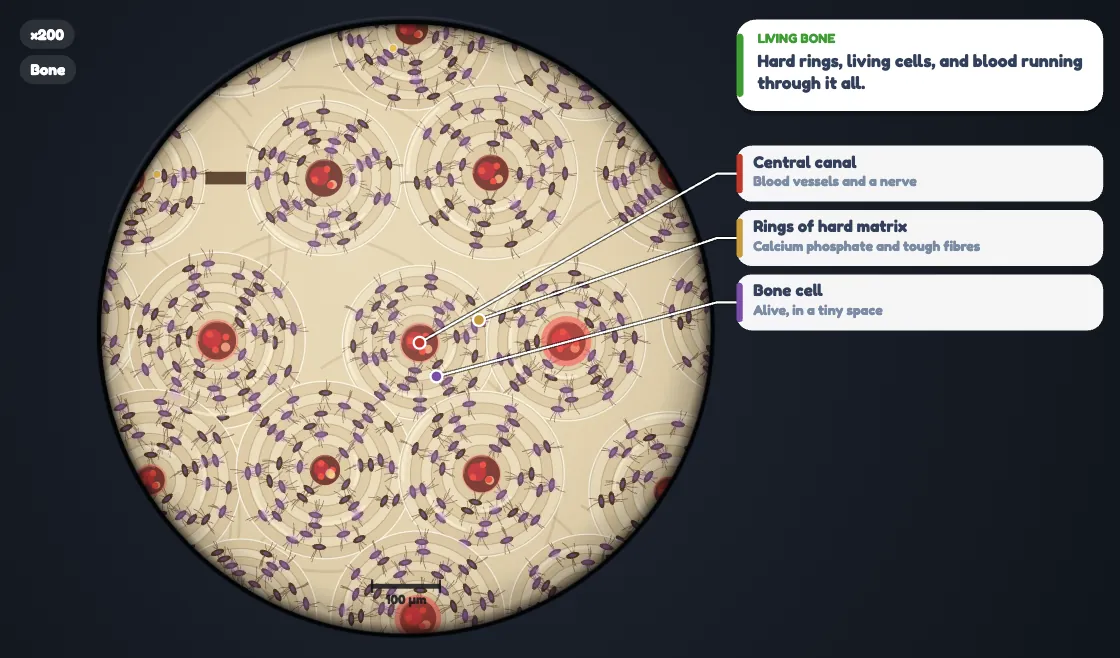
Bone is alive
Compact bone is built of ring systems. Each has rings of hard matrix, calcium phosphate with tough protein fibres, round a canal with blood vessels and a nerve. Bone cells live in tiny spaces between the rings, linked to the canal by even tinier channels.
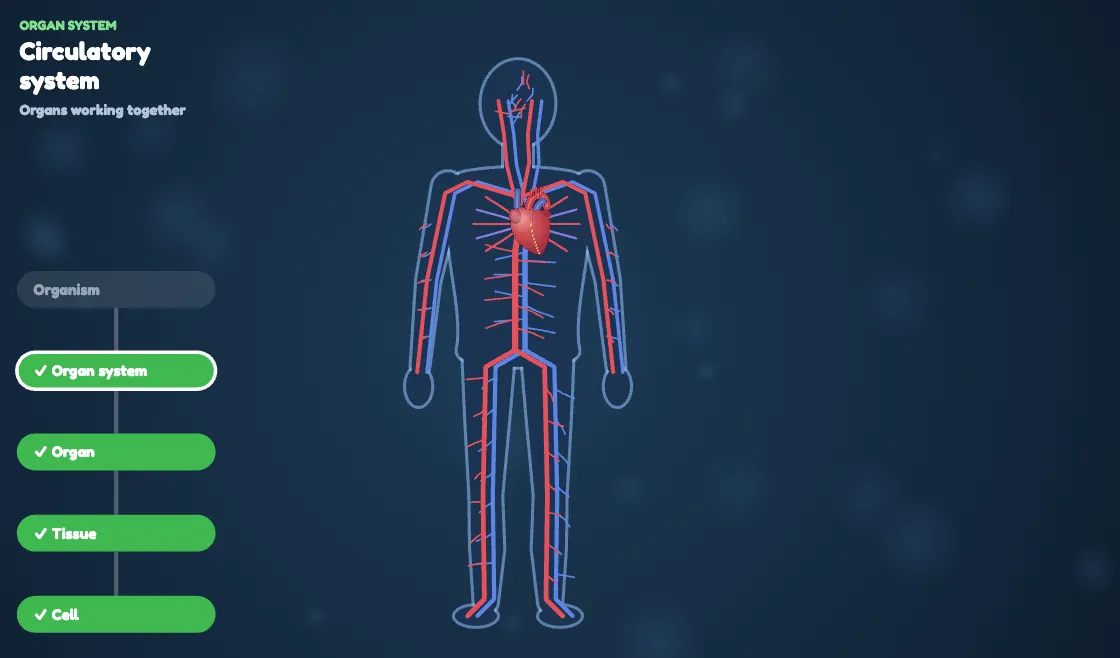
Cell to organism
Similar cells make a tissue. Several tissues make an organ, like the heart or a leaf. Organs work together in an organ system, and all the systems together make an organism.
Inside the lab
8 missions in 4 parts: Leaf slice, Muscle & bone, Cell to organism, Bonus. Each one is something to try for yourself, with the science behind it once you’ve done it.
- Inside a leafSlice a leaf and find all six of its tissues by their jobs.Each layer of a leaf is a tissue: a team of similar cells with one job. Their shapes suit their jobs, like tall palisade cells packed side by side to catch the light.
- Three musclesWork out which muscle slide came from the arm, the gut wall and the heart.Skeletal muscle has long striped fibres with many nuclei. Smooth muscle has spindle-shaped cells and no stripes. Cardiac muscle is striped and branched, with one nucleus in each cell.
- Who's in charge?Tell each kind of muscle to contract.Skeletal muscle is voluntary: it moves when you decide. Smooth and cardiac muscle are involuntary: they work by themselves, day and night.
- Living boneSlice a thigh bone and find its canal, its rings and a bone cell.Bone is a living tissue. Its hard matrix is calcium phosphate with tough protein fibres, and its cells get food and oxygen from blood vessels in the canals.
- Heart cell to humanBuild up from one cardiac muscle cell to a whole human.Cardiac muscle cells make cardiac muscle tissue. With other tissues it makes the heart, and the heart, blood vessels and blood make the circulatory system.
- Leaf cell to plantBuild up from one palisade cell to a whole plant.Palisade cells make palisade tissue; five tissues make a leaf; leaves, stem and flowers make the shoot system; with the root system, that's a plant.
- Bone cell to skeletonBuild up from one bone cell to a whole human.Every bone is an organ: bone tissue, marrow, blood vessels and nerves. An adult's skeletal system has 206 of them.
- Sharp eyesFind all six leaf tissues without a wrong tap.You read each tissue's job from its cells' shapes. That's how biologists work out what an unknown tissue does.
How the quest works
- Predict. Coco asks the mystery and you lock in an answer.
- Learn. A short, picture-led story of the big ideas (6 slides).
- Experiment. 8 missions in the lab, each one yours to try.
- Final Challenge. 8 questions that check you can use what you found, then the mystery’s answer.
For teachers
Present it live on the board while your class follows on their own screens. It fits one class period: about 7 minutes of Learn, 22 in the lab and 7 for the Final Challenge.
Students can
- define a tissue as a group of similar cells working together to do one job, in plants and in animals.
- name the tissues in a leaf cross-section (cuticle and upper epidermis, palisade, spongy layer, xylem, phloem, lower epidermis with guard cells) and link each one's cell shape to its job.
- tell skeletal, smooth and cardiac muscle apart under a microscope, say where each is found, and say which one is voluntary.
- describe compact bone as living tissue and order cell, tissue, organ, organ system and organism with real examples.
NGSS: HS-LS1-2.
Teacher notes for Tissue ExplorerQuestions people ask
What is Tissue Explorer?
Tissue Explorer is an interactive plant and animal tissues simulation from Thinkodile for ages 11 to 14. Slice a leaf, a muscle and a bone under the microscope and match each tissue to its job. It opens with a mystery to predict, explains the big ideas in a short Learn story, lets you run the experiments yourself in the lab, and ends with a Final Challenge.
Is Tissue Explorer free?
Tissue Explorer is part of Thinkodile Plus for families and Teacher Pro for teachers. A free account includes 6 quests: Photosynthesis, Build a Cell, Build an Electromagnet, Particles in Motion, Dissolving, Moon Phases Explorer. A parent or teacher creates the account; children never sign up themselves.
How long does Tissue Explorer take?
About 36 minutes for a class working through it together: around 7 minutes for the Learn story, 22 in the lab and 7 for the Final Challenge. At home you can stop and pick it up again later.
Which curriculum does Tissue Explorer cover?
In the US it supports the Next Generation Science Standards HS-LS1-2. It's organised by topic, not by grade, so it fits other syllabuses too.
Does Tissue Explorer work on phones, tablets and Chromebooks?
Yes. It runs in the web browser on laptops, Chromebooks, tablets and phones, with nothing to install. On a phone the lab plays sideways, so turn the phone on its side.