
Creature DesignerAn interactive animal adaptations simulation for ages 11 to 14
Design an animal for the desert, the deep sea or the Arctic, drop it in and see if it lasts a year.
Part of Thinkodile Plus · about 38 minutes · plays in the browser
The mystery
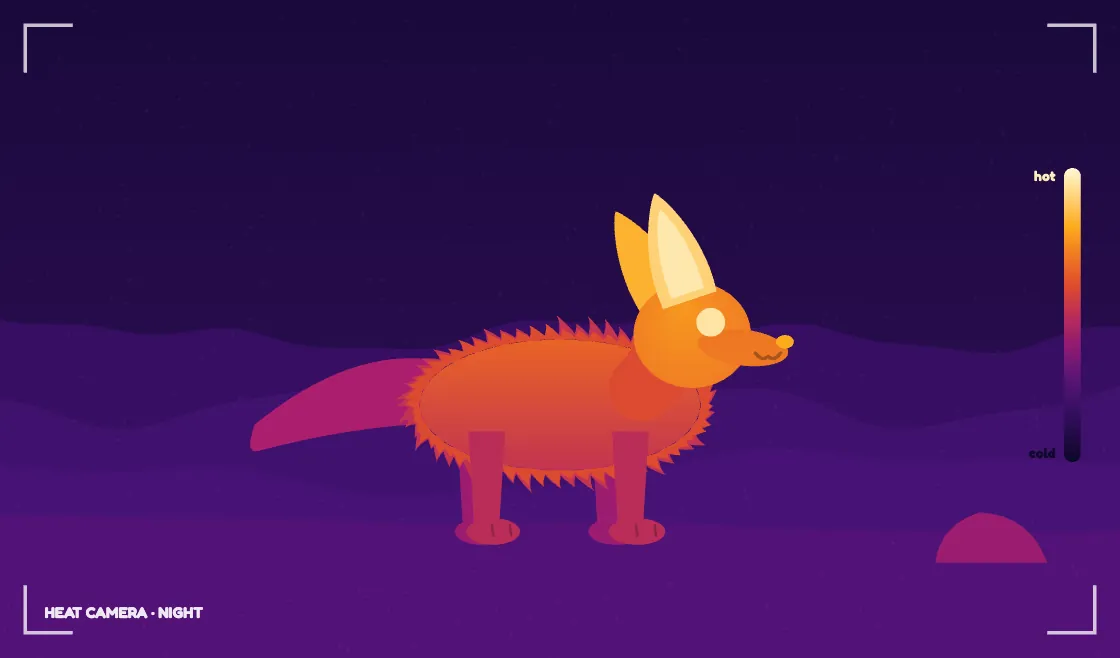
Point a heat camera at a polar bear and it almost vanishes: only its face and breath glow. Why?
Every quest starts with a prediction. Lock yours in, then run the experiments to find out who was right.
What you’ll learn
Adaptations
An adaptation is a feature that helps a living thing survive in its habitat. Some are body parts, like thick fur. Some are ways of behaving, like hunting at night.
Keeping cool in the desert
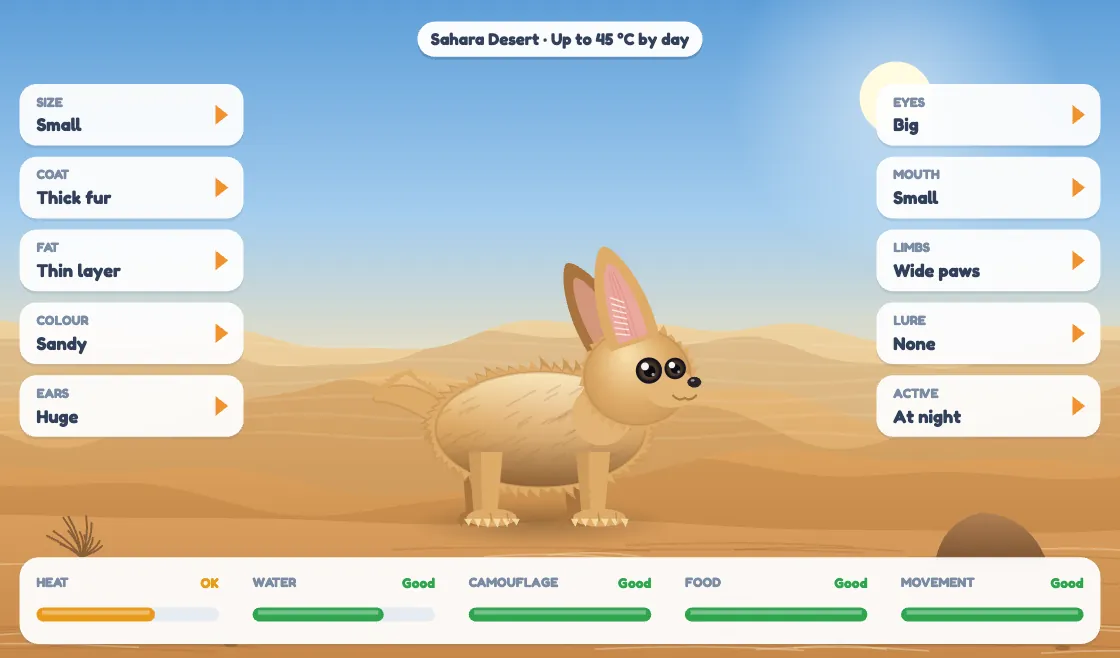
Sahara days reach 45 °C. The fennec fox's huge ears give off heat. It sleeps in a cool burrow by day, hunts at night, and gets most of its water from its food. Furry soles let it walk on hot sand.
Keeping warm in the Arctic
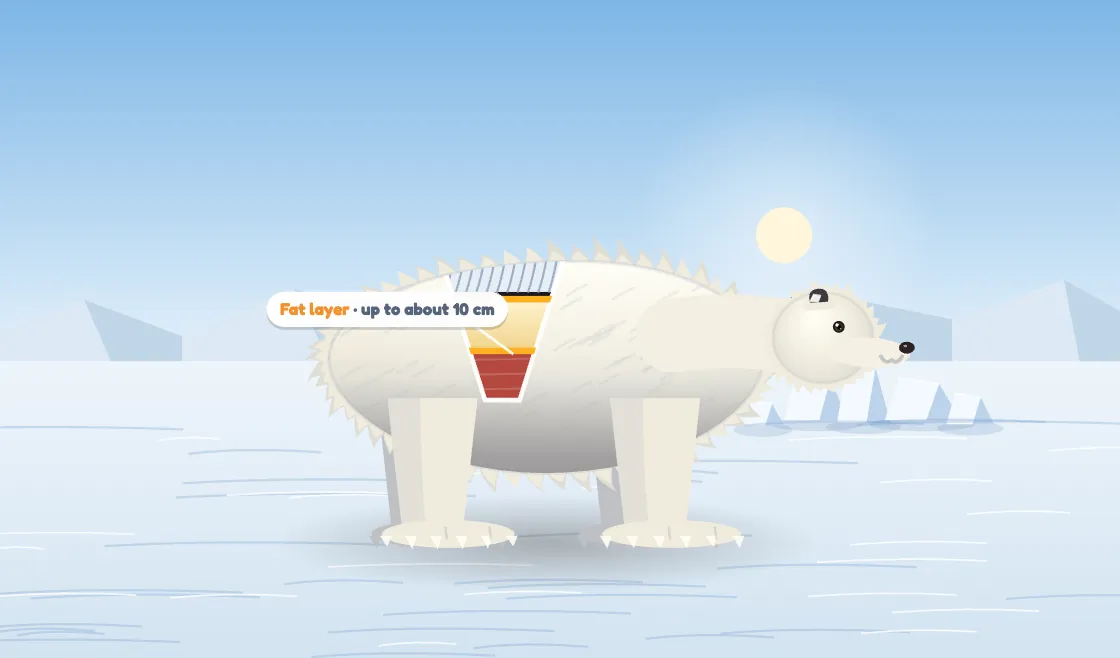
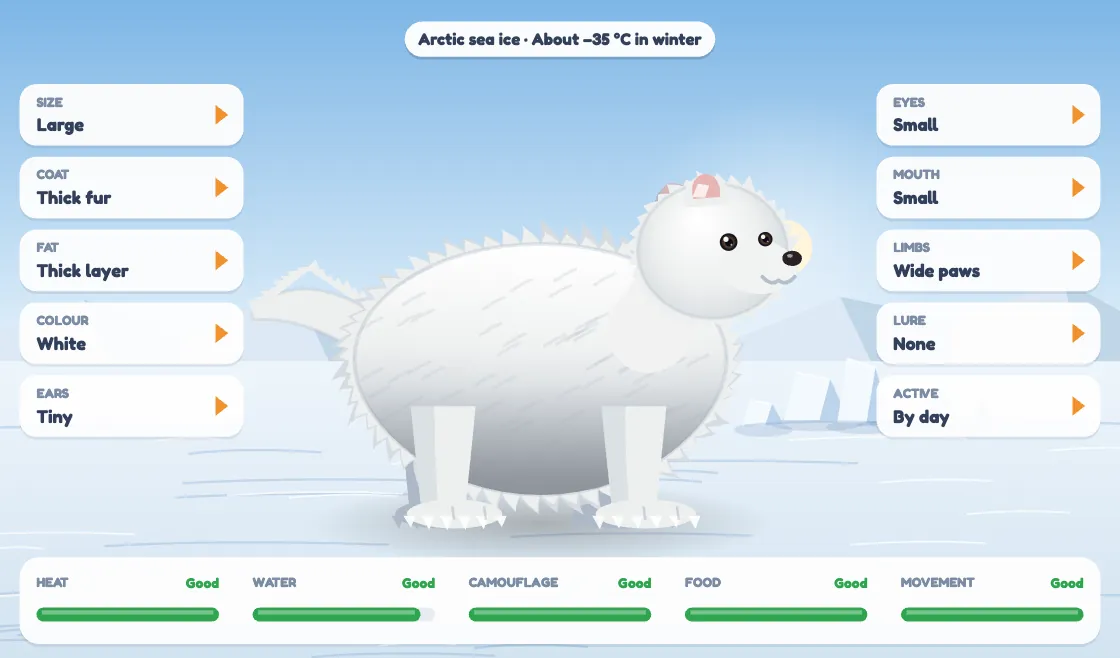
Arctic winters fall to about −35 °C. A polar bear's thick fur traps warm air, a layer of fat up to about 10 cm thick keeps the cold out, and its ears are small. Wide paws spread its weight on snow and ice.
Life in the dark
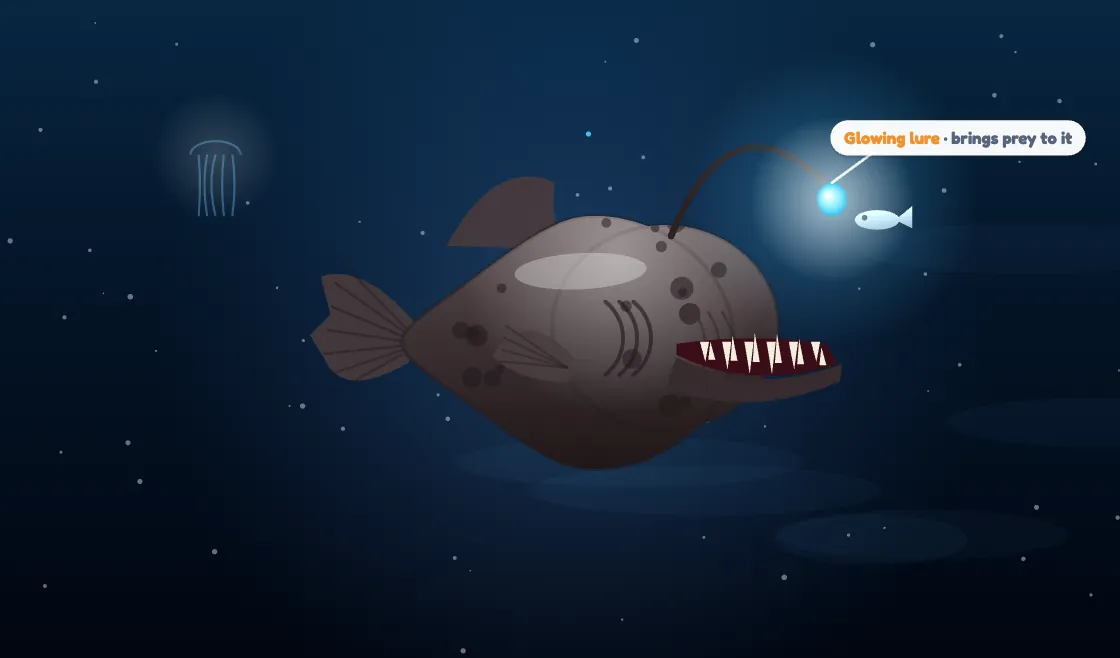
No sunlight reaches below about 1,000 m. The water is 2–4 °C and presses about 100 times harder than air at the surface. An anglerfish's glowing lure brings prey to it, and its huge mouth never wastes a rare meal.
Size, surface and colour
A big body has less surface for its size, so it holds heat: good in the cold. Big ears and bare skin let heat out: good in the heat. A coat the colour of the ground hides an animal from predators, and from its prey.
Suited to one place
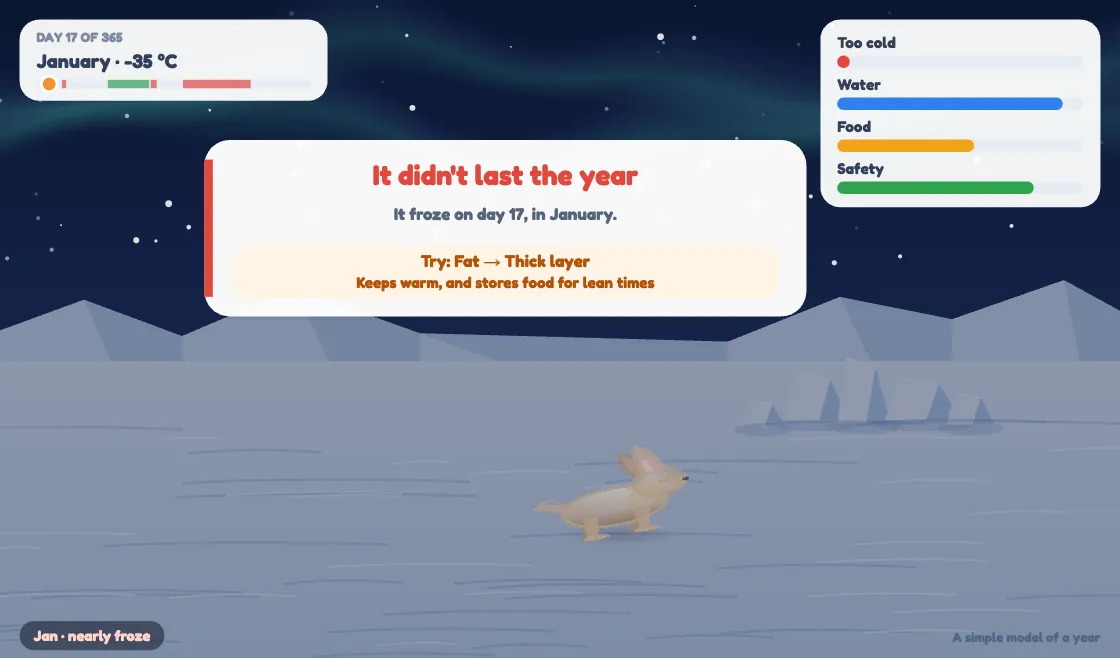
In any habitat some living things survive well, some less well and some not at all. A feature that helps in one place can be useless, or harmful, in another: thick fur saves a bear in the Arctic but would cook it in the Sahara.
Inside the lab
8 missions in 4 parts: Meet the experts, Design a creature, A year in the wild, Bonus. Each one is something to try for yourself, with the science behind it once you’ve done it.
- Three expertsFind out what every feature of the fox, the bear and the anglerfish is for.A feature that helps a living thing survive where it lives is an adaptation. Each expert's body fits its home.
- Heat cameraLook at the fox and the polar bear through the heat camera.Through a heat camera a polar bear almost disappears: its fur and fat keep its heat in. Only its face and breath glow.
- Built for a homeDesign a creature whose five gauges are all at least OK for its home.Every part does a job: fur and fat hold heat in, big ears let it out, colour hides you, and the right feet or fins get you about.
- A whole yearDrop your creature in and keep it alive for a whole year.Surviving one good week isn't enough. A habitat changes through the year, so a creature must cope with its worst days too.
- The wrong homeDrop a creature that lasted a year into a different habitat.In any habitat some living things survive well, some less well, and some not at all. Adaptations suit one place.
- Adapt itChange a creature that didn't make it until it survives that habitat.Change one part and the whole year can turn out differently. That's how features that suit a place matter.
- Three homesGet creatures through a whole year in the desert, the Arctic and the deep sea.Three very different bodies for three very different places: no single design does well everywhere.
- Not one close callDesign a creature that gets through a whole year without a single close call.The best-adapted animals don't just scrape through: they cope comfortably with the worst their habitat throws at them.
How the quest works
- Predict. Coco asks the mystery and you lock in an answer.
- Learn. A short, picture-led story of the big ideas (6 slides).
- Experiment. 8 missions in the lab, each one yours to try.
- Final Challenge. 8 questions that check you can use what you found, then the mystery’s answer.
For teachers
Present it live on the board while your class follows on their own screens. It fits one class period: about 7 minutes of Learn, 24 in the lab and 7 for the Final Challenge.
Students can
- define an adaptation as a feature of body or behaviour that helps a living thing survive in its habitat, and give an example of each.
- explain how the fennec fox, the polar bear and the anglerfish are adapted to heat, cold and darkness, linking each feature to its job.
- predict how body size, coat, fat, ear size, colour and limbs affect heat loss, water loss, camouflage, food finding and movement in a given habitat.
- use evidence from a model to explain that in a habitat some organisms survive well, some less well and some not at all, and that adaptations suit one place.
NGSS: 3-LS4-3, 4-LS1-1, MS-LS4-4.
Teacher notes for Creature DesignerQuestions people ask
What is Creature Designer?
Creature Designer is an interactive animal adaptations simulation from Thinkodile for ages 11 to 14. Design an animal for the desert, the deep sea or the Arctic, drop it in and see if it lasts a year. It opens with a mystery to predict, explains the big ideas in a short Learn story, lets you run the experiments yourself in the lab, and ends with a Final Challenge.
Is Creature Designer free?
Creature Designer is part of Thinkodile Plus for families and Teacher Pro for teachers. A free account includes 6 quests: Photosynthesis, Build a Cell, Build an Electromagnet, Particles in Motion, Dissolving, Moon Phases Explorer. A parent or teacher creates the account; children never sign up themselves.
How long does Creature Designer take?
About 38 minutes for a class working through it together: around 7 minutes for the Learn story, 24 in the lab and 7 for the Final Challenge. At home you can stop and pick it up again later.
Which curriculum does Creature Designer cover?
In the US it supports the Next Generation Science Standards 3-LS4-3, 4-LS1-1, MS-LS4-4. It's organised by topic, not by grade, so it fits other syllabuses too.
Does Creature Designer work on phones, tablets and Chromebooks?
Yes. It runs in the web browser on laptops, Chromebooks, tablets and phones, with nothing to install. On a phone the lab plays sideways, so turn the phone on its side.