
Series & ParallelAn interactive series and parallel circuits simulator for ages 11 to 14
Wire fairy lights so one dead bulb doesn't switch off the rest, clip in meters to find where the current splits, then wire a doll's house room by room.
Part of Thinkodile Plus · about 34 minutes · plays in the browser
The mystery
One bulb on Coco's fairy lights broke, and the whole string went dark. Her other string has a dead bulb too, but the rest still shine. What's different?
Every quest starts with a prediction. Lock yours in, then run the experiments to find out who was right.
What you’ll learn
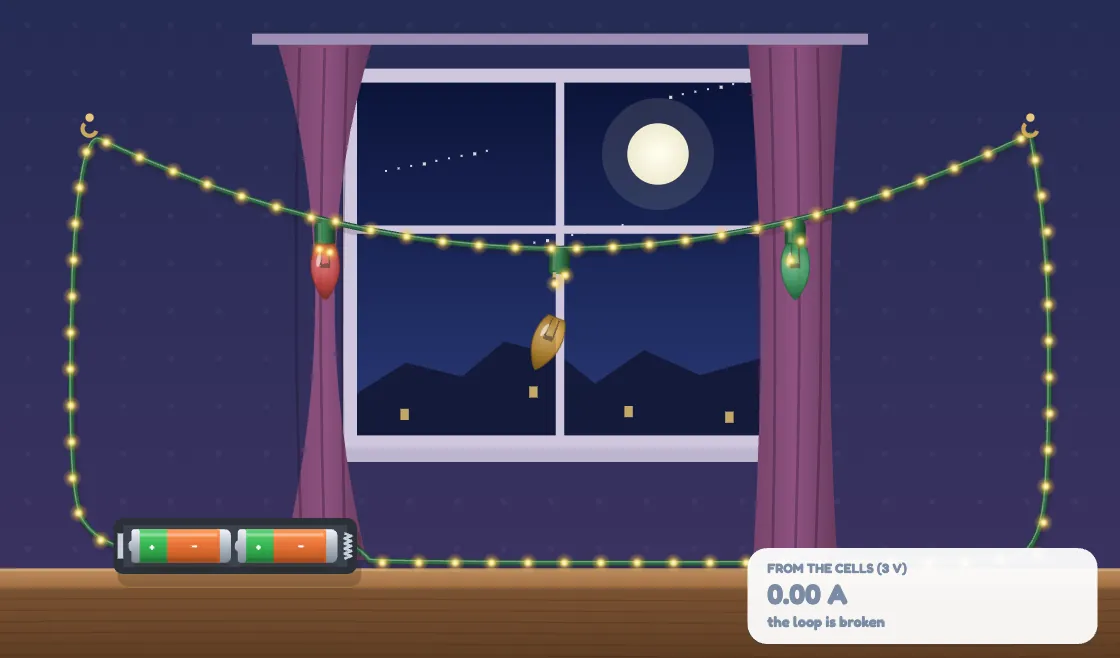
Series: one path
Bulbs in series sit one after another in a single loop. The same current flows through each in turn, so if one bulb breaks or is taken out, the loop is broken and they all go out.
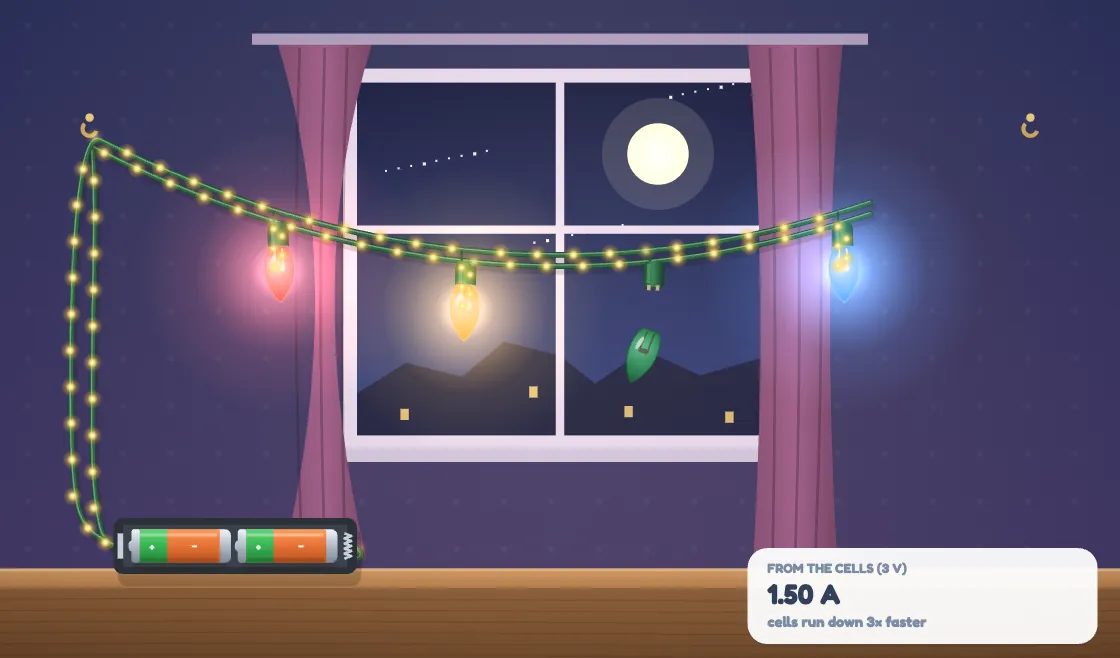
Parallel: a path each
In parallel, each bulb is on its own branch across the cells. If one goes out, the others still have a complete path, so they keep shining.
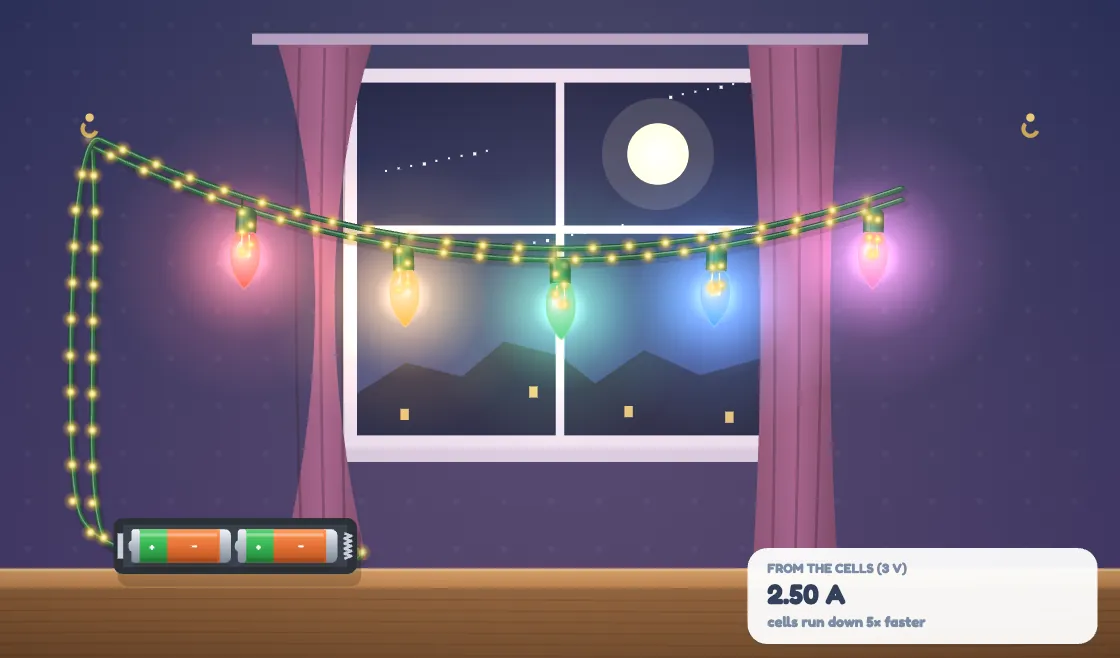
Brighter or dimmer?
Add bulbs in series and they share the cells' push, so each gets dimmer. In parallel each gets the full push and stays bright, but the cells have to give more current, so they run down faster.
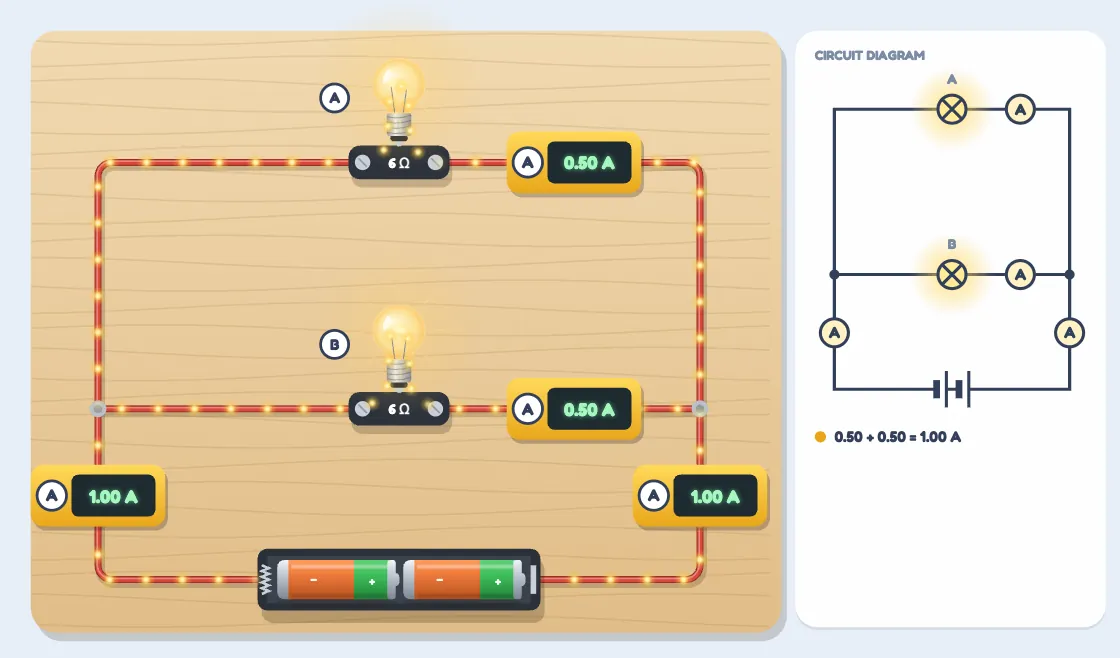
Measuring current
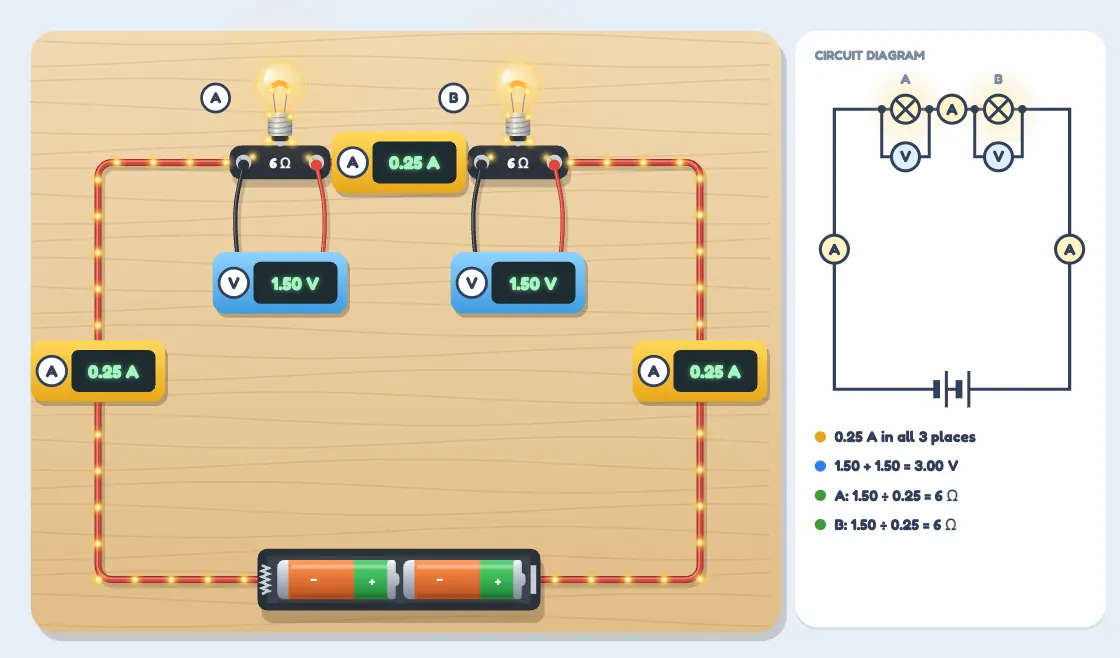
An ammeter measures current, in amps (A). It goes in the line, in series. Round a series circuit it reads the same everywhere. In parallel the current splits at a junction and adds up again: 0.5 A + 0.5 A = 1.0 A.
Measuring voltage
A voltmeter measures voltage, in volts (V). It goes across a part, in parallel with it. In series the bulbs share the cells' 3 V; in parallel each gets all 3 V. In this lab each bulb keeps the same resistance; a real filament's resistance rises as it heats up.
Wiring a house
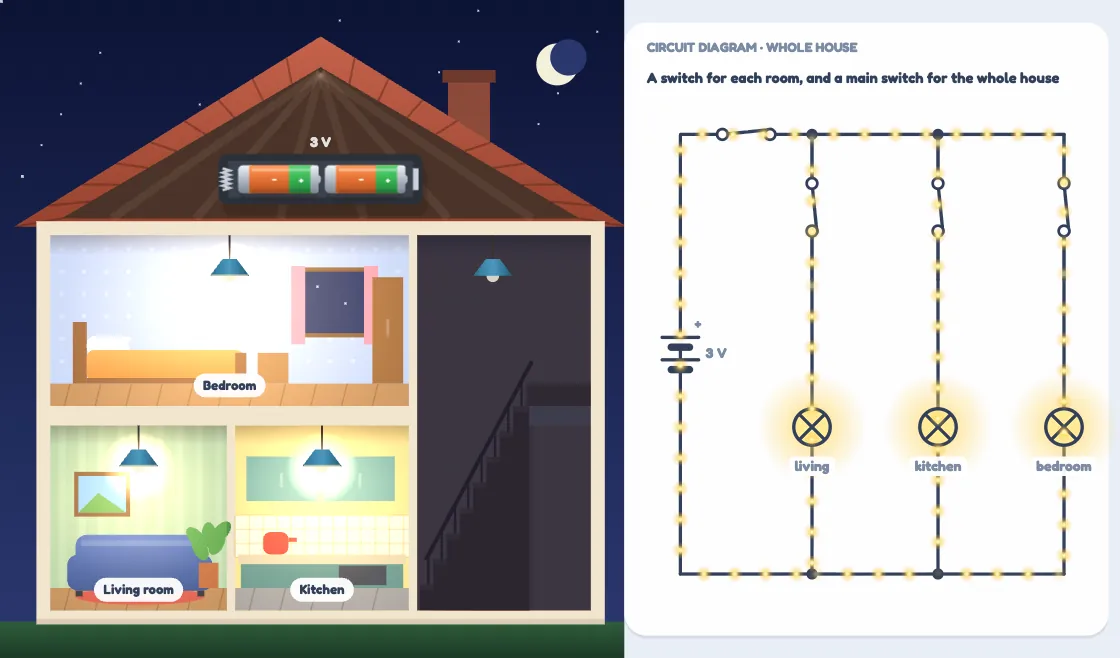
Homes are wired in parallel: each light gets the full voltage and has its own switch, and a main switch can turn everything off. A staircase light has two two-way switches, so you can switch it from the top or the bottom.
Inside the lab
9 missions in 4 parts: Fairy lights, Meters, The doll's house, Bonus. Each one is something to try for yourself, with the science behind it once you’ve done it.
- One goes, all goPut three bulbs on the string in series, then unscrew one.In series there's only one path, through every bulb in turn. Unscrew one and the loop is broken: the current stops everywhere at once, so they all go out. Each bulb you add makes them all dimmer, because they share the cells' 3 V.
- The rest shine onRewire three or more bulbs in parallel, then unscrew one.In parallel each bulb sits on its own branch, straight across the cells. Take one out and the others still have a complete path and the full 3 V each, so they shine on, just as bright.
- The same all roundIn the series circuit, clip ammeters into the line in two different places.Current isn't used up by the bulbs. In a series circuit the same current flows through every part: as much charge comes out of a bulb as goes in. What the bulbs take is energy.
- Sharing the pushClip voltmeters across both bulbs in series, then across a bulb in parallel.Voltage is the push the cells give the charge. In series it's shared: the voltages across the bulbs add up to the battery's 3 V. In parallel each branch is joined straight across the cells, so each bulb gets all 3 V.
- Where it splitsIn parallel, clip ammeters into both branches and the main wire.At a junction the current splits between the branches, and where they join it adds up again. More of it goes through the branch with less resistance.
- Room by roomWire the living room and the kitchen so each has its own switch, then test it.Each lamp is on its own branch, with its switch in that branch: opening it breaks only that path. A switch in the main wire would turn both rooms off. Homes are wired in parallel like this.
- The staircase lightWire the stairs light so either switch turns it on or off, then test it.A two-way switch joins its lever to one of two wires. With both wires in, the light is on when the two levers pick the same wire, so flipping either one changes it. Real staircases are wired just like this.
- Five bright bulbsLight five bulbs in series, then five in parallel.Five in series carry just 0.1 A, so each is dim. Five in parallel take 0.5 A each: 2.5 A from the cells, 25 times as much, so they run down far faster.
- The whole houseGive every room its own switch, and add a main switch for the whole house.The main switch sits in the wire before the circuit branches, so opening it breaks every path at once. A real house has one beside its fuses.
How the quest works
- Predict. Coco asks the mystery and you lock in an answer.
- Learn. A short, picture-led story of the big ideas (6 slides).
- Experiment. 9 missions in the lab, each one yours to try.
- Final Challenge. 8 questions that check you can use what you found, then the mystery’s answer.
For teachers
Present it live on the board while your class follows on their own screens. It fits one class period: about 7 minutes of Learn, 21 in the lab and 6 for the Final Challenge.
Students can
- explain why one broken bulb puts out every bulb in a series circuit but not in a parallel one.
- connect an ammeter in series and a voltmeter across a component, and read them.
- state that current is the same all round a series circuit and splits and adds up at the junctions of a parallel one, and that voltage is shared in series but the same across each parallel branch.
- use V = I × R to find a bulb's resistance, and wire lamps so each has its own switch, including a two-way staircase circuit.
NGSS: 4-PS3-2.
Teacher notes for Series & ParallelQuestions people ask
What is Series & Parallel?
Series & Parallel is an interactive series and parallel circuits simulator from Thinkodile for ages 11 to 14. Wire fairy lights so one dead bulb doesn't switch off the rest, clip in meters to find where the current splits, then wire a doll's house room by room. It opens with a mystery to predict, explains the big ideas in a short Learn story, lets you run the experiments yourself in the lab, and ends with a Final Challenge.
Is Series & Parallel free?
Series & Parallel is part of Thinkodile Plus for families and Teacher Pro for teachers. A free account includes 6 quests: Photosynthesis, Build a Cell, Build an Electromagnet, Particles in Motion, Dissolving, Moon Phases Explorer. A parent or teacher creates the account; children never sign up themselves.
How long does Series & Parallel take?
About 34 minutes for a class working through it together: around 7 minutes for the Learn story, 21 in the lab and 6 for the Final Challenge. At home you can stop and pick it up again later.
Which curriculum does Series & Parallel cover?
In the US it supports the Next Generation Science Standards 4-PS3-2. It's organised by topic, not by grade, so it fits other syllabuses too.
Does Series & Parallel work on phones, tablets and Chromebooks?
Yes. It runs in the web browser on laptops, Chromebooks, tablets and phones, with nothing to install. On a phone the lab plays sideways, so turn the phone on its side.