
Bending LightAn interactive refraction simulation for ages 11 to 14
Bend a laser through water and glass, make a hidden coin appear, and trap light inside a glass fibre.
Part of Thinkodile Plus · about 31 minutes · plays in the browser
The mystery
Coco puts a coin in an empty mug and steps back until the rim just hides it. A friend slowly pours in water, and the coin comes into view! Nothing touched the coin. How?
Every quest starts with a prediction. Lock yours in, then run the experiments to find out who was right.
What you’ll learn
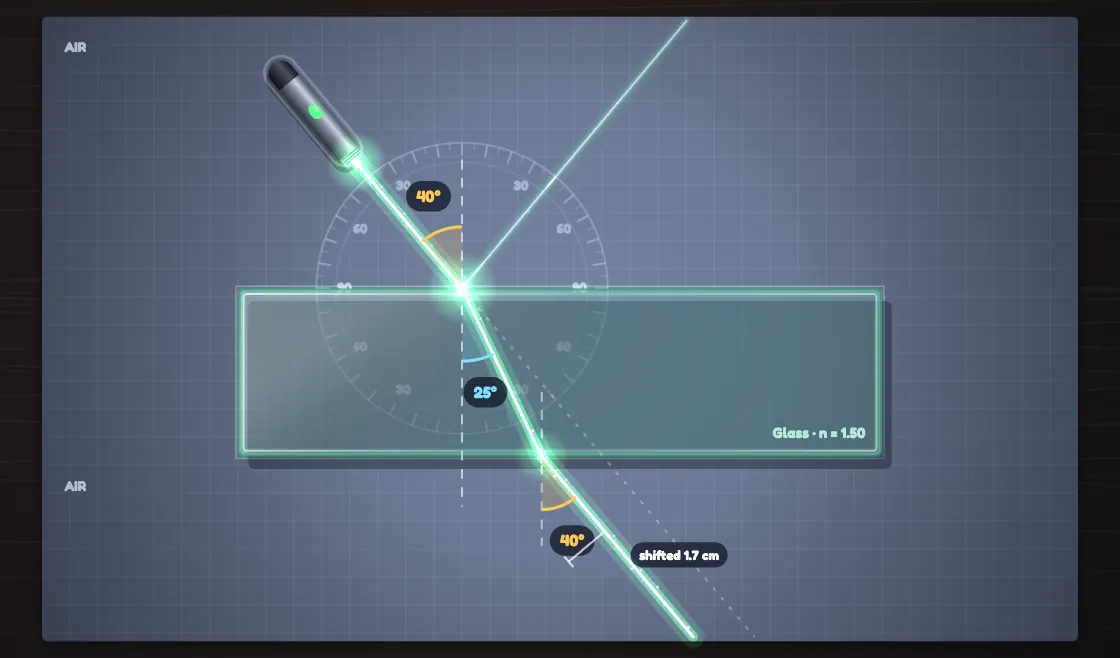
Light changes speed
Light travels about 300,000 km every second in air. In water it slows to about 225,000 km/s, and in glass to about 200,000 km/s. Crossing into them at a slant, the change of speed turns it: that's refraction.
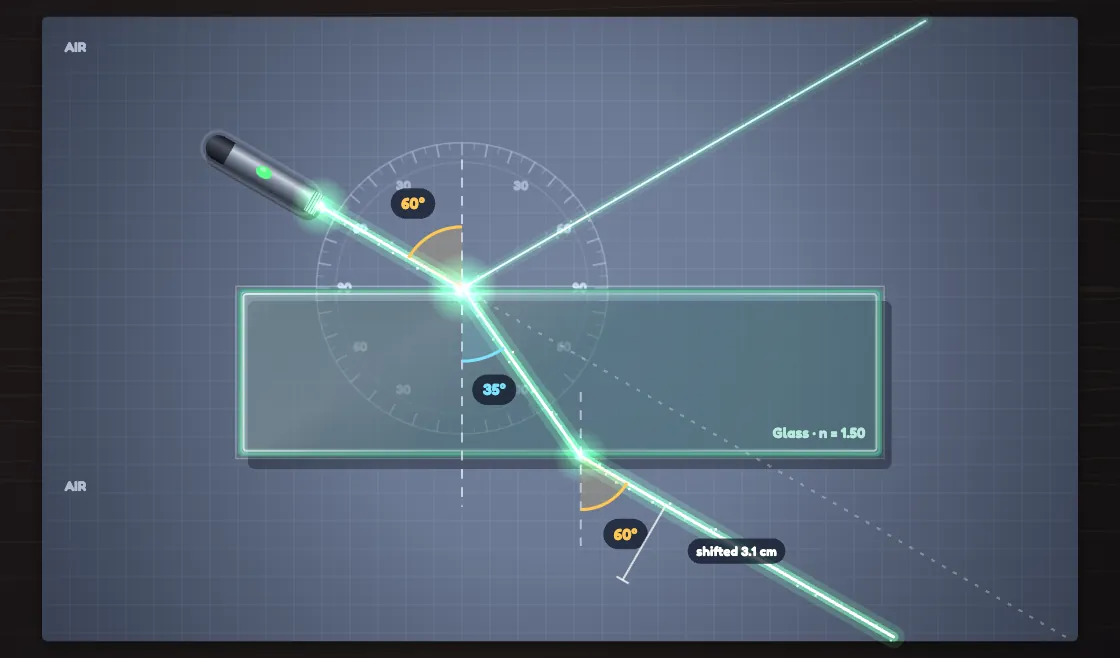
Towards, then away
Going into glass or water, light bends towards the normal, the line at right angles to the surface. Coming out, it bends away again. Through a block with parallel sides it leaves parallel to the way it went in, just shifted sideways.
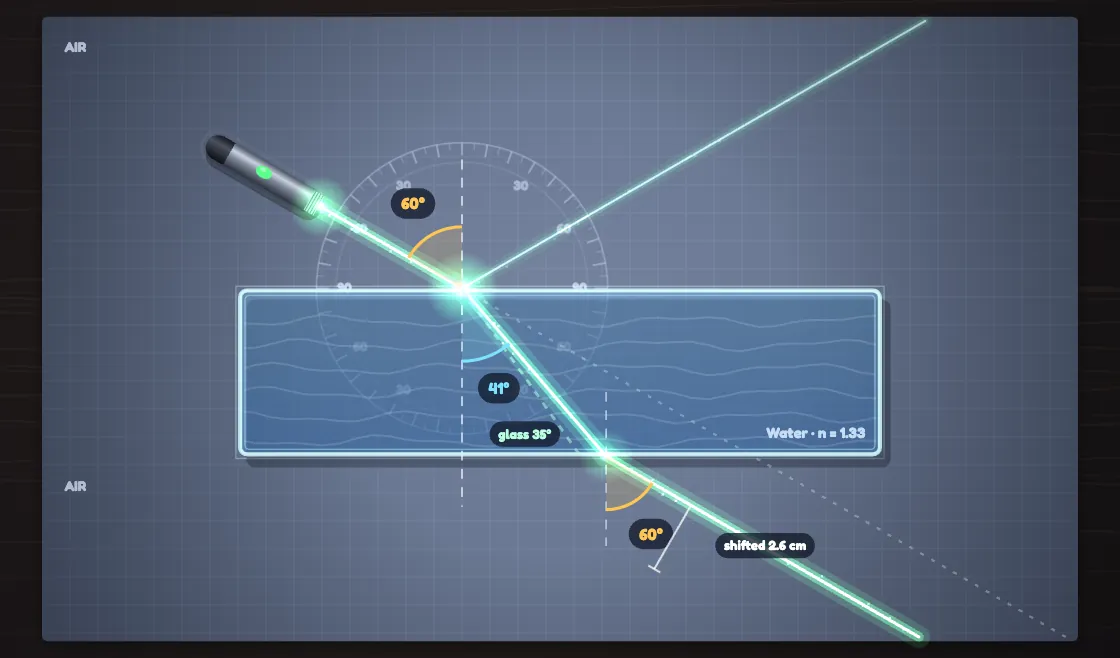
Refractive index
A material's refractive index says how much it slows light: speed in air ÷ speed in the material. The bigger it is, the more the material bends light. Snell's law links the angles: n₁ sin i = n₂ sin r.
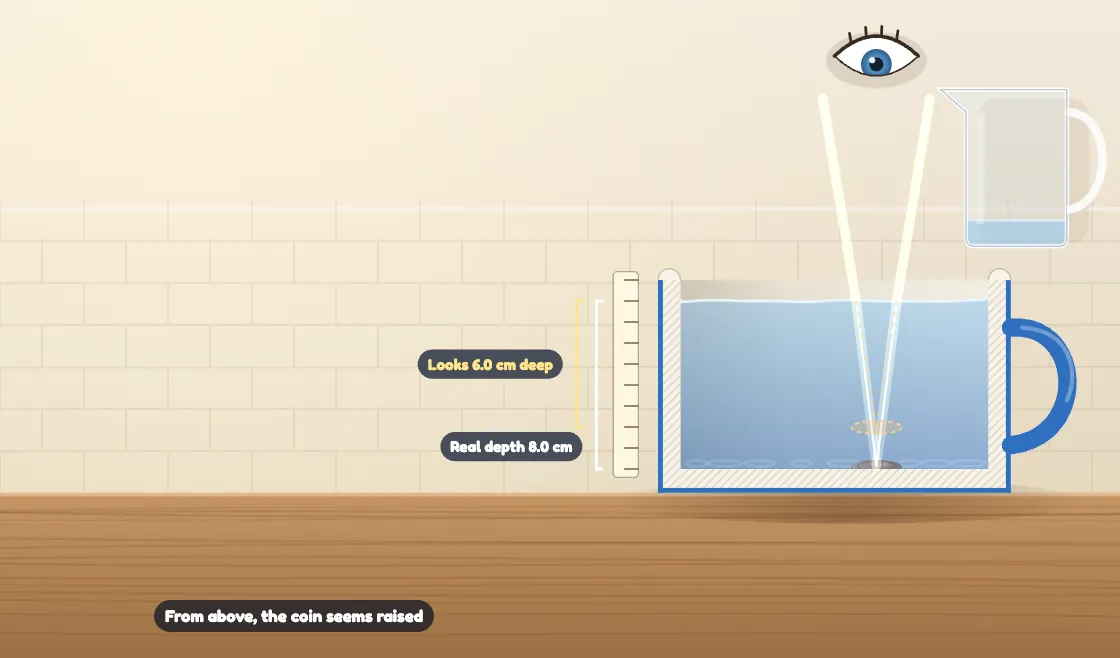
Deeper than it looks
Light from the bottom of a pool bends away from the normal as it leaves the water, so your eyes trace it back to somewhere higher. From above, water looks about three-quarters as deep as it is: real depth ÷ 1.33. A hidden coin can come into view the same way.
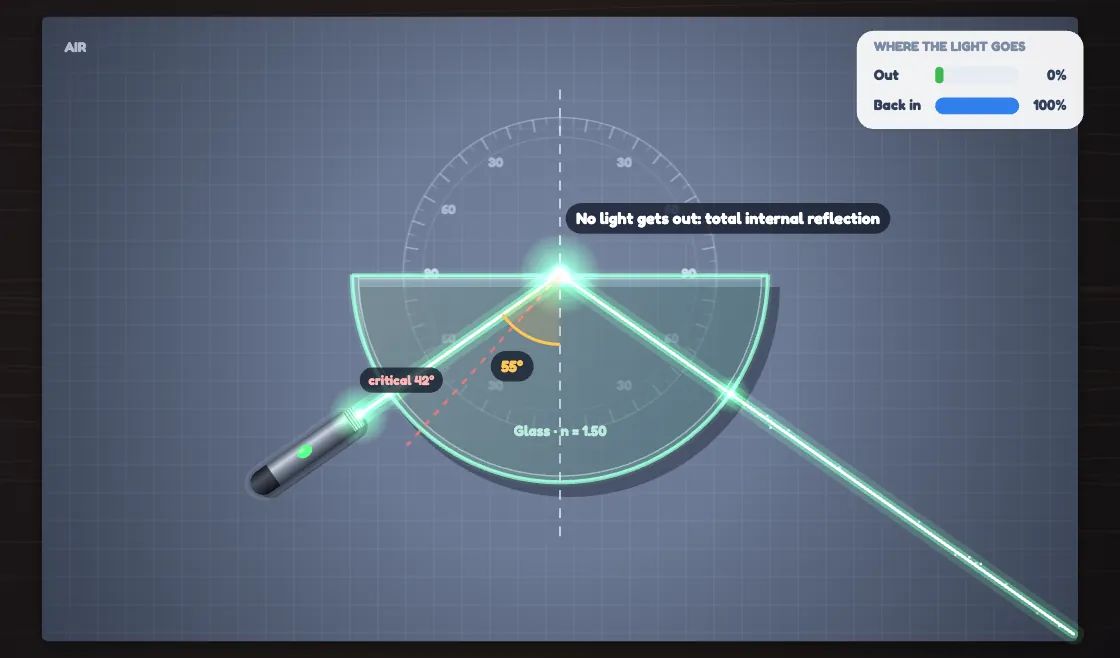
Total internal reflection
Going from glass out into air, light bends away from the normal. At the critical angle, about 42° for glass and 49° for water, it skims along the surface. Any steeper and none gets out: it all reflects back inside.
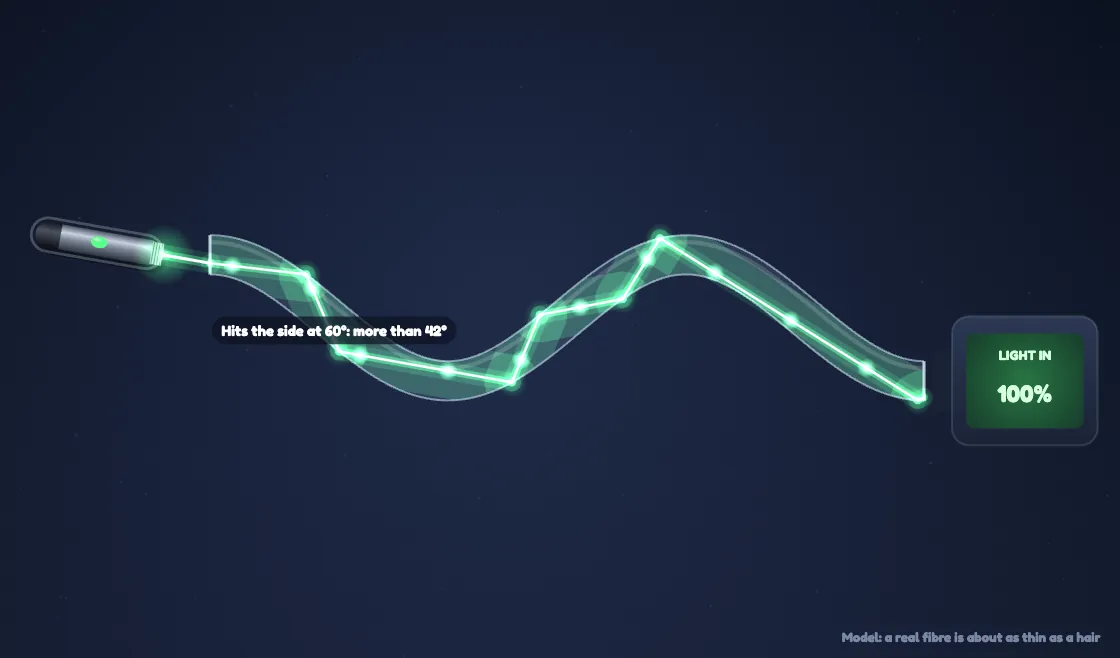
Light pipes
An optical fibre is a glass thread about as thin as a hair. Light inside meets its side past the critical angle, so it bounces along the whole way, even round bends. Fibres carry phone calls and the internet, and let doctors see inside the body.
Inside the lab
8 missions in 4 parts: The laser and the block, The hidden coin, Trap the light, Bonus. Each one is something to try for yourself, with the science behind it once you’ve done it.
- Into the glassTurn the laser from straight in to a slant, and watch the beam go into the glass.Going into glass at a slant, light slows down and bends towards the normal: the line at right angles to the surface. Straight in, along the normal, it doesn't bend at all.
- Out the other sideShine the laser in at 60° and follow the beam out of the far side of the block.Coming out into air, light speeds up and bends away from the normal, by just as much as it bent going in. So it leaves the block parallel to the way it went in, shifted sideways.
- Water or glass?Swap the block for the tank of water and shine in at the same angle. Which bends light more?Glass slows light more than water does, so it bends light more. A material's refractive index says how much: water's is 1.33, glass's about 1.5.
- The coin appearsPour water into the mug until the eye can see the hidden coin.Light from the coin bends away from the normal as it leaves the water, so it can slip over the rim to the eye. The coin hasn't moved: the light has bent.
- Trapped!Turn the laser past the critical angle, so no light gets out of the flat side of the half-moon block.Past the critical angle (about 42° for glass, 49° for water) no light can get out: every bit reflects back inside. That's total internal reflection.
- Light down a fibreAim the laser into the end of the glass fibre and send its light all the way to the far end.Inside the fibre, the light meets the side at more than the critical angle every time, so it all reflects and zig-zags along, even round bends. Fibres like this carry the internet under the oceans.
- Deeper than it looksFill the mug, then look from straight above. How deep does the water seem?From above, water looks only about three-quarters as deep as it really is: real depth ÷ 1.33. That's why a swimming pool looks shallower than it is.
- Too tightBend the fibre so tightly that light leaks out of its side.Round a very tight bend, the light meets the side at less than the critical angle, so some of it escapes. That's why fibre cables must never be kinked.
How the quest works
- Predict. Coco asks the mystery and you lock in an answer.
- Learn. A short, picture-led story of the big ideas (6 slides).
- Experiment. 8 missions in the lab, each one yours to try.
- Final Challenge. 8 questions that check you can use what you found, then the mystery’s answer.
For teachers
Present it live on the board while your class follows on their own screens. It fits one class period: about 6 minutes of Learn, 18 in the lab and 7 for the Final Challenge.
Students can
- describe, with measured angles, how light bends towards the normal going into glass or water and away from it coming out.
- explain why a ray leaves a parallel-sided block parallel to the way it went in, and compare how much glass and water bend light using their refractive indices.
- explain why a hidden coin comes into view when water is poured in, and why water looks shallower than it is (real depth ÷ 1.33).
- state what happens past the critical angle (about 42° for glass, 49° for water) and explain how an optical fibre carries light round bends.
NGSS: MS-PS4-2, HS-PS4-1.
Teacher notes for Bending LightQuestions people ask
What is Bending Light?
Bending Light is an interactive refraction simulation from Thinkodile for ages 11 to 14. Bend a laser through water and glass, make a hidden coin appear, and trap light inside a glass fibre. It opens with a mystery to predict, explains the big ideas in a short Learn story, lets you run the experiments yourself in the lab, and ends with a Final Challenge.
Is Bending Light free?
Bending Light is part of Thinkodile Plus for families and Teacher Pro for teachers. A free account includes 6 quests: Photosynthesis, Build a Cell, Build an Electromagnet, Particles in Motion, Dissolving, Moon Phases Explorer. A parent or teacher creates the account; children never sign up themselves.
How long does Bending Light take?
About 31 minutes for a class working through it together: around 6 minutes for the Learn story, 18 in the lab and 7 for the Final Challenge. At home you can stop and pick it up again later.
Which curriculum does Bending Light cover?
In the US it supports the Next Generation Science Standards MS-PS4-2, HS-PS4-1. It's organised by topic, not by grade, so it fits other syllabuses too.
Does Bending Light work on phones, tablets and Chromebooks?
Yes. It runs in the web browser on laptops, Chromebooks, tablets and phones, with nothing to install. On a phone the lab plays sideways, so turn the phone on its side.
Keep exploring Mirrors & Lenses
- Lens Lab: Focus sunlight through a lens until paper burns, catch a sharp upside-down candle on a screen, and watch a ladybird through a magnifying glass.
- All of Mirrors & Lenses