
Boat BuilderAn interactive float or sink and upthrust simulation for ages 11 to 14
Find out why a steel ship floats but a steel nail sinks, measure how hard water pushes up, then fold a foil boat that carries the most coins.
Part of Thinkodile Plus · about 35 minutes · plays in the browser
The mystery
A steel nail sinks in a moment. A steel cargo ship can weigh over 100,000 tonnes, yet it floats. How?
Every quest starts with a prediction. Lock yours in, then run the experiments to find out who was right.
What you’ll learn
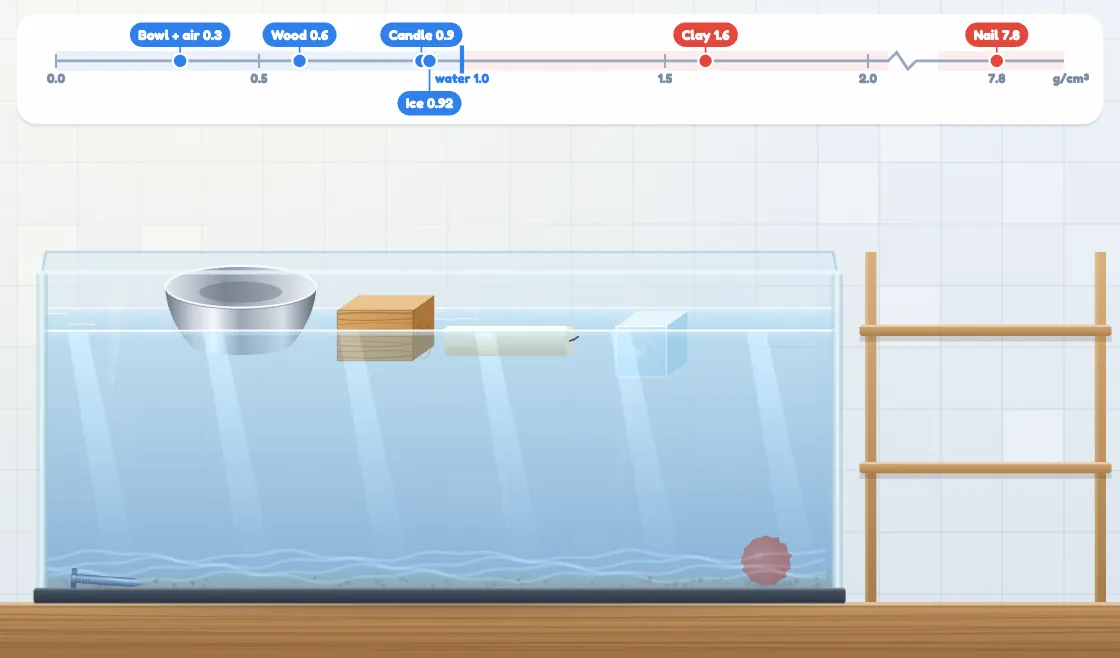
Float or sink?
Whether a solid thing floats depends on its density: how much mass is packed into each cubic centimetre. Water's density is 1 g/cm³. Wood and wax are less dense, so they float; steel and clay are denser, so they sink.
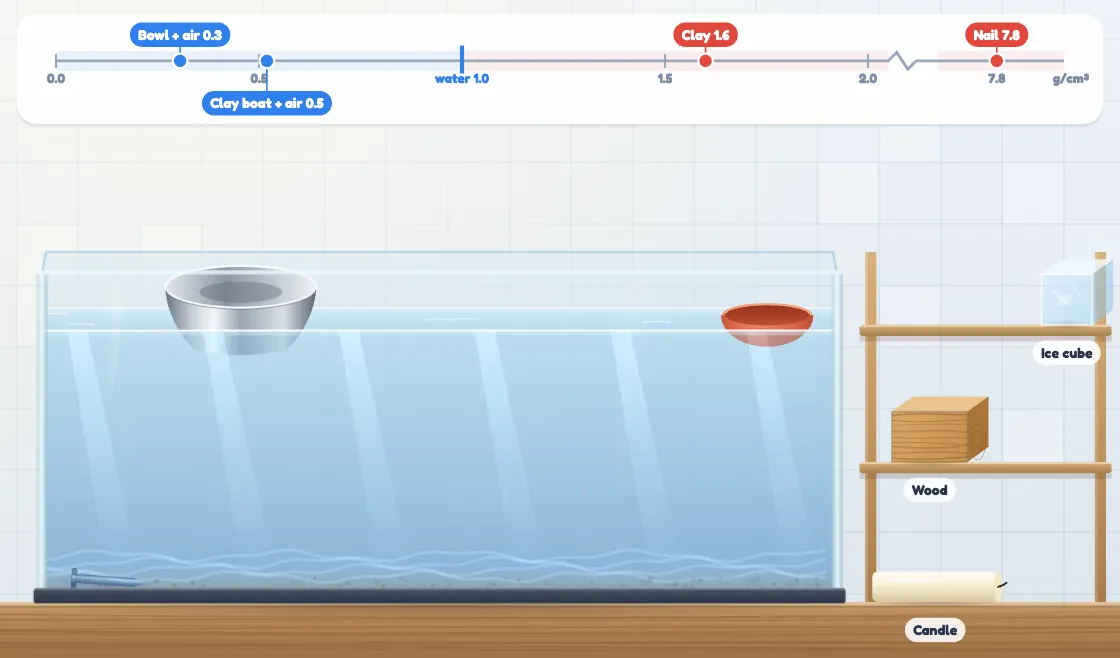
Shape it into a boat
A lump of clay sinks. Press the same clay into a hollow boat and it floats: with the air inside, the boat takes up far more space, so overall it's less dense than water. A steel ship floats for the same reason.
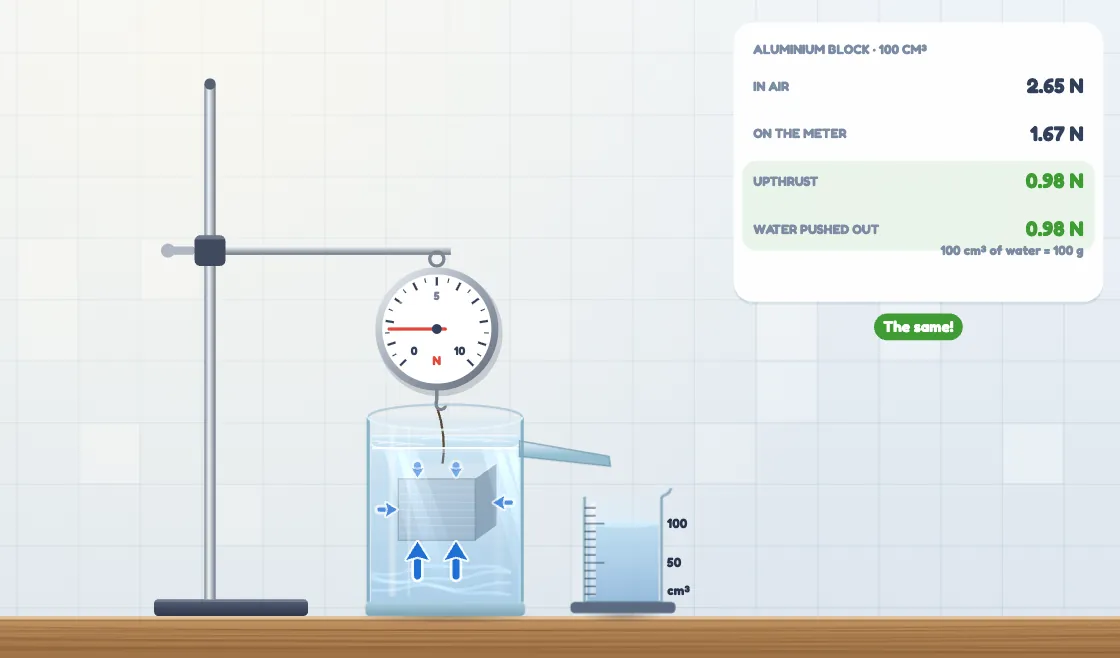
Water pushes up
Water presses on everything in it, and the deeper you go, the harder it presses. So the bottom of a block is pushed up harder than its top is pushed down. The difference is the upthrust. Once the block is all under, going deeper doesn't change it.
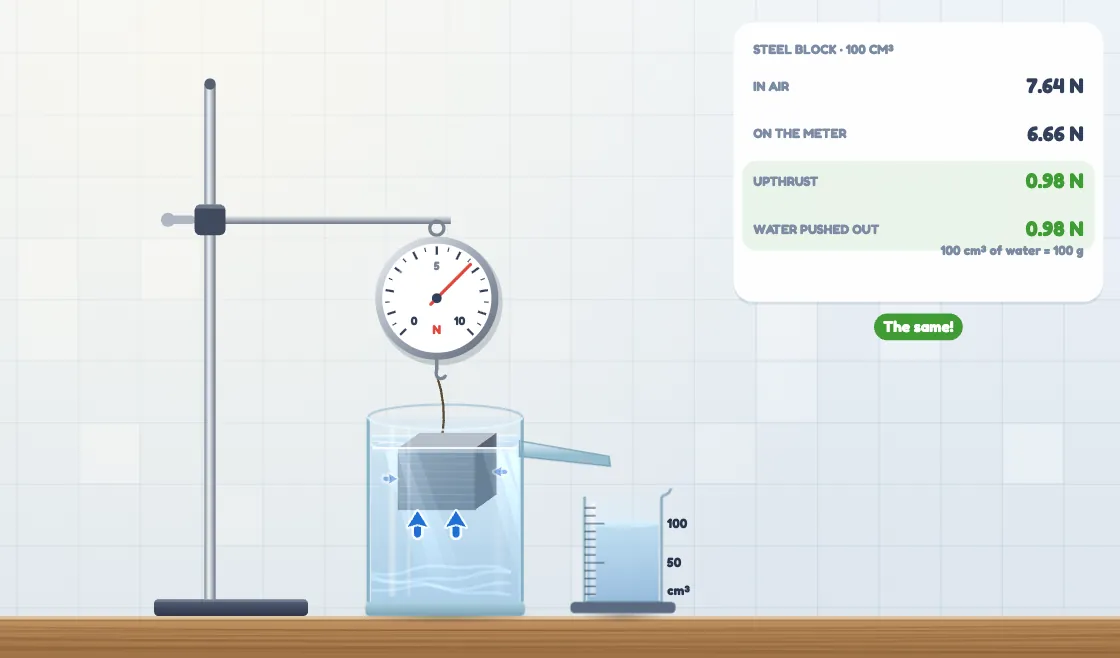
Archimedes' principle
The upthrust on an object equals the weight of the water it pushes aside. A 100 cm³ block pushes out 100 g of water, which weighs 0.98 N, so it feels 0.98 N lighter, whatever it's made of.
Floating
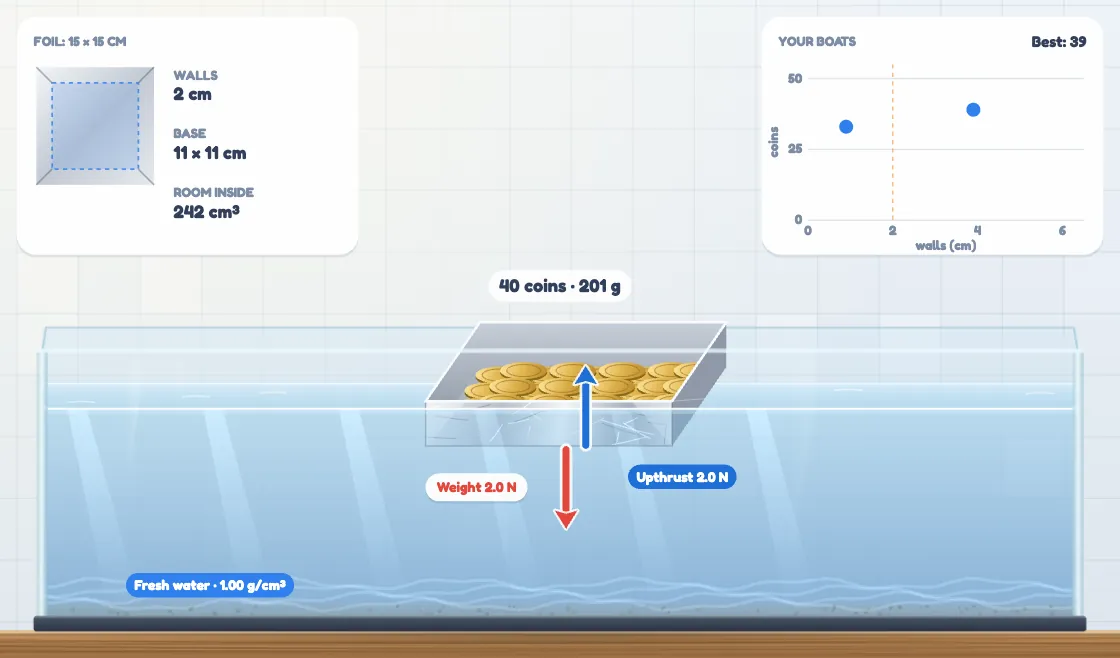
A floating thing sinks in until it has pushed aside its own weight of water. Load a boat and it sits deeper. When water comes over the side, it can't push aside any more, and it sinks.
Sea water and load lines
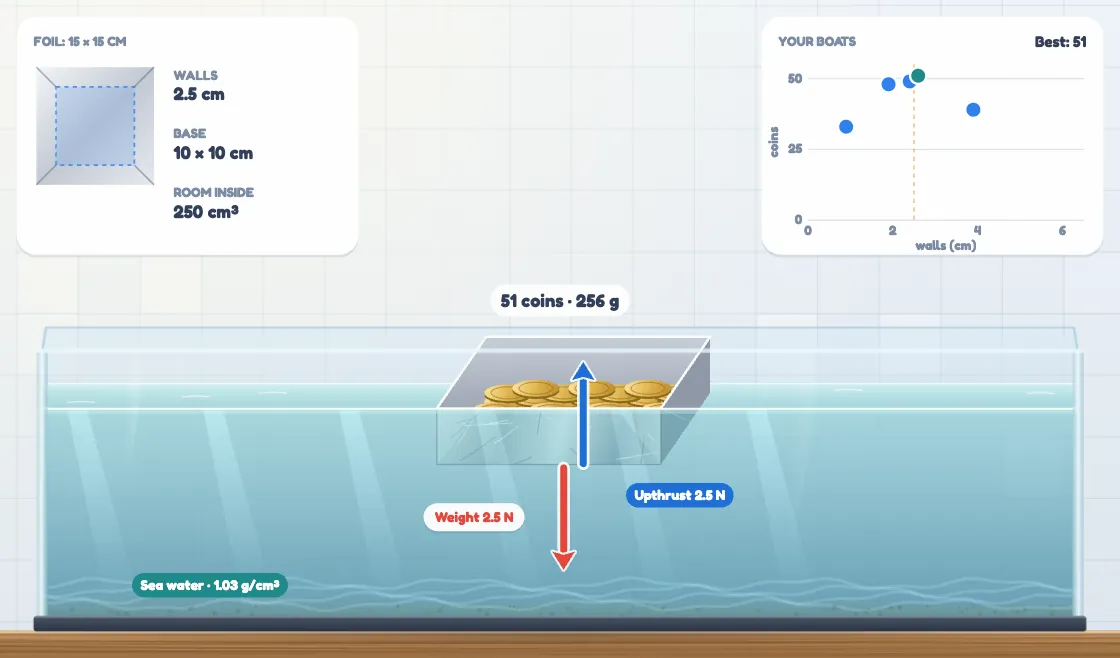
Sea water is a little denser than fresh water, about 1.03 g/cm³, so a boat floats a little higher in it and can carry a little more. Ships have load lines painted on their sides, showing how deep they may safely sit in fresh and sea water.
Inside the lab
8 missions in 4 parts: Float or sink, Water pushes up, Boat builder, Bonus. Each one is something to try for yourself, with the science behind it once you’ve done it.
- Float or sinkDrop all six things into the tank.Density is how much mass is packed into each cm³. Water's is 1 g/cm³: anything denser sinks in it, anything less dense floats.
- Clay that floatsMake the clay float without taking any away.The same clay, hollowed into a boat, takes up far more space. With the air inside, it's less dense than water, so it floats. That's how a steel ship floats.
- Archimedes' principleLower a metal block all the way under the water.The upthrust on anything in water equals the weight of the water it pushes aside. That's Archimedes' principle.
- Hold it upLower the wooden block until it floats.A floating thing sinks in until it has pushed aside its own weight of water. Then the upthrust holds up all of its weight, and the meter reads 0.
- Test three boatsLoad three boats with different walls until each one sinks.Engineers test a design, change one thing, and test again. Each result shows which way to go next.
- 45 coinsBuild a boat that carries 45 coins or more.A boat can carry coins until the water it could push aside, filled to its rim, weighs no more than the boat and its load.
- The best foldFind the fold that carries 49 coins in fresh water.Walls of 2.5 cm give a 10 × 10 cm base and 250 cm³ of room: the most this sheet can hold. Real ship designers hunt for the best shape the same way.
- Sea waterShow that the same boat carries more coins in sea water.Sea water is denser (about 1.03 g/cm³), so the same room pushes aside more weight of water. Ships float a little higher at sea, and their load lines show how deep they may safely sit in each kind of water.
How the quest works
- Predict. Coco asks the mystery and you lock in an answer.
- Learn. A short, picture-led story of the big ideas (6 slides).
- Experiment. 8 missions in the lab, each one yours to try.
- Final Challenge. 8 questions that check you can use what you found, then the mystery’s answer.
For teachers
Present it live on the board while your class follows on their own screens. It fits one class period: about 7 minutes of Learn, 21 in the lab and 7 for the Final Challenge.
Students can
- use density (mass ÷ volume, compared with water's 1 g/cm³) to predict whether a solid floats or sinks, and explain why a hollow steel bowl or clay boat floats when a lump of the same stuff sinks.
- measure upthrust as the drop in a newton meter's reading, and show that it equals the weight of the water pushed aside (Archimedes' principle).
- explain upthrust as water pressing harder on the bottom of an object than on its top, and say why it stops growing once the object is all under.
- test a boat design, change one thing, test again, use their results to find the best design, and explain why the same boat carries more in sea water.
NGSS: MS-ETS1-4.
Teacher notes for Boat BuilderQuestions people ask
What is Boat Builder?
Boat Builder is an interactive float or sink and upthrust simulation from Thinkodile for ages 11 to 14. Find out why a steel ship floats but a steel nail sinks, measure how hard water pushes up, then fold a foil boat that carries the most coins. It opens with a mystery to predict, explains the big ideas in a short Learn story, lets you run the experiments yourself in the lab, and ends with a Final Challenge.
Is Boat Builder free?
Boat Builder is part of Thinkodile Plus for families and Teacher Pro for teachers. A free account includes 6 quests: Photosynthesis, Build a Cell, Build an Electromagnet, Particles in Motion, Dissolving, Moon Phases Explorer. A parent or teacher creates the account; children never sign up themselves.
How long does Boat Builder take?
About 35 minutes for a class working through it together: around 7 minutes for the Learn story, 21 in the lab and 7 for the Final Challenge. At home you can stop and pick it up again later.
Which curriculum does Boat Builder cover?
In the US it supports the Next Generation Science Standards MS-ETS1-4. It's organised by topic, not by grade, so it fits other syllabuses too.
Does Boat Builder work on phones, tablets and Chromebooks?
Yes. It runs in the web browser on laptops, Chromebooks, tablets and phones, with nothing to install. On a phone the lab plays sideways, so turn the phone on its side.