
Equation BalancerAn interactive balancing chemical equations simulation for ages 11 to 14
Run reactions from burning methane to silver plating, sort them into types, and balance each one by building it from real atoms.
Part of Thinkodile Plus · about 40 minutes · plays in the browser
The mystery
A big log burns on a campfire all night. By morning, all that's left is a small heap of ash. Where did most of the log go?
Every quest starts with a prediction. Lock yours in, then run the experiments to find out who was right.
What you’ll learn
Atoms swap partners
In a chemical reaction, atoms let go of each other and join up in new ways, making new substances. No atom is made and none is destroyed: the same atoms are there before and after.
Reading an equation
CH₄ + 2O₂ → CO₂ + 2H₂O. The small numbers count the atoms in one molecule. The big number in front counts the molecules.
Balancing
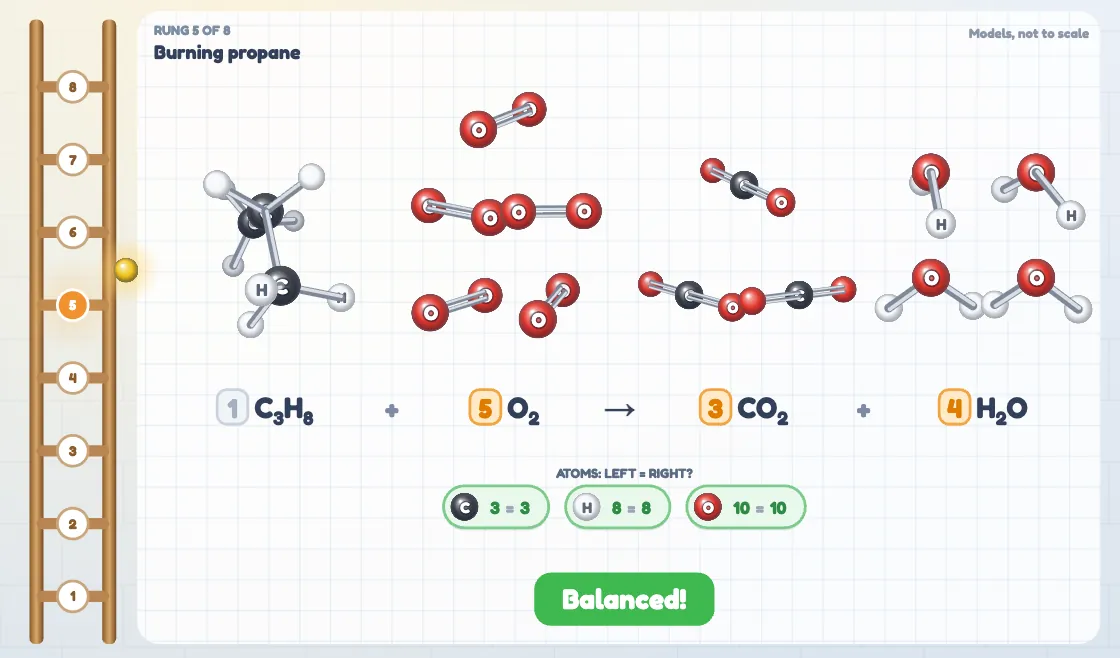
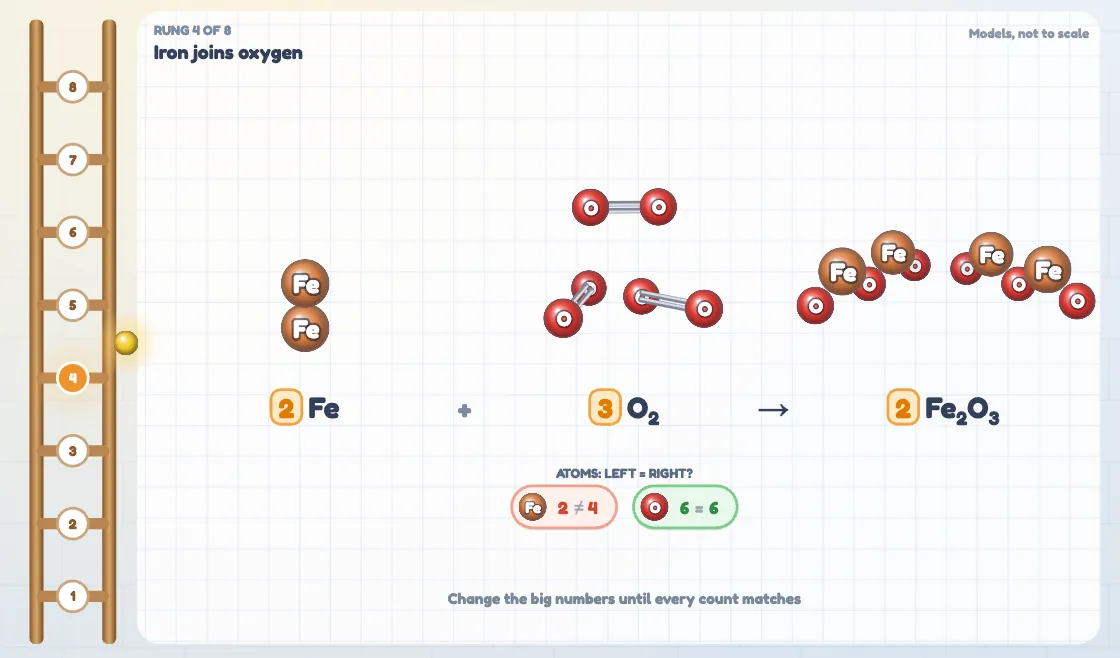
Count each element on both sides, then change only the big numbers until they match. Never change the small ones: H₂O₂ isn't water, it's hydrogen peroxide. Leave an element on its own, like O₂, till last.
Mass is conserved
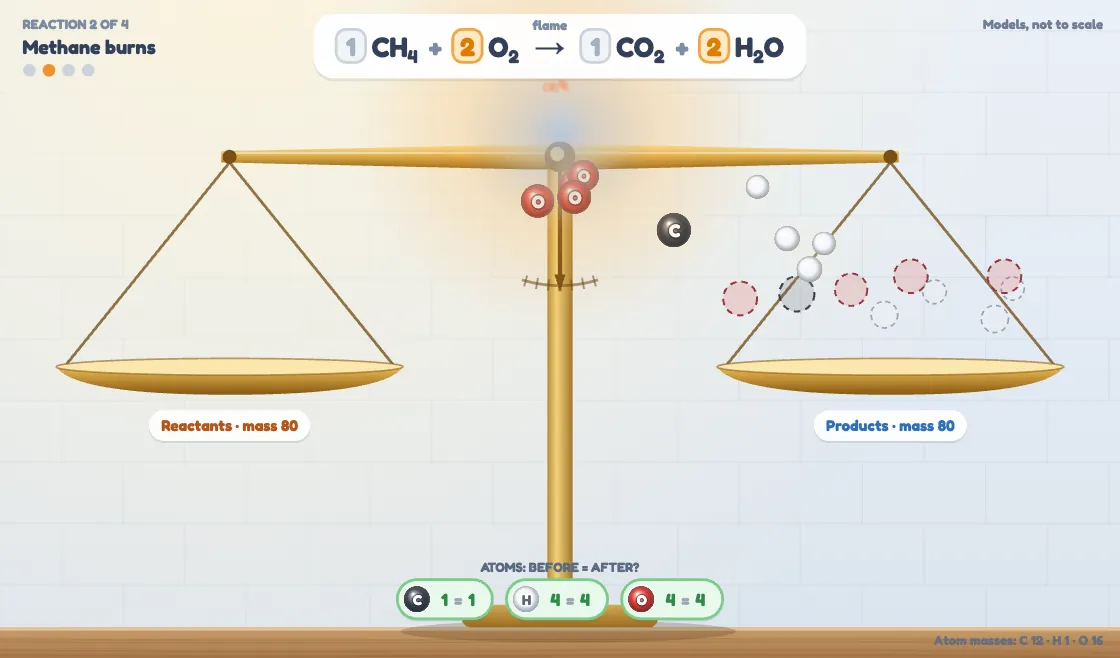
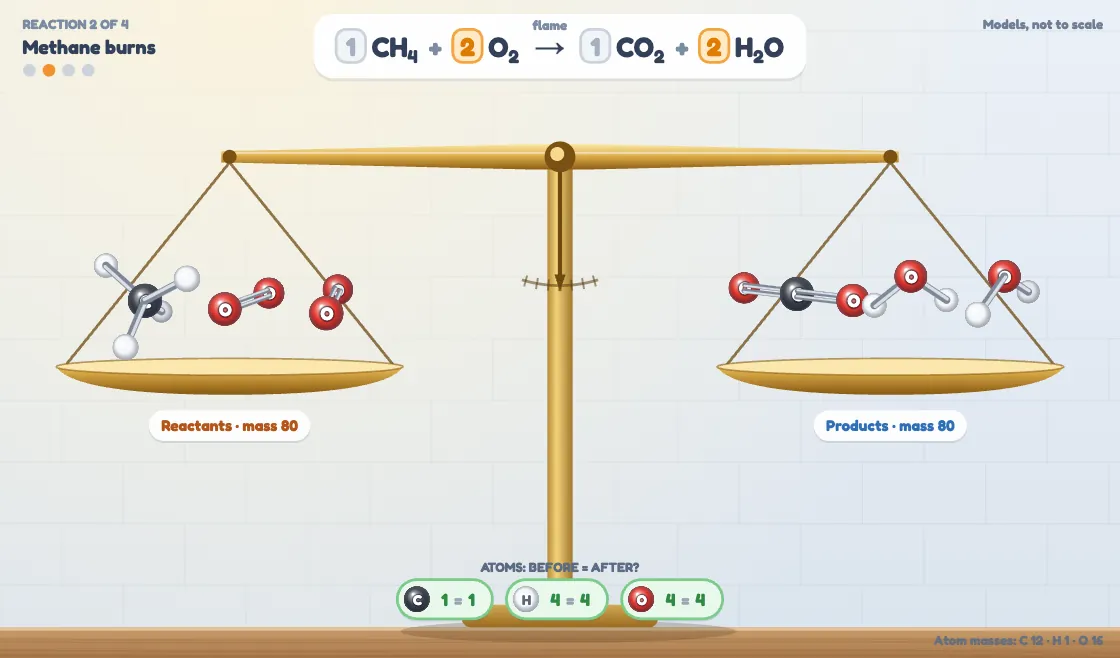
The same atoms have the same mass. 16 g of methane burns in 64 g of oxygen to give 44 g of carbon dioxide and 36 g of water: 80 g in, 80 g out. When a gas escapes, what's left weighs less, but nothing is lost.
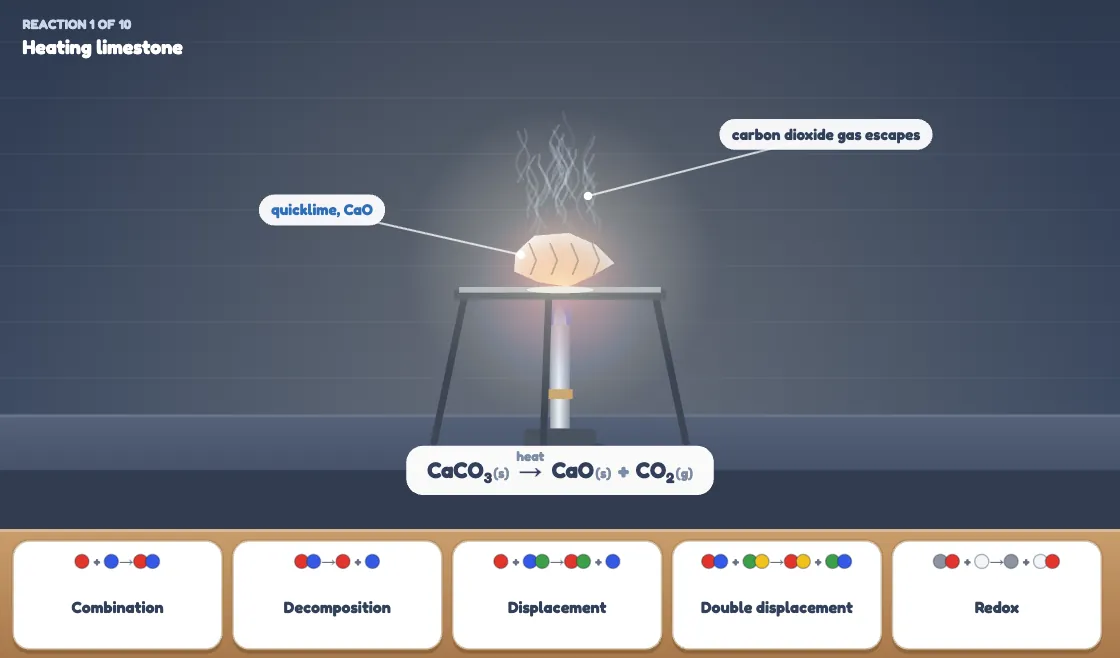
Joining and breaking up
In a combination reaction, substances join into one: quicklime and water make slaked lime. In decomposition, one substance breaks into more, often by heat, light or electricity: limestone into quicklime and carbon dioxide.
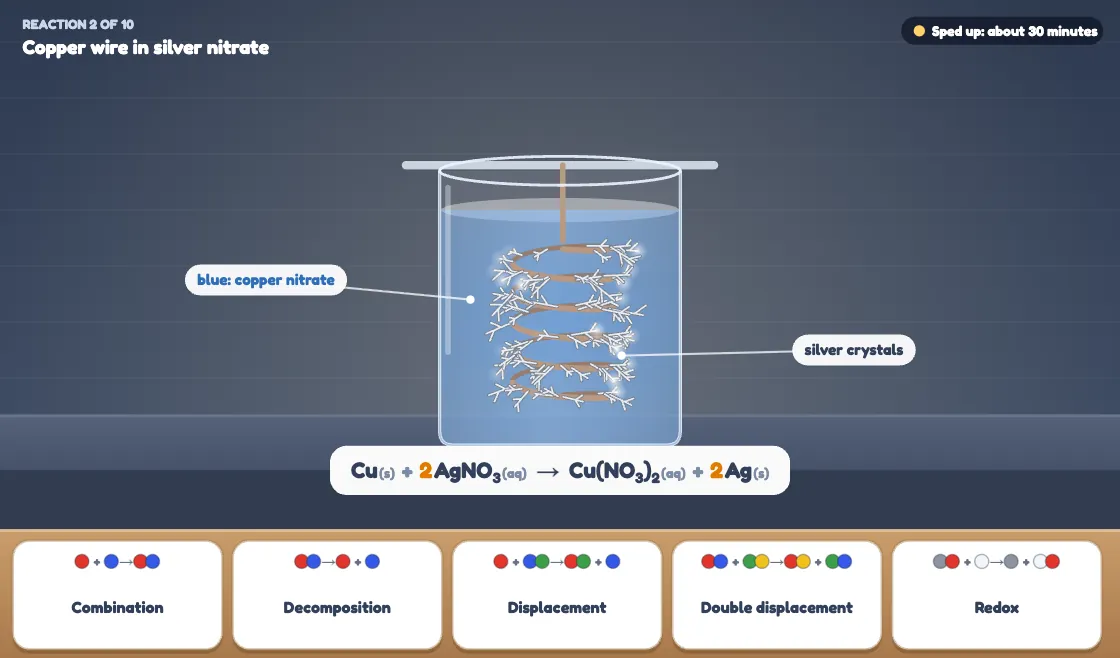
Swaps and oxygen
In displacement, a more reactive element pushes another out: copper pushes silver out of silver nitrate. In double displacement, two compounds swap partners, often making a solid called a precipitate. In redox, one substance gains oxygen (oxidation) while another loses it (reduction).
Inside the lab
8 missions in 4 parts: Count the atoms, Sort them, The balancing ladder, Bonus. Each one is something to try for yourself, with the science behind it once you’ve done it.
- Lost atoms?Run the reaction just as it's written, H₂ + O₂ → H₂O, and watch every atom.One oxygen atom had nowhere to go. Atoms are never made or destroyed in a reaction, so it was the equation that was wrong, not the atoms.
- Make waterBalance hydrogen burning, then run it with no atom spare or missing.2H₂ + O₂ → 2H₂O. The big number counts molecules: 2H₂O is two water molecules, with 4 H and 2 O between them.
- Burn methaneBalance methane burning, run it, and watch the balance.CH₄ + 2O₂ → CO₂ + 2H₂O. Mass 80 on each side: the same atoms always have the same mass. That's conservation of mass.
- Five sortedWatch 5 reactions and sort each one into its type.Combination joins substances into one; decomposition breaks one into more. Displacement pushes an element out, double displacement swaps partners, and redox moves oxygen.
- Every reactionSort all ten reactions.Some reactions are two types at once: copper pushing silver out is a displacement, and a redox reaction too.
- Five rungsBalance 5 equations to climb the ladder.Count every element, change only the big numbers, and save the element that's on its own till last.
- Four on the balanceBalance and run all four reactions on the balance, ammonia too.N₂ + 3H₂ → 2NH₃. Factories make millions of tonnes of ammonia this way every year, to make fertilisers.
- Top of the ladderClimb all eight rungs, right up to respiration.C₆H₁₂O₆ + 6O₂ → 6CO₂ + 6H₂O. Your cells run this reaction all day, in many small steps, to release the energy in food.
How the quest works
- Predict. Coco asks the mystery and you lock in an answer.
- Learn. A short, picture-led story of the big ideas (6 slides).
- Experiment. 8 missions in the lab, each one yours to try.
- Final Challenge. 8 questions that check you can use what you found, then the mystery’s answer.
For teachers
Present it live on the board while your class follows on their own screens. It fits one class period: about 7 minutes of Learn, 26 in the lab and 7 for the Final Challenge.
Students can
- explain that in a chemical reaction the atoms are rearranged into new substances, with none made or destroyed, so the total mass stays the same.
- count the atoms of each element in a formula and in several molecules of it (3CO₂ has 3 C and 6 O), and read state symbols such as (s), (aq) and (g).
- balance an equation by changing only the numbers in front of the formulas, using the smallest whole numbers.
- classify reactions as combination, decomposition, displacement, double displacement or redox, and recognise a precipitate.
NGSS: MS-PS1-5, HS-PS1-7.
Teacher notes for Equation BalancerQuestions people ask
What is Equation Balancer?
Equation Balancer is an interactive balancing chemical equations simulation from Thinkodile for ages 11 to 14. Run reactions from burning methane to silver plating, sort them into types, and balance each one by building it from real atoms. It opens with a mystery to predict, explains the big ideas in a short Learn story, lets you run the experiments yourself in the lab, and ends with a Final Challenge.
Is Equation Balancer free?
Equation Balancer is part of Thinkodile Plus for families and Teacher Pro for teachers. A free account includes 6 quests: Photosynthesis, Build a Cell, Build an Electromagnet, Particles in Motion, Dissolving, Moon Phases Explorer. A parent or teacher creates the account; children never sign up themselves.
How long does Equation Balancer take?
About 40 minutes for a class working through it together: around 7 minutes for the Learn story, 26 in the lab and 7 for the Final Challenge. At home you can stop and pick it up again later.
Which curriculum does Equation Balancer cover?
In the US it supports the Next Generation Science Standards MS-PS1-5, HS-PS1-7. It's organised by topic, not by grade, so it fits other syllabuses too.
Does Equation Balancer work on phones, tablets and Chromebooks?
Yes. It runs in the web browser on laptops, Chromebooks, tablets and phones, with nothing to install. On a phone the lab plays sideways, so turn the phone on its side.
Keep exploring Chemical Reactions
- Reaction Detective: Mix pairs of substances and catch the signs of a chemical reaction: bubbles, colour, heat, light or a new solid.
- All of Chemical Reactions