
Reaction DetectiveAn interactive signs of a chemical reaction simulation for ages 11 to 14
Mix pairs of substances and catch the signs of a chemical reaction: bubbles, colour, heat, light or a new solid.
Part of Thinkodile Plus · about 35 minutes · plays in the browser
The mystery
Coco mixes two clear liquids, and a white solid appears out of nowhere. Coco's friend heats a pan of water, and it bubbles hard. Which of them made a chemical reaction?
Every quest starts with a prediction. Lock yours in, then run the experiments to find out who was right.
What you’ll learn
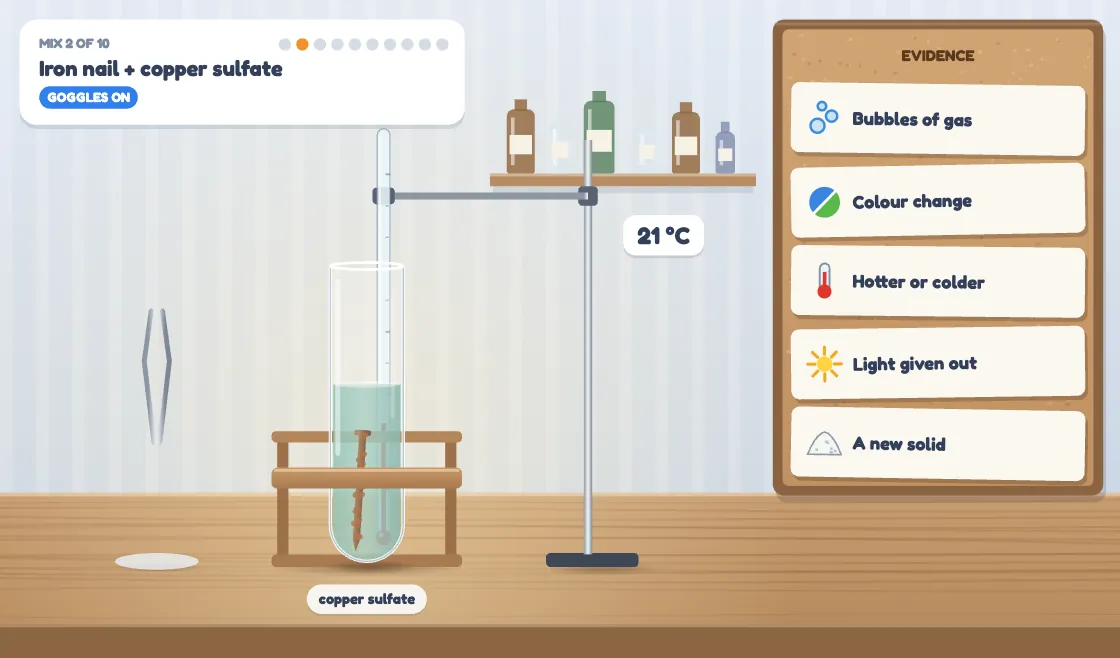
New substances
In a chemical reaction, the substances you start with (the reactants) change into new substances (the products), with new properties. An iron nail in blue copper sulfate grows a brown coat of copper, and the blue fades to green.
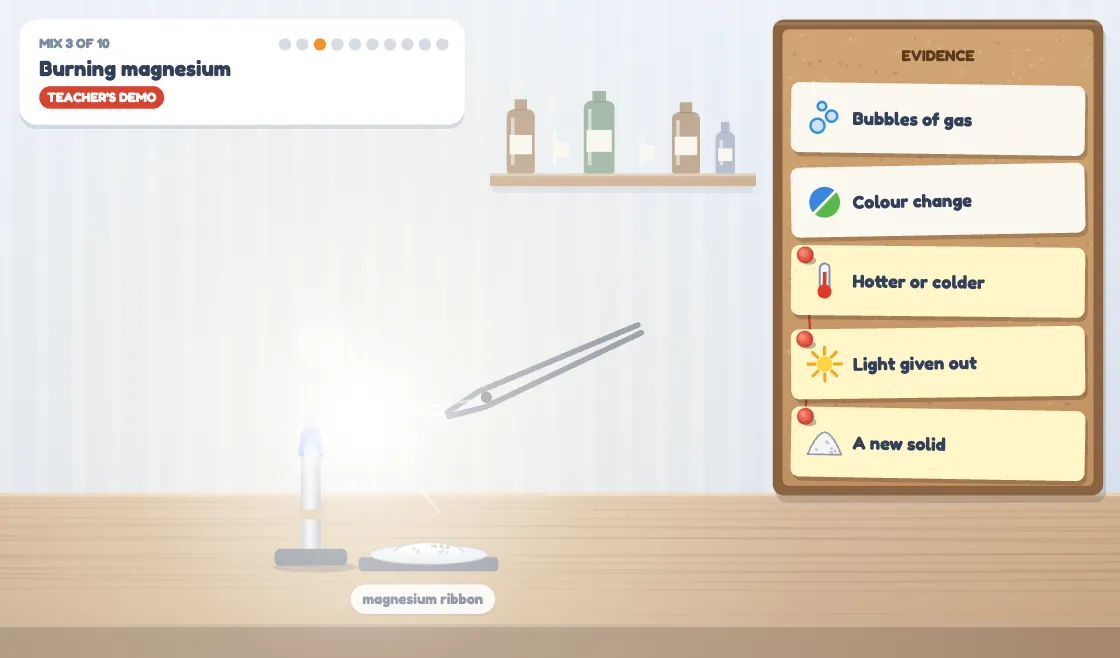
Five signs
You can't see the atoms change, but you can see the clues: bubbles of gas, a colour change, getting hotter or colder, light, or a new solid. Burning magnesium gives a dazzling white light and leaves a white powder.
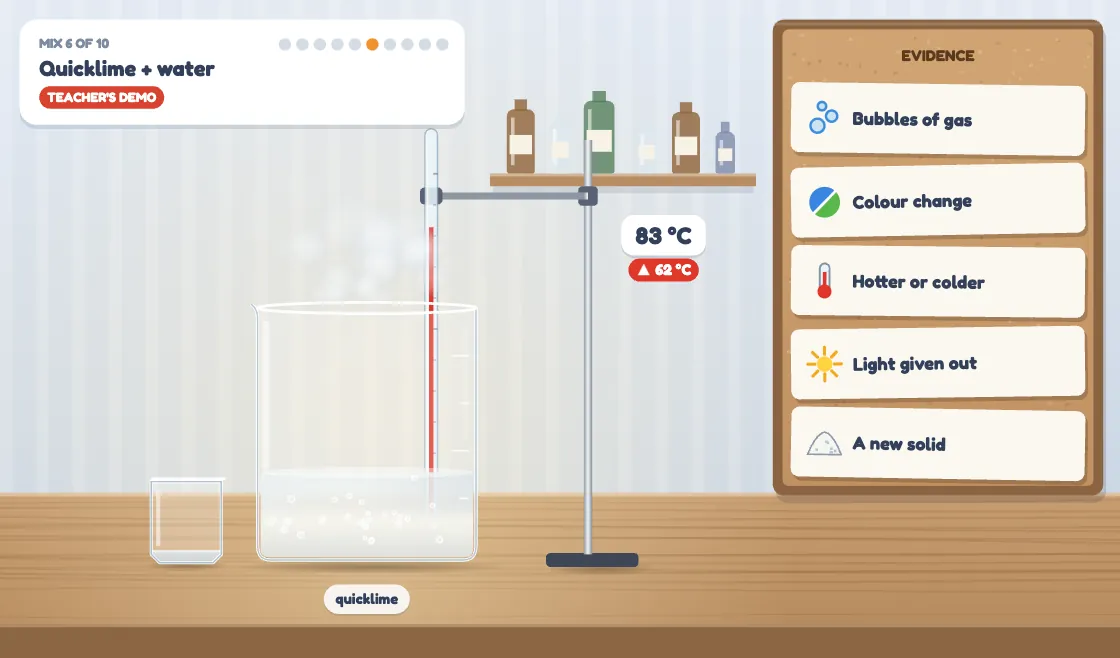
Hotter or colder
Most reactions give out heat: quicklime and water get hot enough to steam. A few take heat in: baking soda and vinegar get a few degrees colder. A thermometer catches what your eyes can't.
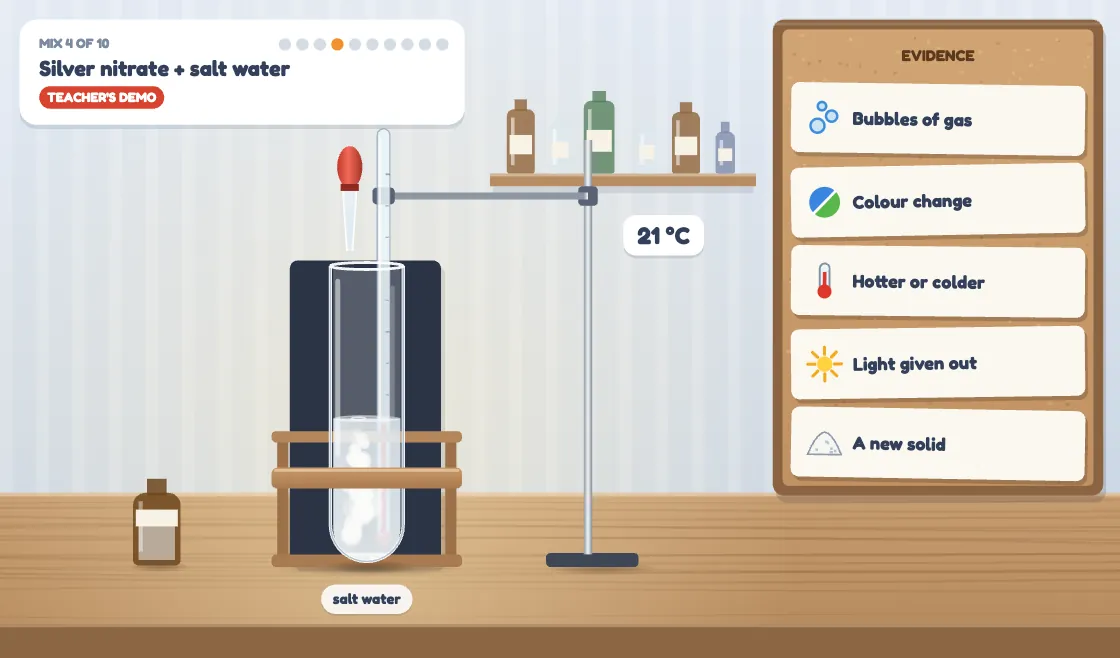
A new solid
When two solutions mix and a solid forms, the solid is called a precipitate. Salt water and silver nitrate make white silver chloride; copper sulfate and sodium hydroxide make pale blue copper hydroxide.
Lookalikes
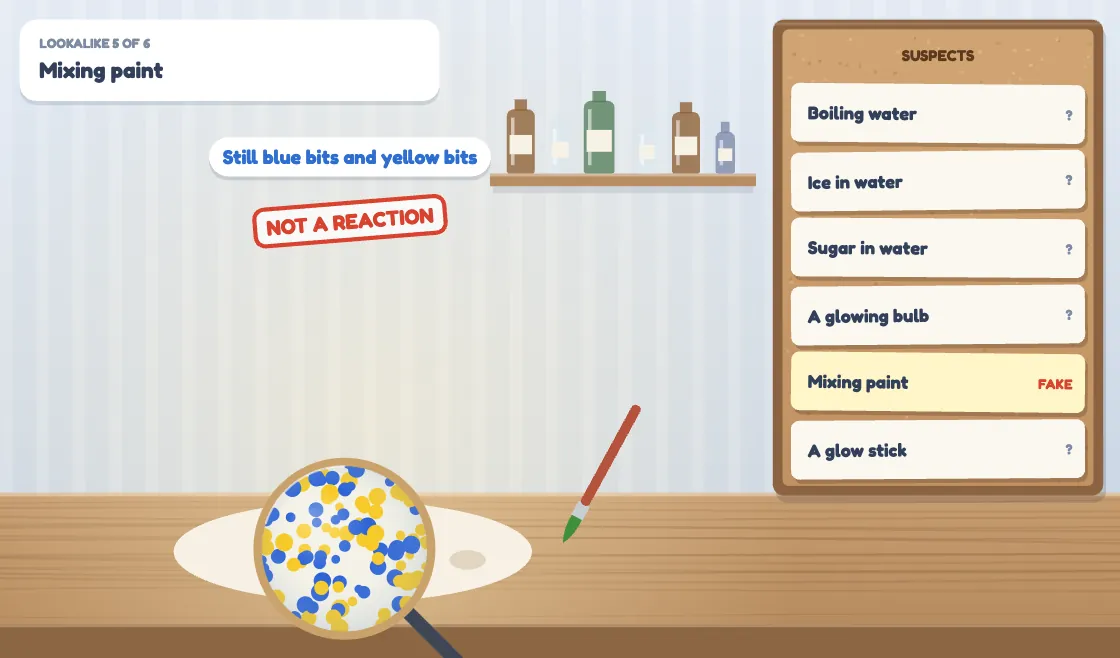
Boiling water bubbles, melting ice cools a drink, a bulb glows, blue and yellow paint make green. Each shows a sign, but nothing new is made: they're physical changes. The proof of a reaction is a new substance.
Testing gases
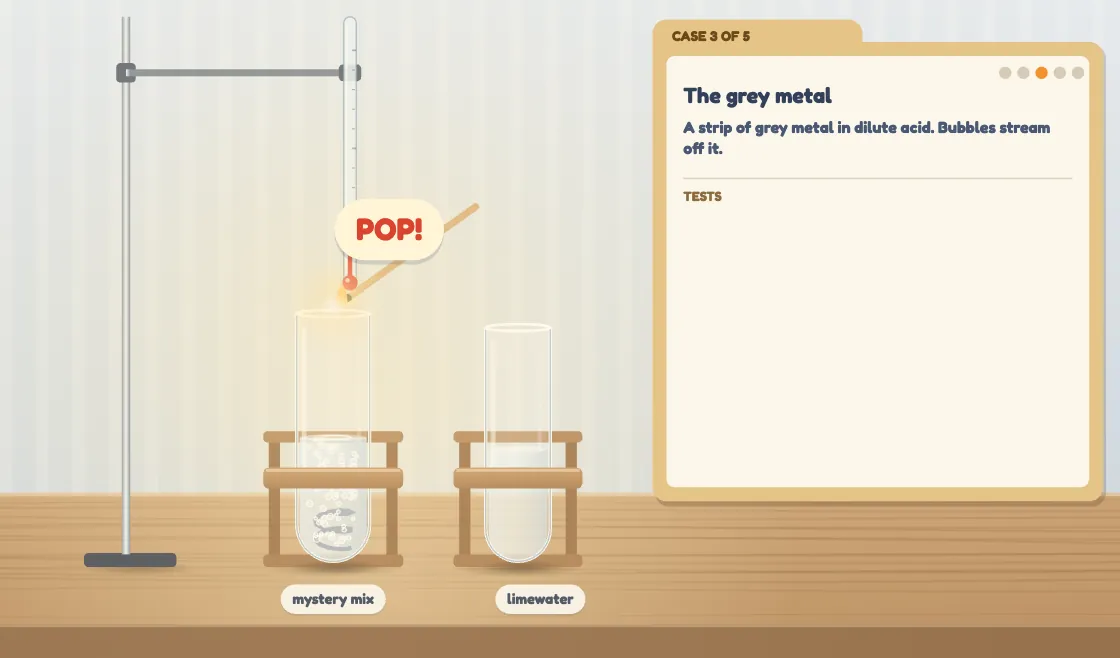
Bubbles tell you a gas is made; a test tells you which. Some reactions, like burning magnesium, are only done by teachers, with the class standing well back.
Inside the lab
8 missions in 4 parts: The ten mixes, Is it a reaction?, Case files, Bonus. Each one is something to try for yourself, with the science behind it once you’ve done it.
- Fizz and chillMix baking soda and vinegar, then pin every sign you saw and file it.It fizzes with carbon dioxide, and it gets a few degrees colder. Most reactions give out heat; a few, like this one, take heat in.
- Out of nowhereAdd silver nitrate to salt water, and file what you saw.A solid that forms when two solutions mix is called a precipitate. Here it's silver chloride, a new substance that doesn't dissolve in water.
- Ten for tenFile all ten mixes with the right signs.Every one made a new substance: carbon dioxide, copper, magnesium oxide, silver chloride and more. The signs are how we spot it.
- Just waterBoil the water, then test its bubbles with a cold glass.The bubbles in boiling water are water vapour. On a cold glass they turn straight back into water: nothing new was made.
- Not fooledTest all five lookalikes: boiling, ice, sugar, the bulb and the paint.Boiling, melting, dissolving, a glowing wire and mixing paint all show a sign, but nothing new is made. They're physical changes.
- Case closedCrack 3 case files: test the mix, then give a verdict with proof.A sign is a clue; proof is a new substance. Gas tests tell you which gas was made: limewater for carbon dioxide, a lit splint for hydrogen, a glowing splint for oxygen.
- Cold lightSnap the glow stick, then try it again tomorrow.A glow stick is a real reaction: two liquids mix and make new substances, giving out light but almost no heat. Once they're used up, it never glows again.
- Top detectiveCrack all five case files.You found carbon dioxide, hydrogen and oxygen, and caught two mixes where nothing new was made at all.
How the quest works
- Predict. Coco asks the mystery and you lock in an answer.
- Learn. A short, picture-led story of the big ideas (6 slides).
- Experiment. 8 missions in the lab, each one yours to try.
- Final Challenge. 8 questions that check you can use what you found, then the mystery’s answer.
For teachers
Present it live on the board while your class follows on their own screens. It fits one class period: about 6 minutes of Learn, 22 in the lab and 7 for the Final Challenge.
Students can
- name the observations that show a chemical reaction has happened: bubbles of gas, a colour change, a temperature change, light, or a new solid (a precipitate).
- use a thermometer to spot reactions that give out heat (quicklime and water) and the few that take it in (baking soda and vinegar).
- explain why boiling, melting, dissolving, a glowing bulb and mixing paint show a sign but are not reactions: no new substance is made.
- choose a test to identify a gas (limewater for carbon dioxide, a lit splint for hydrogen, a glowing splint for oxygen) and use it as evidence for a verdict.
NGSS: MS-PS1-2, 5-PS1-4. NCERT: Class 7, ch. 5 Changes Around Us: Physical and Chemical.
Teacher notes for Reaction DetectiveQuestions people ask
What is Reaction Detective?
Reaction Detective is an interactive signs of a chemical reaction simulation from Thinkodile for ages 11 to 14. Mix pairs of substances and catch the signs of a chemical reaction: bubbles, colour, heat, light or a new solid. It opens with a mystery to predict, explains the big ideas in a short Learn story, lets you run the experiments yourself in the lab, and ends with a Final Challenge.
Is Reaction Detective free?
Reaction Detective is part of Thinkodile Plus for families and Teacher Pro for teachers. A free account includes 6 quests: Photosynthesis, Build a Cell, Build an Electromagnet, Particles in Motion, Dissolving, Moon Phases Explorer. A parent or teacher creates the account; children never sign up themselves.
How long does Reaction Detective take?
About 35 minutes for a class working through it together: around 6 minutes for the Learn story, 22 in the lab and 7 for the Final Challenge. At home you can stop and pick it up again later.
Which curriculum does Reaction Detective cover?
In the US it supports the Next Generation Science Standards MS-PS1-2, 5-PS1-4. In India it matches NCERT Class 7 Science, chapter 5: Changes Around Us: Physical and Chemical. It's organised by topic, not by grade, so it fits other syllabuses too.
Does Reaction Detective work on phones, tablets and Chromebooks?
Yes. It runs in the web browser on laptops, Chromebooks, tablets and phones, with nothing to install. On a phone the lab plays sideways, so turn the phone on its side.
Keep exploring Chemical Reactions
- Equation Balancer: Run reactions from burning methane to silver plating, sort them into types, and balance each one by building it from real atoms.
- All of Chemical Reactions