
Family TraitsAn interactive heredity and Punnett square simulation for ages 11 to 14
Cross Mendel's peas and count the 3 : 1, crack a family's hidden blood groups across four generations, then pair X and Y chromosomes for 100 babies.
Part of Thinkodile Plus · about 34 minutes · plays in the browser
The mystery
Mum is blood group A. Dad is group B. Their new baby is group O: neither of theirs. How can that be?
Every quest starts with a prediction. Lock yours in, then run the experiments to find out who was right.
What you’ll learn
Genes come in versions
A gene is an instruction for one feature, like the colour of a flower. Most genes come in different versions, called alleles. You get one allele of each gene from each parent, so you have two.
Dominant and recessive
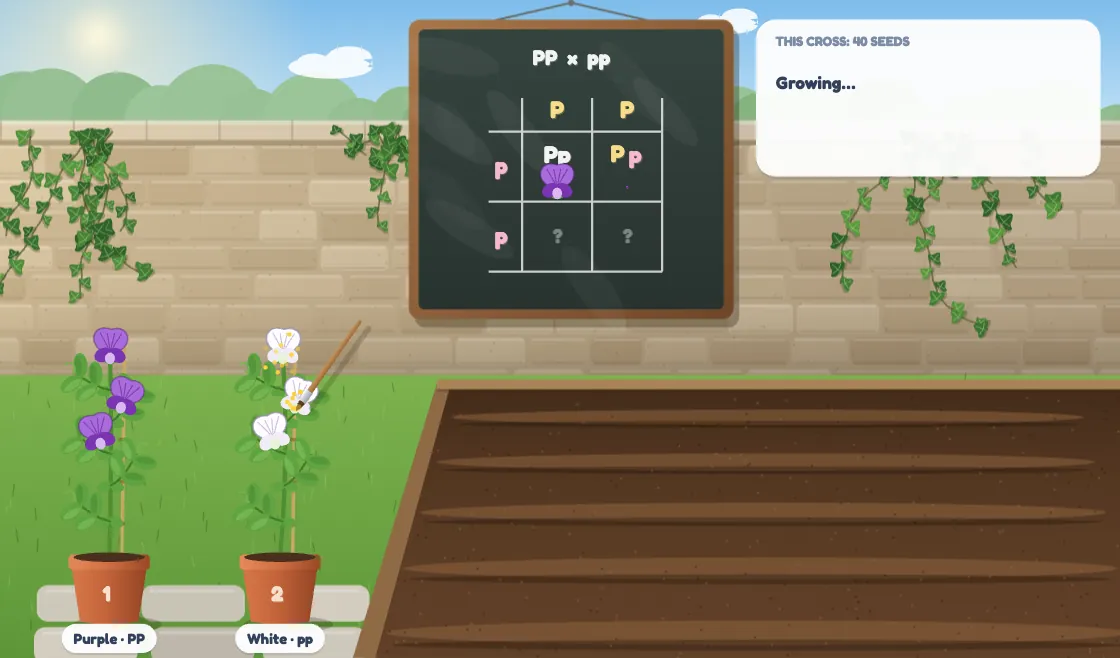
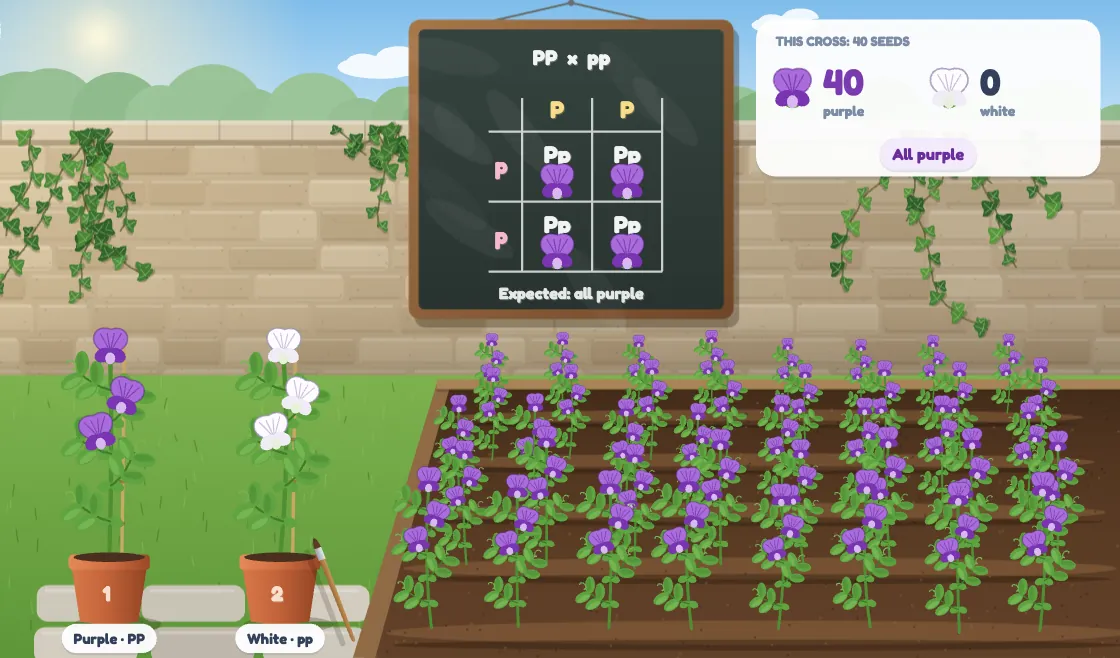
Mendel crossed purple-flowered peas with white ones. Every seed grew purple flowers: one purple allele (P) is enough to show. Purple is dominant. White (p) is recessive: it only shows in a pp plant.
Punnett squares
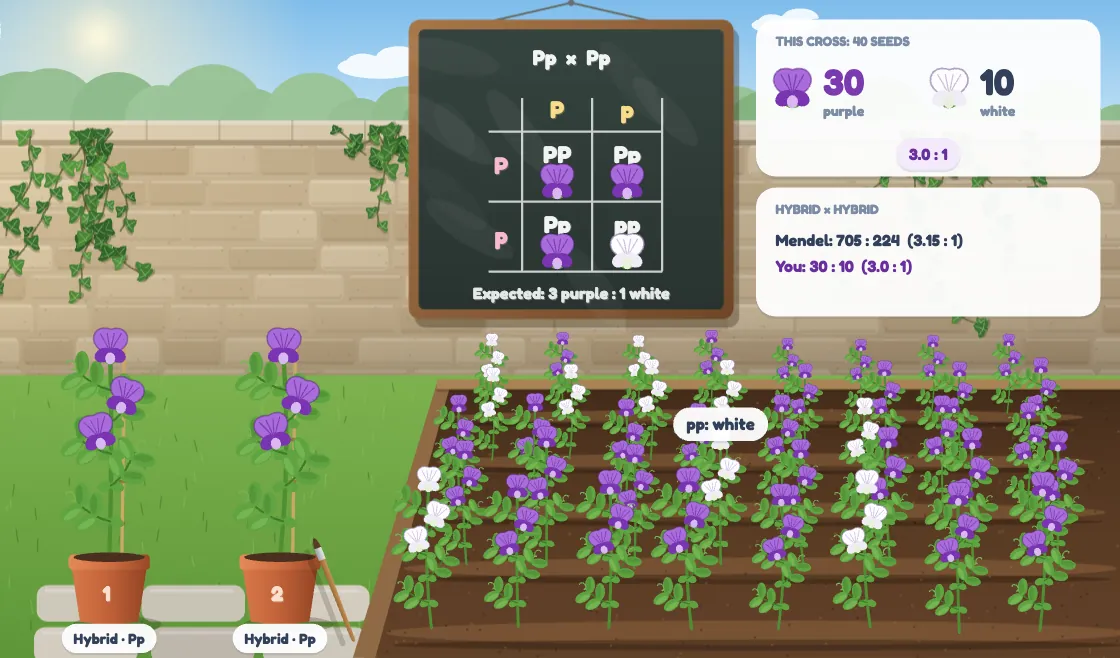
A Punnett square puts each parent's alleles along its edges and fills in every pairing. Two hybrids, Pp × Pp, give PP, Pp, Pp and pp: about 3 purple to 1 white. Mendel counted 705 purple and 224 white.
Blood groups
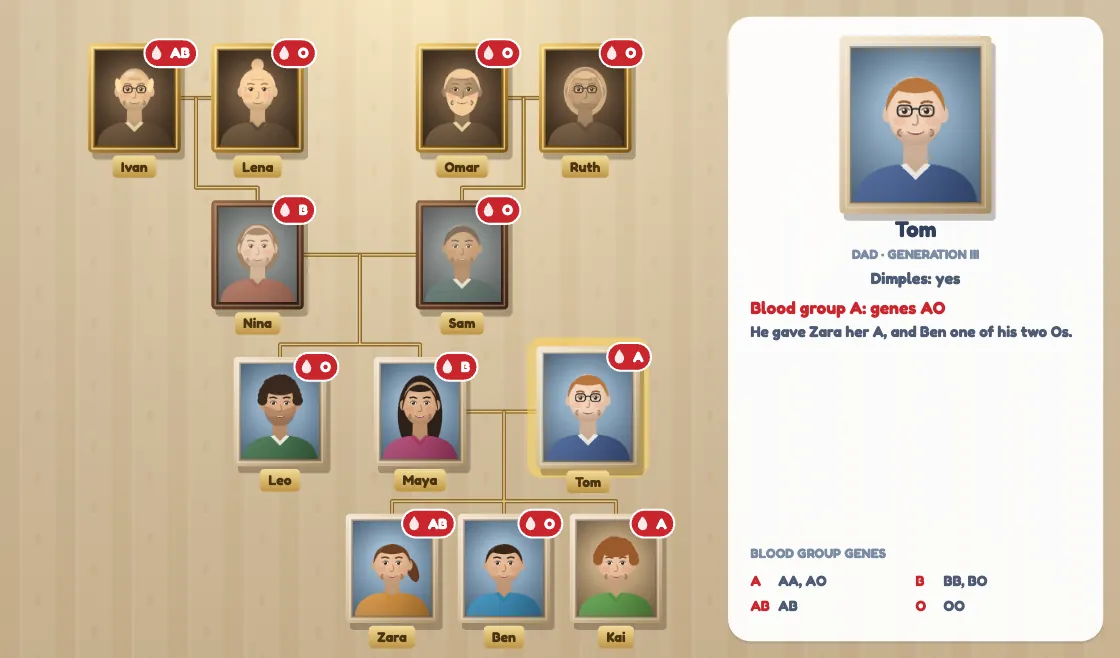
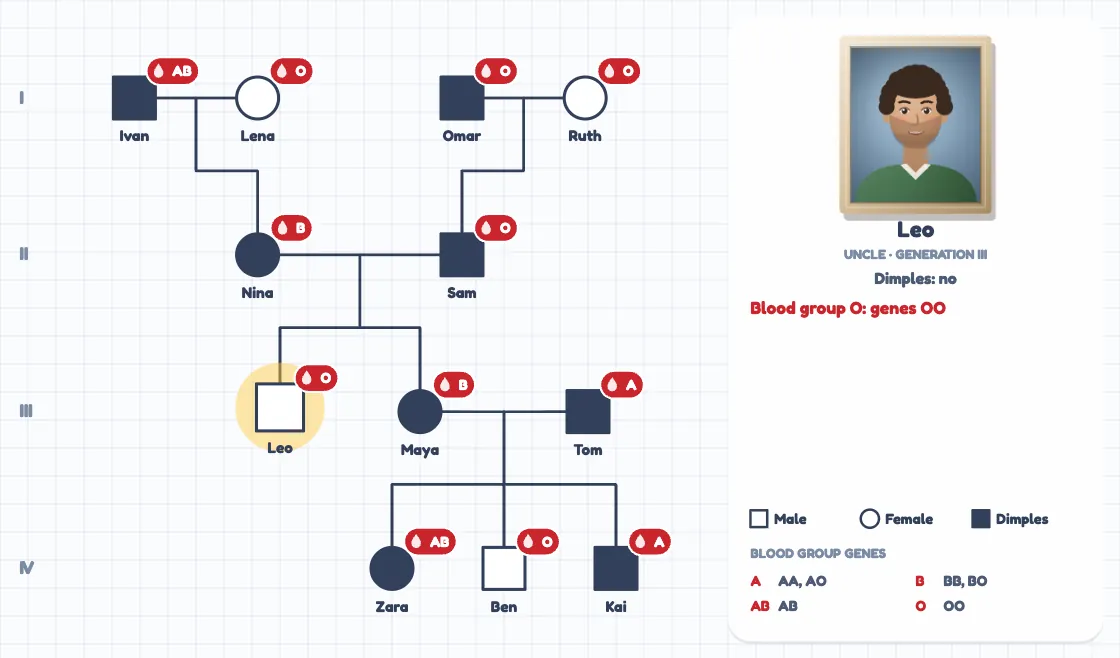
The ABO gene has three alleles: A, B and O. A and B are codominant, so someone with both is group AB. O is recessive: group O means OO. Two group O parents can only have group O children.
Pedigrees
A pedigree is a family tree for one trait. Squares are males, circles are females, and shading means the trait shows. When a child shows a recessive trait that neither parent shows, both parents must carry it, hidden.
Boy or girl?
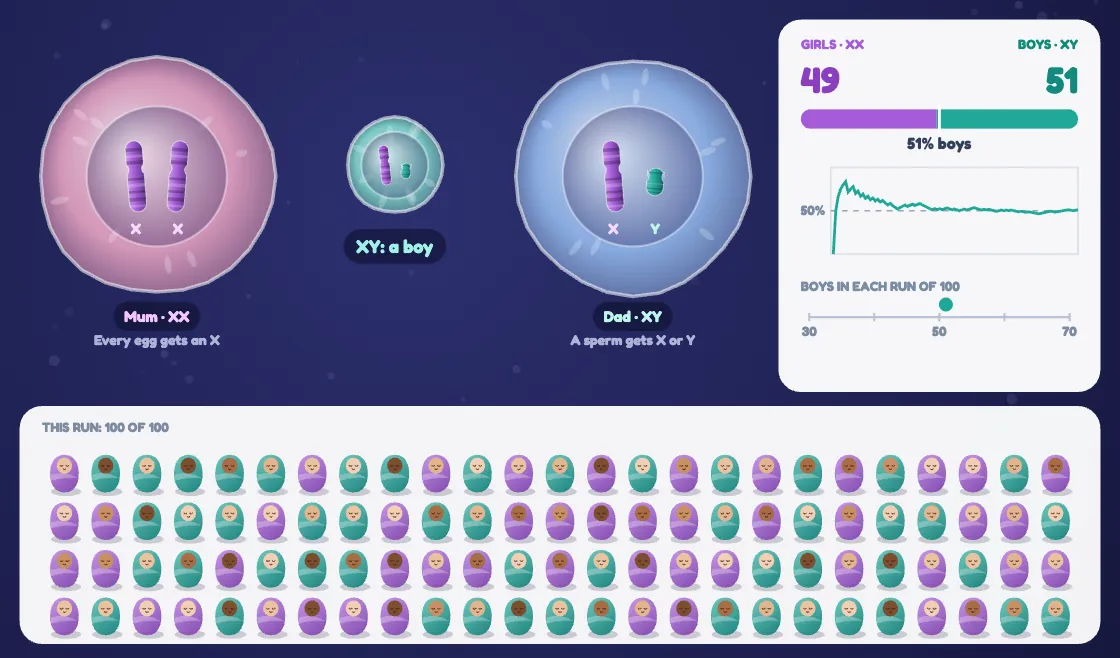
Humans have 23 pairs of chromosomes, and one pair decides sex: females are XX, males XY. Every egg carries an X; half of all sperm carry an X and half a Y. So each baby is about a 50:50 chance.
Inside the lab
8 missions in 4 parts: Mendel's garden, The family wall, A hundred babies, Bonus. Each one is something to try for yourself, with the science behind it once you’ve done it.
- First crossCross a purple plant with a white one, and grow their seeds.Every new plant got a P from the purple parent and a p from the white one: Pp. One P is enough for purple flowers, so purple is dominant and white is recessive.
- The next generationCross two hybrids from your first cross, and count the flowers.Each hybrid passes on P or p, half and half. So about 1 seed in 4 gets p from both parents and flowers white: about 3 purple to 1 white. Mendel counted 705 to 224.
- Read the pedigreeSwitch to the pedigree, then tap a boy with no dimples whose parents both have them.In a pedigree, squares are males, circles are females, and shading means the trait shows. In this simple model, dimples are dominant: two parents with dimples can each carry a hidden no-dimples allele.
- Blood group detectiveWork out the three hidden blood groups.A and B are codominant: someone with both is group AB. O is recessive, so group O means two O alleles, and an O child means both parents carry an O.
- Boy or girl?Pair a chromosome from Mum with one from Dad: make a girl and a boy.Mum's cells are XX, so every egg carries an X. Dad's are XY, so each sperm carries an X or a Y. It's Dad's chromosome that decides.
- A hundred babiesMake 100 babies at random, and count the girls and boys.Each baby is a 50:50 chance, like tossing a coin, so a hundred land near half and half, but rarely exactly. Run it again and the count changes.
- The mystery plantIs the mystery purple plant hiding a white allele? Cross it with a white plant to find out.This is a test cross. A PP plant crossed with white gives only purple; a Pp plant gives about half white. Plant breeders still use it.
- A thousand babiesMake 1,000 babies and watch the share of boys settle.The more babies, the closer to half. Real births worldwide come out at about 105 boys for every 100 girls, a little over half.
How the quest works
- Predict. Coco asks the mystery and you lock in an answer.
- Learn. A short, picture-led story of the big ideas (6 slides).
- Experiment. 8 missions in the lab, each one yours to try.
- Final Challenge. 8 questions that check you can use what you found, then the mystery’s answer.
For teachers
Present it live on the board while your class follows on their own screens. It fits one class period: about 6 minutes of Learn, 22 in the lab and 6 for the Final Challenge.
Students can
- use the words gene, allele, dominant, recessive, genotype and phenotype, and explain why Mendel's purple × white cross gave only purple flowers.
- draw a Punnett square for a monohybrid cross, predict the 3 : 1 ratio from two hybrids, and compare a real count with the prediction (Mendel's 705 : 224).
- explain codominance with the ABO blood groups, read a pedigree diagram, and work out an unknown blood group from a person's parents or children.
- explain that a baby's sex is decided by the X or Y chromosome from the father, and why many births come out close to half boys and half girls.
NGSS: HS-LS3-1.
Teacher notes for Family TraitsQuestions people ask
What is Family Traits?
Family Traits is an interactive heredity and Punnett square simulation from Thinkodile for ages 11 to 14. Cross Mendel's peas and count the 3 : 1, crack a family's hidden blood groups across four generations, then pair X and Y chromosomes for 100 babies. It opens with a mystery to predict, explains the big ideas in a short Learn story, lets you run the experiments yourself in the lab, and ends with a Final Challenge.
Is Family Traits free?
Family Traits is part of Thinkodile Plus for families and Teacher Pro for teachers. A free account includes 6 quests: Photosynthesis, Build a Cell, Build an Electromagnet, Particles in Motion, Dissolving, Moon Phases Explorer. A parent or teacher creates the account; children never sign up themselves.
How long does Family Traits take?
About 34 minutes for a class working through it together: around 6 minutes for the Learn story, 22 in the lab and 6 for the Final Challenge. At home you can stop and pick it up again later.
Which curriculum does Family Traits cover?
In the US it supports the Next Generation Science Standards HS-LS3-1. It's organised by topic, not by grade, so it fits other syllabuses too.
Does Family Traits work on phones, tablets and Chromebooks?
Yes. It runs in the web browser on laptops, Chromebooks, tablets and phones, with nothing to install. On a phone the lab plays sideways, so turn the phone on its side.
Keep exploring Genes & Heredity
- Meiosis Shuffle: Shuffle chromosomes into eggs and sperm, and see why every brother and sister is a brand-new mix.
- All of Genes & Heredity