
Meiosis ShuffleAn interactive meiosis simulation for ages 11 to 14
Shuffle chromosomes into eggs and sperm, and see why every brother and sister is a brand-new mix.
Part of Thinkodile Plus · about 33 minutes · plays in the browser
The mystery
Each cell in your mum's body has 46 chromosomes, and so does each cell in your dad's. You got chromosomes from both of them, yet your cells have 46 too, not 92. How?
Every quest starts with a prediction. Lock yours in, then run the experiments to find out who was right.
What you’ll learn
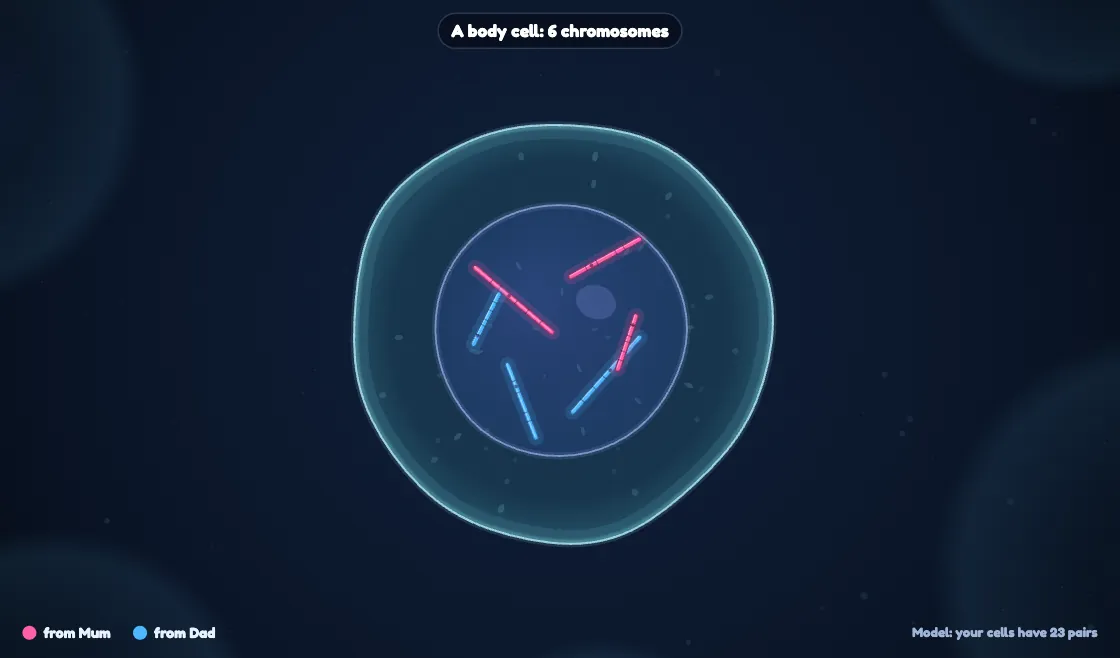
Chromosomes come in pairs
The nucleus of a body cell holds chromosomes: long threads of DNA carrying the genes. Yours have 46, in 23 pairs. One of each pair came from your mum and one from your dad. One pair decides sex: XX or XY.
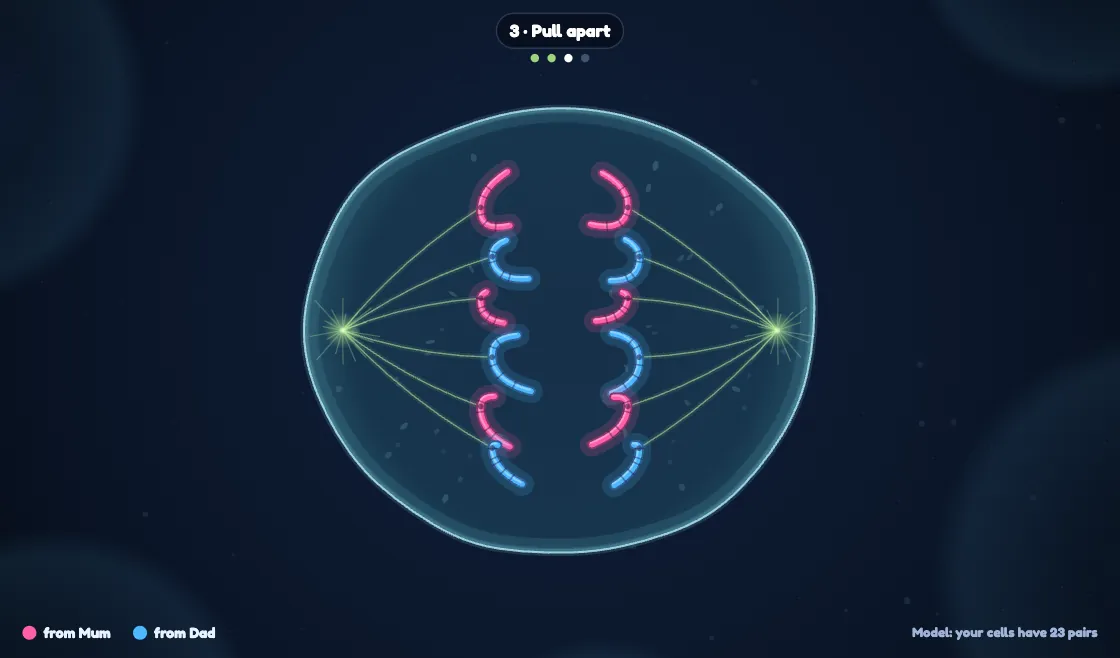
Mitosis copies
To grow or heal, a body cell divides by mitosis. Each chromosome copies itself, spindle threads pull the copies apart, and the cell splits in two. Both new cells have the same 46 chromosomes.
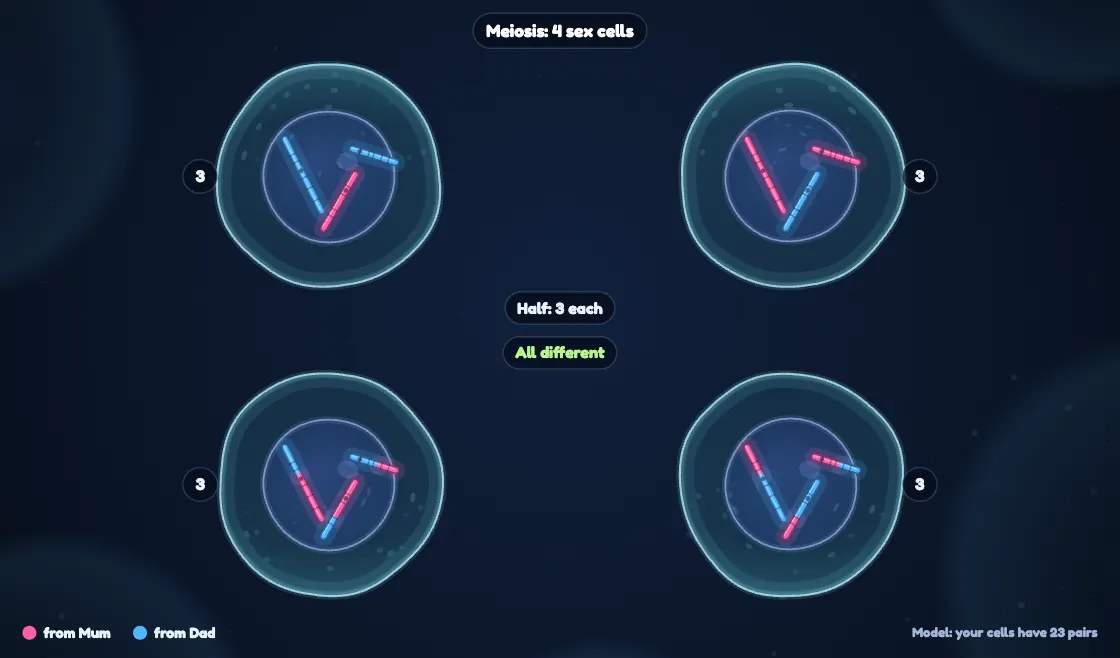
Meiosis halves
Eggs are made in the ovaries and sperm in the testes, by meiosis. The cell copies its chromosomes once but divides twice, making four cells with 23 chromosomes each, one of every pair. (In an ovary, only one of the four grows into an egg.)
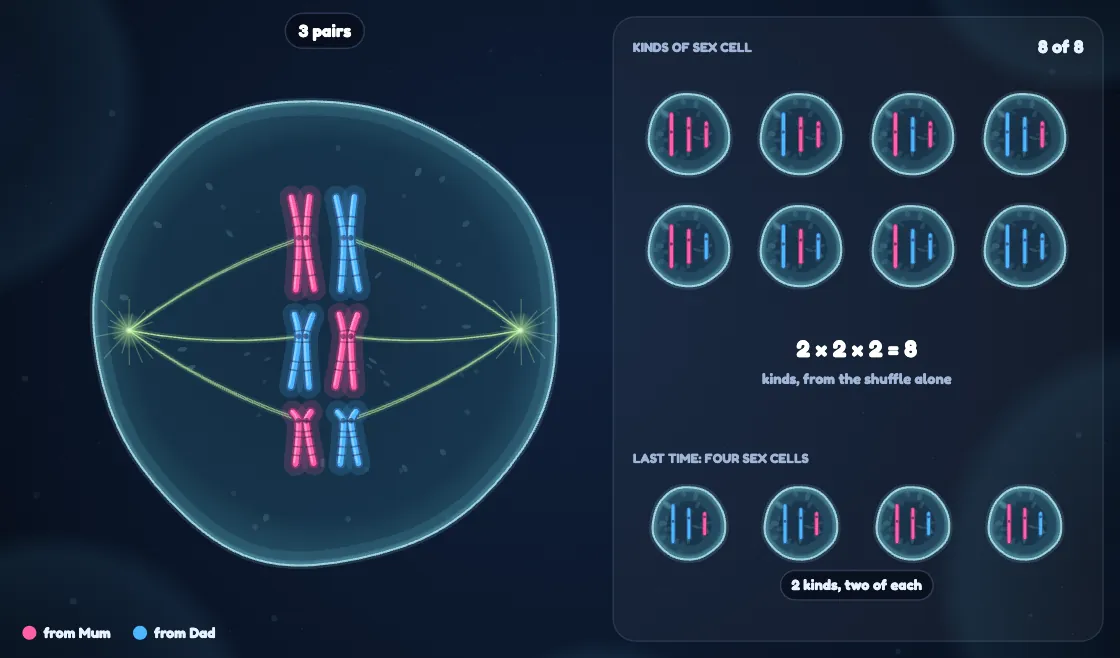
The shuffle
Which chromosome of each pair goes into an egg or sperm is like a coin toss, separately for each pair. Every pair doubles the kinds of sex cell.
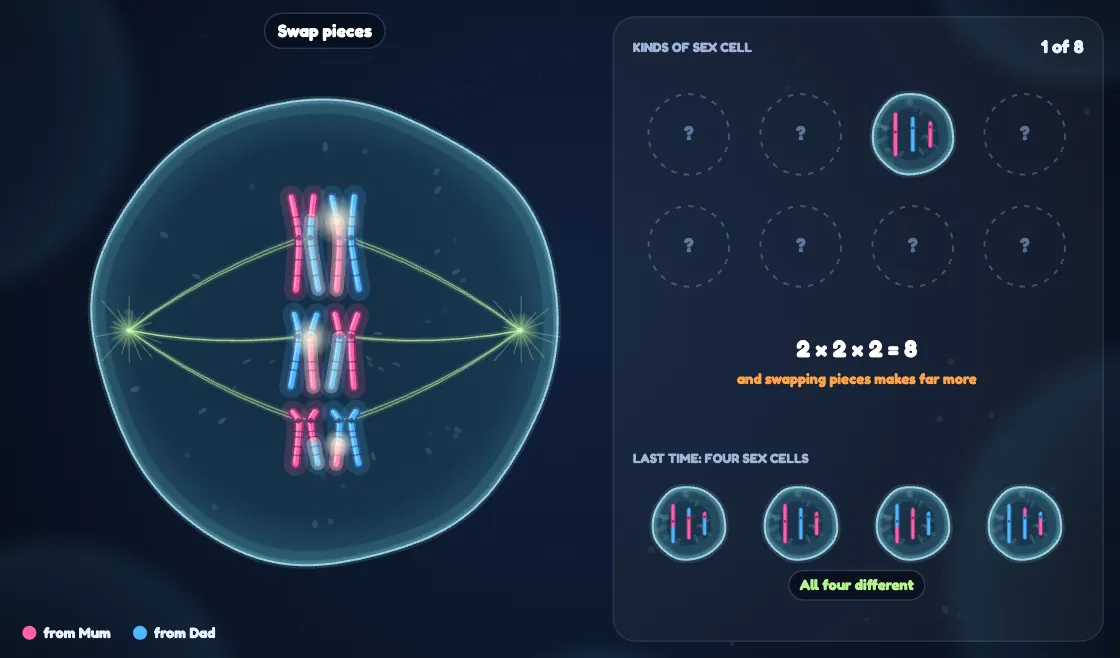
Swapping pieces
Before a pair splits up, its two chromosomes cross over and swap pieces. The new chromosomes are part Mum's, part Dad's, so the kinds of egg and sperm go far beyond 8 million.
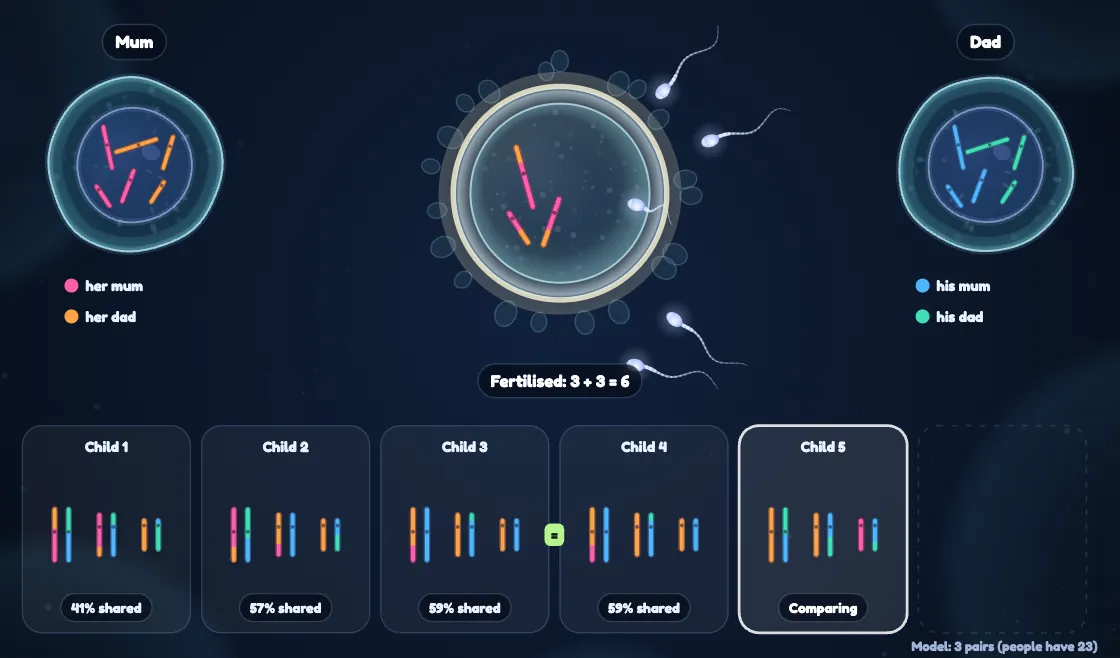
Brothers and sisters
At fertilisation an egg and a sperm join: 23 + 23 = 46. Every egg and sperm is a new shuffle, so siblings share about half their chromosomes, never all. Identical twins share all of theirs: they come from one fertilised egg that split.
Inside the lab
8 missions in 4 parts: Two ways to divide, The shuffle, Brothers and sisters, Bonus. Each one is something to try for yourself, with the science behind it once you’ve done it.
- Copy a body cellDivide a body cell by mitosis.In mitosis each chromosome copies itself, the copies are pulled apart, and the cell splits: two cells, each with the same chromosomes as the first. It's how you grow and heal.
- Make sex cellsDivide a cell from an ovary or testis by meiosis.Meiosis divides twice. The pairs split up first, then the copies, so it makes four cells with half the chromosomes each. In people that's 23: one of every pair.
- All eight kindsMake all 8 kinds of sex cell from a cell with 3 pairs.Each pair lines up either way, like a coin toss, so 3 pairs give 2 × 2 × 2 = 8 kinds. Every pair you add doubles the number.
- 23 pairsGive the cell 23 pairs, like yours, and make sex cells.With 23 pairs, the shuffle alone can make 2²³ = 8,388,608 kinds of egg or sperm.
- A fertilised eggMake a baby: an egg from Mum, a sperm from Dad.The egg brings one of every pair and the sperm the other: 23 + 23 = 46, a full set again. Then the fertilised egg divides by mitosis, again and again, into a baby.
- Brothers and sistersGive the same parents 3 children, and compare them.Every egg and every sperm is a new shuffle, so children of the same parents share about half their chromosomes with each other, never all of them.
- Swap piecesTurn on crossing over in the shuffle and make sex cells.Before they split up, the two chromosomes of a pair swap pieces. That makes new mixed chromosomes, so the kinds go far beyond 8,388,608.
- Identical twinsMake identical twins.Identical twins come from one fertilised egg that splits in two, so they share exactly the same chromosomes. Other twins come from two eggs and two sperm.
How the quest works
- Predict. Coco asks the mystery and you lock in an answer.
- Learn. A short, picture-led story of the big ideas (6 slides).
- Experiment. 8 missions in the lab, each one yours to try.
- Final Challenge. 8 questions that check you can use what you found, then the mystery’s answer.
For teachers
Present it live on the board while your class follows on their own screens. It fits one class period: about 6 minutes of Learn, 20 in the lab and 7 for the Final Challenge.
Students can
- compare mitosis (two cells identical to the parent, for growth and repair) with meiosis (four cells with half the chromosomes, each different, for making eggs and sperm).
- explain that a human egg or sperm carries 23 chromosomes, one of every pair, and that fertilisation makes 46 again.
- work out the kinds of sex cell the shuffle makes as 2 to the power of the number of pairs (8 for 3 pairs, 8,388,608 for 23) and explain that crossing over makes even more.
- explain why brothers and sisters share about half their chromosomes and never all of them, while identical twins share all of theirs.
NGSS: HS-LS3-2.
Teacher notes for Meiosis ShuffleQuestions people ask
What is Meiosis Shuffle?
Meiosis Shuffle is an interactive meiosis simulation from Thinkodile for ages 11 to 14. Shuffle chromosomes into eggs and sperm, and see why every brother and sister is a brand-new mix. It opens with a mystery to predict, explains the big ideas in a short Learn story, lets you run the experiments yourself in the lab, and ends with a Final Challenge.
Is Meiosis Shuffle free?
Meiosis Shuffle is part of Thinkodile Plus for families and Teacher Pro for teachers. A free account includes 6 quests: Photosynthesis, Build a Cell, Build an Electromagnet, Particles in Motion, Dissolving, Moon Phases Explorer. A parent or teacher creates the account; children never sign up themselves.
How long does Meiosis Shuffle take?
About 33 minutes for a class working through it together: around 6 minutes for the Learn story, 20 in the lab and 7 for the Final Challenge. At home you can stop and pick it up again later.
Which curriculum does Meiosis Shuffle cover?
In the US it supports the Next Generation Science Standards HS-LS3-2. It's organised by topic, not by grade, so it fits other syllabuses too.
Does Meiosis Shuffle work on phones, tablets and Chromebooks?
Yes. It runs in the web browser on laptops, Chromebooks, tablets and phones, with nothing to install. On a phone the lab plays sideways, so turn the phone on its side.
Keep exploring Genes & Heredity
- Family Traits: Cross Mendel's peas and count the 3 : 1, crack a family's hidden blood groups across four generations, then pair X and Y chromosomes for 100 babies.
- All of Genes & Heredity