
Bounce LabAn interactive bouncing ball energy simulation for ages 11 to 14
Drop balls on different floors and find where the energy goes as the bounces die away.
Part of Thinkodile Plus · about 38 minutes · plays in the browser
The mystery
Coco drops a tennis ball from 1 metre. It bounces back up to only about 55 cm. What happened to the energy it needed for the other 45 cm?
Every quest starts with a prediction. Lock yours in, then run the experiments to find out who was right.
What you’ll learn
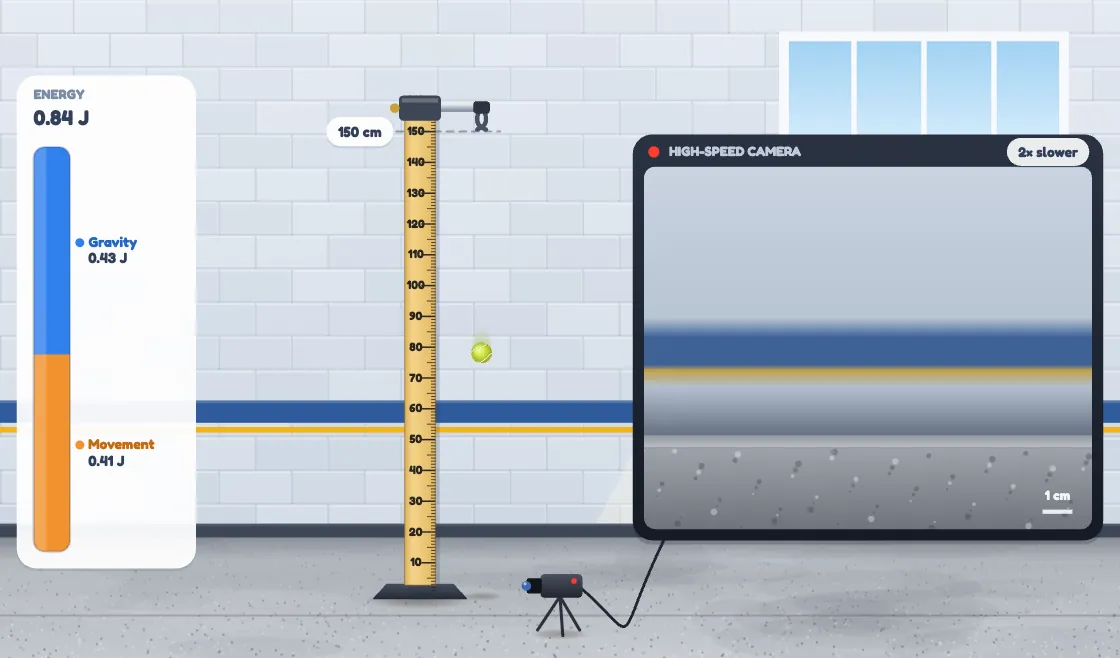
Falling
A ball held up has energy in its gravity store. A 57 g tennis ball 1 m up has about 0.56 J. As it falls, that energy moves into its kinetic store, the store of movement, joule for joule.
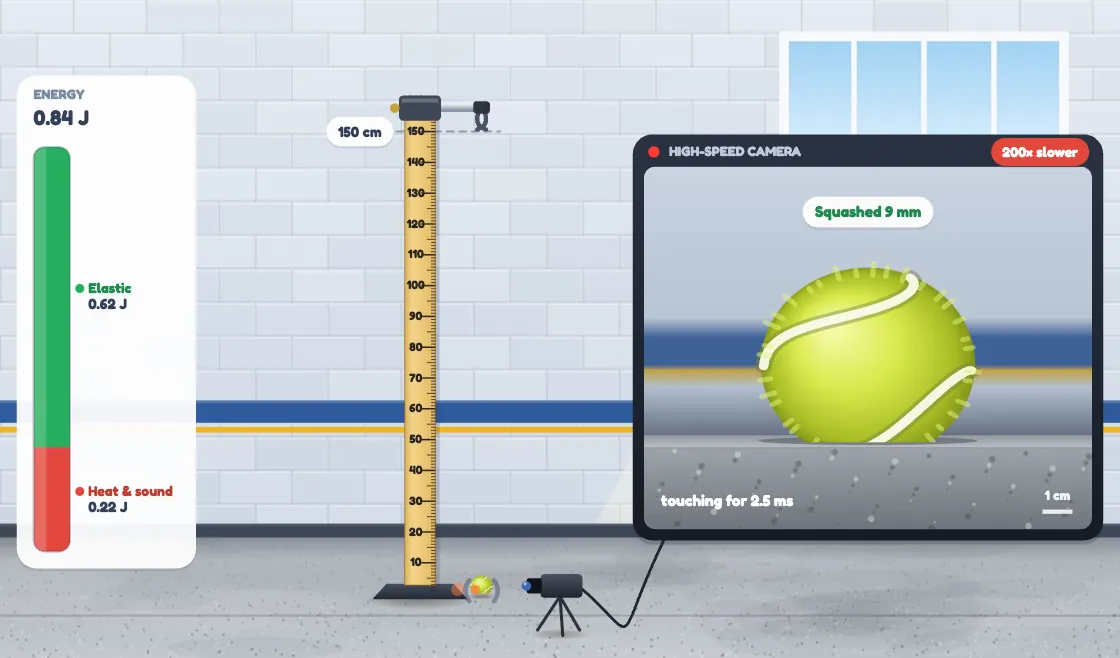
The squash
When it hits the floor the ball squashes, and for an instant it stops. Its energy is now in its elastic store. Then it springs back: elastic to kinetic, and as it rises, kinetic to gravity again.
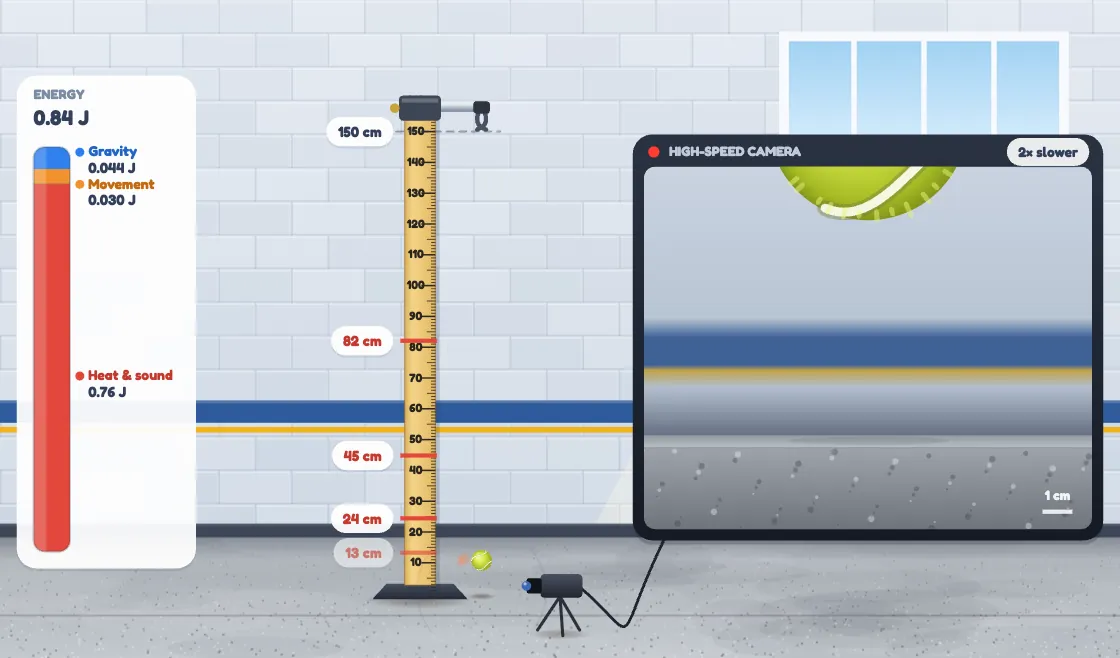
Every bounce lower
Each squash turns part of the energy into heat, in the ball and the floor, and a little into sound. It's the same share each time, so the bounces shrink by the same fraction: 100 cm, 55, 30, 16…
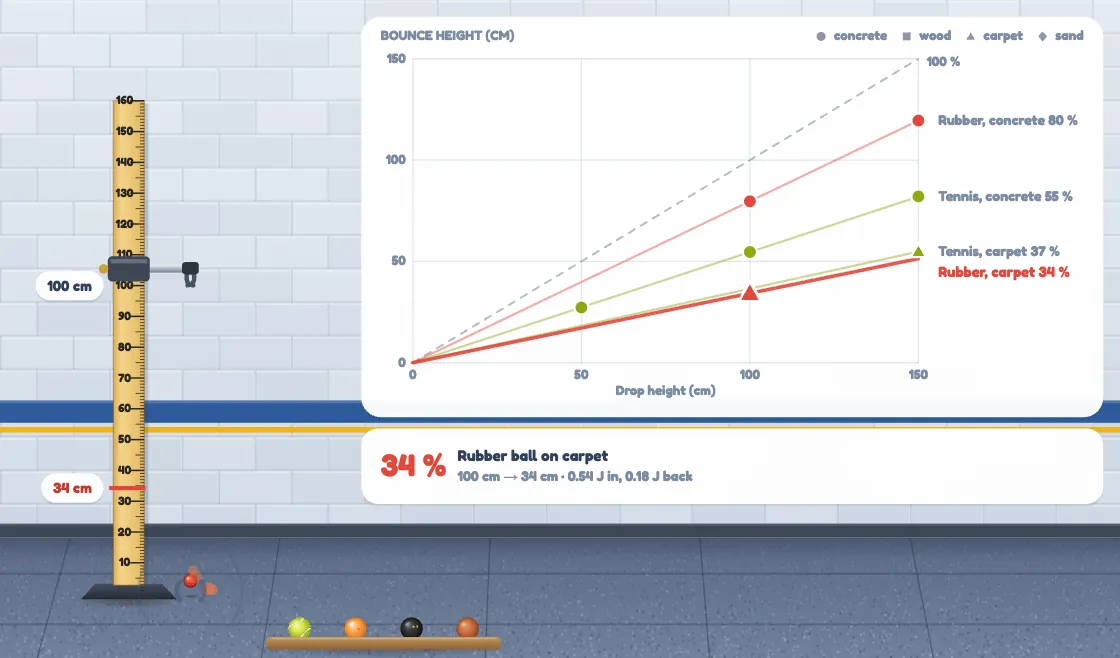
Bounce ratio and efficiency
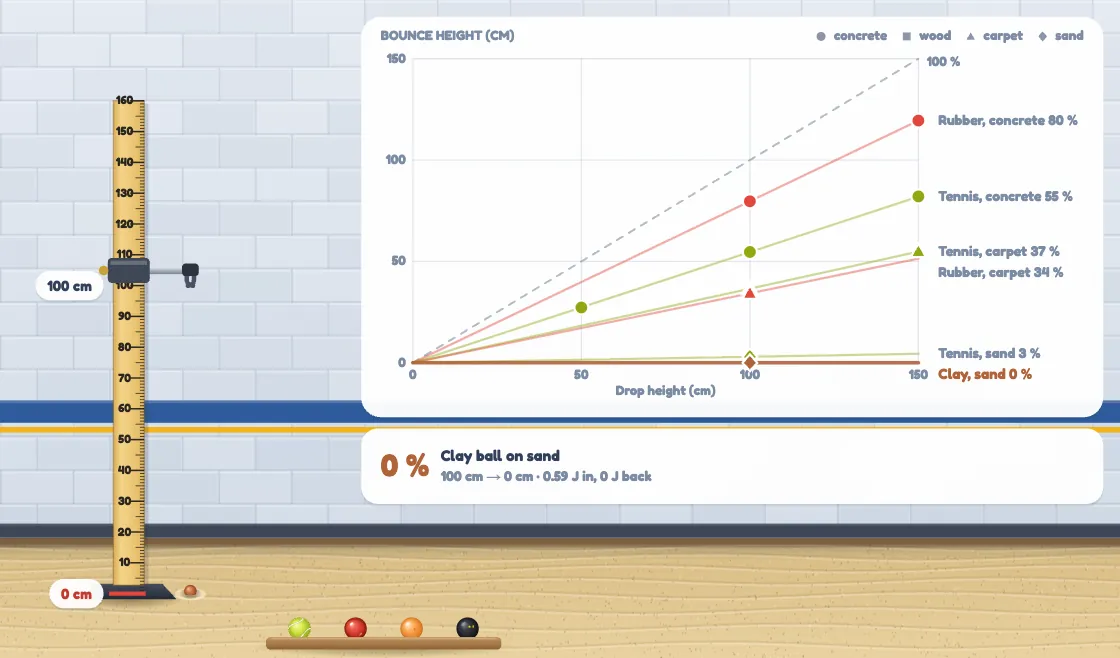
How high a ball bounces, divided by how high it fell, tells you what share of its energy came back. That's the bounce's efficiency. A tennis ball on concrete gives back about 55 %.
Balls and floors
A hard floor gives back the most. Carpet squashes and hardly springs back; sand doesn't spring back at all, which is why long jumpers land in it. Clay never springs back. A squash ball bounces about twice as high when it's warm.
Spread out, not lost
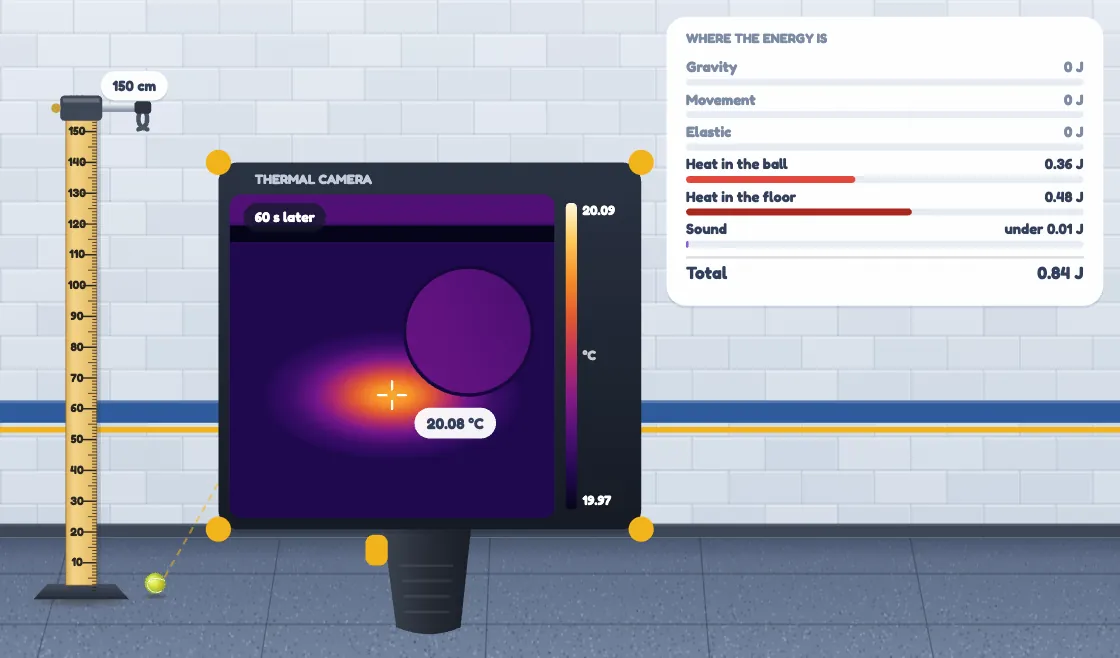
When the ball stops, every joule is still there, as heat in the ball and the floor and a little sound in the air. But it's spread so thinly that it can't lift the ball again. We say it has been dissipated.
Inside the lab
8 missions in 4 parts: The drop test, A fair test, Where did it go?, Bonus. Each one is something to try for yourself, with the science behind it once you’ve done it.
- The squashDrop the tennis ball and watch it hit the floor on the high-speed camera.For a few thousandths of a second the ball is squashed flat against the floor and stops. Its energy is in its elastic store, the squashed rubber and the air inside it, until it springs back.
- Lower and lowerLet the ball bounce until it stops, and read at least four bounces on the rule.Each bounce is about 55 % as high as the one before: 100 cm, 55, 30, 16, 9… Every squash turns the same share of what's left into heat and sound.
- Twice the dropDrop the same ball on the same floor from three different heights.Bounce height is proportional to drop height: the points lie on a straight line through zero. Twice the drop puts twice the energy in, and twice as much comes back.
- Fair testDrop one ball from the same height onto three different floors.Hard floors give back the most. Carpet squashes and hardly springs back, and sand doesn't spring back at all, so they turn far more of the energy into heat.
- Balance the booksDrop the ball with the thermal camera watching, and wait until it stops.The total never changes: every joule is still there, as heat in the ball and the floor, and a tiny bit of sound. Then the warm patch spreads out and gets cooler, but the heat in it stays the same.
- Hard or soft?Drop the ball onto concrete and onto carpet, and see where the heat goes.Concrete hardly squashes, so the heat is made in the ball. Carpet takes much of the squash, so much of the heat is made in the carpet.
- Dead dropDrop the clay ball.Clay doesn't spring back at all. All its energy goes into heat, a little sound and a dent in the clay: its bounce ratio is 0 %.
- Warm it upDrop a cold squash ball, then a warmed one, from the same height onto the same floor.Warm rubber wastes less of its energy as heat, and the air inside pushes harder, so a warm squash ball bounces about twice as high. That's why players warm it up by hitting it hard before a game.
How the quest works
- Predict. Coco asks the mystery and you lock in an answer.
- Learn. A short, picture-led story of the big ideas (6 slides).
- Experiment. 8 missions in the lab, each one yours to try.
- Final Challenge. 8 questions that check you can use what you found, then the mystery’s answer.
For teachers
Present it live on the board while your class follows on their own screens. It fits one class period: about 7 minutes of Learn, 24 in the lab and 7 for the Final Challenge.
Students can
- describe the energy transfers in a bounce: gravity to kinetic as the ball falls, kinetic to elastic as it squashes, and back again, with some energy moving into thermal stores and sound at every squash.
- calculate the efficiency of a bounce as bounce height ÷ drop height, and explain why that equals useful energy out ÷ energy in.
- plan a fair test that changes one variable (the ball, the floor or the height) and keeps the others the same, and use a graph of bounce height against drop height to show a proportional relationship.
- explain that energy is conserved but dissipated: when the ball stops, all its energy is still there as heat in the ball and the floor and a little sound, spread too thinly to be useful.
NGSS: MS-PS3-5, 4-PS3-3.
Teacher notes for Bounce LabQuestions people ask
What is Bounce Lab?
Bounce Lab is an interactive bouncing ball energy simulation from Thinkodile for ages 11 to 14. Drop balls on different floors and find where the energy goes as the bounces die away. It opens with a mystery to predict, explains the big ideas in a short Learn story, lets you run the experiments yourself in the lab, and ends with a Final Challenge.
Is Bounce Lab free?
Bounce Lab is part of Thinkodile Plus for families and Teacher Pro for teachers. A free account includes 6 quests: Photosynthesis, Build a Cell, Build an Electromagnet, Particles in Motion, Dissolving, Moon Phases Explorer. A parent or teacher creates the account; children never sign up themselves.
How long does Bounce Lab take?
About 38 minutes for a class working through it together: around 7 minutes for the Learn story, 24 in the lab and 7 for the Final Challenge. At home you can stop and pick it up again later.
Which curriculum does Bounce Lab cover?
In the US it supports the Next Generation Science Standards MS-PS3-5, 4-PS3-3. It's organised by topic, not by grade, so it fits other syllabuses too.
Does Bounce Lab work on phones, tablets and Chromebooks?
Yes. It runs in the web browser on laptops, Chromebooks, tablets and phones, with nothing to install. On a phone the lab plays sideways, so turn the phone on its side.
Keep exploring Energy
- Chain Reaction Machine: Follow a ball's energy, tip a giant domino with one tap, then build a machine of ramps, dominoes, pulleys and springs to ring a bell.
- Roller Coaster Designer: Trade height for speed down a real-size drop, loop the loop safely, then design a coaster that thrills without hurting anyone.
- All of Energy