
Roller Coaster DesignerAn interactive roller coaster energy simulation for ages 11 to 14
Trade height for speed down a real-size drop, loop the loop safely, then design a coaster that thrills without hurting anyone.
Part of Thinkodile Plus · about 38 minutes · plays in the browser
The mystery
The park's old coaster drops 20 m and reaches 68 km/h at the bottom. Coco wants a new one that's twice as fast: 136 km/h. How high must its first drop be?
Every quest starts with a prediction. Lock yours in, then run the experiments to find out who was right.
What you’ll learn
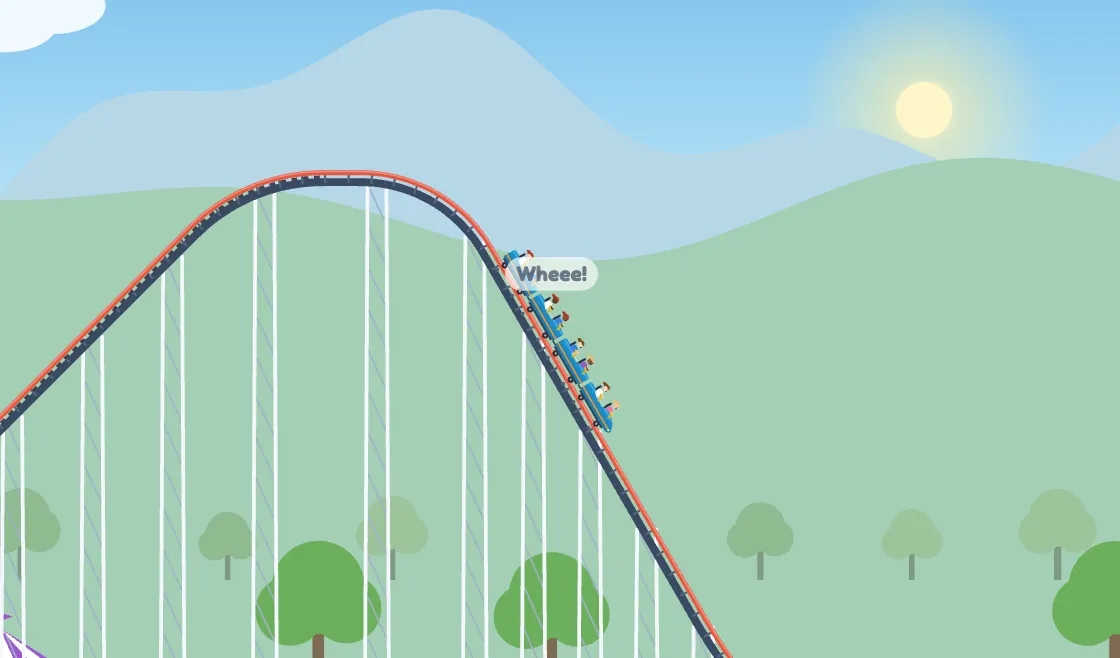
Height for speed
A coaster has no engine. A chain drags the train up the first hill, filling its gravity store. On the drop, that store empties into its kinetic (movement) store: height turns into speed.
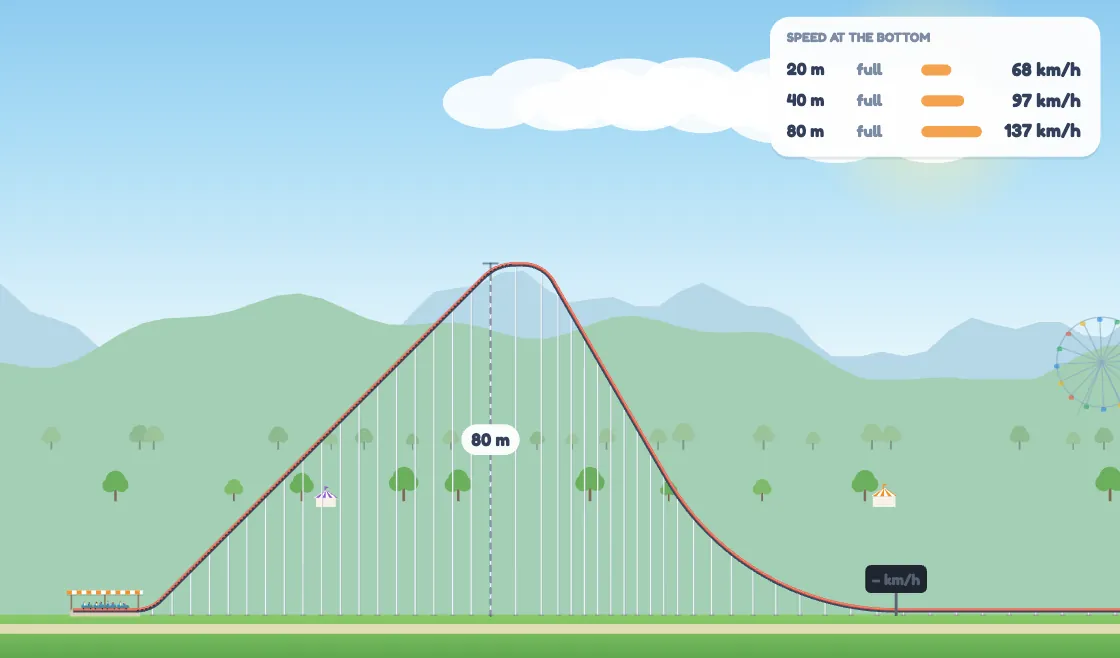
Four times as high
The kinetic store grows with the square of the speed. Twice as fast needs four times the energy, so four times the height: 20 m gives about 68 km/h, 80 m about 136.
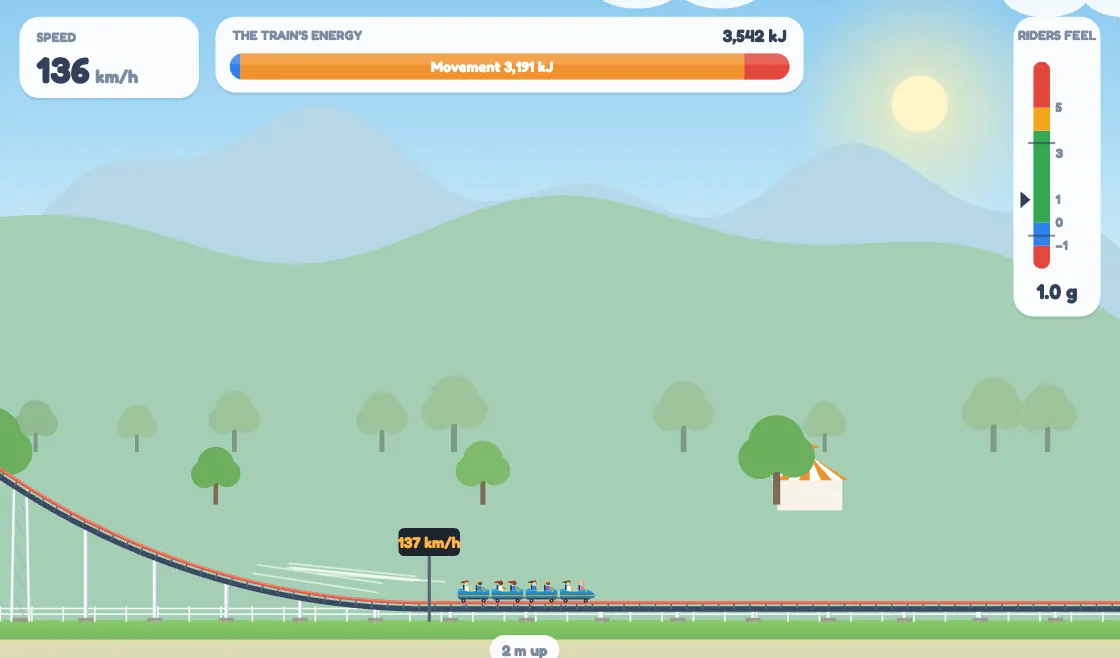
Full or empty
A full train has more energy at the top, and needs more to move it at the bottom. The two balance, so full or empty, it reaches the same speed (a full one is a touch faster: the air holds it back less).
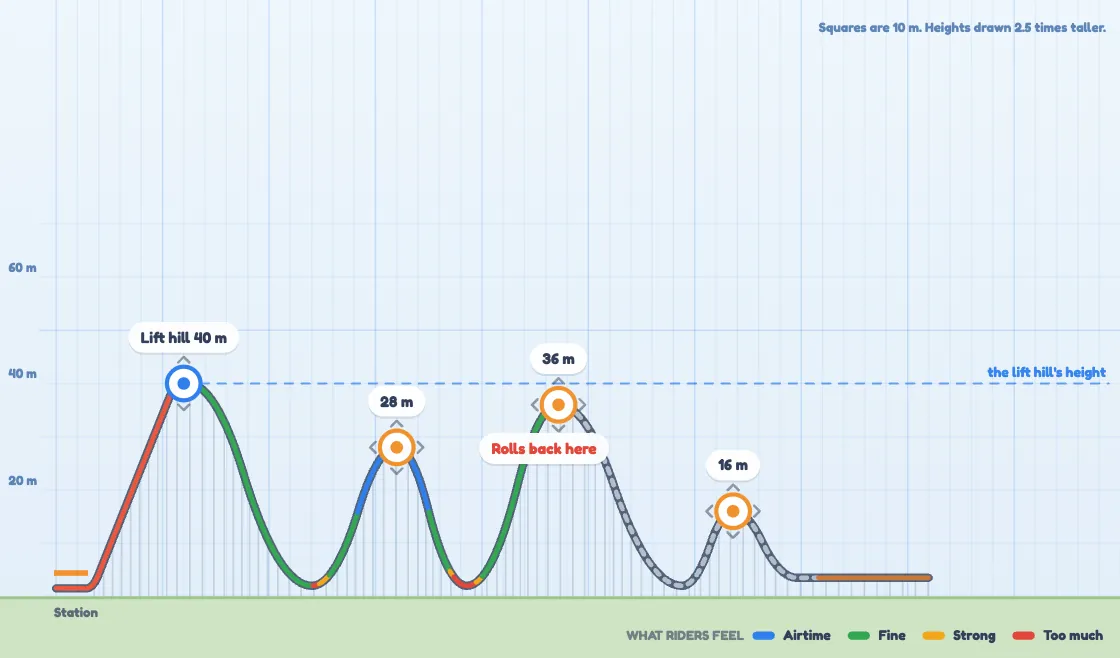
Never as high again
On every metre, friction and the air move a little energy into heat and sound. So each hill must be lower than the one before. Too high, and the train rolls back, or gets stuck between two hills.
What riders feel
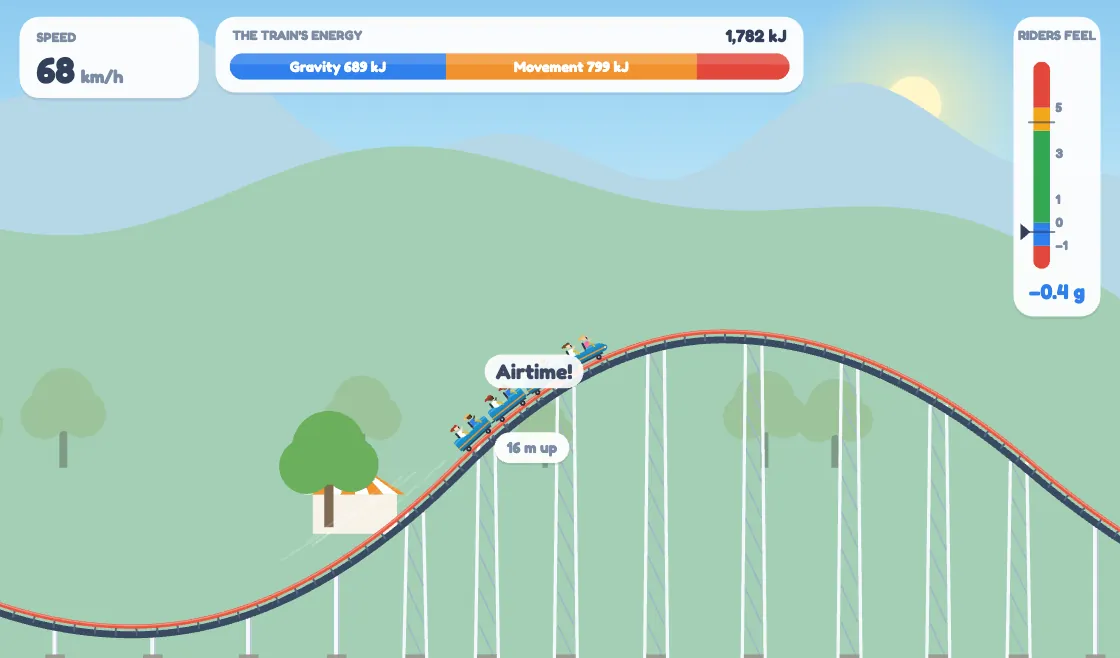
Sitting still you feel 1 g. At the bottom of a dip you're pressed into your seat: 3 g feels three times as heavy. Over a hilltop you float up: that's airtime. Most coasters keep riders under 5 g.
Why loops are teardrops
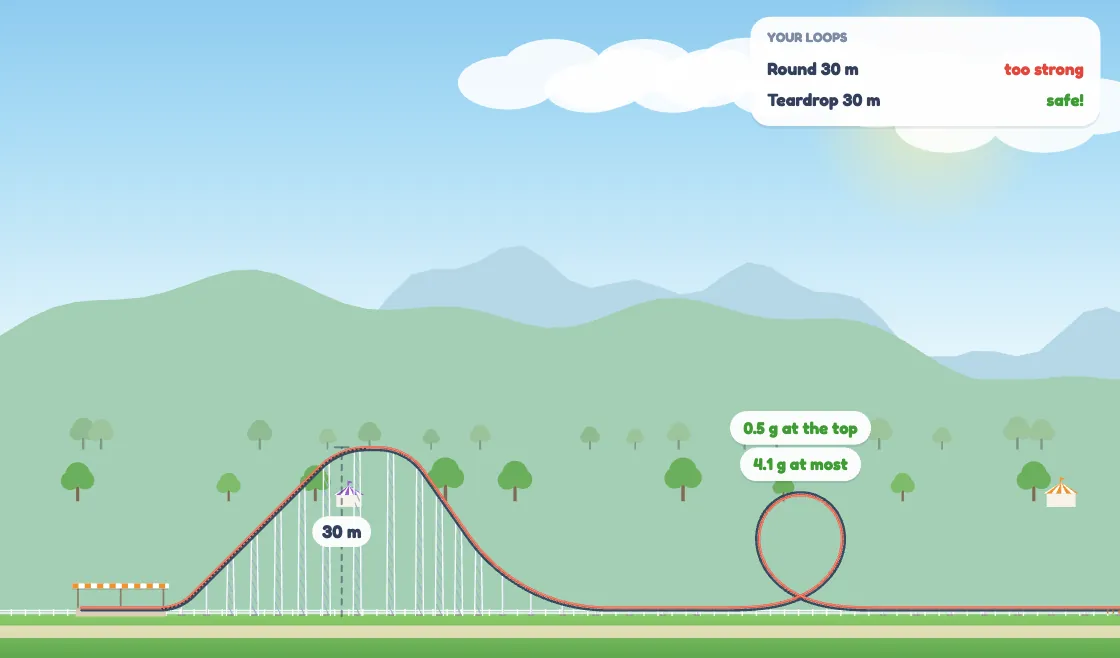
In 1895 a coaster at Coney Island, New York, had a round loop. It jolted riders so hard that some hurt their necks. Since 1976, loops are teardrops: gentle at the bottom, where the train is fastest, tight at the top, where it's slowest.
Inside the lab
8 missions in 4 parts: The first drop, The loop, Your coaster, Bonus. Each one is something to try for yourself, with the science behind it once you’ve done it.
- First dropSend the train down the first drop.The chain lift fills the train's gravity store. On the way down, that store empties into its kinetic (movement) store: height turns into speed.
- Twice as fastFind the hill that makes the train twice as fast as the 20 m hill.The kinetic store grows with the square of the speed. Twice the speed needs four times the energy, so four times the height.
- Full or emptySend a full train and an empty train down the same hill.Both stores grow with mass, so a heavier train gains more energy falling, and needs more to move. They balance: it reaches the same speed, carrying more energy.
- Loop the loopGet round the loop with riders pressed into their seats at the top, and no more than 5 g at the bottom.A round loop can't do both: fast enough for the top means far too fast for its tight bottom. A teardrop is gentle where the train is fastest and tight where it's slowest.
- Pass inspectionTest a coaster that gets home safely: never over 5 g, never under −1 g.A ride inspector checks the forces riders feel all the way round. Spreading a dip out softens it; squeezing it up makes it stronger.
- Airtime!Pass the inspection with at least two moments of airtime.Over a hilltop, the track drops away faster than the riders would fall, so they float up off their seats. Each hill must be lower than the last: some energy leaves as heat and sound on every metre.
- Loop itPass the inspection with a loop in your coaster.Real designers fit the loop to the speed: start too high and the loop squashes the riders, too low and they hang at the top.
- Speed recordPass the inspection going faster than 105 km/h.More speed needs a higher lift hill, and then every dip must be stretched out to keep the g-forces safe. That's why record coasters are so long.
How the quest works
- Predict. Coco asks the mystery and you lock in an answer.
- Learn. A short, picture-led story of the big ideas (6 slides).
- Experiment. 8 missions in the lab, each one yours to try.
- Final Challenge. 8 questions that check you can use what you found, then the mystery’s answer.
For teachers
Present it live on the board while your class follows on their own screens. It fits one class period: about 7 minutes of Learn, 24 in the lab and 7 for the Final Challenge.
Students can
- describe the energy transfers on a roller coaster: the lift motor fills the gravity store, the drop moves it into the kinetic store, and friction, the air and the brakes move it into thermal stores.
- use evidence to show that the speed at the bottom of a drop depends on its height, and that four times the height gives twice the speed, because kinetic energy depends on the square of the speed.
- explain why a full and an empty train reach about the same speed, while the full one has more kinetic energy.
- design and test a ride against criteria (gets home, between −1 g and 5 g, at least two moments of airtime) and improve it one change at a time.
NGSS: MS-PS3-1, MS-PS3-2, MS-PS3-5, HS-PS3-2.
Teacher notes for Roller Coaster DesignerQuestions people ask
What is Roller Coaster Designer?
Roller Coaster Designer is an interactive roller coaster energy simulation from Thinkodile for ages 11 to 14. Trade height for speed down a real-size drop, loop the loop safely, then design a coaster that thrills without hurting anyone. It opens with a mystery to predict, explains the big ideas in a short Learn story, lets you run the experiments yourself in the lab, and ends with a Final Challenge.
Is Roller Coaster Designer free?
Roller Coaster Designer is part of Thinkodile Plus for families and Teacher Pro for teachers. A free account includes 6 quests: Photosynthesis, Build a Cell, Build an Electromagnet, Particles in Motion, Dissolving, Moon Phases Explorer. A parent or teacher creates the account; children never sign up themselves.
How long does Roller Coaster Designer take?
About 38 minutes for a class working through it together: around 7 minutes for the Learn story, 24 in the lab and 7 for the Final Challenge. At home you can stop and pick it up again later.
Which curriculum does Roller Coaster Designer cover?
In the US it supports the Next Generation Science Standards MS-PS3-1, MS-PS3-2, MS-PS3-5, HS-PS3-2. It's organised by topic, not by grade, so it fits other syllabuses too.
Does Roller Coaster Designer work on phones, tablets and Chromebooks?
Yes. It runs in the web browser on laptops, Chromebooks, tablets and phones, with nothing to install. On a phone the lab plays sideways, so turn the phone on its side.
Keep exploring Energy
- Chain Reaction Machine: Follow a ball's energy, tip a giant domino with one tap, then build a machine of ramps, dominoes, pulleys and springs to ring a bell.
- Bounce Lab: Drop balls on different floors and find where the energy goes as the bounces die away.
- All of Energy