
Crash LabAn interactive momentum, collisions and crumple zones simulation for ages 11 to 14
Crash gliders that bounce, stick and push apart, and follow their momentum. Then crash an egg-driven cart and design a crumple zone that saves it.
Part of Thinkodile Plus · about 34 minutes · plays in the browser
The mystery
Modern cars are designed so that their fronts crumple up in a crash. Why would anyone build a car to crumple?
Every quest starts with a prediction. Lock yours in, then run the experiments to find out who was right.
What you’ll learn
Momentum
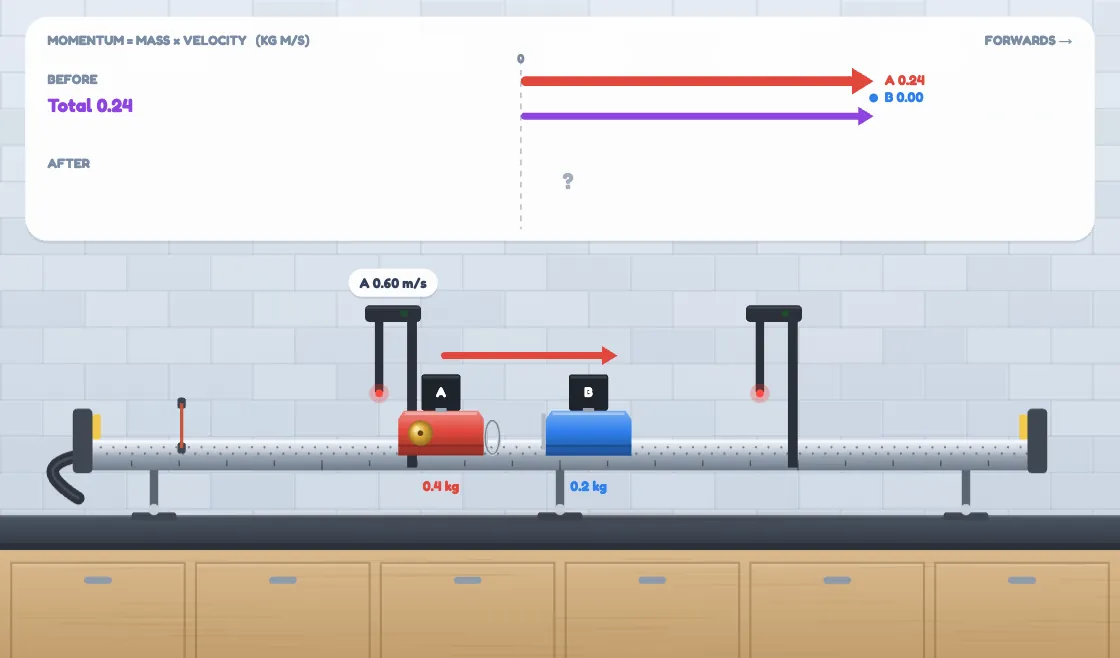
Anything moving has momentum: its mass times its velocity. A 0.2 kg glider at 0.6 m/s has 0.2 × 0.6 = 0.12 kg m/s. Direction matters: we count forwards as plus and backwards as minus.
Never lost
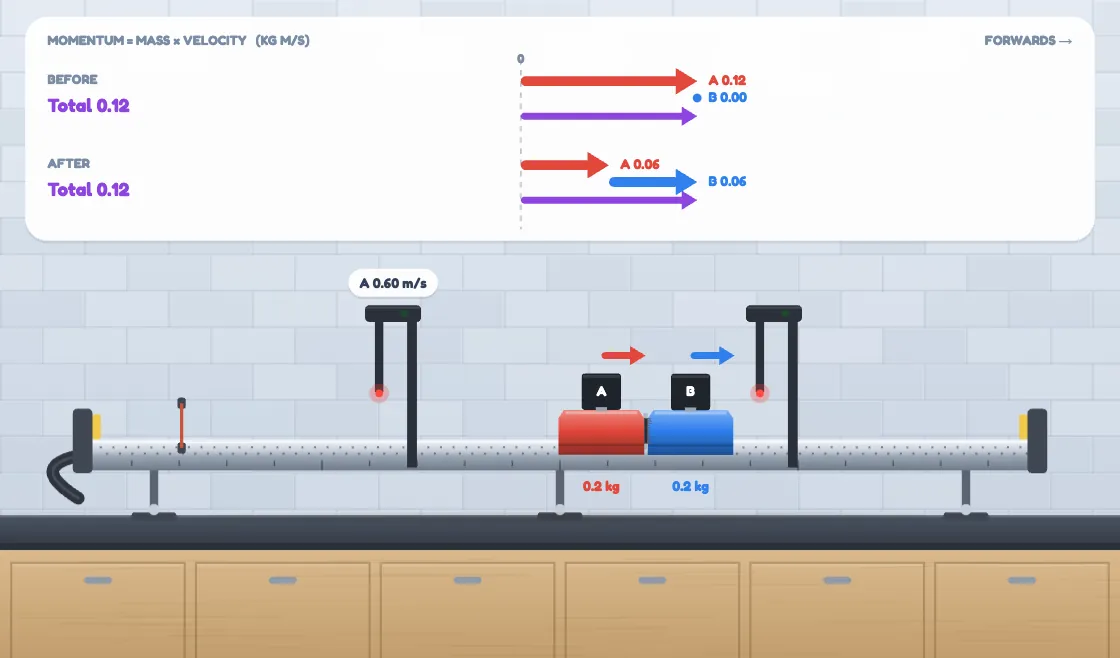
When things collide, the total momentum afterwards is the same as before, as long as nothing outside pushes on them. Two equal gliders that stick together move off at half the speed: twice the mass, half the speed, the same momentum.
Equal and opposite
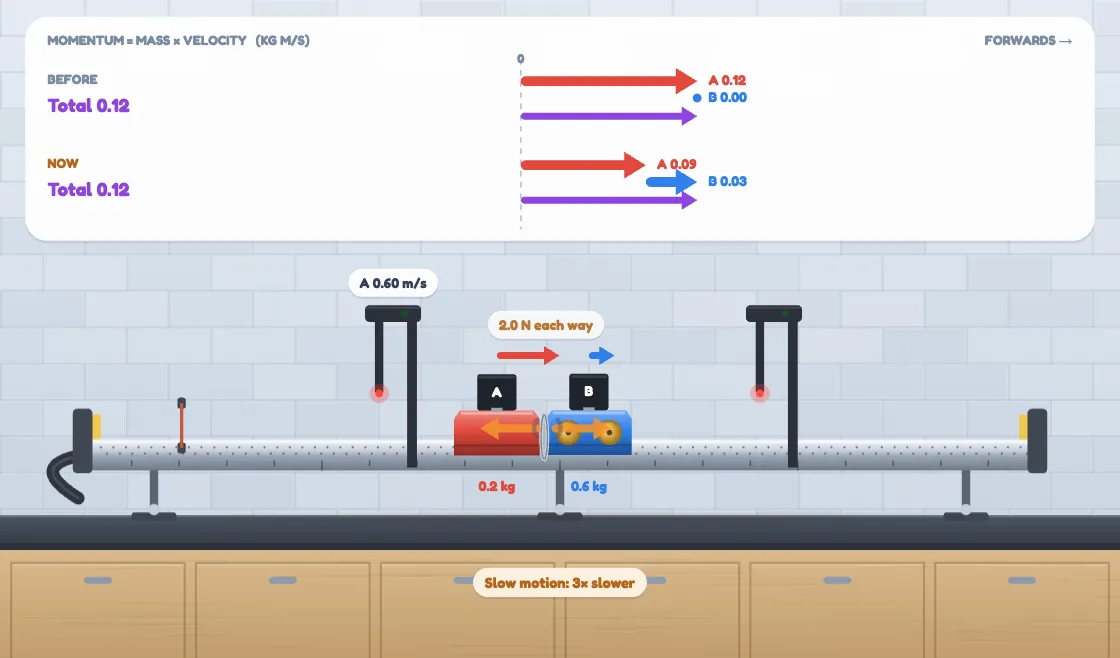
Why is it never lost? While they touch, each glider pushes the other exactly as hard, the opposite way, for exactly as long. Whatever momentum one gains, the other loses.
From zero to zero
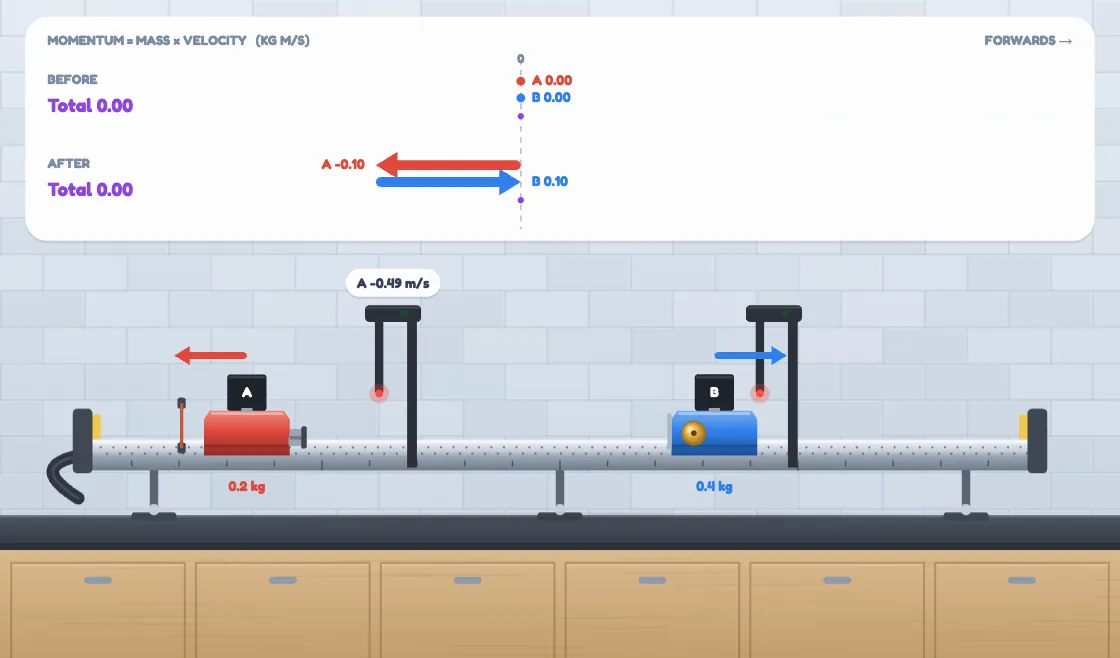
Two gliders pushed apart from rest start with a total of zero, and they still have zero: their momenta are equal and opposite. The lighter one moves off faster. That's why a gun kicks back and a rocket flies.
Force and time
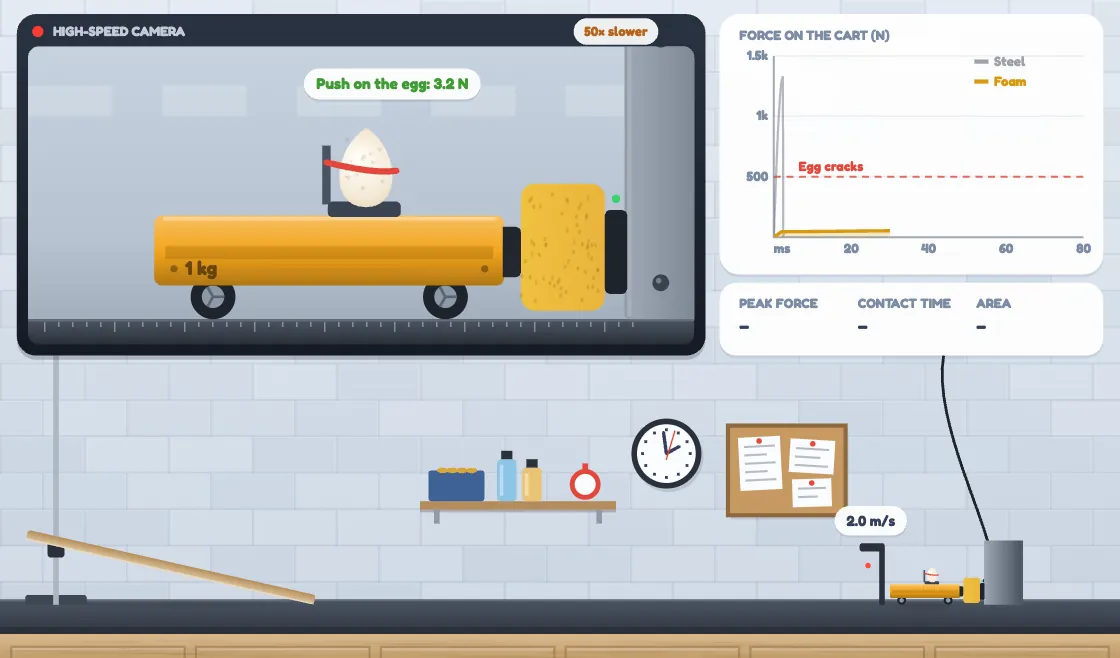
Changing momentum takes a force acting for a time: force × time = change in momentum. Take longer to stop, and the force is smaller. Same cart, same speed: steel stopped it in 2 ms with 1300 N, foam in 44 ms with only 54 N.
Crumple zones
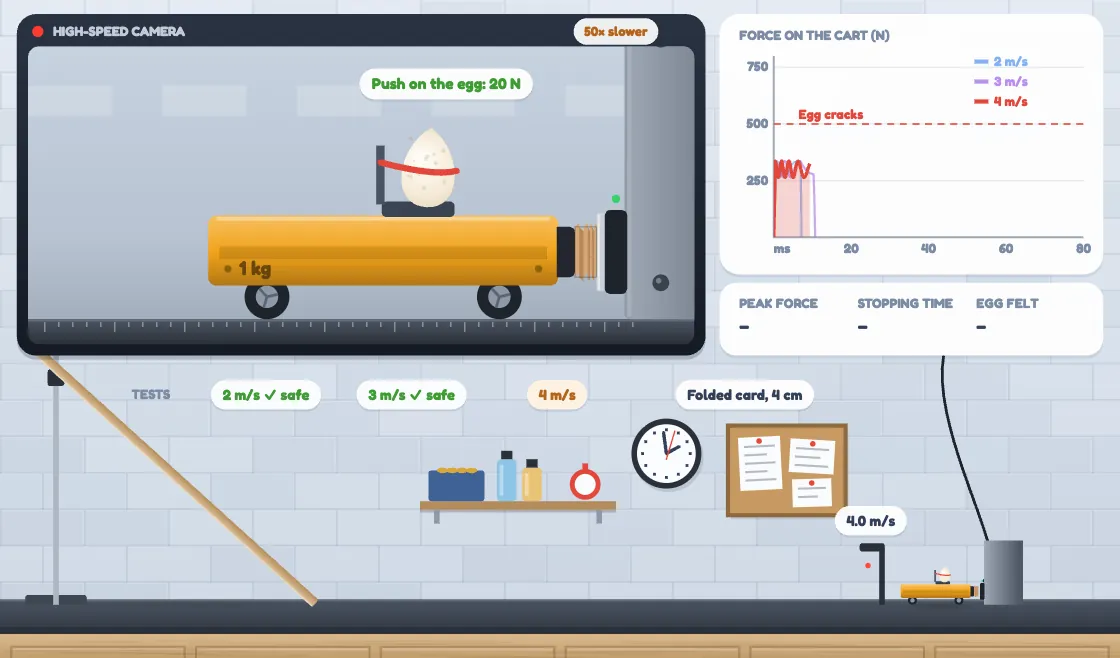
Crumple zones, seatbelts, airbags, cycle helmets and crash mats all make a stop take longer. A crumple zone must also crush at the right force and be long enough: too soft and it's crushed flat before the car stops.
Inside the lab
8 missions in 4 parts: Air track, Crash wall, Crumple zone, Bonus. Each one is something to try for yourself, with the science behind it once you’ve done it.
- Stuck togetherSet the bumpers to Stick and launch A into B.Stuck together, more mass moves off more slowly: two equal gliders share the speed half each. The total momentum is the same before and after. Some movement energy went into heat and sound in the Velcro, but no momentum was lost.
- A perfect passWith the bouncy springs and two gliders of the same mass, launch A into B.A stops dead and B moves off at A's speed: A hands over all of its momentum. That's what the balls in a Newton's cradle do.
- From zero to zeroChoose Push apart and two gliders of different masses, then cut the thread.The total was zero before and it's still zero after: one glider's momentum forwards exactly cancels the other's backwards. The lighter glider moves off faster. That's why a gun kicks back and a rocket flies.
- Crack!Crash the cart into the steel wall.Steel hardly gives, so the cart stopped in about 2 thousandths of a second. Stopping that fast took a huge push: about 1300 N on the cart, and 80 N on the egg. It cracked.
- Soft landingCrash the cart into the foam, at the same speed.The cart lost the same momentum, but the foam made the stop last about 20 times longer, so the push was about 25 times smaller. The egg was fine. The area under each graph is the same: it's the change in momentum.
- Crumple zoneDesign a nose that saves the egg at 2, 3 and 4 m/s.A good crumple zone crushes at a steady force the passenger can survive, and it's long enough to stop the car before it's crushed flat. Too soft, and it runs out before the car stops. Too stiff, and the stop is too sudden.
- Bounce backCrash the cart into the spring.The cart bounced back at almost its own speed, so its momentum went from +2 to −1.9 kg m/s: a change of 3.9, nearly twice as much as stopping. The area under the graph nearly doubled. Bouncing makes a crash worse, so crumple zones crush and stay crushed.
- Short noseSave the egg at all three speeds with a nose 4 cm long or less.Folded card crushes at a steady 300 N or so: nearly as hard as the egg can take (500 N on the cart) but never more, so it stops the cart in the least room. Car makers face the same puzzle: a short car front has to crush as firmly as the people inside can stand.
How the quest works
- Predict. Coco asks the mystery and you lock in an answer.
- Learn. A short, picture-led story of the big ideas (6 slides).
- Experiment. 8 missions in the lab, each one yours to try.
- Final Challenge. 8 questions that check you can use what you found, then the mystery’s answer.
For teachers
Present it live on the board while your class follows on their own screens. It fits one class period: about 6 minutes of Learn, 22 in the lab and 6 for the Final Challenge.
Students can
- calculate momentum as mass × velocity in kg m/s, and treat its direction as a sign: forwards plus, backwards minus.
- show from measurements that the total momentum is the same before and after a collision (bouncing or sticking) and an explosion from rest, and explain why using Newton's third law.
- use force = change in momentum ÷ time, read the area under a force-time graph as the change in momentum, and explain why a longer stop means a smaller force.
- design and test a crumple zone against criteria (the egg survives at 2, 3 and 4 m/s), and explain the trade-off between how hard it crushes and how long it is.
NGSS: MS-PS2-1, HS-PS2-2, HS-PS2-3, MS-ETS1-4.
Teacher notes for Crash LabQuestions people ask
What is Crash Lab?
Crash Lab is an interactive momentum, collisions and crumple zones simulation from Thinkodile for ages 11 to 14. Crash gliders that bounce, stick and push apart, and follow their momentum. Then crash an egg-driven cart and design a crumple zone that saves it. It opens with a mystery to predict, explains the big ideas in a short Learn story, lets you run the experiments yourself in the lab, and ends with a Final Challenge.
Is Crash Lab free?
Crash Lab is part of Thinkodile Plus for families and Teacher Pro for teachers. A free account includes 6 quests: Photosynthesis, Build a Cell, Build an Electromagnet, Particles in Motion, Dissolving, Moon Phases Explorer. A parent or teacher creates the account; children never sign up themselves.
How long does Crash Lab take?
About 34 minutes for a class working through it together: around 6 minutes for the Learn story, 22 in the lab and 6 for the Final Challenge. At home you can stop and pick it up again later.
Which curriculum does Crash Lab cover?
In the US it supports the Next Generation Science Standards MS-PS2-1, HS-PS2-2, HS-PS2-3, MS-ETS1-4. It's organised by topic, not by grade, so it fits other syllabuses too.
Does Crash Lab work on phones, tablets and Chromebooks?
Yes. It runs in the web browser on laptops, Chromebooks, tablets and phones, with nothing to install. On a phone the lab plays sideways, so turn the phone on its side.
Keep exploring Forces
- Push & Pull Arena: Play tug-of-war with balanced and unbalanced forces, push empty and loaded trolleys, then add up the arrows on a boat, a bike, a car and a skydiver.
- Friction Race: Roll a toy car over glass, sandpaper and sand, pull a brick with a spring balance, and race clay shapes through water.
- Gravity Drop: Drop heavy and light things from a balcony, drop a hammer and a feather on the Moon in 3D, and weigh a bag of rice on four worlds.
- All of Forces