
Push & Pull ArenaAn interactive balanced and unbalanced forces simulation for ages 11 to 14
Play tug-of-war with balanced and unbalanced forces, push empty and loaded trolleys, then add up the arrows on a boat, a bike, a car and a skydiver.
Part of Thinkodile Plus · about 33 minutes · plays in the browser
The mystery
Coco rides along a flat road at a steady 20 km/h: no faster, no slower. How does her push forward compare with the air resistance and friction holding her back?
Every quest starts with a prediction. Lock yours in, then run the experiments to find out who was right.
What you’ll learn
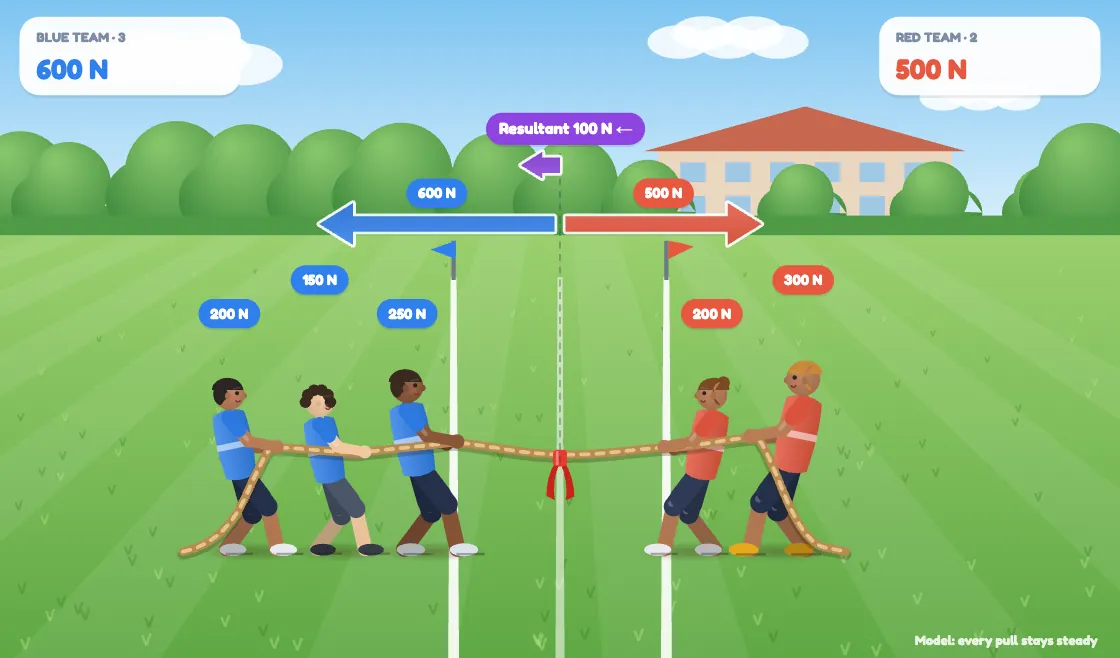
Pushes and pulls
A force is a push or a pull. It has a size, measured in newtons (N), and a direction, so we draw it as an arrow: the longer the arrow, the bigger the force.
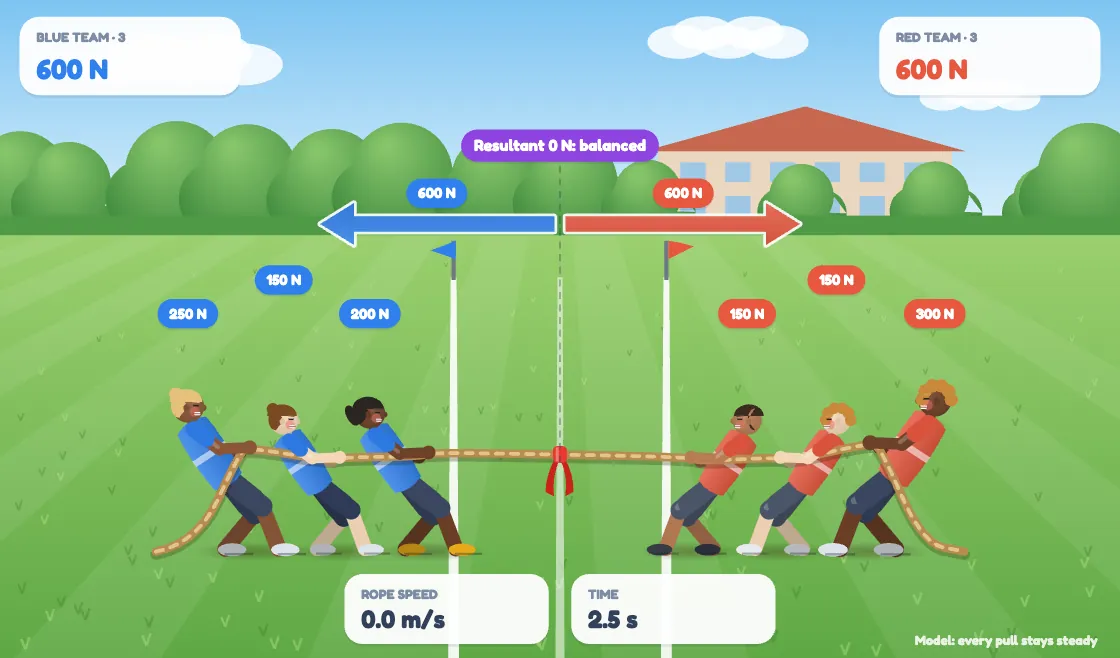
Balanced forces
When the forces on something are equal and opposite, they cancel out: the resultant force is zero. Balanced forces don't change motion, so the rope in a tug of war stays still.
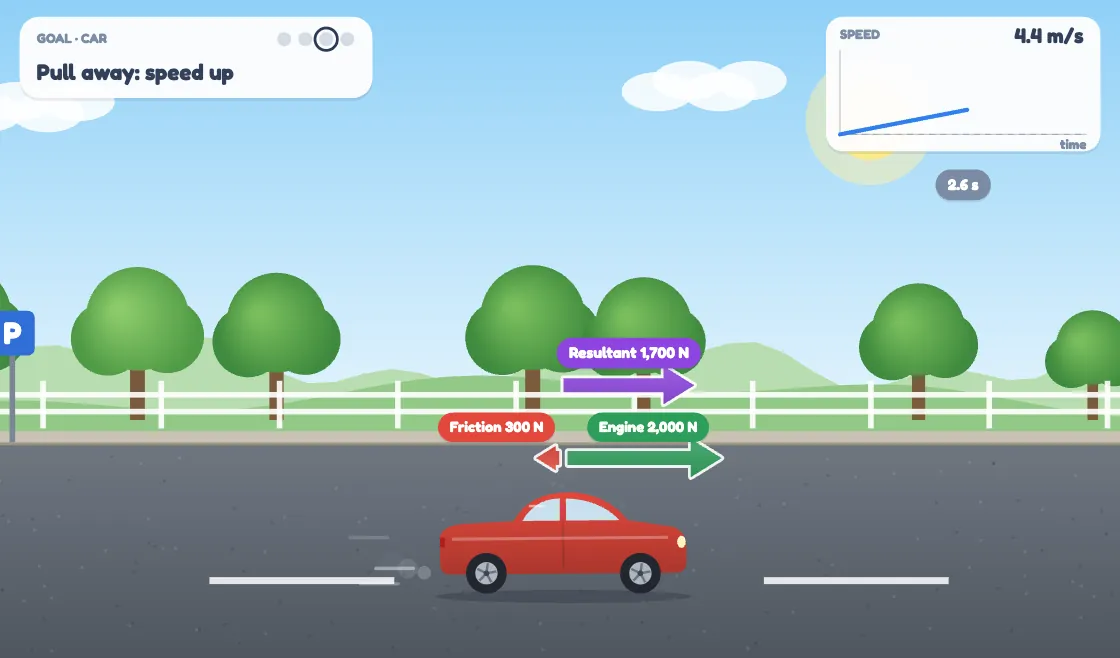
Unbalanced forces
Add up the arrows: forces the same way add, opposite ones take away. What's left is the resultant force. It speeds things up or slows them down, and the bigger it is, the faster the change.
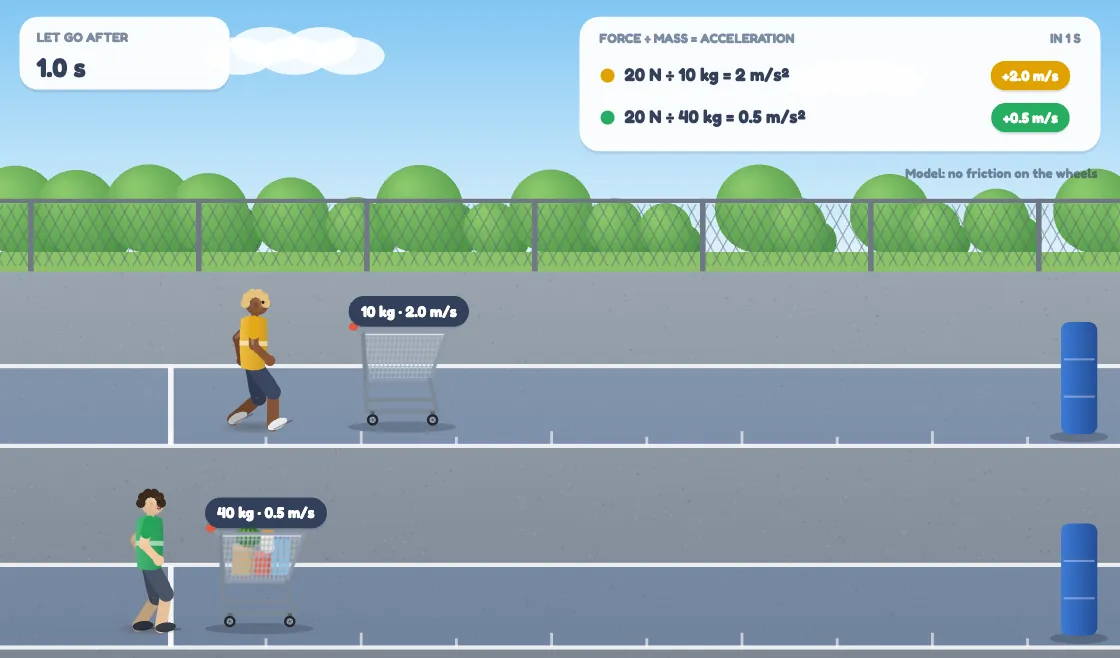
Force, mass and acceleration
The same push speeds up a light trolley more than a heavy one. Acceleration = force ÷ mass, in m/s²: the speed gained every second.
Balanced doesn't mean still
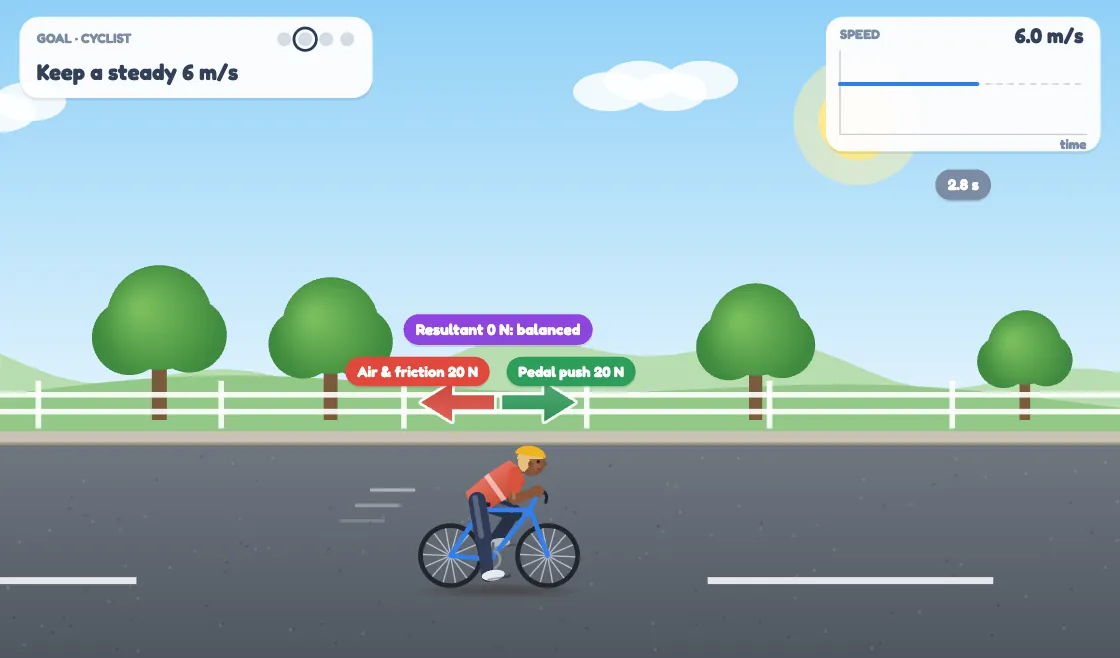
A cyclist riding at a steady speed has balanced forces: her push forward equals the air resistance and friction. With no resultant force, a moving thing keeps going at the same speed in the same direction.
Slowing down
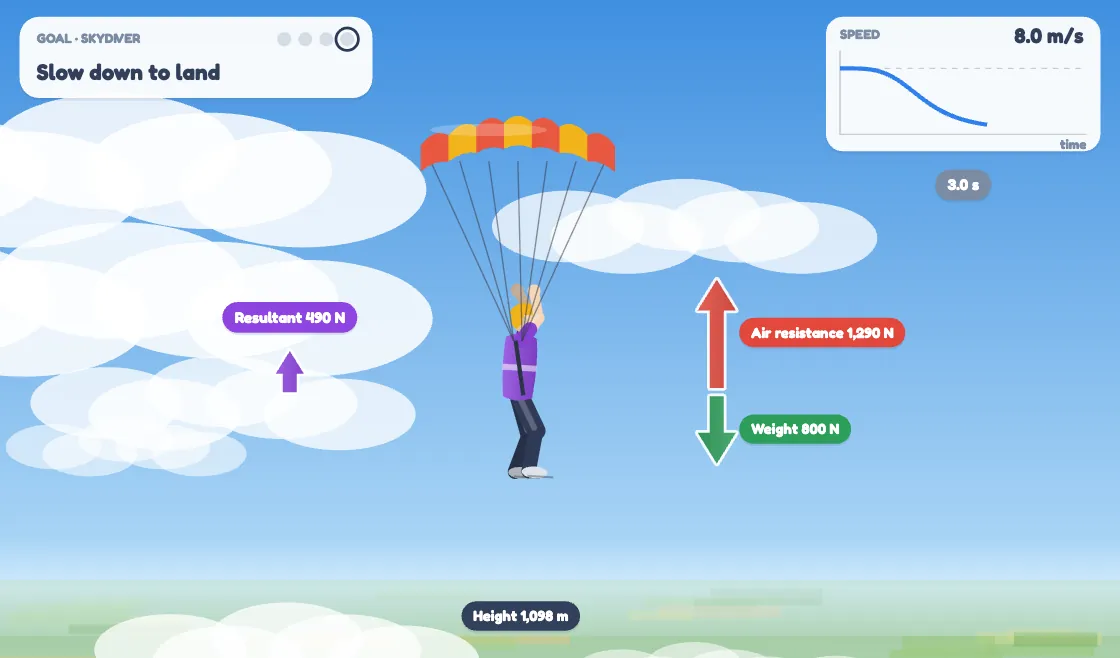
When the resultant force points against the motion, things slow down. A parachute makes the air resistance far bigger than the skydiver's weight, so she slows, but she's still falling, until the forces balance again at about 5 m/s.
Inside the lab
8 missions in 4 parts: Tug of war, Trolley push, Add the arrows, Bonus. Each one is something to try for yourself, with the science behind it once you’ve done it.
- StalemateMake both teams pull equally hard, then pull. Keep the ribbon still.Equal pulls in opposite directions cancel out: the resultant force is zero. Balanced forces don't change how something moves, so the rope stays still.
- Tip the balanceMake one team pull harder, and pull until a team wins.Unbalanced forces change motion. The rope sped up towards the stronger team, driven by the difference between the pulls: the resultant force.
- Same pushPush the empty and the loaded trolley with the same force.The loaded trolley has 4 times the mass, so the same force speeds it up only a quarter as fast. Acceleration = force ÷ mass.
- Catch upMake the loaded trolley speed up exactly as fast as the empty one.Four times the mass needs four times the force for the same acceleration: 80 N on 40 kg gives 2 m/s², just like 20 N on 10 kg.
- Steady riderMake the cyclist keep a steady 6 m/s.Her push forward equals the air resistance and friction, so the forces are balanced and her speed doesn't change. Balanced forces mean no change in motion, not no motion.
- Four motionsSolve all four: the boat, the cyclist, the car and the skydiver.Balanced forces: still things stay still and moving things keep a steady speed. Unbalanced forces: things speed up or slow down, in the direction of the resultant force.
- Fewer but strongerTap a puller to swap them. Win with fewer people than the other team.It's the total force that counts, not the number of people. Two strong pullers can beat three weaker ones.
- Big gapWin the tug of war with a resultant force of 200 N or more.A bigger resultant force gives a bigger acceleration: the rope speeds up faster, so the win comes sooner.
How the quest works
- Predict. Coco asks the mystery and you lock in an answer.
- Learn. A short, picture-led story of the big ideas (6 slides).
- Experiment. 8 missions in the lab, each one yours to try.
- Final Challenge. 8 questions that check you can use what you found, then the mystery’s answer.
For teachers
Present it live on the board while your class follows on their own screens. It fits one class period: about 7 minutes of Learn, 20 in the lab and 6 for the Final Challenge.
Students can
- describe a force as a push or a pull with a size in newtons and a direction, and draw it as an arrow.
- add forces along a line to find the resultant force, and say whether the forces are balanced or unbalanced.
- predict that balanced forces leave motion unchanged (still things stay still, moving things keep a steady speed) and that unbalanced forces make things speed up or slow down.
- use acceleration = force ÷ mass to compare how quickly an empty and a loaded trolley speed up.
NGSS: 3-PS2-1, MS-PS2-2. NCERT: Class 8, ch. 5 Exploring Forces.
Teacher notes for Push & Pull ArenaQuestions people ask
What is Push & Pull Arena?
Push & Pull Arena is an interactive balanced and unbalanced forces simulation from Thinkodile for ages 11 to 14. Play tug-of-war with balanced and unbalanced forces, push empty and loaded trolleys, then add up the arrows on a boat, a bike, a car and a skydiver. It opens with a mystery to predict, explains the big ideas in a short Learn story, lets you run the experiments yourself in the lab, and ends with a Final Challenge.
Is Push & Pull Arena free?
Push & Pull Arena is part of Thinkodile Plus for families and Teacher Pro for teachers. A free account includes 6 quests: Photosynthesis, Build a Cell, Build an Electromagnet, Particles in Motion, Dissolving, Moon Phases Explorer. A parent or teacher creates the account; children never sign up themselves.
How long does Push & Pull Arena take?
About 33 minutes for a class working through it together: around 7 minutes for the Learn story, 20 in the lab and 6 for the Final Challenge. At home you can stop and pick it up again later.
Which curriculum does Push & Pull Arena cover?
In the US it supports the Next Generation Science Standards 3-PS2-1, MS-PS2-2. In India it matches NCERT Class 8 Science, chapter 5: Exploring Forces. It's organised by topic, not by grade, so it fits other syllabuses too.
Does Push & Pull Arena work on phones, tablets and Chromebooks?
Yes. It runs in the web browser on laptops, Chromebooks, tablets and phones, with nothing to install. On a phone the lab plays sideways, so turn the phone on its side.
Keep exploring Forces
- Friction Race: Roll a toy car over glass, sandpaper and sand, pull a brick with a spring balance, and race clay shapes through water.
- Gravity Drop: Drop heavy and light things from a balcony, drop a hammer and a feather on the Moon in 3D, and weigh a bag of rice on four worlds.
- Crash Lab: Crash gliders that bounce, stick and push apart, and follow their momentum. Then crash an egg-driven cart and design a crumple zone that saves it.
- All of Forces