
Solar eclipses in 2027: dates, path, times and where to see them
The total solar eclipse of 2 August 2027 crosses Spain, North Africa and Arabia. Times, the path, what the UK, US and India see, and how to watch safely.

There are two solar eclipses in 2027. The big one is the total solar eclipse of Monday 2 August 2027: the Moon's shadow crosses southern Spain, North Africa and Arabia, and in Egypt the Sun stays completely hidden for up to 6 minutes 23 seconds. Earlier, on Saturday 6 February 2027, an annular "ring of fire" eclipse crosses South America and ends at sunset in West Africa.
There's no total or partial lunar eclipse in 2027, only three faint penumbral ones. Here's what happens, where and when, why eclipses come in seasons, and how to watch safely.
The 2027 eclipses at a glance
There are five eclipses in 2027: two solar and three lunar.
- 6 February: annular solar eclipse. A ring of fire over southern Chile, Argentina, the coast of Uruguay and the southern tip of Brazil, then West Africa at sunset.
- 20 February: penumbral lunar eclipse. The full Moon slips into the pale outer part of the Earth's shadow. Seen from Europe, Africa and much of Asia, and partly from the Americas.
- 18 July: penumbral lunar eclipse. The Moon only grazes the very edge of the shadow. You won't see any change.
- 2 August: total solar eclipse. Southern Spain, North Africa, Egypt and Arabia, with a partial eclipse across Europe, Africa, the Middle East and South Asia.
- 17 August: penumbral lunar eclipse. Best placed for the Americas, in the middle of the night.
Times here are in UTC (Universal Time). On 2 August, UK clocks (BST) are 1 hour ahead of UTC, Spain's 2 hours and India's 5½ hours.
When and where is the total solar eclipse of 2 August 2027?
It happens on Monday 2 August 2027. The Moon's dark shadow touches the Earth over the Atlantic at about 08:23 UTC and leaves it over the Indian Ocean at about 11:50 UTC, drawing a path of totality about 258 km wide. Greatest eclipse is at about 10:07 UTC, over Egypt.
Inside that path, the Sun is completely covered for a few minutes. Roughly, from west to east:
- Southern Spain and Gibraltar, at about 08:45 to 08:50 UTC (10:45 to 10:50 in Spain). Cádiz and Málaga lie near the northern edge of the path, so their totality is short: about 3 minutes in Cádiz and under 2 in Málaga. Gibraltar gets about 4½ minutes.
- Northern Morocco: Tangier, closer to the centre line, gets almost 5 minutes.
- Algeria, Tunisia and Libya, between about 08:50 and 09:40 UTC. Benghazi gets about 6 minutes.
- Egypt, around 10:00 UTC. Luxor, with its ancient temples, sits close to the centre line and gets about 6 minutes 20 seconds. The longest totality anywhere, 6 minutes 23 seconds, is in the desert of central Egypt.
- Saudi Arabia, around 10:25 UTC. Jeddah gets about 6 minutes.
- Yemen and the tip of Somalia, before the shadow heads out over the Indian Ocean.
Why the fuss? Totality is usually shorter. The April 2024 eclipse across North America gave at most 4 minutes 28 seconds; this one gives over 6 minutes, in places that are easy to reach. That's why it's been nicknamed the eclipse of the century.
Outside the path, far more people see a partial eclipse. The closer to the path, the bigger the bite out of the Sun: about 95% of the Sun is covered in Cairo, 86% in Madrid, 51% in Paris and 42% in London.
Can you see the 2027 eclipse from the UK, the US or India?
The UK and India see a partial eclipse. The United States sees almost nothing.
- UK: a morning partial eclipse. In London it starts at about 09:03 BST, peaks at about 10:00 BST with roughly 42% of the Sun covered, and ends at about 10:59 BST. Further north the bite is smaller: about 27% in Edinburgh.
- India: a late-afternoon partial eclipse, bigger in the south and west. About half the Sun is covered in Thiruvananthapuram, about 40% in Bengaluru and about a third in Chennai and Mumbai, but less than a tenth in Delhi and only a small bite in Kolkata. In Mumbai it runs from about 3:47 to 5:31 pm IST, peaking at about 4:40 pm.
- US: only the far eastern tip of Maine catches anything: a tiny bite out of the rising Sun, for a few minutes after 5 am EDT. The rest of the country sees nothing. Parts of Atlantic Canada see a little more at sunrise.
None of the three sees the February annular eclipse.
The ring of fire: 6 February 2027
On 6 February the Moon passes right in front of the Sun but is too far away to cover it, so a bright ring of Sun is left around its dark disc. That's an annular eclipse (from the Latin for "ring"). The Moon's orbit is slightly oval: near its farthest point the Moon looks a little smaller than the Sun and can't quite hide it; nearer, it covers the Sun completely and you get a total eclipse.
The ring is seen along a path that starts over the Pacific, crosses southern Chile and Argentina, touches the coast of Uruguay and the southern tip of Brazil, then runs across the South Atlantic and ends at sunset on the coast of West Africa, in Côte d'Ivoire, Ghana, Togo, Benin and Nigeria. Over the ocean off Uruguay and southern Brazil the ring lasts nearly 8 minutes. Greatest eclipse is at about 16:00 UTC. Much of South America and western Africa sees a partial eclipse: about 82% of the Sun is covered in Buenos Aires and about 62% in Santiago.
There's no moment in an annular eclipse when it's safe to look without protection. Even the thin ring is far too bright.
Are there any lunar eclipses in 2027?
Yes, three, but all of them are penumbral, so there's no red "blood moon" in 2027.
The Earth's shadow has a dark middle, the umbra, and a paler outer part, the penumbra. In a total lunar eclipse the Moon goes deep into the umbra and turns coppery red. In a penumbral eclipse it only passes through the penumbra, so it dims slightly, often too little to notice.
- 20 February: the deepest of the three. At about 23:13 UTC nearly the whole Moon is in the penumbra; look for a faint shading on one edge. The UK and Europe see it in the evening, India in the early hours of 21 February.
- 17 August: about half the Moon dips into the penumbra, between about 05:24 and 09:03 UTC. That's the middle of the night in the Americas: roughly 1:30 to 5 am on the US East Coast.
- 18 July: the Moon barely touches the penumbra. Nothing to see.
For a real red Moon, wait for the total lunar eclipse of 31 December 2028.
Why don't we get an eclipse every month?
Because the Moon's orbit is tilted by about 5° to the Earth's orbit round the Sun. At most new and full moons, the Moon passes a little above or below the line from the Sun to the Earth, and the shadows miss.
5° sounds tiny, but the Moon is about 384,400 km away. At that distance, the tilt lets it pass up to about 34,000 km above or below the line, while the whole Earth is only about 12,700 km across. Most months, the shadow simply sails past.
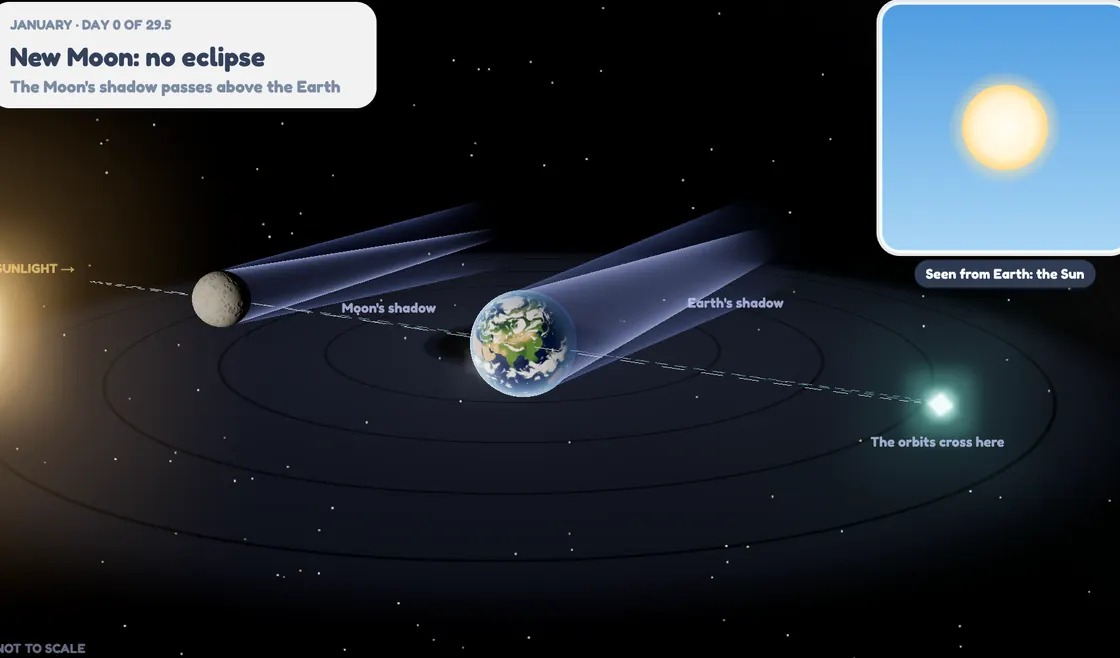
The two orbits cross at two points. An eclipse can only happen when a new or full moon falls close to one of those crossing points, and that only lines up for a few weeks at a time, about every 173 days. These windows are called eclipse seasons. Each one lasts about five weeks, longer than the 29½ days between one new moon and the next, so every eclipse season has at least one solar eclipse, often with a lunar eclipse two weeks before or after.
You can see this in the 2027 dates. February brings a solar eclipse (6 February) and a lunar one two weeks later (20 February). July and August bring three, two weeks apart: 18 July, 2 August and 17 August.
The seasons also creep earlier through the calendar each year, because the line where the orbits cross slowly turns. The summer eclipse was on 12 August in 2026, is on 2 August in 2027, and will be on 22 July in 2028. By the end of 2028 a third season has crept into the year: a total lunar eclipse on 31 December.
Eclipses need the Moon to be new (for a solar eclipse) or full (for a lunar eclipse). If phases are hazy, start with why the Moon changes shape.
What does totality look like?
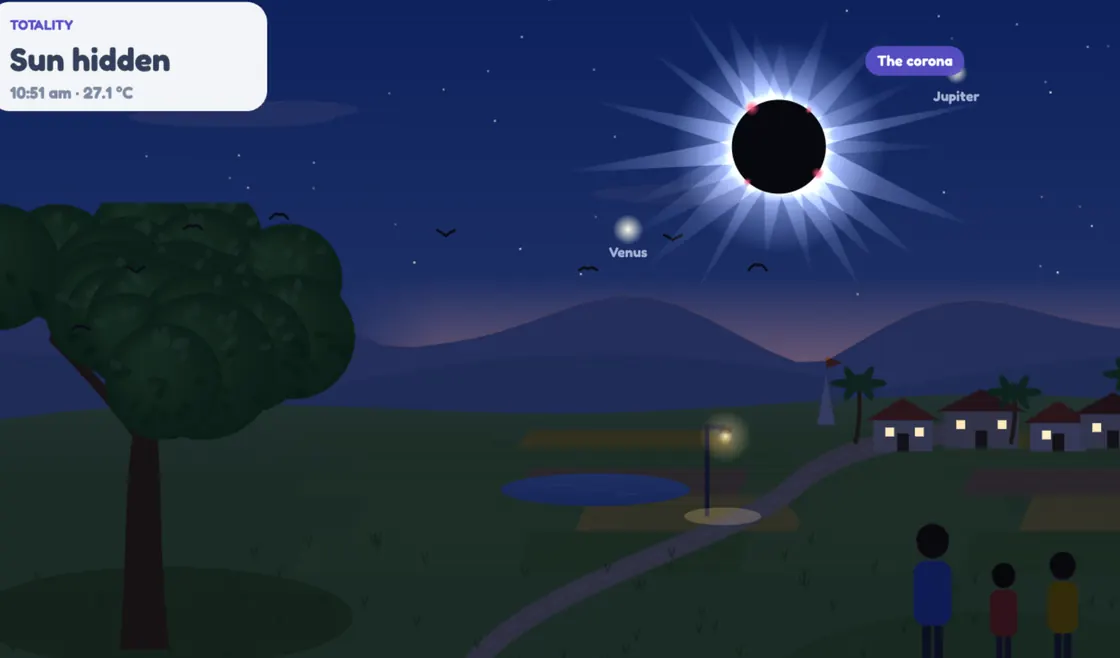
In totality the sky goes dark enough for bright stars and planets to appear, the air cools, birds go quiet, and the Sun's faint outer atmosphere, the corona, normally lost in the glare, shines out around the black Moon. The lead-up surprises people too: even with half the Sun covered it's still bright daylight, and the light only fades fast near the end. In the last seconds, a final bead of sunlight shines through a valley on the Moon's edge, like a diamond on a ring.
How to watch the 2027 eclipses safely
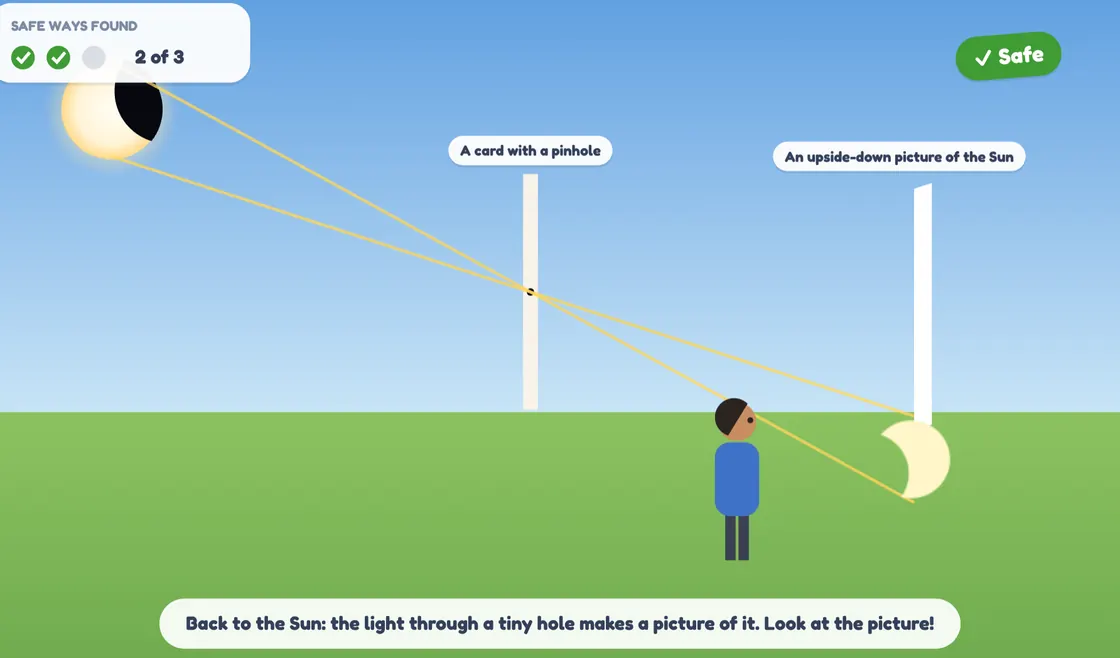
Never look straight at the Sun without proper protection, even when most of it is covered. Use eclipse glasses that meet the ISO 12312-2 standard, or project an image of the Sun with a pinhole. Sunglasses, even very dark ones, are not safe.
- Eclipse glasses: buy them from a reputable supplier, because fakes can carry a printed ISO label too (the American Astronomical Society keeps a list of suppliers it has checked). Don't use them if they're scratched, torn or loose. Grown-ups should supervise children wearing them.
- Cameras, binoculars and telescopes: never look at the Sun through any of them unless a proper solar filter is fitted to the front. Don't wear eclipse glasses behind them either: the concentrated light can burn through the filter and into your eye.
- A pinhole projector: make a small, neat hole in a piece of card. Stand with your back to the Sun and let the light fall through the hole onto a second card. You'll see a small, upside-down picture of the Sun, with the Moon's bite out of it. Look at the picture, never through the hole. A kitchen colander, or the gaps between leaves on a tree, make dozens of little crescents in the same way.
- Totality only: inside the path of totality, you can take your glasses off for the minutes when the Sun is completely covered, and must put them back the moment any bright Sun reappears. Anywhere outside the path, including the UK and India, keep protection on the whole time.
Sun damage to the back of the eye doesn't hurt, so you may not notice it until later.
Try it in the Eclipse Lab
Thinkodile's Eclipse Lab has three stations. First, you see the Sun, the Earth and the Moon in 3D with both their shadows, and move the Moon round its tilted orbit and change the month until a shadow lands: a total solar eclipse, a total lunar eclipse, then a new moon with no eclipse at all. Next, you stand where the Moon's shadow falls and watch the daylight, the temperature and the sky change as the Moon slides over the Sun. Last, you try five ways of watching (just looking, sunglasses, eclipse glasses, a pinhole viewer and the shade of a tree) and find the three safe ones. Bonus missions: make a ring of fire, and stop the Moon at the diamond ring.
The Eclipse Lab is part of Thinkodile Plus. Moon Phases, in the same Earth, Moon & Sun topic, is one of the six quests in the free account.
In short
- The total solar eclipse of 2 August 2027 crosses southern Spain, North Africa and Arabia, with up to 6 minutes 23 seconds of totality in Egypt.
- The UK and India see a partial eclipse; the US sees almost nothing.
- The annular eclipse of 6 February 2027 makes a ring of fire over South America and West Africa.
- 2027's three lunar eclipses are all penumbral and faint.
- Eclipses come in seasons because the Moon's orbit is tilted by about 5°. Never look at the Sun without ISO 12312-2 glasses or a pinhole projector.
Questions people ask
Can I see the 2027 solar eclipse from the UK?
Yes, but only as a partial eclipse. On the morning of Monday 2 August 2027 the Moon covers about 42% of the Sun as seen from London, with the peak at about 10:00 BST; the eclipse runs from about 09:03 to 10:59 BST. Scotland sees less, about 27% in Edinburgh. Use ISO 12312-2 eclipse glasses or a pinhole projector the whole time.
Will the August 2027 solar eclipse be visible in India?
Yes, as a partial eclipse in the late afternoon of 2 August 2027, roughly between 3:35 and 5:55 pm IST depending on where you are. The south and west see most: about half the Sun is covered in Thiruvananthapuram and about a third in Mumbai and Chennai, but less than a tenth in Delhi. Totality is not visible anywhere in India.
Can you see the 2 August 2027 eclipse from the United States?
Practically, no. Only the far eastern tip of Maine catches a tiny bite out of the Sun as it rises, for a few minutes after 5 am EDT, and the rest of the country sees nothing. The nearest totality is in southern Spain and Morocco. The Americas do get a faint penumbral lunar eclipse in the early hours of 17 August 2027.
Is there a total lunar eclipse in 2027?
No. All three lunar eclipses in 2027, on 20 February, 18 July and 17 August, are penumbral: the Moon only passes through the pale outer part of the Earth's shadow, so it dims slightly and doesn't turn red. The next total lunar eclipse is on 31 December 2028, with partial lunar eclipses on 12 January and 6 July 2028.
Why is the 2 August 2027 eclipse called the eclipse of the century?
Because its totality is unusually long. In central Egypt the Sun stays completely hidden for up to 6 minutes 23 seconds, and the path crosses places that are easy to reach, from southern Spain to Luxor and Jeddah. For comparison, the April 2024 total eclipse across North America gave at most 4 minutes 28 seconds of totality.


