
Physical and chemical changes examples: 20 from everyday life
Physical and chemical changes examples, from melting ice to rusting iron. A physical change makes no new substance; a chemical change does. Here are 20.

A physical change alters how something looks, its shape, size or state, but makes no new substance. Melting ice, boiling water, dissolving sugar and cutting paper are all physical changes. A chemical change makes at least one new substance. Burning wood, rusting iron, cooking an egg and toasting bread are all chemical changes.
So the question to ask is "Has something new been made?", not "Can I undo it?". The two often give the same answer, but not always, as the tricky cases below show.
What's the difference between a physical and a chemical change?
In a physical change, the substance stays the same substance. Ice, liquid water and steam look very different, but they're all water, made of the same particles. Only the way the particles are arranged, or how fast they move, has changed.
In a chemical change, the particles themselves change. Their atoms are rearranged into new particles, making new substances with new properties: a different colour, smell, taste, texture or way of behaving. Ash isn't paper, and rust isn't iron.
10 examples of physical changes
- Ice melting. Melted ice is still water. Put it back in the freezer and it's ice again.
- Water boiling in a kettle. Steam is water as a gas. It turns back into liquid water when it cools.
- A bathroom mirror misting up. Water vapour in the air condenses into tiny drops of liquid water on the cold glass.
- Washing drying on a line. The water evaporates into the air as water vapour. The clothes and the water are both unchanged.
- Sugar dissolving in tea. The sugar is still there, which is why the tea tastes sweet. Here's why it dissolves faster in hot water.
- Chocolate melting. Melted chocolate is still chocolate, and it sets again in the fridge.
- Freezing juice into ice lollies. Frozen juice is still juice, just solid.
- Cutting paper or hair. Every piece is still paper, or still hair.
- Crushing a drinks can. It's a different shape, but it's still aluminium.
- Breaking a glass. The pieces are still glass.
10 examples of chemical changes
- Burning wood or paper. Burning turns it into ash, smoke, carbon dioxide and water vapour. You can't turn those back into paper.
- A candle burning. The wax reacts with oxygen in the flame, making carbon dioxide and water vapour. (The melting wax around the wick is a physical change: more on that below.)
- Toasting bread. Heat makes the sugars and proteins in the bread react, forming new brown substances with new flavours and smells. Scraping burnt toast won't make it bread again.
- Cooking an egg. Heat makes the proteins in the egg white unfold and link together, turning a runny, clear liquid into a firm, white solid.
- Baking a cake. Baking powder reacts to make bubbles of carbon dioxide gas, which make the cake rise, and the egg and flour set into something new.
- Iron rusting. Iron, oxygen and water make a new substance, rust. Here's why iron rusts and how to stop it.
- A cut apple going brown. Substances in the apple react with oxygen in the air, helped by an enzyme in the fruit, making new brown substances. Lemon juice slows it down.
- Milk going sour. Bacteria turn the sugar in milk into lactic acid, which makes the milk taste sour and go thick and lumpy.
- Baking soda and vinegar fizzing. They react to make new substances, including carbon dioxide gas: the bubbles.
- Digesting food. Chemicals called enzymes break your food down into new, smaller substances that your body can absorb.
What are the signs of a chemical change?
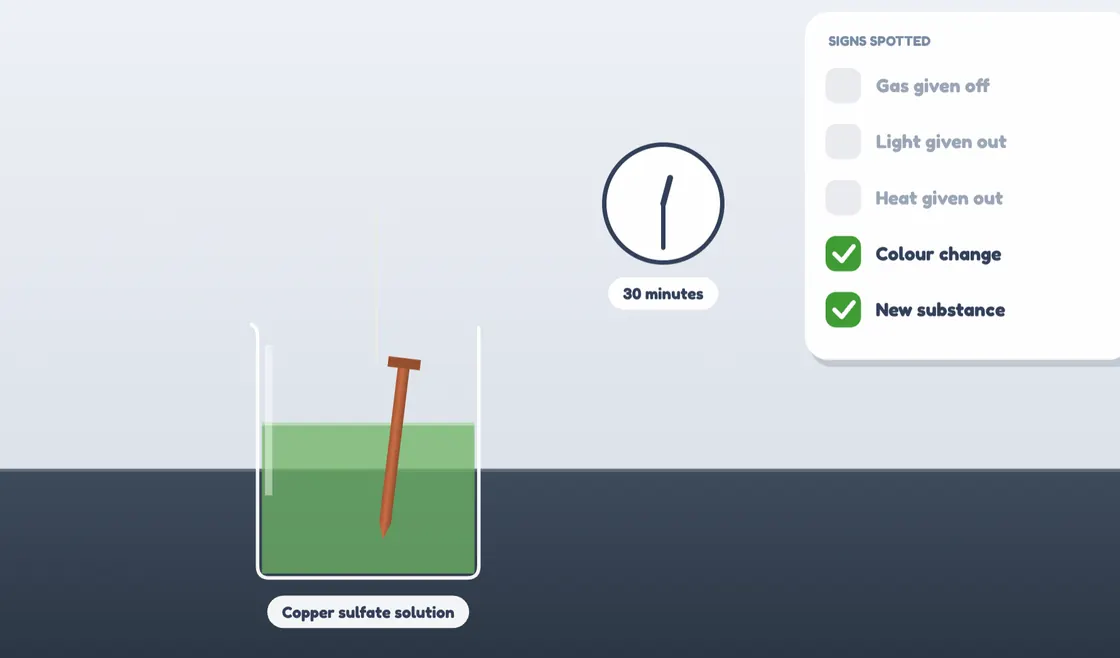
These are the clues that a chemical change might be happening:
- Gas given off, as bubbles, when nothing is boiling
- Light given out, such as a flame or a glow
- A temperature change on its own: getting hot or cold without being heated or cooled
- A colour change
- A new smell
- A solid appearing in a liquid, making it cloudy
They're clues, not proof. Boiling water bubbles, but that's a physical change. A hot iron bar glows red, but it's still iron. What proves a chemical change is a new substance, so scientists test for one. Limewater, for example, turns milky when carbon dioxide bubbles through it.
Is "can it be undone?" the right test?
Not quite. It's a useful rule of thumb, because physical changes are often easy to reverse and chemical changes usually aren't. But it goes wrong both ways.
Some physical changes can't be undone. You can't tape cut paper back into a single sheet, or uncrush a can perfectly, but no new substance has been made, so they're still physical changes.
And some chemical changes can be undone:
- Copper sulfate crystals. Heat blue copper sulfate crystals and they turn into a white powder as their water is driven off. Drip water back on and they turn blue again, getting warm as they do.
- A rechargeable battery. As a battery powers your phone, a chemical reaction runs inside it. Charging the phone runs that reaction backwards.
- Red cabbage indicator. Lemon juice turns it red. Add enough baking soda and it turns purple again, then blue-green. The colour changes because the substance that colours it changes from one form to another, back and forth. Here's how to make it.
Scientists have even "unboiled" an egg, sort of. In 2015, chemists at the University of California, Irvine, and Flinders University in Australia dissolved boiled egg white in a chemical called urea, then spun it in a special machine that untangled one of its proteins back into its working shape. They didn't turn a boiled egg raw again: they were looking for cheaper ways to make proteins for medicine and research. Cooking an egg is still a chemical change.
So the real test is always the same: has a new substance been made?
Is burning a candle a physical or chemical change?
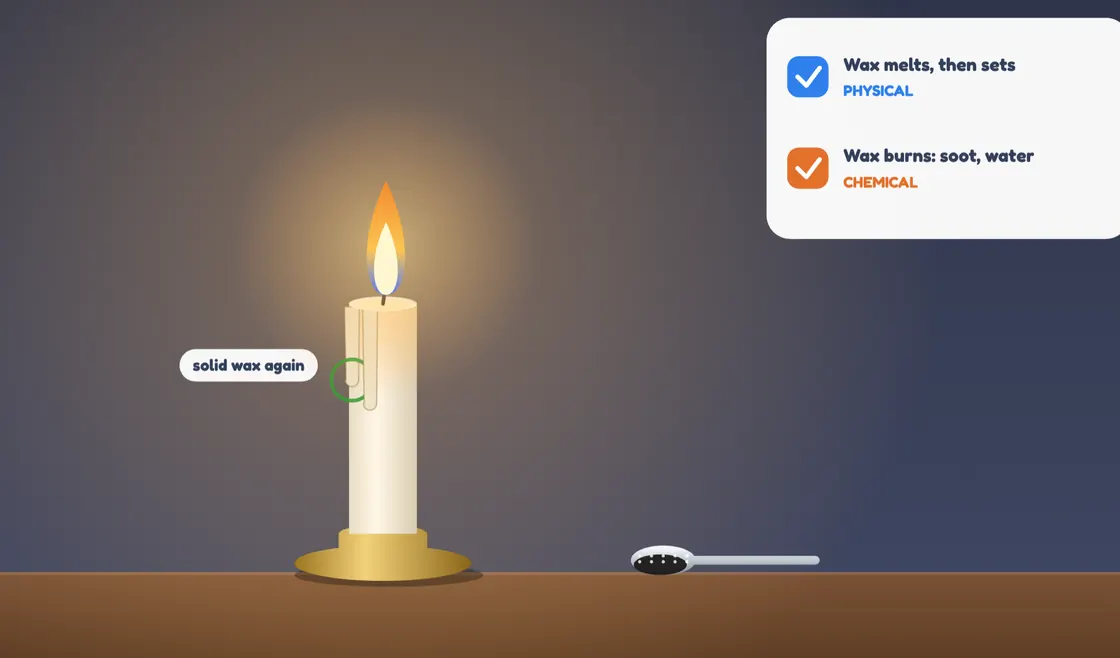
Both, at the same time. Near the flame, the wax melts and runs down the side of the candle, where it hardens again into solid wax. Melting and setting are physical changes: it's still wax.
But in the flame itself, wax vapour reacts with oxygen from the air, making carbon dioxide and water vapour. That's a chemical change, and it's what gives out the light and heat. When the wax doesn't burn completely, it also makes soot, which is mostly carbon. That's the black smudge you'd see on a cold spoon held near the flame.
Is dissolving a physical or chemical change?
Dissolving is a physical change. When sugar or salt dissolves in water, no new substance is made. The sugar or salt is still there, spread out in the water in particles too small to see, and you can get it back. Leave salty water on a saucer in a warm place and, as the water evaporates, salt crystals are left behind.
Try it: an "undo it" test at home
Make four changes, try to undo each one, and decide whether anything new was made. You'll need an ice cube, salt, a slice of bread, baking soda, vinegar, a small plastic bottle, a balloon, two saucers and a toaster.
- Ice. Leave an ice cube to melt on a saucer, then put the saucer in the freezer. What do you get back?
- Salt water. Stir a teaspoon of salt into a few spoonfuls of warm water. Pour a little onto a dark saucer and leave it on a sunny windowsill for a few days. What's left?
- Toast. Toast a slice of bread until it's brown, and let it cool. Can you get soft, white bread back? Smell it and compare it with the untoasted bread.
- Fizz. Put a teaspoon of baking soda in the bottle and stand it on a tray. Pour in a little vinegar, then quickly stretch the balloon over the neck. What fills the balloon? Can you get your baking soda back?
For each one, write down what changed, any signs of a chemical change you saw, and whether you could undo it. Then decide: physical or chemical? You should find that the ice and salt come back, while the toast and the fizz are gone for good. The toast and the fizz made new substances.
Stay safe: keep your face away from the bottle in the fizz test, and wash your hands if you get vinegar on them, because it stings eyes. Use the toaster carefully and don't touch the hot slots.
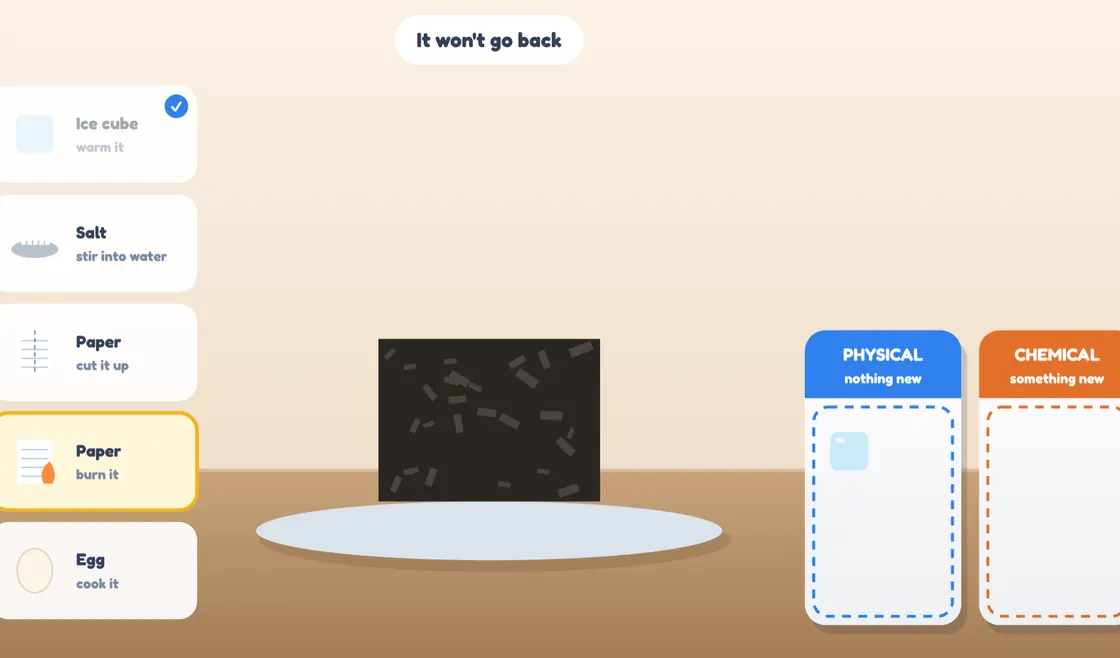
In the Undo It? quest, you can melt, cut, burn and cook things and try to change them back, sort each change as physical or chemical, look for the signs of a chemical change in three experiments, including burning magnesium and an iron nail in copper sulfate, and watch a candle melt and burn at the same time.
In short
- A physical change makes no new substance: only the shape, size or state changes. Melting, freezing, boiling, dissolving and cutting are physical changes.
- A chemical change makes at least one new substance. Burning, rusting, cooking, toasting and souring are chemical changes.
- Gas, light, a temperature change, a colour change or a new smell are signs of a chemical change, but they're clues, not proof.
- "Can it be undone?" isn't a reliable test. Cut paper can't be undone but is a physical change, and some chemical changes can be reversed.
- The real test is whether a new substance has been made.
Questions people ask
Is melting a physical or chemical change?
Melting is a physical change. When ice melts, it's still water, and when chocolate or butter melts, it's still chocolate or butter. No new substance is made: the particles just move more freely as the solid becomes a liquid. Cool it down again and it goes back to being a solid, which is typical of a physical change.
Is burning a chemical change?
Yes. Burning is a chemical change because it makes new substances. When paper or wood burns, it reacts with oxygen in the air, making ash, smoke, carbon dioxide and water vapour, and it gives out light and heat. You can't turn ash and smoke back into paper. A burning candle also shows a physical change: its wax melts before it burns.
Can chemical changes be reversed?
Usually not easily, but some can. Heating blue copper sulfate crystals turns them into a white powder, and adding water turns them blue again. Charging a rechargeable battery runs its chemical reaction backwards. Red cabbage indicator changes colour back and forth with acids and bases. That's why the test for a chemical change is whether a new substance is made, not whether it can be undone.
Is dissolving a physical or chemical change?
Dissolving is a physical change. When sugar or salt dissolves in water, no new substance is made: the sugar or salt is still there, spread out in particles too small to see, and the water still tastes sweet or salty. You can get it back by letting the water evaporate, which leaves the sugar or salt behind as crystals.
What are the signs of a chemical change?
The main signs are gas being given off as bubbles, light or a flame, a temperature change without heating or cooling, a colour change, a new smell, and a solid appearing in a liquid. These are clues rather than proof: boiling water bubbles but is a physical change. A chemical change is confirmed when a new substance with new properties has been made.


