
Why does iron rust? What causes rusting and how to stop it
Why does iron rust? It needs both oxygen and water. See the three-test-tube experiment, why salt speeds rusting up, and how paint, oil and zinc stop it.

Iron rusts because it reacts with oxygen from the air and with water. Together they turn hard, shiny iron into rust: a flaky, orange-brown substance called hydrated iron(III) oxide. Take away either the oxygen or the water, and the iron stays shiny.
What is rust?
Rust is a new substance, made when iron, oxygen and water react together. In words:
iron + oxygen + water → hydrated iron(III) oxide (rust)
"Hydrated" means water is built into it. (Chemists write rust as Fe₂O₃·xH₂O, where x, the amount of water, varies.) Only iron and steel rust, and steel is mostly iron. Other metals react with the air too, but we call that corrosion, not rusting.
The trouble with rust is that it doesn't protect the metal underneath. It's crumbly and full of tiny gaps, so air and water keep getting through, and it flakes away to uncover fresh iron. That's why a rusty gate keeps on rusting. Aluminium is different: it reacts with the air too, but its oxide forms a thin, tight skin that seals the metal in.
Does iron need both air and water to rust?
Yes. Iron needs oxygen (from the air) and water at the same time. The classic way to show this is the three-test-tube experiment, a neat fair test in which each tube takes away one thing.
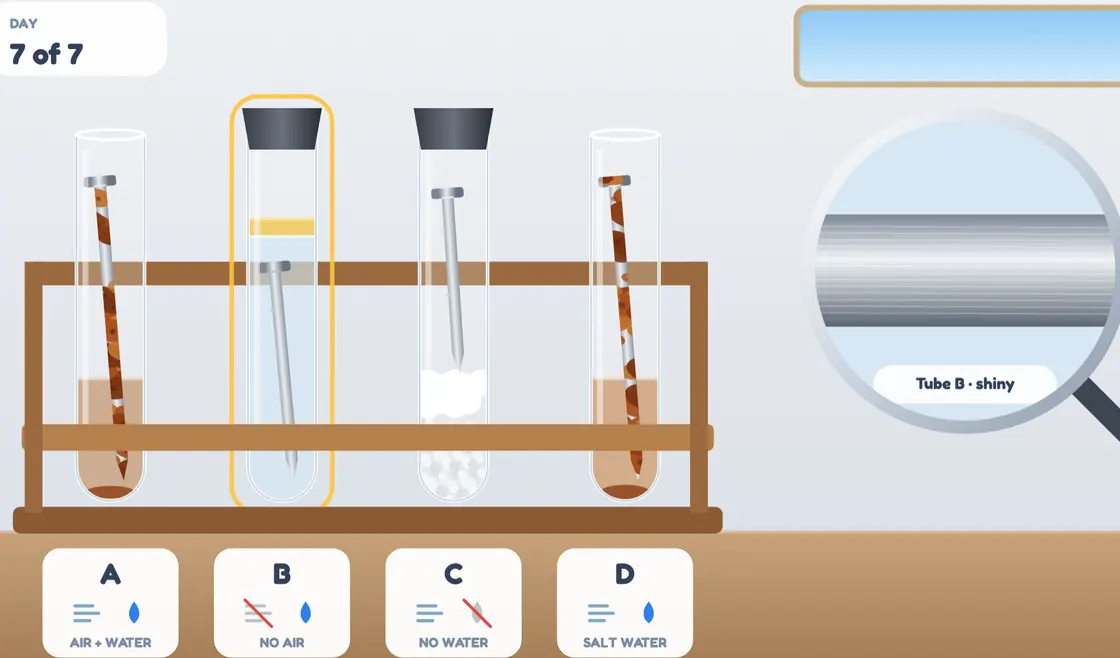
Put an iron nail in each of three test tubes:
- Tube A: air and water. The nail sits in ordinary water, open to the air.
- Tube B: water, no air. The nail sits in water that has been boiled to drive out the air dissolved in it. A layer of oil on top stops air dissolving back in, and the tube is stoppered.
- Tube C: air, no water. The nail sits with some anhydrous calcium chloride, a white solid that soaks up water vapour, so the air inside is dry. The tube is stoppered.
Leave them for at least three days, ideally a week. Then look closely:
- Tube A: the nail has rusted.
- Tube B: the nail is still shiny. There was no air.
- Tube C: the nail is still shiny. There was no water.
Rust only formed where the iron had both, so both are needed. (Strictly, it's the oxygen in the air that matters.) Many schools add a fourth tube of salt water, open to the air. Its nail rusts most of all.
Try it at home
You don't need a lab: three clean jam jars will do. Use plain steel nails, not galvanised or stainless steel ones, which are made not to rust.
- Jar A: half-fill it with tap water, add a nail and leave the lid off.
- Jar B: ask an adult to fill it with water from a kettle that has just boiled. Let it cool for a few minutes, add a nail, then gently pour on a layer of cooking oil about 1 cm thick and screw the lid on.
- Jar C: put a dry nail and a few silica gel sachets (the little "do not eat" packets from shoe boxes) in a dry jar, and screw the lid on tightly.
Keep the jars side by side and check them every day for a week. To make it a fair test, use the same kind of nail and the same size of jar each time.
Stay safe: an adult should handle the boiling water. Keep silica gel away from young children. In a school lab, anhydrous calcium chloride is an irritant, so wear eye protection.
Why does salt make iron rust faster?
Salt speeds up rusting because salty water carries electric charge much better than plain water, and rusting depends on charge moving.
When iron rusts, its atoms give away electrons, tiny particles with a negative charge. The electrons travel through the metal to a place where oxygen and water take them in. To keep this going, charged particles called ions have to move through the water, a little like the inside of a battery. Dissolved salt fills the water with ions, so the whole reaction runs faster.
That's why ships, piers and cars near the sea rust quickly, and why cars rust faster where the roads are salted in winter. Salt doesn't cause rusting on its own, though. Without oxygen and water, nothing happens.
Why is rusting a chemical change?
Rusting is a chemical change because it makes a new substance, rust, with different properties from iron, and you can't easily turn it back.
- New properties. Iron is grey, shiny and strong. Rust is orange-brown, dull, flaky and weak.
- Hard to reverse. You can't scrape rust off and get your iron back. Turning iron oxide back into iron takes a furnace at a very high temperature, like the blast furnaces that make iron from iron ore in the first place.
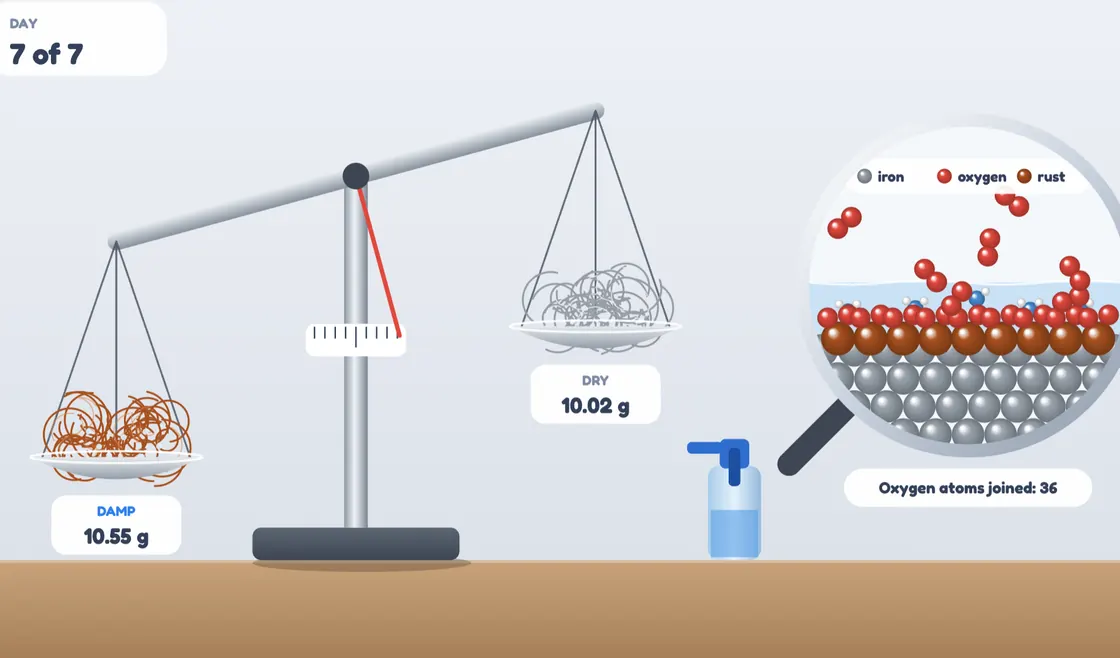
- It gets heavier. Oxygen from the air joins on to the iron, so rust weighs more than the iron it came from.
That last point surprises people, who often think rust "eats" metal away. The object does lose good, strong iron, but nothing vanishes: every iron atom is still there, now joined to oxygen. Put some damp steel wool on a sensitive balance and its mass slowly goes up over a week.
A colour change on its own isn't proof of a chemical change, by the way. It's the new substance that counts. For more examples, see our 20 physical and chemical changes from everyday life and our topic on physical and chemical changes.
How do we stop iron rusting?
To stop rust, keep oxygen and water away from the iron, or give them something else to react with instead.
- Paint. A coat of paint is a barrier, used on bridges, railings and cars. If it gets scratched, rust can start at the scratch and creep underneath.
- Oil or grease. Best for moving parts, like bicycle chains and hinges, where paint would rub off. Rain washes it away, so it needs topping up.
- Galvanising. The iron is coated with zinc, as on many fences, buckets and roofing sheets. Zinc is more reactive than iron, so even where the coating is scratched, the zinc reacts instead of the iron.
- Stainless steel. This is iron mixed with chromium (at least about 10.5%) and often nickel. The chromium forms an invisible layer of chromium oxide that seals the surface and repairs itself if scratched. It's used for sinks, cutlery and surgical tools.
- Sacrificial protection. Blocks of a more reactive metal, such as zinc or magnesium, are fixed to ships' hulls and underground pipes. The blocks corrode instead of the steel, and are replaced when they wear away.
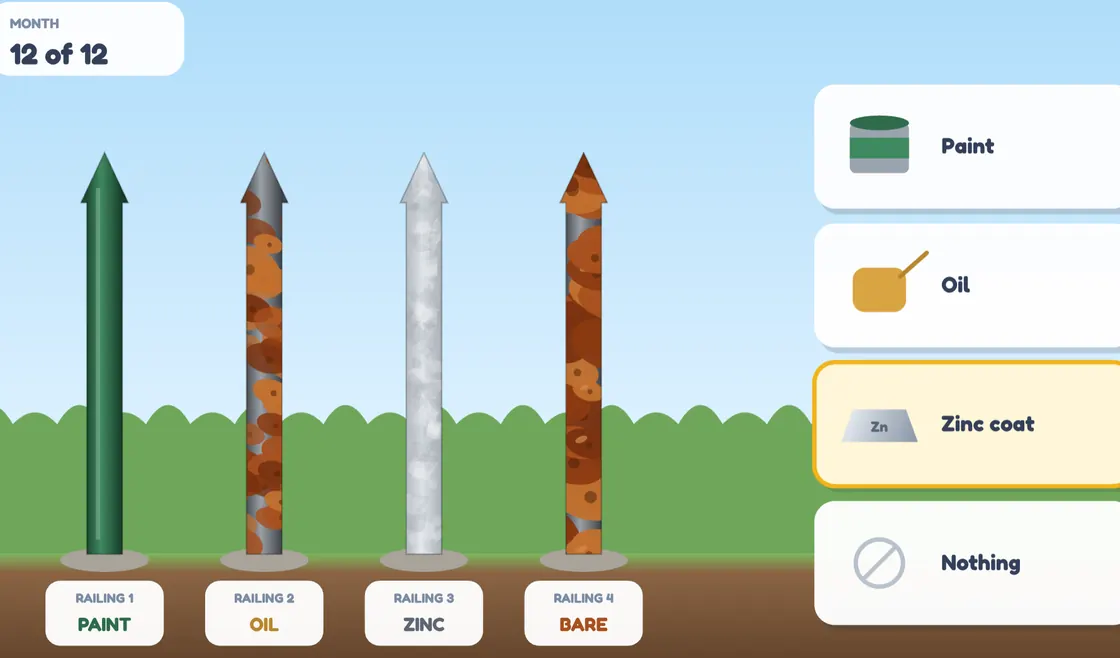
In the Rusting quest, you run the rust test with four test tubes, weigh steel wool as it rusts, then give iron railings a coat of paint, oil or zinc and leave them out in the rain for a year. Then you scratch them, to see which coat still protects.
In short
- Iron rusts when it reacts with oxygen and water, making hydrated iron(III) oxide.
- Take away either the oxygen or the water and iron doesn't rust, as the three-test-tube experiment shows.
- Salt speeds rusting up by helping electric charge move through the water.
- Rusting is a chemical change: rust is a new substance, it weighs more than the iron, and it can't easily be reversed.
- Paint, oil, zinc coatings, stainless steel and sacrificial metal blocks all keep rust away.
Questions people ask
How long does it take for a nail to rust?
A plain steel nail in water that's open to the air usually shows its first rust within a few days, which is why school rusting experiments are left for at least three days and often a week. Salt water, warmth and damp air all speed it up. In dry air, or in boiled water sealed under oil, the same nail stays shiny.
Does stainless steel rust?
Stainless steel resists rust very well, but it isn't completely rust-proof. It contains at least about 10.5% chromium, which reacts with oxygen to form a thin, invisible layer of chromium oxide. That layer protects the iron and repairs itself when scratched. In very salty places, such as near sea spray, the salt can break through the layer in spots and leave small marks of rust.
Does aluminium rust?
No. Rust is the name for iron's oxide, so only iron and steel rust. Aluminium does react with oxygen in the air, but it forms a thin, tough layer of aluminium oxide that sticks to the surface and stops the reaction going deeper. Other metals corrode in their own ways: copper slowly turns green, which is why old copper roofs and statues look green.
Can rust be turned back into iron?
Not on the object itself. Rusting is a chemical change: the iron that became rust is now part of a new substance. You can scrub or dissolve the rust away, but that leaves the object thinner and weaker, with less iron than before. Turning iron oxide back into iron needs a reaction at very high temperature, which is what a blast furnace does with iron ore.


