
Why does sugar dissolve faster in hot water? It's the particles
Why does sugar dissolve faster in hot water? Its particles move faster, so they pull sugar off the crystal and carry it away sooner. Plus a test to try.

Sugar dissolves faster in hot water because the particles in hot water move faster. They bump into the sugar crystal more often and harder, pulling its particles away sooner, and they carry the dissolved sugar off more quickly so that fresh water can reach the crystal. Hot water can also hold more sugar before it's full.
Cold water dissolves sugar too, and far more of it than most people think. It just does it slowly. Here's what's happening, and a simple two-glass test to try at home.
Why does sugar dissolve in water?
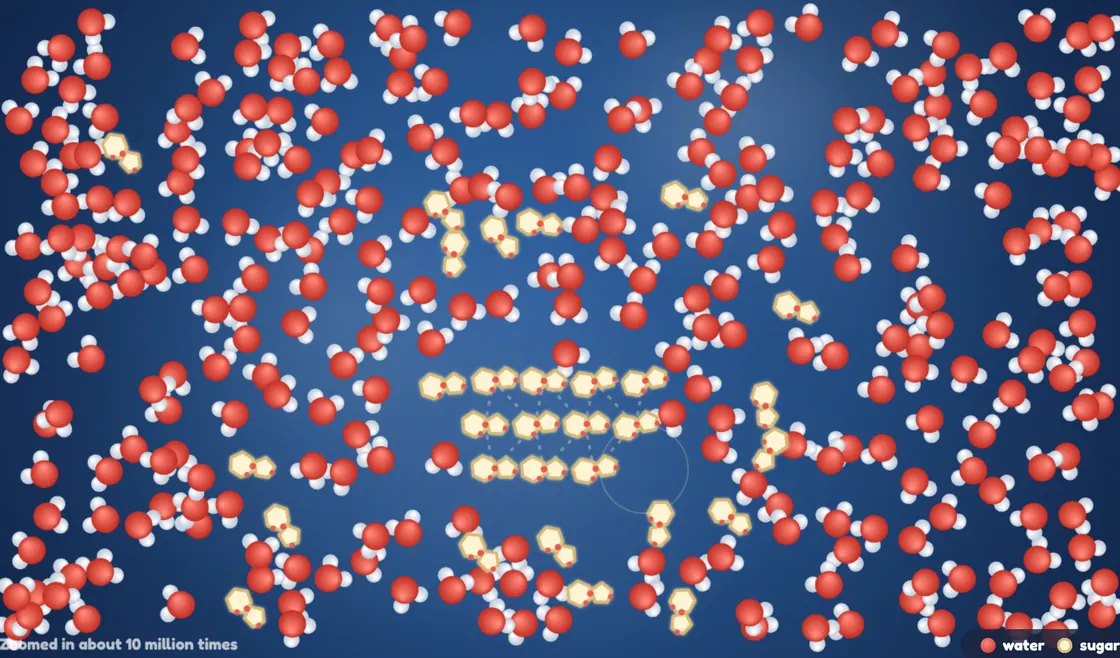
When sugar dissolves, water particles pull sugar particles off the crystal one by one, until the crystal has gone. The sugar particles spread out between the water particles. They're far too small to see, but they're still there, which is why the water tastes sweet.
The sugar is called the solute, the water is the solvent, and the sweet mixture they make is a solution.
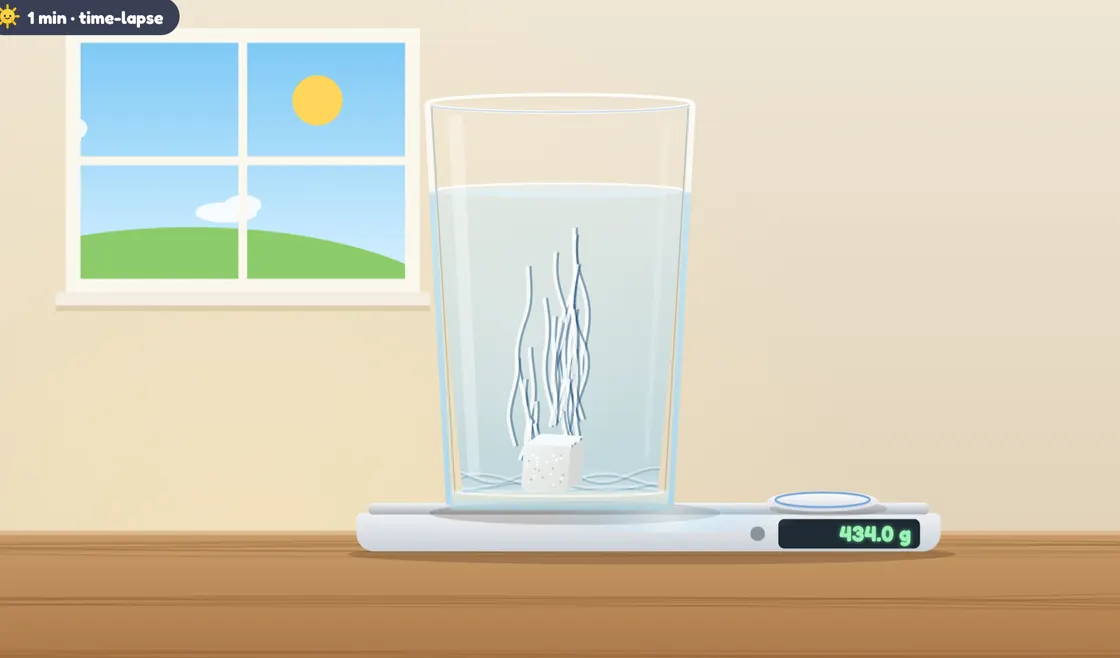
Each sugar particle is a single sucrose molecule, and it stays whole in the water. Dissolving doesn't break the sugar into anything new or destroy any of it, which makes it a physical change. A glass of water weighs exactly the same after a sugar cube has dissolved in it as the water and the cube weighed before. There's a quick kitchen-scale version of that test in our homeschool science plan.
Dissolving isn't the same as melting, either. Sugar doesn't melt in a cup of tea. On its own, sugar has to be heated far hotter than boiling water before it seems to melt, and even then it's starting to break down, which is how caramel is made.
Not everything dissolves. Sugar and salt are soluble in water. Sand is insoluble: its particles hold on to each other too tightly for water to pull them apart, so however long you stir, it settles at the bottom.
Why does sugar dissolve faster in hot water?
Everything is made of particles that are always moving, and the hotter something is, the faster its particles move. That changes three things in a glass of sugar water.
- The water particles hit harder and more often. In hot water, they bump into the crystal more often and with more energy, so they knock sugar particles loose sooner.
- The sugar particles jiggle more. The particles in the crystal vibrate faster too, which makes it easier for them to break away.
- The sugar gets carried away faster. As sugar dissolves, a layer of thick, sweet syrup builds up around the crystal. While that layer is there, the water touching the crystal is already full of sugar and dissolves more only slowly. In hot water, the dissolved sugar spreads away faster, and the syrup is runnier, so fresh water reaches the crystal sooner.
It's the same reason a drop of food colouring spreads faster in hot water than in cold.
On top of that, hot water can hold much more sugar before it's full, so the water around the crystal stays further from full. That's why it's so much easier to make thick sugar syrup with hot water.
Why can you see wavy lines when sugar dissolves?
Drop a sugar cube into a glass of still water and look from the side. You'll see wavy streams pouring down from the cube, like heat haze. They're syrup: water with lots of sugar dissolved in it.
Syrup is heavier than plain water, so it sinks and collects at the bottom of the glass. It also bends light slightly differently from plain water, which is why you can see the streams even though the syrup is clear.
That sinking syrup is why the bottom of a cold, unstirred drink often tastes much sweeter than the top.
Does sugar dissolve in cold water?
Yes. Cold water dissolves plenty of sugar: at 0 °C, 100 g of water can dissolve about 179 g of sugar, nearly twice its own weight. It just takes much longer.
That's why sugar stirred into iced tea or a cold drink often ends up as a gritty, sweet layer at the bottom. The sugar dissolves slowly, and the syrup it makes sinks instead of mixing. Stir for longer, or sweeten the drink with sugar syrup instead, as many cafés do for iced drinks.
What makes sugar dissolve faster?
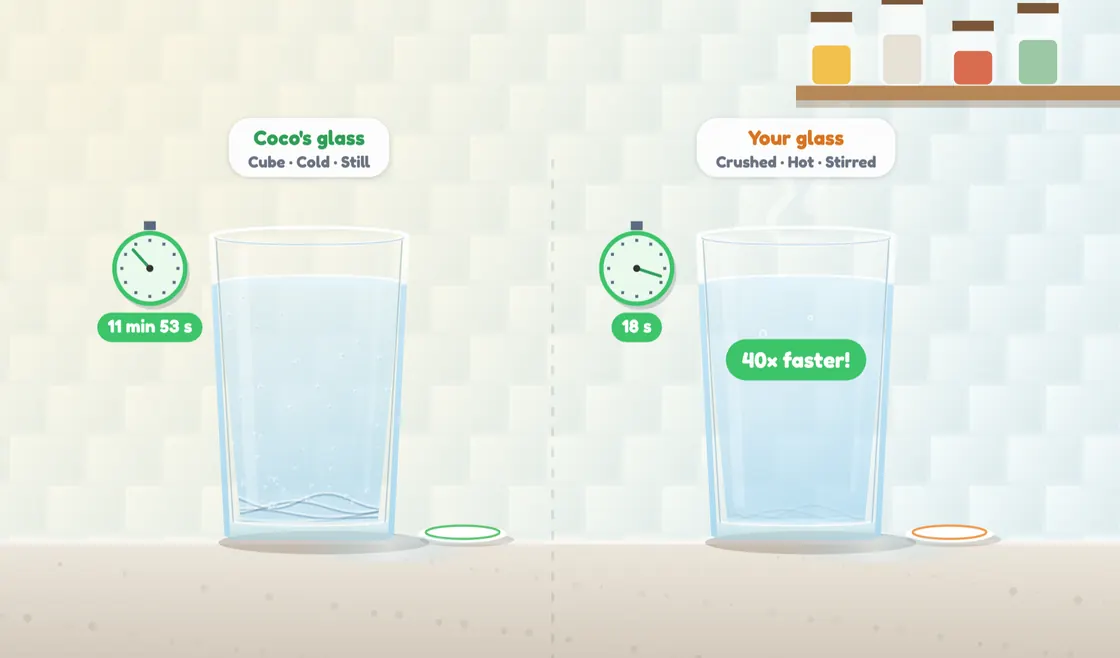
Three things make sugar dissolve faster in water: warmer water, stirring, and smaller pieces.
- Warmer water: its particles move faster, as above.
- Stirring: it sweeps away the syrup around the sugar and brings fresh water to it.
- Smaller pieces: crushing a cube gives the water much more surface to work on. The sugar particles themselves stay the same size, but far more of them are touching the water at once.
So a sugar cube dissolves more slowly than the same amount of loose granulated sugar, and very fine icing sugar (powdered sugar) dissolves fastest of all. Many icing sugars also contain a little starch to stop them clumping, and starch doesn't dissolve, so the water may turn slightly cloudy. Check the packet.
The amount of sugar already in the water matters too. The closer a solution is to full, the more slowly any extra sugar dissolves.
What is a saturated solution?
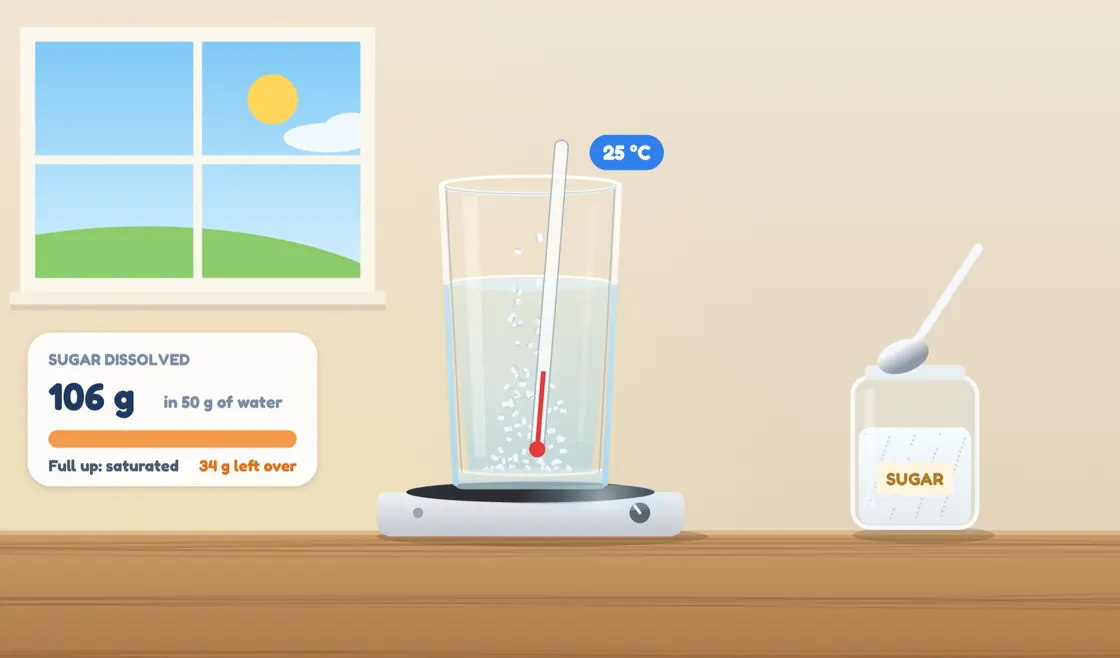
A saturated solution is one that can't dissolve any more of the solute at that temperature. Keep adding sugar to a glass of water and eventually some will stay at the bottom however much you stir. The solution is full up.
How much sugar that takes depends on the temperature. For every 100 g of water, it's about:
- 0 °C (ice-cold): 179 g of sugar
- 20 °C (room temperature): 204 g
- 60 °C (hot tap water): 287 g
- 100 °C (boiling): 487 g, almost five times the water's own weight
If a hot, saturated syrup cools down, it can no longer hold all its sugar. The extra sugar comes back out of the solution as crystals. Given time and a string to grow on, that's how rock sugar sweets are made.
Try it: sugar in hot and cold water
You'll need two clear glasses the same size, two sugar cubes, cold water from the fridge, warm water from the hot tap, a measuring jug and a stopwatch. A kitchen thermometer helps but isn't essential.
- Fill the glasses. Measure 200 ml of cold water into one glass and 200 ml of warm water into the other. If you have a thermometer, write down both temperatures.
- Drop and start. Drop a sugar cube into each glass at the same moment and start the stopwatch.
- Don't stir. Watch from the side, against something dark, and look for the wavy streams of syrup.
- Stop the clock for each glass when you can no longer see any solid sugar, and write down both times.
- Repeat it three times with fresh water and fresh cubes, then work out the average time for each.
- Change one more thing. Try water at the same temperature in both glasses, but stir one, or crush one cube and leave the other whole.
The warm glass should win clearly. In still, cold water a cube can take many minutes, so be patient. Write a prediction before you start, with a reason, and check it against your results at the end.
Stay safe: use warm water from the hot tap, not boiling water, which can scald. Wipe up any spills, because sugar water is sticky.
To make it a fair test, change only the temperature and keep the glasses, the water, the cubes and the stirring the same. For a bigger project with four temperatures, see idea 5 in our science fair project ideas.
The Dissolving quest is one of the six quests on Thinkodile's free plan. You can drop a sugar cube into water on a kitchen scale, zoom in about 10 million times to watch water particles pull a crystal apart, race to dissolve sugar ten times faster than Coco, and keep adding sugar until the glass is saturated.
In short
- When sugar dissolves, water particles pull sugar particles off the crystal and spread them through the water. The sugar is still there: nothing is lost.
- Sugar dissolves faster in hot water because the particles move faster. Water knocks sugar particles loose sooner, and the dissolved sugar is carried away from the crystal more quickly.
- Cold water dissolves sugar too, nearly twice its own weight at 0 °C, but much more slowly.
- Stirring and smaller pieces also make sugar dissolve faster.
- A saturated solution can't dissolve any more. Hot water can hold far more sugar than cold, and a hot syrup that cools gives some of its sugar back as crystals.
Questions people ask
Why does sugar dissolve faster in hot water than in cold water?
Because the particles in hot water move faster. They bump into the sugar crystal more often and with more energy, so they pull sugar particles off it sooner. The sugar particles in the crystal jiggle more too. The dissolved sugar also spreads away from the crystal faster, letting fresh water reach it. Hot water can hold more sugar as well, so it stays further from full.
Does sugar dissolve in cold water?
Yes, and a lot of it. At 0 °C, 100 g of water can dissolve about 179 g of sugar, nearly twice its own weight. It just dissolves much more slowly than in hot water, because the water particles move more slowly. That's why sugar in iced tea often ends up as a sweet layer at the bottom unless you stir it for a long time.
What is a saturated solution?
A saturated solution can't dissolve any more of the solute at that temperature. If you keep adding sugar to water, eventually some stays at the bottom however much you stir. The amount depends on temperature: 100 g of water holds about 204 g of sugar at 20 °C and about 487 g at 100 °C. When a hot saturated syrup cools, some sugar comes back out as crystals.
What are the solute, solvent and solution in sugar water?
The sugar is the solute: the substance that dissolves. The water is the solvent: the liquid it dissolves in. The sweet, clear mixture they make together is the solution. In salty water, the salt is the solute and the water is the solvent. A solution looks like a single liquid because the solute's particles are spread out too finely to see.
Is dissolving sugar a physical or chemical change?
It's a physical change. No new substance is made: the sugar particles stay whole and simply spread out between the water particles. The water still tastes sweet, and you can get the sugar back. Leave sugar water somewhere warm and, as the water slowly evaporates, sugar crystals are left behind. A chemical change, like heating sugar until it turns into caramel, makes new substances.


