
A middle school science homeschool plan for 2027–28 (ages 11–14)
A middle school science homeschool plan for 2027–28: what to teach in what order, how many weeks each, a hands-on activity per block and how to check learning.

A middle school science year at home can be simple: about 36 weeks, two or three sessions a week, and nine blocks that take turns between physics, chemistry, life science and Earth & space. Start with measuring and particles, because so much rests on them, and finish with an investigation your child designs.
Here's the plan for 2027–28, for ages 11–14 (US grades 6–8). It works with library books, videos and a kitchen table; where Thinkodile has a matching topic, we link to it.
The year at a glance
Nine blocks of topics, then a final week for your child's own investigation:
- Weeks 1–3: Measuring, motion and forces (physics)
- Weeks 4–7: Particles, dissolving and mixtures (chemistry)
- Weeks 8–13: Cells, plants and ecosystems (life science)
- Weeks 14–16: Light and shadows (physics)
- Weeks 17–20: Earth, Moon, Sun and sky (Earth & space)
- Weeks 21–23: Electricity and magnetism (physics)
- Weeks 24–27: Acids, metals and chemical changes (chemistry)
- Weeks 28–30: Heat, air and weather (physics and Earth & space)
- Weeks 31–35: The body, health and inheritance (life science)
- Week 36: your child's own investigation
Start in the last week of August 2027, take a week off at Thanksgiving and two at Christmas, and week 36 ends in late May 2028. Weeks 17–20 then fall in January 2028, when there are two eclipses to watch.
Why this order?
There's no single correct order for middle school science. This plan follows three rules:
- Skills and big models first. Measuring and fair tests come first, so every later activity is a real experiment. Particles and cells come early, because dissolving, heat, weather, health and inheritance all depend on them.
- Each block sets up another. Light and shadows lead into eclipses; circuits come before electromagnets; particles return in heat and weather.
- Every subject comes back. Physics, chemistry and life science each return later in the year, so earlier ideas get used again instead of fading.
It also follows the prerequisites in Thinkodile's topic map. Swap whole blocks if it suits your child.
How to run a week
Plan on two or three sessions of 45 to 60 minutes: one to ask a question and get a written prediction, one to learn the idea and do the activity, and one for your child to explain what happened, in their own words, in a science notebook.
The plan, block by block
Weeks 1–3: Measuring, motion and forces
Topics: Motion & Measurement, Forces. Speed is distance divided by time; forces change how things move; friction slows things down.
Try this: a pendulum fair test. Hang a metal washer on a string from the edge of a table. Time 10 swings and divide by 10. Change only the string's length and time again, then change only the weight. Longer strings swing more slowly; the weight makes almost no difference.
Check: "What would a string four times as long do?" (Each swing takes about twice as long.) Ask for a distance–time graph of a walk to the end of the street and back, with a stop in the middle.
Weeks 4–7: Particles, dissolving and mixtures
Topics: Matter & Particles, Solutions, Elements, Compounds & Mixtures. Everything is made of moving particles, arranged differently in solids, liquids and gases; dissolving spreads them out, and nothing is lost.
Try this: does dissolving make things disappear? Weigh a glass of water and a small dish of sugar together on a kitchen scale. Tip the sugar in, stir until it vanishes, put the empty dish and spoon back on the scale, and weigh again. The total hasn't changed.
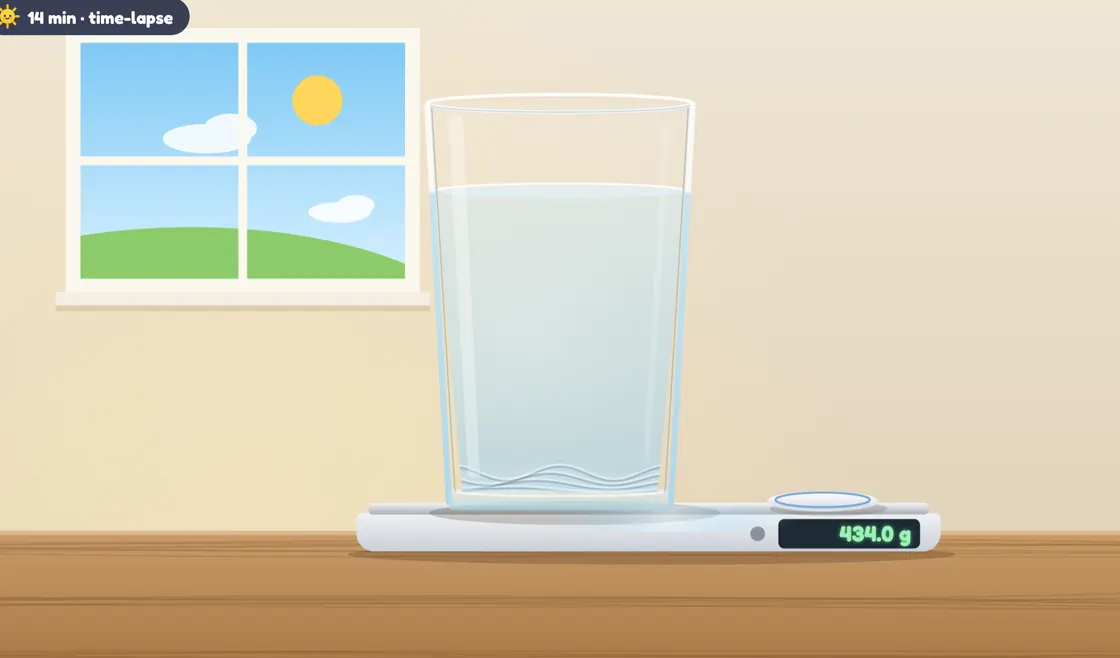
Check: ask for particle drawings of an ice cube, water and steam, then "Where did the sugar go?" A good answer talks about particles spreading out between the water particles, not "it disappeared" or "it melted".
Weeks 8–13: Cells, plants and ecosystems
Topics: Cells & Microbes, Plant Biology, Ecosystems & Food Webs. All living things are made of cells; plants make food from light, water and carbon dioxide; energy flows along food chains.
Try this: watch water climb a plant. Stand a stick of celery, leaves on, in water with plenty of food colouring. After a day, the leaves are tinged with colour. Cut across the stalk (a grown-up's job if the knife is sharp): the coloured dots are the xylem tubes that carried the water up.
Check: ask for a plant cell and an animal cell with three differences labelled, and where most of a tree's mass comes from (carbon dioxide from the air, as our photosynthesis article explains). Then a food web of five living things: what happens if one disappears?
Weeks 14–16: Light and shadows
Topics: Light & Shadows, Mirrors & Lenses. Light travels in straight lines; shadows form where it's blocked; mirrors reflect it and lenses bend it.
Try this: a pinhole picture. Make a neat pinhole in a piece of card. In a darkened room, hold it between a bright lamp and a white wall, and move it until a small, upside-down picture of the lamp appears. It's the same trick that lets you watch an eclipse safely.
Check: ask them to draw rays from the top and bottom of the lamp through the hole, to show why the picture is upside down, and to explain why a shadow grows as an object moves towards the lamp.
Weeks 17–20: Earth, Moon, Sun and sky
Topics: A Planet for Life, Earth, Moon & Sun, Time from the Sky. Day and night come from the Earth spinning; the Moon's phases from seeing different amounts of its lit half; eclipses from the Sun, Earth and Moon lining up.
Try this: a Moon diary. Each clear evening (and some mornings: the Moon is often up in daylight), draw the Moon's shape and note the time. After two weeks, model it in a dark room with a lamp as the Sun and a ball as the Moon, as in our article on why the Moon changes shape.
Watch the sky in January 2028. Late on Tuesday 11 January, from about 10:45 to 11:40 pm Eastern time, the full Moon dips a tiny way into the Earth's dark shadow: a small partial lunar eclipse. On the morning of Wednesday 26 January, much of the US east of the Rockies sees a partial solar eclipse: about a sixth of the Sun covered in Miami, a sliver in New York and Chicago, nothing on the West Coast. Use ISO 12312-2 eclipse glasses or a pinhole projector, never your bare eyes; our guide to the 2027 eclipses explains how.
Check: with the lamp and ball, your child shows you a new moon, a full moon and a solar eclipse, and explains why there isn't an eclipse every month (the Moon's orbit is tilted by about 5°).
Weeks 21–23: Electricity and magnetism
Topics: Electric Circuits, Electromagnetism. A circuit needs a complete loop; some materials conduct and others insulate; a current in a coil makes a magnet.
Try this: build an electromagnet. Wrap insulated wire 20 times round a large steel nail and touch the bare ends to a 1.5 V battery. Count the paper clips it lifts, then add 20 more turns and test again. Connect it for only a few seconds at a time (the wire and battery get warm), and never use mains electricity. Full steps: how to make an electromagnet.
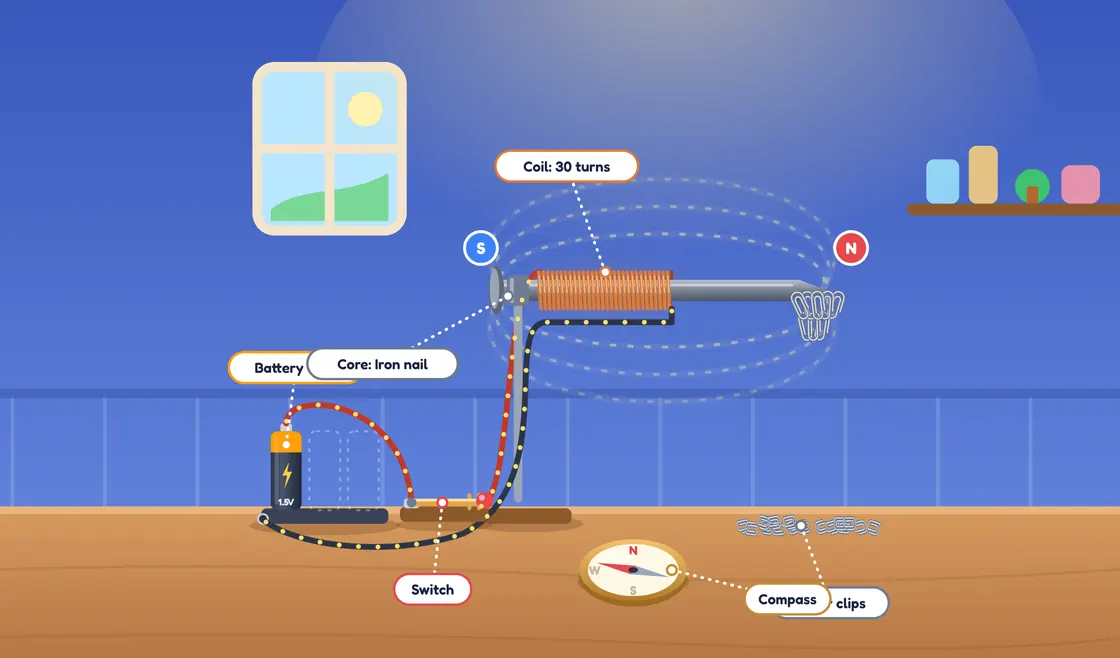
Check: ask for a prediction before adding the turns, and afterwards, why the clips drop when the battery is disconnected.
Weeks 24–27: Acids, metals and chemical changes
Topics: Acids & Bases, Metals & Materials, Physical & Chemical Changes. Indicators sort acids from bases; acids and bases neutralise each other; iron rusts in air and water; some changes make new substances.
Try this: red cabbage indicator. A grown-up pours hot water over chopped red cabbage; once cool, strain off the purple-blue liquid. Add a little to lemon juice, vinegar, plain water, and baking soda dissolved in water. Acids turn it pink or red; bases turn it green. Use kitchen ingredients only, never cleaning products.
Check: ask for a colour prediction for a kitchen liquid they haven't tested. Then: "Is melting chocolate a physical or a chemical change? Toasting bread? How do you know?"
Weeks 28–30: Heat, air and weather
Topics: Heat, Weather & Storms. Heat moves by conduction, convection and radiation; air has pressure, and moves from high pressure to low as wind.
Try this: an insulation fair test. Fill three identical jars with the same amount of warm tap water (not boiling: let a grown-up pour). Wrap one in a towel, one in foil, and leave one bare. Take the temperature every five minutes with a kitchen thermometer and plot a graph.
Check: ask for one example each of conduction, convection and radiation at home, and an explanation, using particles, of why warm air rises.
Weeks 31–35: The body, health and inheritance
Topics: The Human Body, Health & Immunity, Growing Up, Reproduction & Inheritance. Digestion, breathing and respiration; how diseases spread and vaccines work; the changes of adolescence; why young living things vary.
Try this: pulse and exercise. Count the pulse at the wrist for 30 seconds and double it. Do a minute of jumping jacks, count again straight away, then every minute until it's back to normal, and plot the results. Keep it gentle, and skip it if your child has a heart or breathing condition.
Check: ask for the journey of a sandwich from the mouth to a muscle cell, why siblings look alike but never exactly the same (unless they're identical twins), and what a vaccine actually does.
Week 36: Your child's own investigation
Your child picks a question they can test at home ("Which paper towel soaks up the most water?"), writes a prediction, decides what to change, measure and keep the same, runs it three times, and presents the results to the family. It shows whether they can think like a scientist, not just remember facts.
How do I check my child really understands?
Understanding shows when a child can explain why, not just what. Five checks, none of which needs a test paper:
- Predict, then explain. A written prediction before every activity; afterwards, why did the result match or not?
- Teach it back. Your child explains the idea to you, or a younger sibling, without notes. Gaps show up fast.
- Draw the model. A labelled drawing of particles, a cell or the Sun, Earth and Moon shows what they really picture.
- Ask again later. A few quick questions a week or two after a block shows what has stuck, and helps it stick.
- Try something new. "Would sugar dissolve faster in hot tea or iced tea? Why?" Using an idea in a new situation is the real test.
Keeping a record
A science notebook does most of the work: the date, the question, the prediction, what they did, a results table or graph, and what it shows. Add photos of the activities.
Homeschool rules differ from state to state: some ask for records, assessments or a portfolio, others for very little. This is a teaching plan, not a legal checklist, so check your own state's requirements.
If you follow the NGSS
If your state's standards are based on the Next Generation Science Standards, this year touches several middle school performance expectations, including MS-PS1-4 (particles, temperature and changes of state), MS-LS1-1 (living things are made of cells), MS-LS1-6 (photosynthesis), MS-ESS1-1 (a model of the Earth-Sun-Moon system) and MS-PS2-3 (the strength of electric and magnetic forces). It doesn't cover every expectation, so compare it with your state's list.
Where Thinkodile fits
You don't need Thinkodile for this plan, but every block maps to its topics, each with one to three interactive quests: Coco opens with a mystery and asks for a prediction, short Learn slides explain the idea, a virtual lab lets your child test it, and a Final Challenge checks it.
A parent creates the account and the child plays on it; children never sign up themselves. The free account includes six quests, covering four blocks of this plan: Particles and Dissolving (weeks 4–7), Build a Cell and Photosynthesis (weeks 8–13), Moon Phases (weeks 17–20) and Build an Electromagnet (weeks 21–23). The rest are in Thinkodile Plus. It runs in a web browser on laptops, Chromebooks, tablets and phones (phones play sideways).
In short
- Plan about 36 weeks, with two or three science sessions a week.
- Start with measuring and particles; they make later topics easier.
- Alternate subjects, so each one comes back later in the year.
- Do one hands-on activity per block, with a prediction first.
- Check understanding with explanations, drawings and new questions, not just quizzes.
Questions people ask
What science should a homeschooled middle schooler learn?
A balanced middle school year covers four areas: life science (cells, plants, the human body, ecosystems and inheritance), chemistry (particles, dissolving, acids and chemical changes), physics (motion, forces, electricity, light and heat) and Earth and space (the Earth, Moon and Sun, and weather). Just as important are the skills: making predictions, running fair tests, measuring carefully and explaining results.
How many days a week should a middle schooler do science?
Two or three sessions a week of 45 to 60 minutes is enough for a full year, and it's what this plan assumes. Use one session to ask a question and learn the idea, one for the hands-on activity, and one for writing up and explaining. If your family prefers shorter daily sessions, keep the same order of work.
What order should middle school science be taught in?
There's no single correct order. Some schools teach Earth science, life science and physical science in separate years; others mix all of them every year. Whatever you choose, teach the particle model and cells early, because many later topics depend on them, and bring each subject back after a gap so earlier ideas get used again.
Does this plan meet my state's homeschool requirements?
It isn't designed to. It's a teaching plan, not a legal checklist, and homeschool laws differ from state to state: some ask for records, assessments or a portfolio, and others ask for very little. Check your own state's rules, for example on your state department of education's website, and use the science notebook as part of any records you keep.
Do I need a lab kit or a microscope for middle school science?
Not for this plan. Every activity uses everyday things: string and a washer, a kitchen scale and sugar, celery and food colouring, card and a lamp, red cabbage, a battery, insulated wire and a nail, jars and a kitchen thermometer. The wire and thermometer are the things you are most likely to need to buy. A microscope is a lovely extra for the cells block, but not essential.


