
Science fair project ideas for 2027: 15 fair tests for ages 11–14
15 science fair project ideas for 2027 that are real fair tests: what to change, what to measure and what to keep the same, with safety notes. Ages 11 to 14.

The best science fair projects for ages 11 to 14 are small, honest experiments: one question, one thing you change, one thing you measure, and everything else kept the same. Here are 15 that work at home or at school with cheap materials, grouped by topic, with safety notes.
Pick a question you actually want answered. Judges can tell a project someone cared about from one copied off a list.
How to use this list
Every idea is a fair test: you change one thing (the independent variable), measure one thing (the dependent variable) and keep everything else the same (the controlled variables). Our guide to teaching fair tests explains it in five minutes.
What usually happens lets a grown-up check the method is working. Your results may differ: report what you found, not what you expected.
Where a Thinkodile quest lets you try an idea on screen first, we've linked it. A simulation is a good rehearsal for a prediction, but the fair wants your own measurements. Six quests are free on a grown-up's free account, including Dissolving and Build an Electromagnet; the rest are in Thinkodile Plus.
Check your fair's rules, too: many restrict experiments on people or animals, and growing bacteria or mould.
Plants and living things
1. Does light change how fast pondweed makes oxygen?
- Change: how far a lamp is from a sprig of pondweed (such as Elodea) in water: 10, 20, 30 and 40 cm.
- Measure: bubbles rising from the cut stem in one minute.
- Keep the same: the sprig, the water and its temperature, the lamp.
- What usually happens: the closer the lamp, the more bubbles, until something else runs short.
- Safety: use a cool LED lamp (an old-style bulb also warms the water, changing two things at once) and keep plugs away from water.
- Try it first: the Photosynthesis quest, and our post on what plants need for photosynthesis.
2. Which side of a leaf loses more water?
- Change: where you smear petroleum jelly on four similar leaves: nowhere, the top, the underside, or both.
- Measure: each leaf's mass at the start and after three days, on scales that read to 0.1 g. Work out the percentage lost.
- Keep the same: the plant, leaf size, where they hang and for how long.
- What usually happens: greasing the underside cuts water loss far more than greasing the top, because most stomata (tiny pores) are underneath.
- Safety: use leaves from a plant you know isn't poisonous, and wash your hands.
- Try it first: the Stomata & Transpiration quest races four greased leaves. For a simpler start, catch the water leaving a branch with a plastic bag.
3. Does temperature change how fast yeast makes gas?
- Change: the water temperature: about 10, 20, 35 and 55 °C. Stand each bottle in a bowl of water at its own temperature.
- Measure: the distance round a balloon stretched over the bottle's neck after 30 minutes, using string and a ruler.
- Keep the same: 100 ml of water, a teaspoon each of sugar and dried yeast, the bottles, balloons and time.
- What usually happens: the warm bottle (about 35 °C) inflates its balloon fastest. Cold yeast is slow; very hot water harms it.
- Safety: a grown-up should prepare the hot water, which can scald.
- Try it first: the yeast lab in the Microbe Detective quest.
4. Does salty water stop seeds from sprouting?
- Change: level teaspoons of salt in 250 ml of water: 0, ½, 1 and 2.
- Measure: how many of 20 cress or mung bean seeds on damp kitchen paper have sprouted a root, each day for a week.
- Keep the same: the seeds, the water each dish gets, and where the dishes sit.
- What usually happens: the saltier the water, the fewer seeds sprout and the slower they start.
- Safety: low risk. Label every dish.
Chemistry in the kitchen
5. Does hot water dissolve sugar faster?
- Change: the water temperature: about 5 °C (from the fridge), 20, 35 and 50 °C.
- Measure: the time for one sugar cube to disappear.
- Keep the same: the cubes, 200 ml of water, the glass, and the stirring (one slow stir a second).
- What usually happens: the hotter the water, the faster it dissolves. Warm water particles move faster and pull sugar particles away sooner. Here's why.
- Safety: a grown-up should pour the hot water.
- Try it first: the Dissolving quest, where you race to dissolve sugar faster than Coco.
6. Does more baking soda make more gas?
- Change: baking soda added to 50 ml of vinegar: ¼, ½, 1 and 2 level teaspoons. Put the powder in a balloon, stretch it over the bottle's neck, then tip the powder in.
- Measure: the distance round the balloon when the fizzing stops.
- Keep the same: the vinegar, the bottle and the balloons.
- What usually happens: more baking soda blows the balloon up more, until the vinegar's acid is used up; then the balloon stops growing. Add red cabbage indicator to the vinegar and you'll see it turn from pink towards blue as the acid runs out.
- Safety: wear glasses or goggles, work on a tray, and never seal the bottle with anything but a balloon.
- Try it first: the Neutralisation quest, and the Natural Indicators quest for making the indicator.
7. What makes iron nails rust fastest?
- Change: what each nail sits in: tap water, salty water, boiled water under a layer of oil (no air), or a dry jar with a silica gel packet (no water).
- Measure: a rust score from 0 (shiny) to 5 (covered), from daily photos for a week.
- Keep the same: the nails, jars, place and time. Use plain steel nails: galvanised and stainless ones are made not to rust.
- What usually happens: salt water rusts the nail most, then tap water. Without air or without water, nails stay shiny: iron needs both to rust.
- Safety: a grown-up should boil the water. Silica gel isn't food.
- Try it first: the Rusting quest runs the same test in tubes.
8. Does cooling speed change the size of crystals?
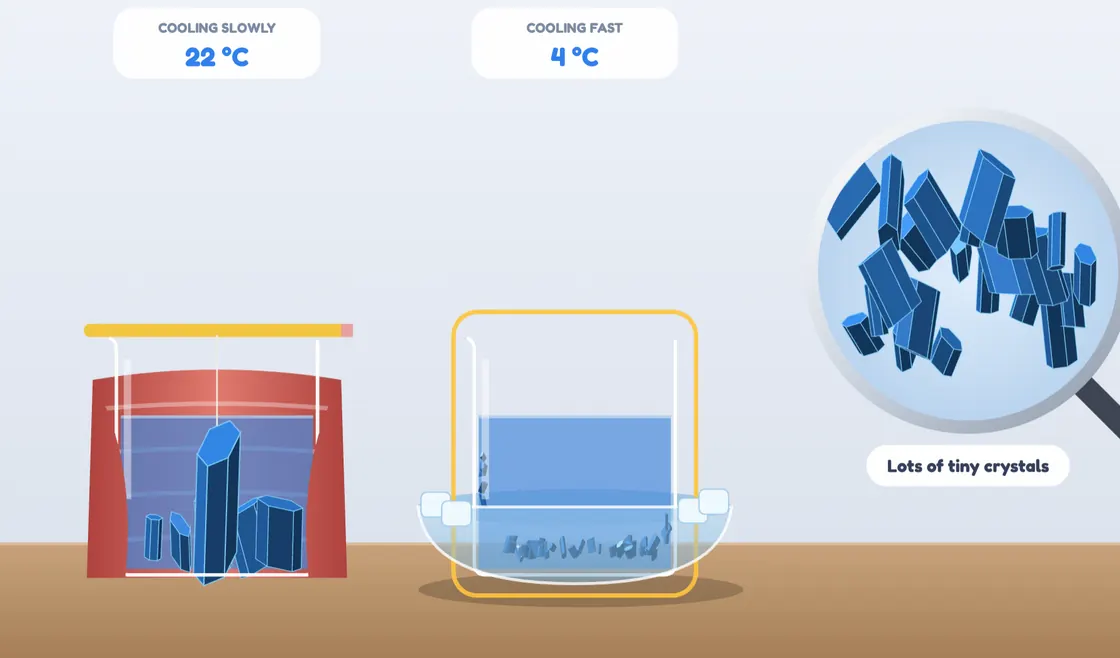
- Change: how fast a hot, saturated solution of alum or Epsom salt cools: wrapped in a towel, on the worktop, or in the fridge.
- Measure: the length of the five biggest crystals in each jar after two days, then the average.
- Keep the same: the substance, the amounts of water and solid, the jars and the starting temperature.
- What usually happens: slow cooling grows a few big crystals; fast cooling makes lots of small ones.
- Safety: a grown-up should handle the hot water. Label the jars: alum and Epsom salt aren't food. Leave copper sulfate, which the quest uses, to school labs.
- Try it first: the Crystallisation quest.
Forces and motion
9. Does the length of a pendulum change its swing time?
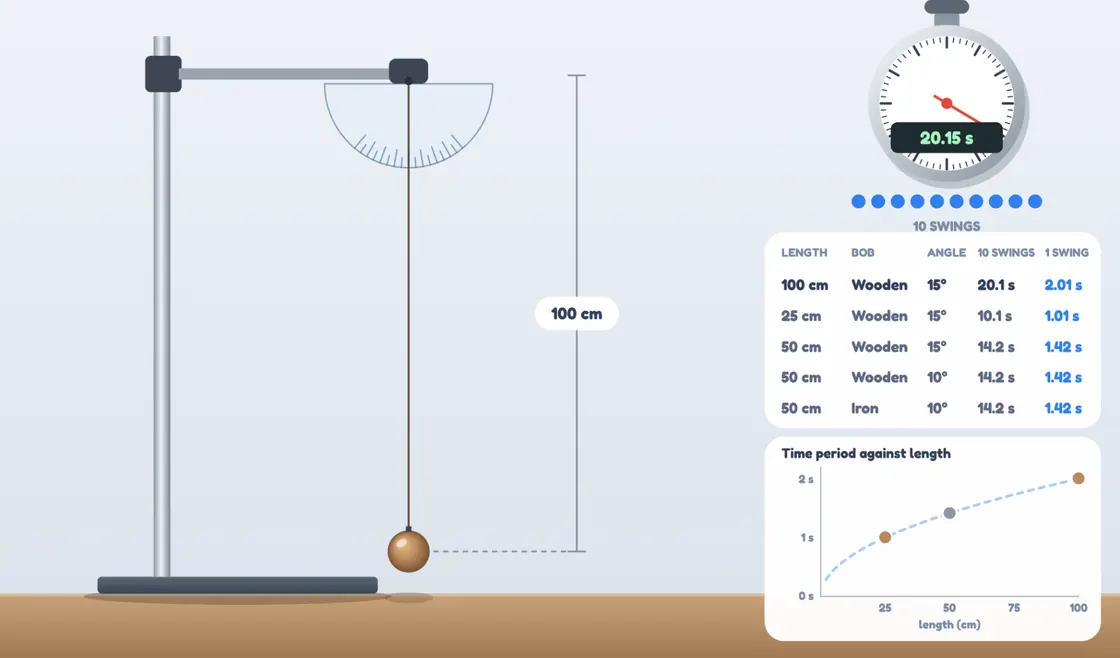
- Change: the string's length, measured to the middle of the weight: 25, 50, 75 and 100 cm.
- Measure: the time for 10 swings there and back, divided by 10. Three times for each length.
- Keep the same: the weight (a metal nut or washers), the string, and a small starting angle.
- What usually happens: longer pendulums swing more slowly: about 2 seconds a swing at 1 m, about 1 second at 25 cm. The surprise: a heavier weight makes almost no difference. Here's why.
- Try it first: the Pendulum Clock quest.
10. Which floor lets a toy car roll furthest?
- Change: the surface at the bottom of a ramp: a smooth floor, flattened cardboard, a rug and a bath towel.
- Measure: how far the car rolls past the ramp. Three runs on each.
- Keep the same: the car, the ramp's height and where you let go (without pushing).
- What usually happens: the smoother the surface, the further it rolls. The rug and towel cause the most friction.
- Try it first: the Friction Race quest.
11. Does a bigger parachute fall more slowly?
- Change: a square canopy cut from a plastic bag: 20, 30, 40 and 50 cm a side.
- Measure: the time to fall from the same height (2 m or more). Five drops each, then the average.
- Keep the same: four equal strings, the load (such as five paper clips), the height and how you let go.
- What usually happens: bigger canopies fall more slowly, because more air pushes up against them.
- Safety: drop from a stair landing with a grown-up nearby, never from a window or balcony.
- Try it first: the Gravity Drop quest, with a flat and a crumpled sheet of paper. Our guide to whether heavier objects fall faster explains why shape matters.
Electricity and heat
12. Do more turns of wire make a stronger electromagnet?
- Change: turns of insulated wire round an iron nail: 10, 20, 30 and 40.
- Measure: how many small paper clips it lifts. Three tries each.
- Keep the same: the nail, clips, battery and length of wire (leave the spare unwound so the current stays the same).
- What usually happens: more turns lift more clips. A battery slowly runs down, a hidden variable, so repeat 10 turns at the end to check.
- Safety: use one or two 1.5 V cells, never mains, a car battery or a power bank. The wire gets hot: connect it for a few seconds at a time.
- Try it first: the free Build an Electromagnet quest, and our guide to making an electromagnet.
13. Does colour change how hot a can gets in the sun?
- Change: what covers three identical cans of water: black paper, white paper or kitchen foil.
- Measure: the water's temperature rise after 30 minutes side by side in sunshine.
- Keep the same: the amount of water, its starting temperature, the spot and the time.
- What usually happens: the black can warms most. Dark surfaces take in more of the Sun's heat; light, shiny ones reflect more.
- Safety: never look at the Sun. Use a digital or spirit thermometer, not mercury.
- Try it first: the "Dark and light" mission in the Heat on the Move quest.
Light and space
14. How does distance change the size of a shadow?
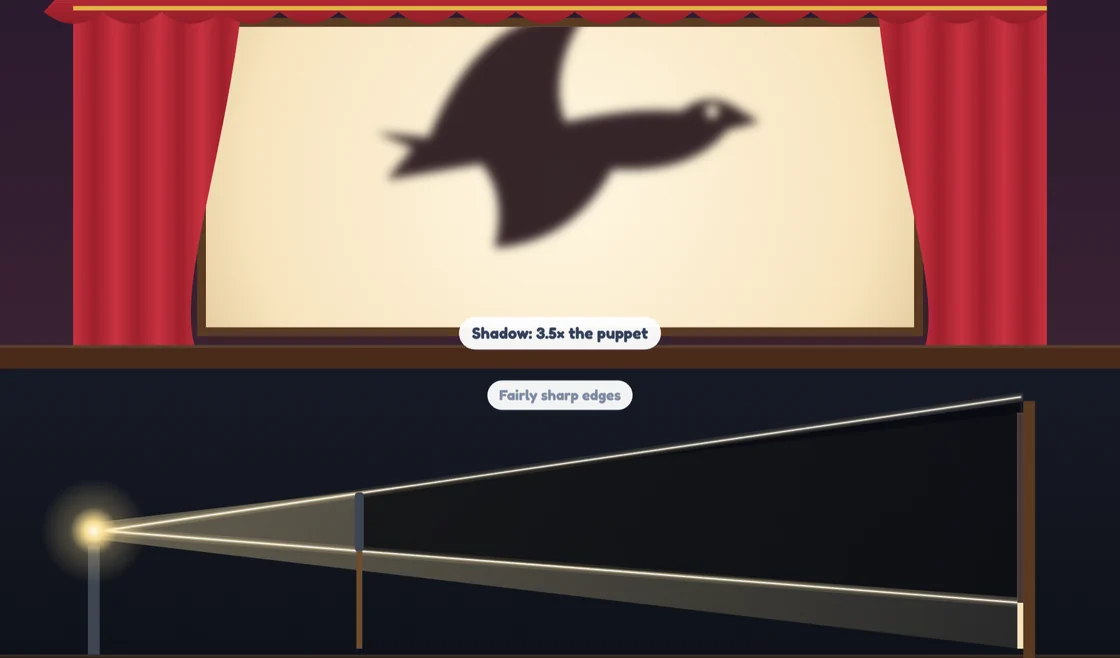
- Change: how far a small toy is from a torch: 20, 40, 60 and 80 cm, with the torch always 1 m from the wall.
- Measure: the height of the shadow on paper taped to the wall.
- Keep the same: the torch, the toy, the wall distance and a dark room.
- What usually happens: the closer to the torch, the bigger the shadow. With a small torch, halving the distance roughly doubles the shadow: a 5 cm toy 20 cm from the torch casts one about 25 cm tall.
- Try it first: the Shadow Theatre quest.
15. Does drop height change the size of a crater?
- Change: the height you drop a marble from into a tray of flour: 25, 50, 75 and 100 cm.
- Measure: the crater's width. Three drops from each height, smoothing the flour between drops.
- Keep the same: the marble and the flour's depth (about 5 cm). A dusting of cocoa on top shows the crater clearly.
- What usually happens: higher drops make wider craters, but doubling the height makes the crater only a little wider.
- Safety: pick up stray marbles, and keep flour dust away from flames.
What makes a science fair project score well?
Judges mostly score the science, not the decoration: a clear question, a fair test, enough data and an honest conclusion. Most fairs publish their marking sheet, so read yours first. A strong project has:
- A testable question. "Does the length of a pendulum change its swing time?" beats "Pendulums".
- A prediction with a reason. "I think longer pendulums swing more slowly, because the weight has further to travel."
- A fair test. Say what you changed, measured and kept the same.
- Repeats. At least three trials for each setting, and an average. Repeats show whether results are reliable and expose flukes.
- A table and a graph. Put what you changed along the bottom and what you measured up the side. Use a line graph when both are numbers, and a bar chart when what you changed is a category (rug, towel, floor).
- An honest conclusion. Say what the data shows, whether it matched your prediction, and what might have gone wrong. "My results didn't match my prediction" is a perfectly good scientific sentence.
- A next step. One improvement to the method, and one new question.
In short
- A good project changes one thing, measures one thing and keeps everything else the same.
- Choose a question you care about, with cheap materials and results you can count or measure.
- Repeat each test at least three times, take an average and draw a graph.
- Write an honest conclusion, especially when the result surprises you.
Questions people ask
What is a good science fair project for a 12-year-old?
A good project for a 12-year-old is a simple fair test with a clear question and cheap materials, such as timing a pendulum at different lengths or counting how many paper clips an electromagnet lifts with more turns of wire. It should change one thing, measure one thing with a number, and be quick enough to repeat at least three times.
How many trials should a science fair experiment have?
Do at least three trials for each setting you test, then work out the average. Repeats show whether your results are reliable and help you spot a fluke. If one result is very different from the others, test it again and mention it in your conclusion rather than quietly leaving it out. When a test is quick, like timing a pendulum, do more.
What is the difference between a demonstration and an experiment?
A demonstration shows something you already know will happen, like a baking soda volcano erupting. An experiment asks a question and tests it by changing one thing and measuring the result, like how the amount of baking soda changes how much gas is made. Judges usually reward experiments, so turn a demonstration into one by adding a variable to change and a number to measure.
Can I use a simulation for my science fair project?
Most fairs expect you to collect your own data from a real experiment, so use a simulation to explore the idea, make a prediction and choose sensible values to test, then run the experiment yourself. Some fairs accept computer modelling projects, so check your fair's rules. If a simulation helped you plan, say so on your board and explain what it showed you.
How long does a science fair project take?
Allow about four to six weeks: a week to choose a question and plan, one or two weeks to run the experiment and its repeats, and the rest for the table, graph, conclusion and board. Projects with seeds, crystals or rusting nails need days of waiting, so start those early. Quick tests like pendulums take an afternoon, but leave time to repeat them.


