
What affects the period of a pendulum? Does a heavier one swing faster?
What affects the period of a pendulum? Mostly its length: a 1 m pendulum takes about 2 seconds to swing there and back. A heavier bob makes no difference.

Mainly its length. The period of a pendulum, the time it takes to swing there and back once, depends on how long it is and how strong gravity is. On Earth, a pendulum 1 metre long takes about 2 seconds, and one 25 cm long takes about 1 second. A heavier bob doesn't make it swing faster or slower, and for small swings, neither does how far you pull it back.
That surprises most people. It feels as if a heavy weight should swing faster, and as if a bigger push should change the timing. Here's what really happens, and an easy way to test it at home.
What affects the period of a pendulum?
A pendulum is a weight, called the bob, hanging from a string or rod so that it can swing freely. One complete swing, from one side to the other and back again, is called an oscillation, and the time it takes is the time period.
Here are the four things you might change, and what each one does:
- Length: the big one. A longer pendulum swings more slowly, so its period is longer.
- Mass of the bob: no difference. A lead bob and a wooden one on the same length of string swing in step.
- How far it swings (the amplitude): almost no difference for small swings. Very wide swings take a little longer.
- Gravity: stronger gravity makes a pendulum swing faster. A pendulum clock taken to the Moon would run very slowly.
Air resistance slowly makes the swings smaller until the pendulum stops, but it hardly changes the period while it's swinging.
Does a heavier pendulum swing faster?
No. Hang a light bob and a heavy bob on strings of the same length, pull them back the same distance, and let go together. They swing side by side, in step.
It works for the same reason that heavy and light objects fall at the same rate. Gravity pulls harder on a heavier bob, but a heavier bob is also harder to speed up. Twice the mass means twice the pull, but also twice the effort needed to get it moving, so the two cancel out exactly.
You can see the same thing at a playground. Two people of different weights, sitting still on two identical swings, go to and fro at roughly the same rate.
One thing can fool you in an experiment. If your heavier bob is also bigger, its middle hangs lower, which makes the pendulum slightly longer, and a longer pendulum swings more slowly. Measure the length from the pivot to the middle of the bob every time, so that you're testing the weight and not the length.
Does a longer pendulum swing faster?
No, a longer pendulum swings more slowly. At the same angle, gravity pulls a long pendulum and a short one along their paths equally hard, but the long one has further to travel on each swing, so each swing takes longer.
The pattern isn't a straight line. To double the period, you need four times the length. Here are typical times on Earth for one swing there and back:
- 25 cm: about 1.0 second
- 50 cm: about 1.4 seconds
- 1 metre: about 2.0 seconds
- 2 metres: about 2.8 seconds
- 4 metres: about 4.0 seconds
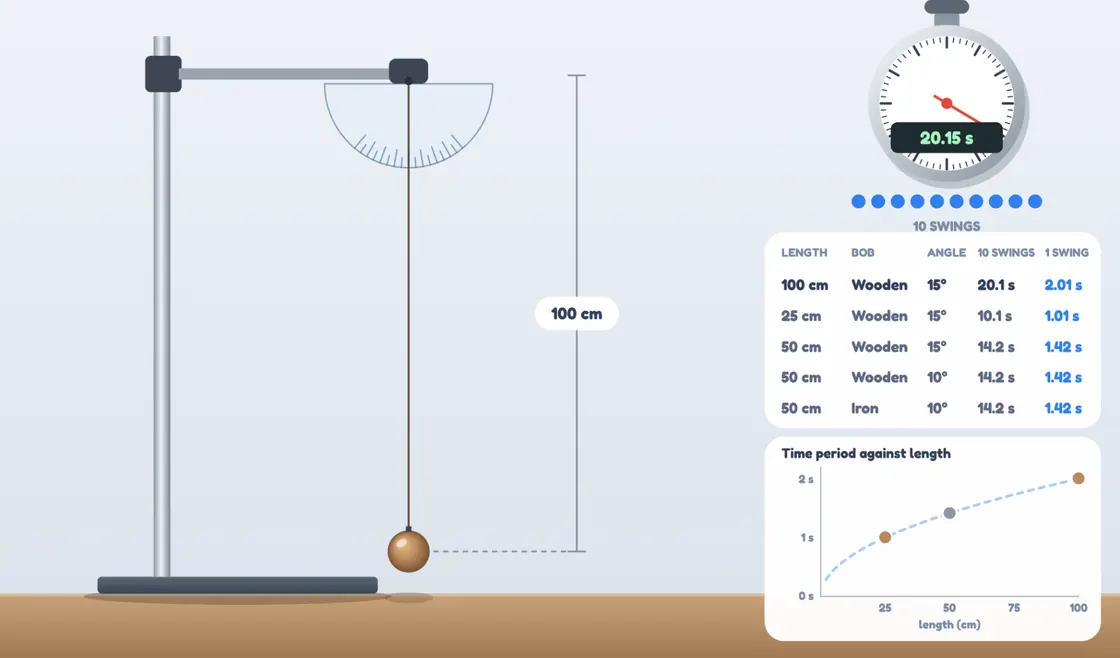
For older students, the formula for a simple pendulum swinging through small angles is T = 2π√(L/g). T is the period in seconds, L is the length in metres, and g is the strength of gravity, about 9.8 on Earth. There's no mass in it at all.
Does how far it swings change the period?
Hardly, for small swings. A pendulum pulled back 10 degrees takes only about 0.2% longer for each swing than one pulled back a tiny amount, and at 30 degrees it's still less than 2% longer. Only very wide swings make a real difference: let go from straight out sideways, at 90 degrees, and each swing takes about 18% longer.
So a pendulum keeps nearly the same beat as its swings slowly die away. That's what made pendulums so useful for clocks.
The story goes that Galileo Galilei noticed this as a young student in about 1583, watching a lamp swing in the cathedral in Pisa and timing it against his own pulse. The tale comes from a biography written decades later by his student Vincenzo Viviani, and historians aren't sure it happened that way. But Galileo did study pendulums, and he saw that their timing stays almost the same as the swings get smaller.
How long is a seconds pendulum?
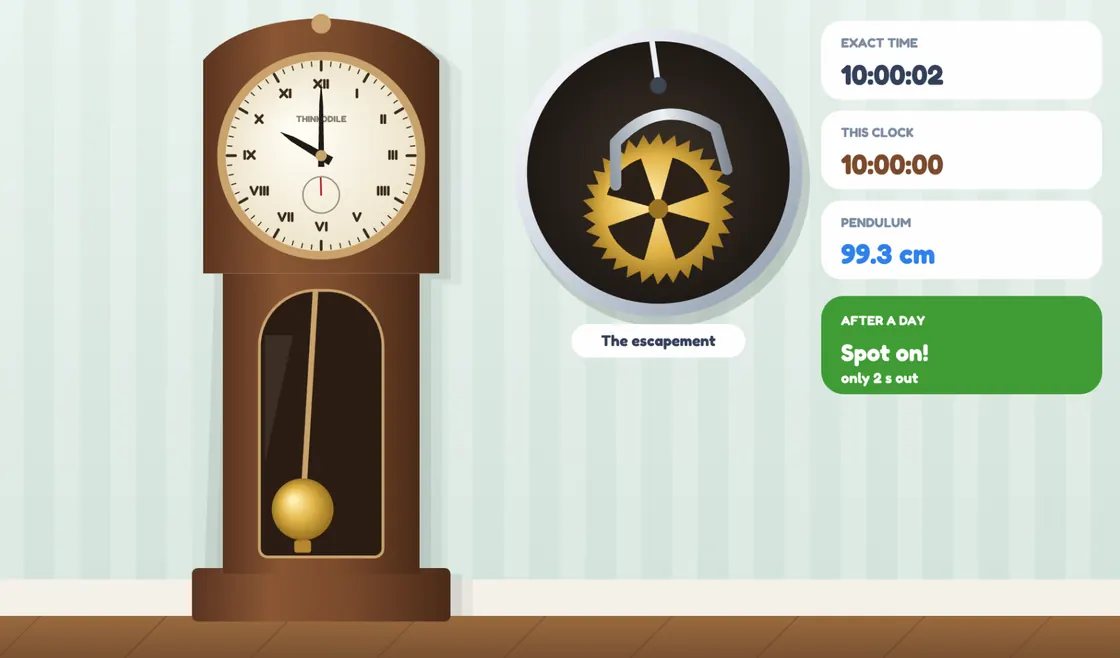
A seconds pendulum takes exactly 1 second to swing each way, so 2 seconds there and back. It's just under a metre long: about 99.4 cm, give or take a few millimetres depending on where you are. Tall longcase clocks, often called grandfather clocks, are built around one, which is why they're so tall and why they tick once a second.
Its length changes from place to place because gravity is slightly weaker near the equator than near the poles. In 1672, the French astronomer Jean Richer took a pendulum clock that kept good time in Paris to Cayenne, in what is now French Guiana, close to the equator. There it lost about two and a half minutes a day, and a pendulum that beat seconds in Cayenne had to be about 3 millimetres shorter than one in Paris. It was early evidence that gravity isn't the same all over the Earth.
What makes a pendulum swing faster?
Two things make a pendulum swing faster: a shorter length and stronger gravity. Nothing else makes much difference.
That's how pendulum clocks are adjusted. Most have a nut under the bob that moves it up or down. A clock that runs slow needs its bob raised, to make the pendulum shorter, and a clock that runs fast needs its bob lowered. The changes are tiny: raising the bob of a seconds pendulum by just 1 millimetre makes the clock gain about 43 seconds a day.
Gravity matters too. On the Moon, where gravity is about one sixth as strong as on Earth, a 1 metre pendulum would take about 4.9 seconds to swing there and back, so a grandfather clock there would run at well under half speed. To see how strong gravity is on other worlds, try our free weight on other planets calculator.
How do pennies keep Big Ben on time?
If the mass of the bob doesn't matter, here's a puzzle. The Great Clock in London's Elizabeth Tower, often called Big Ben, is kept on time with a small stack of old pennies.
The pennies sit on a small tray on the pendulum, above its heavy bob. Adding one raises the pendulum's centre of mass very slightly, which works like making the pendulum a tiny bit shorter, so it swings a little faster. According to the UK Parliament, each penny changes the clock's speed by about 0.4 seconds a day. So it isn't the extra weight that does it. It's where the weight sits.
Try it: a pendulum experiment at home
You'll need a piece of string about 1.2 metres long, a metal washer or nut, sticky tape, a tape measure and a stopwatch (a phone works).
- Hang it up. Tie the washer to one end of the string. Tape the other end to the edge of a high shelf or the top of a door frame, so that the washer hangs freely. Adjust it until it's 50 cm from the tape to the middle of the washer.
- Let it swing. Pull the washer about 10 cm to one side and let go without pushing.
- Time ten swings. Start the stopwatch as you let go, count ten swings there and back, then stop it. Divide the time by 10 to get the period. Timing ten swings and dividing is much more accurate than timing one.
- Repeat it three times and work out the average.
- Change only the length. Try 25 cm and 100 cm, keeping everything else the same.
- Change only the mass. Go back to 50 cm and add a second and a third washer, keeping the length the same.
- Change only the swing. Let go from 5 cm out, then from 20 cm out.
You should find that the length clearly changes the period, from about 1 second at 25 cm to about 2 seconds at 100 cm, while the extra washers and the different swings hardly change it at all. If the extra washers do seem to make a difference, check that the length to the middle of the bob hasn't changed.
Stay safe: use something small and blunt as the bob, like a washer or a nut, keep faces out of the way of the swing, and check that it's all right to tape things to the shelf or door frame first.
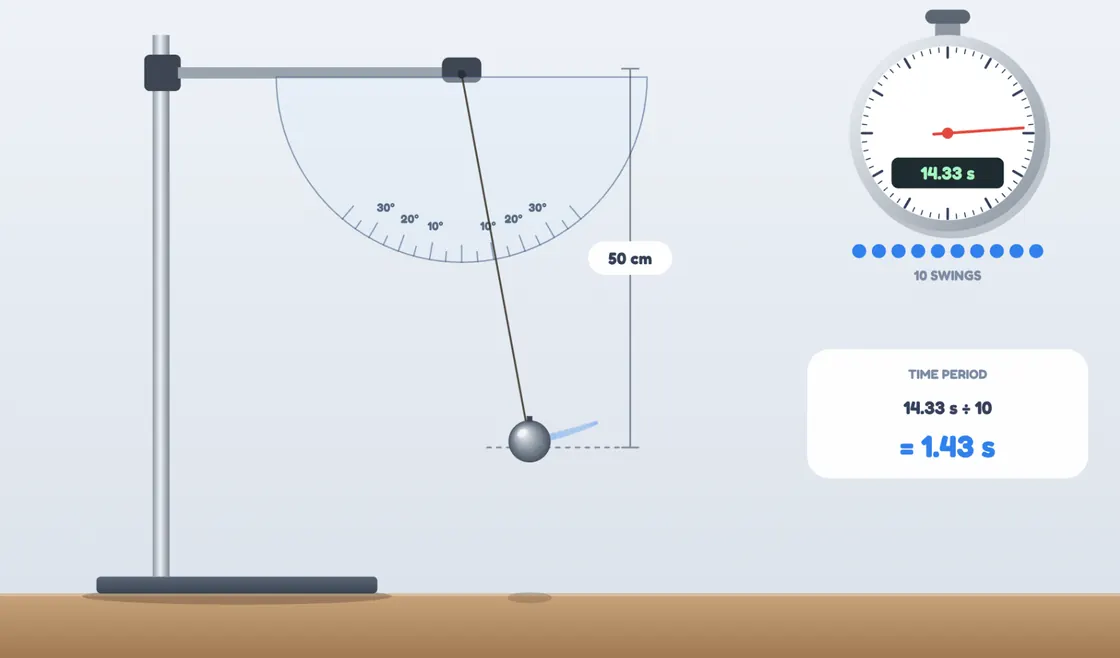
To make it a fair test, change one thing at a time and keep everything else the same. It also makes a good project: it's on our list of science fair project ideas. For more on measuring time and motion, see speed, distance and time.
Who invented the pendulum clock?
The Dutch scientist Christiaan Huygens invented the pendulum clock in 1656, and the clockmaker Salomon Coster built it in The Hague. Before that, good clocks could drift by around 15 minutes a day. Huygens's pendulum clocks kept time to within about 10 to 15 seconds a day. For nearly 300 years, until the 1930s, pendulum clocks were the most accurate timekeepers in the world.
In the Pendulum Clock quest, you can time ten swings with a stopwatch, run a fair test on the length, the bob and the angle, and fix a grandfather clock that runs slow by moving its bob until it keeps time for a whole day.
In short
- The period of a pendulum is the time for one swing there and back. On Earth, it depends almost entirely on the pendulum's length.
- A longer pendulum swings more slowly. Four times the length doubles the period: about 1 second at 25 cm, and 2 seconds at 1 metre.
- A heavier bob doesn't swing faster. Gravity pulls harder on it, but it's also harder to speed up, and the two cancel out.
- For small swings, how far it swings makes almost no difference, which is what makes pendulums so good at keeping time.
- Stronger gravity makes a pendulum swing faster. To make a slow pendulum clock catch up, make its pendulum shorter.
Questions people ask
Does mass affect the period of a pendulum?
No. A heavy bob and a light bob on strings of the same length swing with the same period. Gravity pulls harder on the heavier bob, but the heavier bob is also harder to speed up, and the two effects cancel exactly. In a real experiment, check that a bigger, heavier bob hasn't made the pendulum longer: measure from the pivot to the middle of the bob.
How long is a seconds pendulum?
About 99.4 cm, just under a metre. A seconds pendulum takes 1 second to swing each way, so 2 seconds there and back, and longcase clocks are built around one. Its exact length changes by a few millimetres from place to place, because gravity is slightly weaker near the equator. A pendulum that takes 1 second there and back is about 25 cm long.
Does amplitude affect the period of a pendulum?
Only a little, for small swings. The amplitude is how far the pendulum swings out from the middle. A swing of 10 degrees takes about 0.2% longer than a tiny one, and a swing of 30 degrees less than 2% longer. Very wide swings make a real difference: let go from 90 degrees, straight out sideways, and each swing takes about 18% longer.
What is the formula for the period of a pendulum?
For a simple pendulum swinging through small angles, T = 2π√(L/g). T is the period in seconds, L is the length in metres from the pivot to the middle of the bob, and g is the strength of gravity, about 9.8 on Earth. Mass isn't in the formula, because it doesn't change the period. Four times the length gives twice the period.
How do you make a pendulum swing faster?
Make it shorter. A shorter pendulum has a shorter period, so it swings to and fro more quickly. Stronger gravity would also do it, but you can't change that at home. Adding weight to the bob or pulling it back further won't help. To make a slow pendulum clock catch up, raise its bob a little with the nut underneath it.


