
Speed, distance and time formula, with worked examples
The speed, distance and time formula made simple: how to rearrange it, convert m/s to km/h, find average speed and read distance–time graphs, with examples.

Speed = distance ÷ time. To find the distance instead, multiply the speed by the time; to find the time, divide the distance by the speed. Speed simply tells you how far something travels in each second, or each hour.
Here's a puzzle from Coco, our crocodile guide. A bus travels 100 km in 2 hours. A train travels 70 km in 1 hour. Which is faster? The bus went further, but the train was faster: it covered 70 km in each hour, while the bus managed only 50.
What is the formula for speed, distance and time?
There's one formula, and you can arrange it three ways:
- Speed = distance ÷ time
- Distance = speed × time
- Time = distance ÷ speed
The word "per" is a clue. A speed of 5 metres per second (5 m/s) means 5 metres in each second. "Per" means "divided by", so metres per second is metres ÷ seconds: distance ÷ time.
A memory trick: the triangle
Draw a triangle with a line across its middle. Write D (distance) in the top half, and S (speed) and T (time) side by side in the bottom half. Now cover the letter you want to find with your finger:
- Cover S and you see D above T: speed = distance ÷ time.
- Cover T and you see D above S: time = distance ÷ speed.
- Cover D and you see S next to T: distance = speed × time.
One above the other means divide. Side by side means multiply.
What units is speed measured in?
Speed is a distance divided by a time, so its unit is a distance unit "per" a time unit. Scientists use metres per second (m/s), the SI unit. Road signs use kilometres per hour (km/h) in India and most of the world, and miles per hour (mph) in the UK and the US.
The golden rule: make the units match before you calculate. Kilometres and hours give km/h. Metres and seconds give m/s. If a time is in minutes and you want km/h, change the minutes into hours first: 30 minutes is 0.5 hours, 15 minutes is 0.25 hours and 45 minutes is 0.75 hours.
How do you convert m/s to km/h?
To turn m/s into km/h, multiply by 3.6. To go back from km/h to m/s, divide by 3.6.
Here's why. An hour has 3,600 seconds. Something moving at 1 m/s covers 3,600 metres in an hour, which is 3.6 km. So 1 m/s is the same as 3.6 km/h.
- A cheetah sprinting at 25 m/s: 25 × 3.6 = 90 km/h.
- A car at 72 km/h: 72 ÷ 3.6 = 20 m/s.
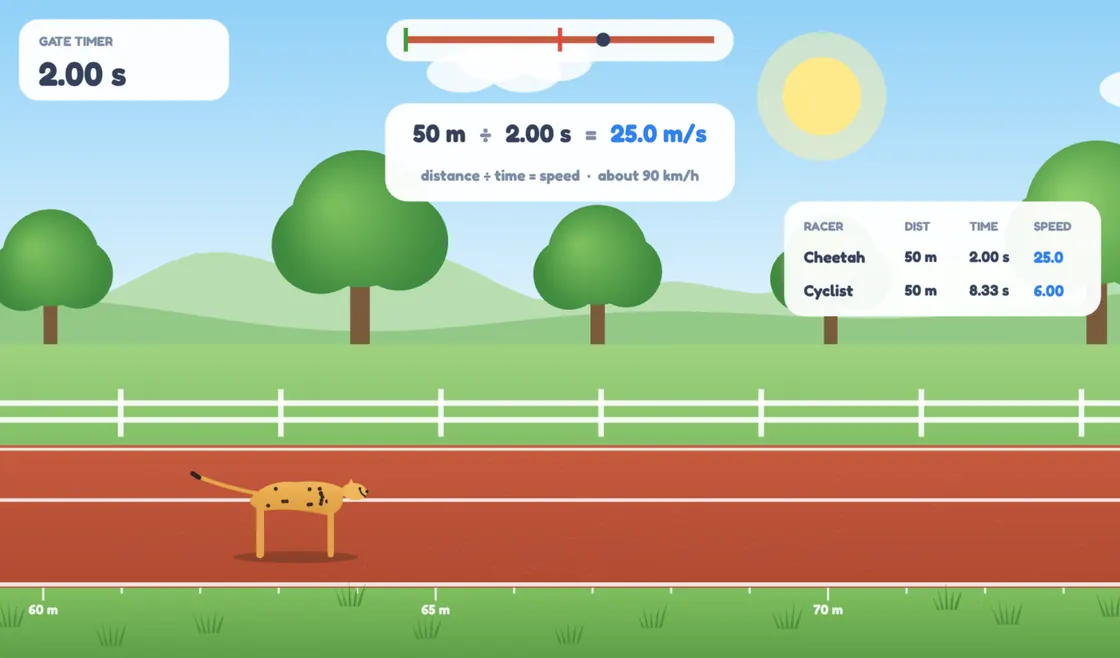
Worked examples
Try each one yourself before you read the answer.
1. Find the speed
Usain Bolt ran 100 m in 9.58 seconds in Berlin in 2009, a world record. What was his average speed?
Speed = distance ÷ time = 100 ÷ 9.58 = about 10.4 m/s. Multiply by 3.6 and that's about 37.6 km/h. His top speed was higher still, because he started the race from standing still.
2. Find the distance
A train travels at a steady 80 km/h for 45 minutes. How far does it go?
The speed is in km/h, so change the time into hours: 45 minutes = 0.75 hours. Distance = speed × time = 80 × 0.75 = 60 km.
3. Find the time
Your walk to school is 1.2 km, and you walk at 1.5 m/s. How long does it take?
The speed is in metres per second, so change the distance into metres: 1.2 km = 1,200 m. Time = distance ÷ speed = 1,200 ÷ 1.5 = 800 seconds, which is 13 minutes and 20 seconds.
4. Which is faster?
A car is doing 12 m/s. A moped is doing 40 km/h. Which is faster?
Put them in the same units first: 12 × 3.6 = 43.2 km/h. The car is faster, by about 3 km/h.
What is average speed?
Average speed is the total distance divided by the total time. Real journeys speed up, slow down and stop at traffic lights, so the speed keeps changing. The average speed is the steady speed that would cover the same distance in the same time.
A car's speedometer shows its speed right now. Its odometer shows how far it has travelled altogether.
A common mistake: you can't find an average speed by averaging the speeds. Say a family drives 30 km through town at 30 km/h, then 30 km on an open road at 60 km/h. The answer isn't 45 km/h. The first part takes 1 hour and the second takes half an hour, so they travel 60 km in 1.5 hours: 60 ÷ 1.5 = 40 km/h. They spent longer going slowly, so the slow part counts for more.
What are uniform and non-uniform motion?
Motion is uniform when something covers equal distances in equal times: its speed is steady. It's non-uniform when it speeds up, slows down or stops. Almost every real journey is non-uniform.
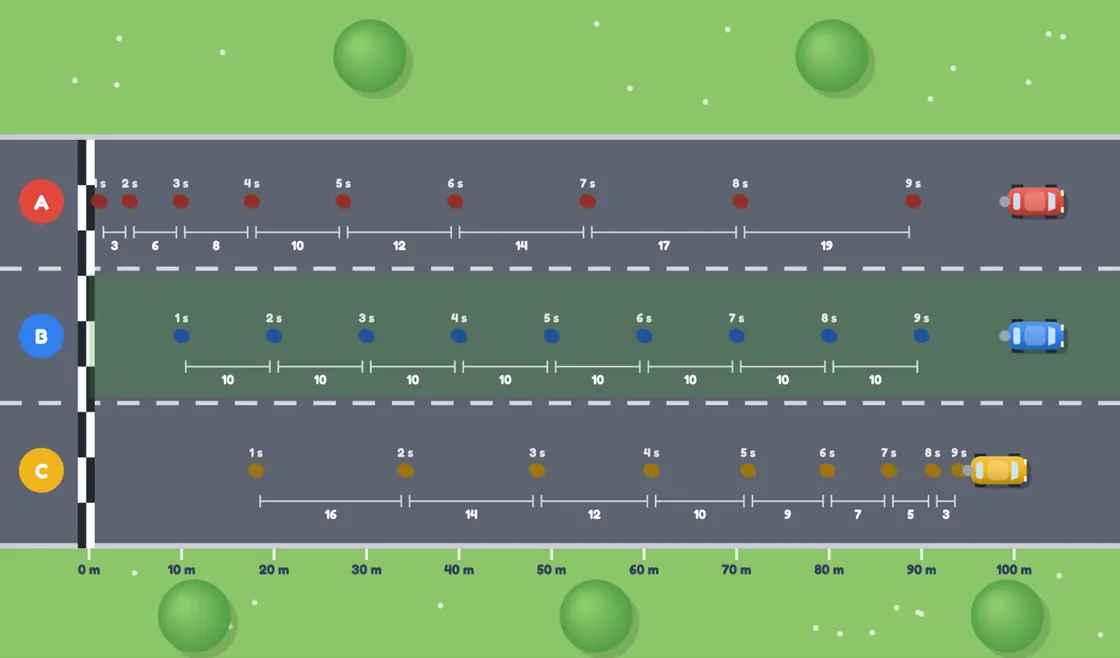
In Speed Lab's drip trail, three cars each leak one drop on the road every second. Car B's drops are always 10 m apart: uniform motion at 10 m/s. Car A's gaps grow from 3 m to 19 m, so it's speeding up. Car C's gaps shrink from 16 m to 3 m, so it's slowing down.
How do you read a distance–time graph?
On a distance–time graph, distance goes up the side and time goes along the bottom. The slope of the line shows the speed: the steeper the line, the faster the motion.
- A straight, sloping line means a steady speed.
- A steeper line means a faster speed.
- A flat line means the object has stopped: time passes, but the distance doesn't change.
- A line that curves upwards and gets steeper means speeding up. One that bends over and gets flatter means slowing down.
To find the speed on a straight part, read how far the line rises and how long that takes, then divide the distance by the time.
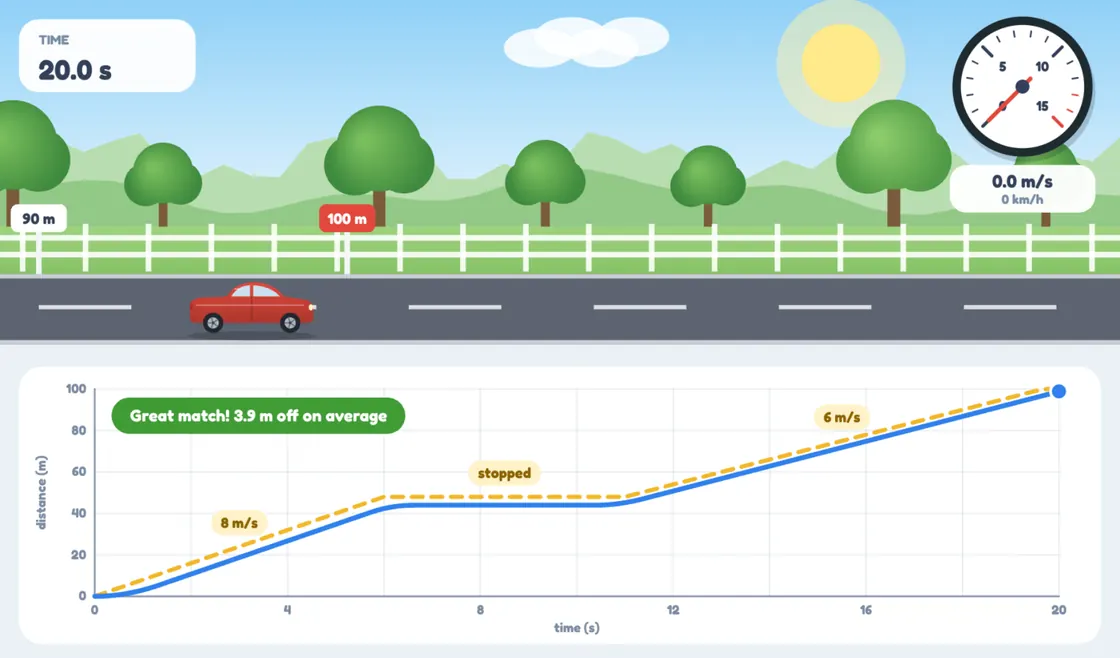
Worked example. On the target graph above, the line rises 48 m in the first 6 seconds: 48 ÷ 6 = 8 m/s. It stays flat for the next 5 seconds, so the car has stopped. Then it rises 54 m in 9 seconds: 54 ÷ 9 = 6 m/s. Altogether the car goes 102 m in 20 seconds, so its average speed is 102 ÷ 20 = 5.1 m/s.
Two mix-ups to avoid. First, a distance–time graph isn't a picture of the road: a line going up doesn't mean the car is climbing a hill. Second, always check the label on the side. On a speed–time graph, a flat line means a steady speed, not a stop.
In Speed Lab you draw these graphs by driving. You set the speed with a throttle, the graph draws itself as you go, and you try to drive along target lines called Steady, Stop and go, and Slow then fast.
Try it: measure your own speed
You need a tape measure, a stopwatch (a phone works) and a friend.
- In a park or playground, well away from roads, mark a start line and a finish line 20 m apart.
- Walk the 20 m while your friend times you from start to finish.
- Do it three times and take the average time.
- Work out your speed: 20 ÷ your time gives m/s. Multiply by 3.6 for km/h.
- Now try a jog and a sprint. Keep the distance, the start (from standing still) and the timer the same each time, so it's a fair test.
Pressing a stopwatch button takes a moment, which adds a small error to every time. A longer distance makes that error matter less. Speed Lab gets round it with light gates: the timer starts and stops itself as each racer passes the gates. For more on keeping tests fair, see teaching fair tests.
Speed sits in Motion & Measurement, alongside the Pendulum Clock quest, where you time a swinging pendulum. Once you can measure speed, Forces explains what makes things speed up and slow down.
In short
- Speed = distance ÷ time. Distance = speed × time. Time = distance ÷ speed.
- Make the units match first. To turn m/s into km/h, multiply by 3.6.
- Average speed is the total distance ÷ the total time, not the average of the speeds.
- On a distance–time graph, steeper means faster and flat means stopped.
Questions people ask
What is the formula for speed, distance and time?
Speed equals distance divided by time. It can be rearranged two ways: distance equals speed multiplied by time, and time equals distance divided by speed. A handy memory aid is a triangle with D on top and S and T underneath: cover the letter you want, and the other two show the sum. Make sure the units match before you calculate, such as kilometres with hours, or metres with seconds.
How do you convert m/s to km/h?
Multiply by 3.6. An hour has 3,600 seconds, so something moving at 1 metre per second covers 3,600 metres, or 3.6 kilometres, in an hour. For example, 25 m/s is 90 km/h. To convert the other way, from km/h to m/s, divide by 3.6: 72 km/h is 20 m/s.
How do you work out average speed?
Divide the total distance travelled by the total time taken, including any stops. Don't average the separate speeds. If you drive 30 km at 30 km/h and then 30 km at 60 km/h, the trip covers 60 km in 1.5 hours, so the average speed is 40 km/h, not 45 km/h, because more of the time was spent going slowly.
What does a flat line on a distance–time graph mean?
A flat, horizontal line on a distance–time graph means the object has stopped. Time keeps passing along the bottom axis, but the distance up the side stays the same. A straight sloping line means a steady speed, and the steeper it is, the faster the object is moving. On a speed–time graph, a flat line means something different: a steady speed.
What is the difference between speed and velocity?
Speed tells you how fast something is moving: how far it goes each second or each hour. Velocity is speed in a particular direction, such as 20 m/s north. Two cars driving at 50 km/h in opposite directions have the same speed but different velocities. A car going round a roundabout at a steady speed has a changing velocity, because its direction keeps changing.


