
Conductors and insulators: everyday examples, and a home test
Conductors and insulators explained, with everyday examples of each, the tricky cases (water, pencil lead, your body) and a safe battery tester to make at home.

A conductor is a material that lets electric current flow through it easily. An insulator is a material that doesn't. Metals such as copper, aluminium, iron and steel are good conductors; plastic, rubber, glass, dry wood, paper and air are insulators. That's why the wire in a charger cable is copper on the inside and plastic on the outside.
What are conductors and insulators?
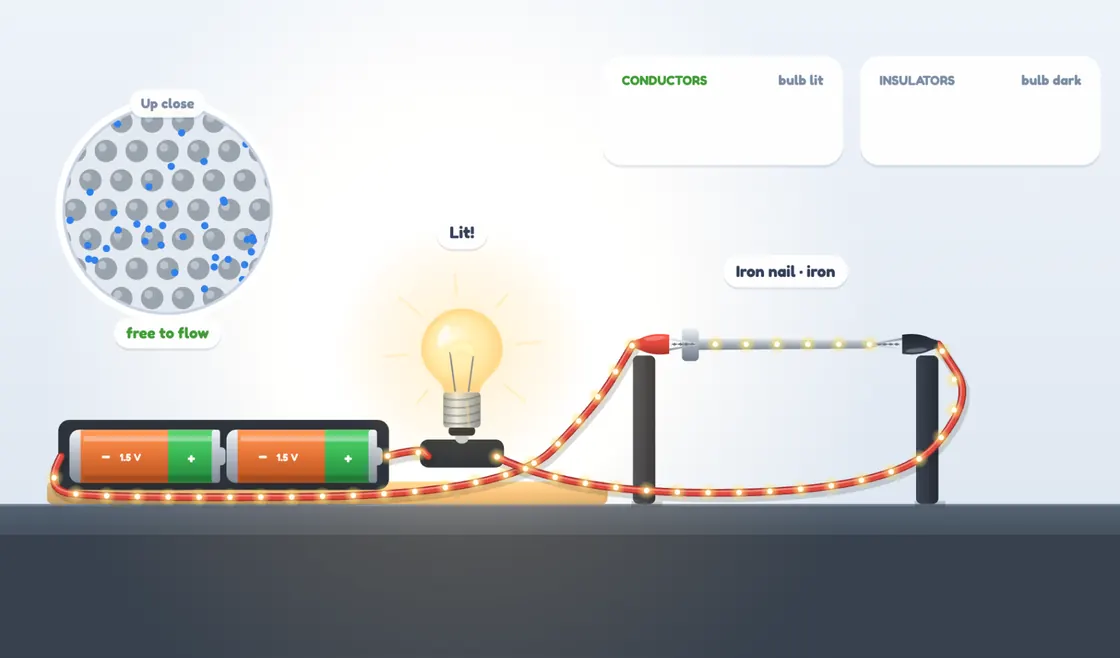
Conductors let electric current pass through them; insulators stop it. You can test any object by putting it across a gap in a circuit: if a bulb in the circuit lights up, the object is a conductor.
The split isn't always perfectly neat. A few materials, like pencil lead and tap water, let some current through but not much, so scientists often talk about good and poor conductors. For most everyday things, though, the two groups are clear.
Why do metals conduct electricity?
Metals conduct because some of their electrons are free to move. In most materials, every electron is held tightly by its own atom. In a metal, some electrons aren't tied to any one atom: they drift about between the atoms. Connect a battery and it pushes these free electrons along the metal. That flow of charge is the electric current.
In plastic, rubber, glass and wood, the electrons are held tight. With nothing free to move, almost no current can flow.
Examples of conductors
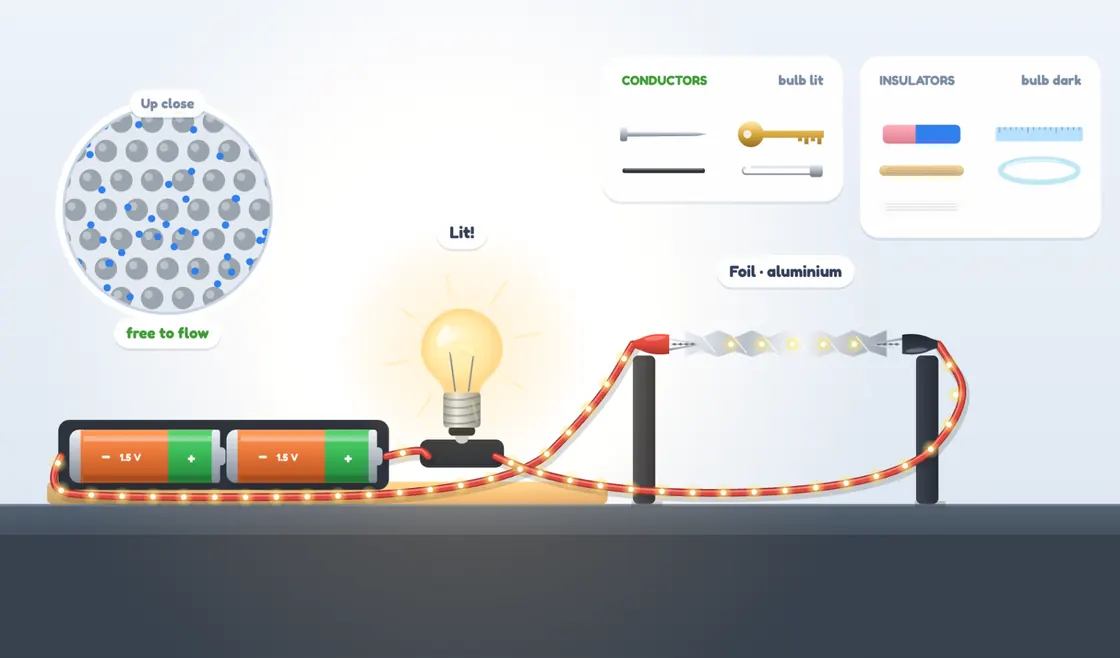
- Copper: the wires inside cables, chargers and plugs
- Aluminium: kitchen foil, and many overhead power lines
- Iron and steel: nails, paper clips, safety pins, scissors and spoons
- Brass: keys, and the pins of many plugs
- Tungsten: the thin, glowing filament in an old-style bulb
- Silver and gold: excellent conductors, used in some electronics (silver conducts best of all the metals)
- Graphite: the "lead" in a pencil, and one of the few non-metals that conducts
- Tap water, salty water and the human body: more on these below
Examples of insulators
- Plastic: the coat on wires, plug cases, switches and the handles of electricians' screwdrivers
- Rubber: erasers, balloons and rubber bands
- Glass: bottles, windows and bangles
- Dry wood: rulers and lolly sticks
- Paper and card
- Ceramics: mugs, plates and tiles, and many of the insulators that hold power lines on pylons (others are glass or tough plastic)
- Dry air: when a switch is off, there's a gap of air inside it, and the current stops. Lightning is the exception: its huge voltage forces a path through the air.
Notice the word "dry". Wood, paper and cloth soak up water, and damp ones can let some current through. A wooden ladder won't keep you safe near power lines.
The tricky cases
Is water a conductor?
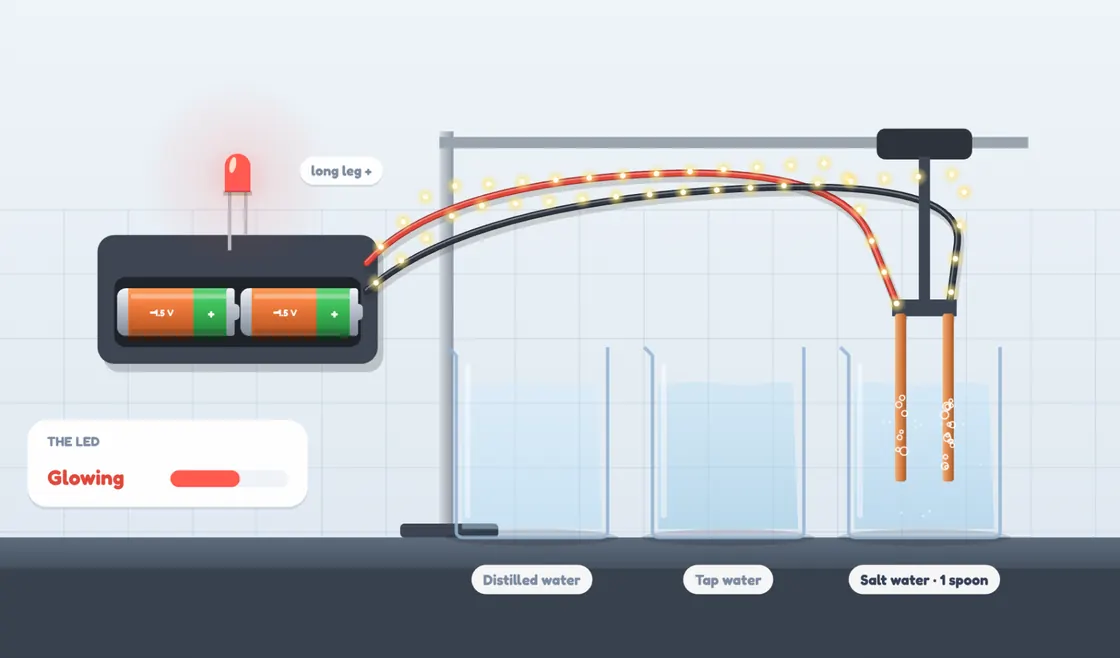
Pure water is a very poor conductor: the US Geological Survey calls it an excellent insulator. But the water around us is almost never pure. Tap water, rivers and the sea all have salts and minerals dissolved in them. When salt dissolves, it splits into tiny charged particles called ions, and these carry a current through the water.
So distilled water hardly conducts, tap water conducts a little, and salty water conducts well. The more salt, the better it conducts. This is why water and electricity are such a dangerous mix.
Is pencil lead a conductor?
Yes. Pencil "lead" has no lead in it: it's graphite, a form of carbon, mixed with clay. Graphite isn't a metal, but some of its electrons can move, so it conducts. It doesn't conduct as well as a metal, so a bulb glows more dimly. Softer pencils, like a 4B, contain more graphite than harder ones, like a 4H. Test both and compare.
Does the human body conduct electricity?
Yes. Your body is mostly water with salts dissolved in it, so it conducts. Dry skin resists current quite well: a medical review found that more than 99% of the body's resistance to current is in the skin. Wet skin lets far more through. That's why you should never touch plugs, switches or sockets with wet hands, and never use mains appliances near a bath or sink.
How to make a conductor tester at home
A tester is just a circuit with a gap in it. You need:
- A battery holder for 2 AA batteries, with its two wires, and 2 AA batteries
- A small torch bulb (2.5 V or 3 V) in a bulb holder
- 2 wires with crocodile clips on the ends
- Things to test: a key, a coin, foil, a paper clip, a pencil sharpened at both ends, an eraser, a plastic ruler, a lolly stick, paper and a glass
Then:
- Join the battery holder's red wire to one side of the bulb holder.
- Clip one crocodile-clip wire to the other side of the bulb holder, and the other to the battery holder's black wire. Their two loose clips are your probes.
- Touch the two loose clips together. The bulb should light: your tester works.
- Now clip both probes onto the thing you're testing, a few centimetres apart.
- If the bulb lights, it's a conductor. If it stays dark, it's an insulator. Sort everything into two piles.
To test water, swap the bulb for an LED with a resistor (about 100 Ω; beginner kits often sell them together). A bulb needs quite a big current, but an LED glows with a tiny one. An LED only lights one way round: its longer leg goes towards the + end of the battery. Dip the two probes into a cup of water without letting them touch. Try distilled water first if you have some, then tap water, then stir in salt a spoonful at a time. You may see tiny bubbles on the probes: the current is causing a small chemical change, so keep each test short.
Stay safe: use batteries only. Never test anything in a mains socket or poke anything into one: mains electricity can kill. Never join the two battery wires together without the bulb in between; that's a short circuit, and the wires and batteries get hot fast. Keep water well away from plugs, sockets and switches, and ask an adult to strip the ends of any bare wires.
How do conductors and insulators keep us safe?
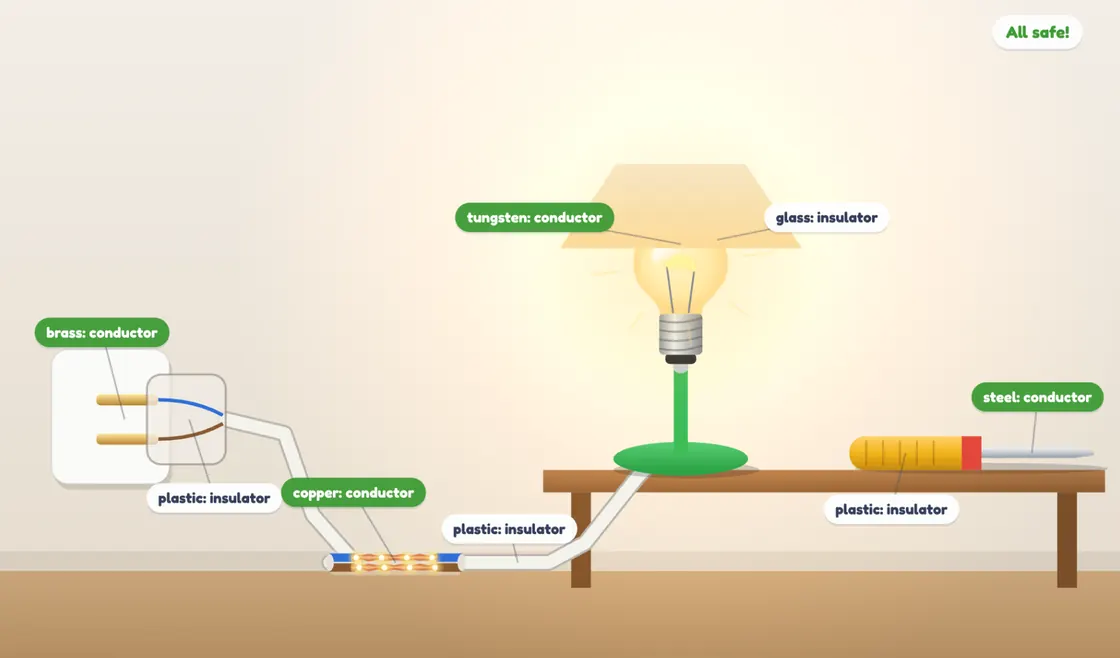
Every electrical thing in your home uses both: a conductor to carry the current where it's needed, and an insulator wrapped round it to keep the current in and away from you. A cable is copper inside plastic. A plug has brass pins in a plastic case. A bulb's filament is tungsten, held inside glass. An electrician's screwdriver has a steel tip and a plastic handle.
To build circuits of your own, with a switch and a torch to fix, try Light It Up. Fuses & Safety shows what happens when too much current flows. Metals are good conductors of heat too, which you can test in Heat on the Move. And the same battery and copper wire can make a magnet: here's how to make an electromagnet.
In short
- Conductors let electric current through; insulators don't.
- Metals conduct because they have free electrons. Graphite conducts too, though it isn't a metal.
- Pure water hardly conducts, but tap water and salty water do, and so does your body.
- Two batteries, a bulb and some wires make a tester. Never test anything with mains electricity.
Questions people ask
Is water a conductor or an insulator?
Pure water, such as distilled water, is a very poor conductor and behaves almost like an insulator. But ordinary water from the tap, rivers or the sea has salts and minerals dissolved in it. These form charged particles called ions, which carry current, so everyday water conducts. Salty water conducts much better than tap water. That is why water and electricity should never be mixed.
Is the human body a conductor of electricity?
Yes. The body is mostly water with salts dissolved in it, so it conducts electricity. Dry skin resists current quite well, and a medical review found that more than 99% of the body's resistance to current is in the skin. Wet skin lets far more current through, which is why you should never touch plugs, switches or sockets with wet hands.
Which metal is the best conductor of electricity?
Silver is the best electrical conductor of all the metals, with copper a close second, followed by gold and then aluminium. Most wires are made of copper because it conducts almost as well as silver but costs far less. Aluminium is lighter, so it is used for many overhead power lines. Gold doesn't corrode easily, so it is used to coat some electrical contacts.
Is wood a conductor or an insulator?
Dry wood is an insulator, which is why a ruler or lolly stick won't light the bulb in a simple circuit tester. Damp or wet wood is different: the water in it, with its dissolved salts, lets some current through. That is why safety experts warn that a wooden ladder will not protect you near power lines. Keep all ladders and long objects well away from overhead wires.
Is graphite a conductor of electricity?
Yes. Graphite, the material in pencil lead, is a form of carbon. It isn't a metal, but some of its electrons are free to move, so it conducts electricity, though not as well as metals do. In a simple battery tester, a pencil sharpened at both ends can make the bulb glow, but more dimly than a metal key or nail does.


