
Do heavier objects fall faster? Why Galileo was right
Do heavier objects fall faster? No. Without air in the way, heavy and light objects fall together, as an astronaut showed on the Moon in 1971.

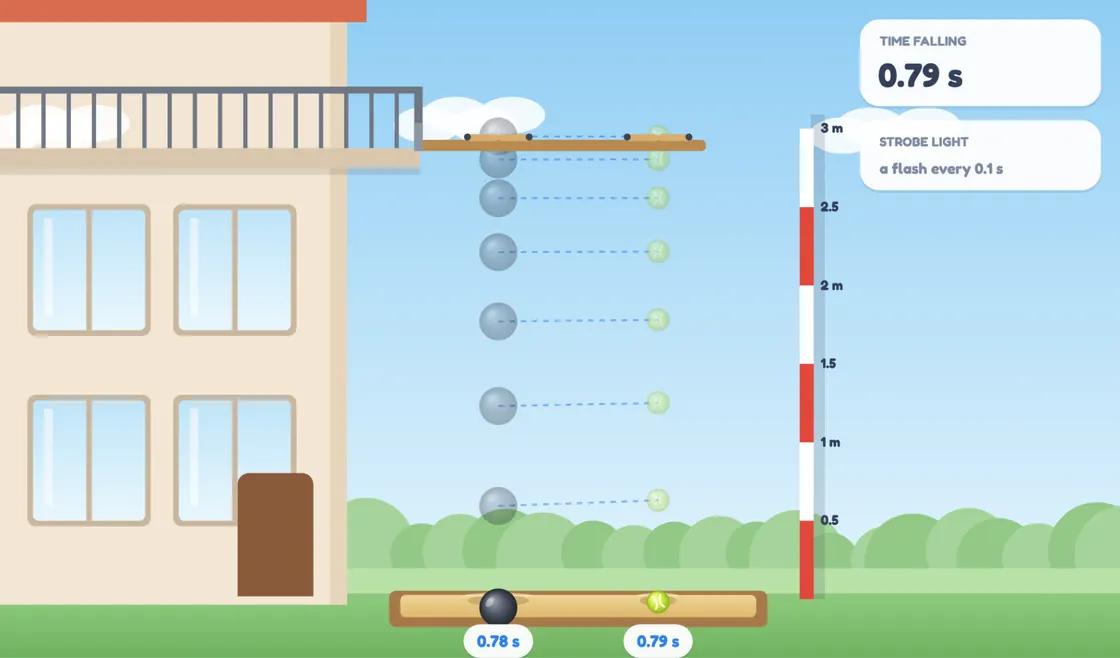
No. Without air in the way, heavy and light objects fall at exactly the same rate. Drop a bowling ball and a tennis ball from the same height at the same moment, and they land together. Air is the only reason a feather or a flat sheet of paper drifts down slowly, and on the Moon, where there's no air, a hammer and a feather hit the ground together.
It's one of the most surprising facts in science, because it feels so wrong. For nearly 2,000 years, most people believed the opposite.
Why do heavy and light objects fall at the same speed?
They fall together because two effects of mass cancel out. Gravity pulls harder on a heavier object, but a heavier object is also harder to get moving. Twice the mass means twice the pull, but also twice the effort to speed it up, so the result is the same.
Think of pushing two shopping trolleys, one empty and one full. To get the full one moving just as quickly, you'd have to push twice as hard. Gravity does exactly that: it pulls the full trolley twice as hard, so both speed up at the same rate. The same cancellation is why a heavier pendulum doesn't swing any faster.
Near Earth's surface, every falling object speeds up by about 9.8 metres per second, every second. After one second it's moving at nearly 10 m/s (about 35 km/h) and has fallen about 5 metres. A ball dropped from a 3 m balcony takes about 0.8 seconds to land, whatever it's made of.
Why does a feather fall more slowly?
A feather falls slowly because of air resistance. As anything falls, it has to push air out of the way, and the air pushes back. For a heavy, compact object like a stone, that push is tiny compared with the pull of gravity. For something light with a big surface, like a feather or a flat sheet of paper, the air's push is almost as big as the pull, so it drifts.
The faster something falls, the harder the air pushes back. Eventually the push can grow until it balances the pull of gravity, and the object stops speeding up. That top speed is called terminal velocity. A feather reaches its terminal velocity almost straight away, which is why it drifts. A skydiver reaches theirs after several seconds, and opening a parachute adds so much air resistance that the speed drops to a gentle one.
So do heavier objects fall faster in air?
Sometimes, by a little. If two objects are the same size and shape, the air pushes back on them in the same way, but the heavier one has more pull from gravity to overcome that push. So in air, a heavy ball falls very slightly faster than a light ball of the same size. From a balcony the difference is too small to see. From the top of a tall building, it starts to show.
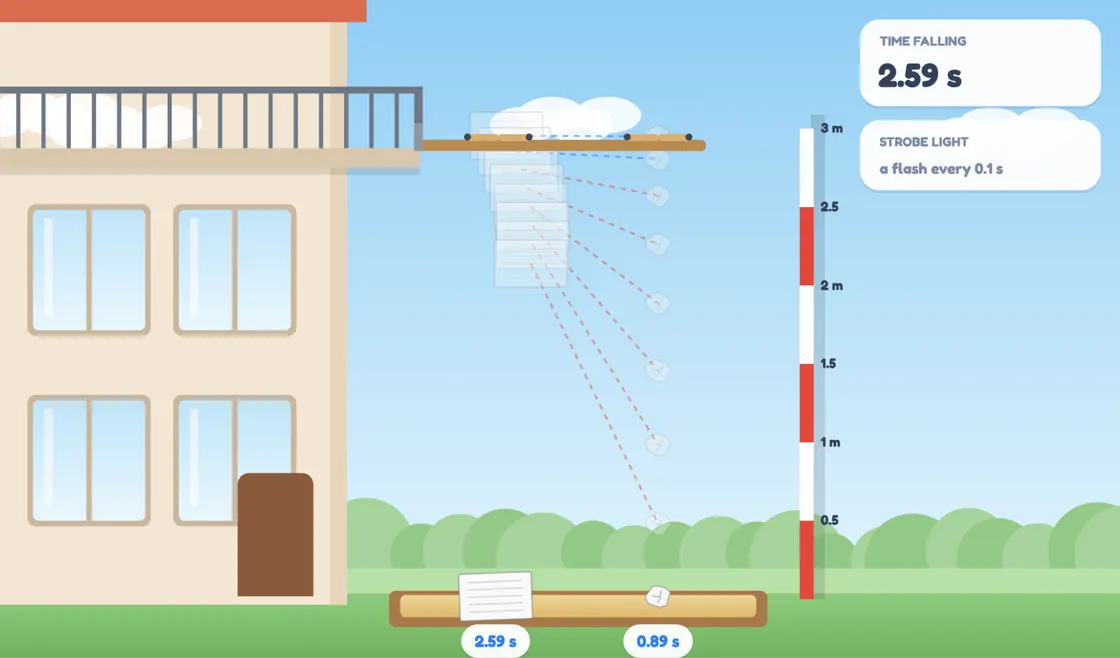
So the full answer is this: gravity makes everything fall at the same rate, and air resistance is what makes some things fall more slowly. Shape usually matters far more than weight. That's why a crumpled ball of paper falls much faster than a flat sheet of the same paper, even though they weigh exactly the same.
What did Galileo show?
For centuries, people followed the Greek thinker Aristotle, who taught that heavier objects fall faster than lighter ones. It seemed obvious: stones fall quickly, and leaves don't.
In the late 1500s and early 1600s, the Italian scientist Galileo Galilei argued that this was wrong, and he gave a brilliant argument without needing to drop anything. Imagine tying a heavy stone to a light one. If heavy things fall faster, the light stone should hold the heavy one back, so the pair falls more slowly than the heavy stone alone. But the pair is heavier than the heavy stone, so it should fall faster. It can't do both. The only answer that makes sense is that weight doesn't change how fast things fall.
You may have heard that Galileo dropped two balls from the Leaning Tower of Pisa. That story comes from a biography written by his student Vincenzo Viviani, and most historians think it probably never happened, or at least not as told. A real drop test did take place, though: in 1586, the Flemish engineer Simon Stevin and Jan Cornets de Groot dropped two lead balls of different weights about 30 feet from a church tower in Delft, in the Netherlands, and they landed together.
Galileo's own experiments used ramps. Falling is too quick to time well by eye, so he rolled balls down gentle slopes, which slowed the motion enough to measure it.
The hammer and feather on the Moon
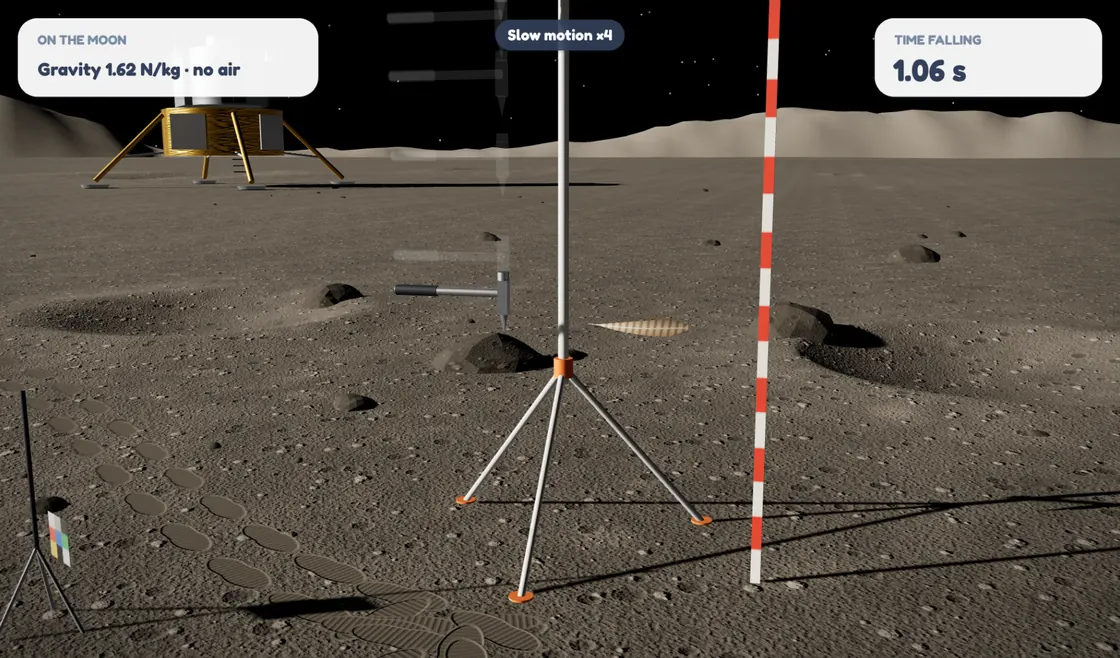
The most famous test happened on the Moon. On 2 August 1971, at the end of the last moonwalk of the Apollo 15 mission, astronaut David Scott held up a 1.32 kg aluminium geological hammer in one hand and a falcon feather in the other, and let them go together in front of the TV camera.
With no air on the Moon to slow the feather, they fell side by side and hit the dusty ground at the same moment. Scott told the watching world that it showed Galileo had been right. NASA's video of the drop is short, and it's well worth watching.
They also fell slowly. The Moon's gravity is about one sixth of Earth's, so things speed up about six times more gently. In the Gravity Drop quest, a hammer takes about 1.4 seconds to fall 1.6 metres on the Moon, against about 0.6 seconds on Earth.
Try it: a flat sheet of paper against a crumpled one
You don't need a moon to test this. Find two sheets of the same paper.
- Crumple one sheet into a tight ball and leave the other flat.
- Hold them at the same height, with the flat sheet held level, like a table top.
- Let go together and watch which lands first.
- Swap hands and repeat a few times, so that you know it isn't just one hand letting go sooner.
The crumpled ball wins easily, even though both sheets weigh the same. Its smaller shape means much less air pushes against it.
Now try a sneaky one. Put a small flat sheet of paper on top of a heavy book, so that the paper doesn't hang over the edges, and drop the book flat. The paper falls with the book, all the way down, because the book clears the air out of its way. Take away the air resistance, and the light paper keeps up with the heavy book.
Stay safe: drop things onto a soft floor or carpet, away from feet and anything breakable. Never drop things from a height or onto people.
To make it a fair test, change one thing at a time: the same paper, the same drop height, and only the shape changing. There's a parachute version on our list of science fair project ideas, and the Friction quest looks at drag in more detail.
What's the difference between mass and weight?
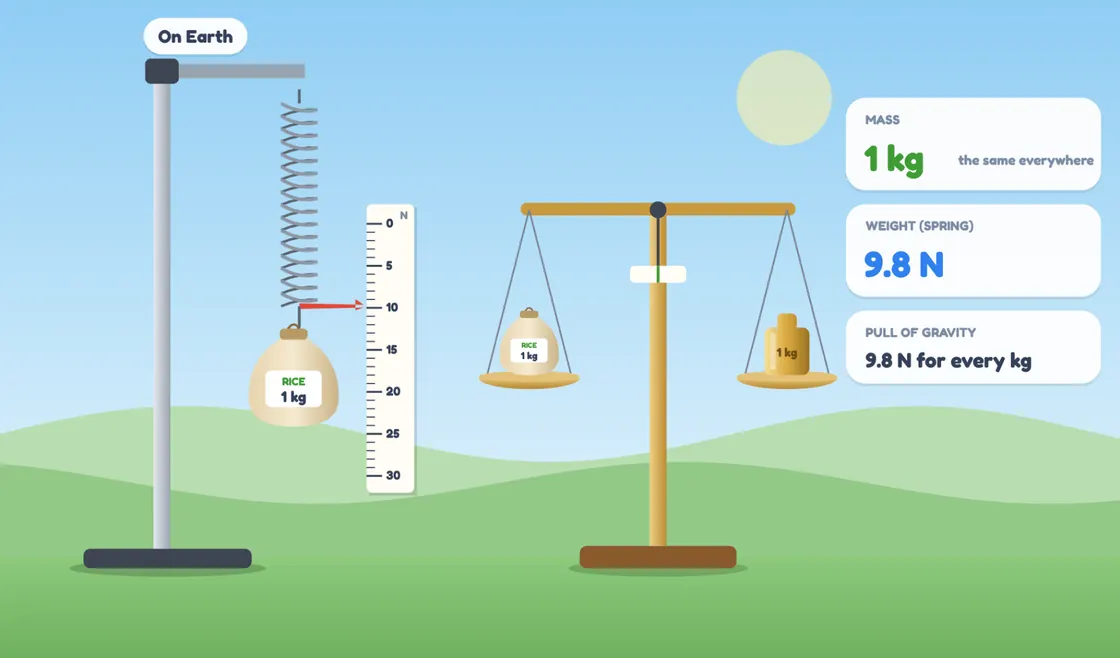
Mass is how much stuff something is made of, measured in kilograms. Weight is how hard gravity pulls on it, a force measured in newtons. Your mass is the same everywhere, but your weight depends on where you are.
On Earth, gravity pulls about 9.8 newtons on every kilogram, so a 1 kg bag of rice weighs about 9.8 N. On the Moon, it weighs about 1.6 N, around one sixth as much, but it's still 1 kg of rice. Bathroom scales show kilograms because they assume you're on Earth.
To see what you'd weigh on every world, try our free weight on other planets calculator.
This explains why heavy and light things fall together. A heavier object has more weight pulling it down, but it also has more mass to get moving. On any world, the two go up together, so everything falls at that world's rate.
In the Gravity Drop quest, you can drop heavy and light things from a balcony with a strobe light, drop a hammer and a feather on a 3D Moon, race a flat and a crumpled sheet of paper, and weigh the same bag of rice on four worlds.
In short
- Without air, heavy and light objects fall at the same rate, because gravity's extra pull on a heavier object is exactly matched by the extra effort needed to speed it up.
- Air resistance is what makes feathers and flat paper fall slowly. Shape usually matters far more than weight.
- In air, a heavy ball can fall very slightly faster than a light ball of the same size, but from everyday heights you can't see the difference.
- Galileo argued that weight doesn't change how fast things fall, and astronaut David Scott proved it on the Moon in 1971 with a hammer and a feather.
- Mass is how much stuff something has, in kilograms. Weight is gravity's pull on it, in newtons, and it changes from world to world.
Questions people ask
Do heavier objects fall faster in a vacuum?
No. In a vacuum there's no air resistance, so every object falls at exactly the same rate, whatever its weight or shape. A feather and a bowling ball dropped together in a vacuum chamber land at the same moment. Gravity pulls harder on the heavier object, but it also takes more effort to speed up, and the two effects cancel out exactly.
Do heavier objects fall faster on the Moon?
No. The Moon has no air, so heavy and light objects fall together there. Astronaut David Scott showed this in 1971 by dropping a hammer and a falcon feather at the same moment: they landed together. Everything falls more slowly on the Moon than on Earth, though, because the Moon's gravity is only about one sixth as strong.
Did Galileo really drop balls from the Leaning Tower of Pisa?
Probably not. The story comes from a biography by Galileo's student Vincenzo Viviani, and most historians think it either didn't happen or didn't happen as told. Galileo did study falling with balls rolling down ramps, and he argued with pure reasoning that weight can't change the speed of a fall. A real tower drop was done in Delft in 1586 by Simon Stevin and Jan Cornets de Groot.
Why does a crumpled sheet of paper fall faster than a flat one?
Both sheets have the same mass, so gravity pulls on them equally. The difference is air resistance. The flat sheet has a big surface pushing against the air, so the air pushes back hard and slows it down. The crumpled ball is small and compact, so much less air pushes on it and it falls far faster. Shape usually matters more than weight.
How fast do objects fall on Earth?
Near Earth's surface, a falling object speeds up by about 9.8 metres per second every second, as long as air resistance is small. After one second it's moving at about 10 m/s and has fallen about 5 metres. After two seconds it's moving at about 20 m/s and has fallen about 20 metres. Air resistance eventually stops it speeding up, at its terminal velocity.


