
Transpiration experiment with a plastic bag, and what it shows
Tie a clear plastic bag round a leafy branch, leave it in the sun for a few hours, and water collects inside. That water came out through the leaves.

Tie a clear plastic bag round a leafy branch on a sunny day, and within a few hours you'll see mist, then water droplets, on the inside. That water came out of the leaves as an invisible gas. The experiment shows transpiration: plants give off water vapour all day long, and the bag catches it.
It's cheap and quick, and it works on a garden tree or a potted plant. Add one small thing, a second bag with no leaves in it, and it goes from a nice demonstration to a real test.
What is transpiration?
Transpiration is the loss of water vapour from a plant, mostly through tiny pores in its leaves. Water travels up from the roots, evaporates inside the leaf and escapes into the air.
It happens on a much bigger scale than you'd guess. The US Geological Survey estimates that a large oak tree can transpire about 151,000 litres of water in a year. Most of the water a plant takes up goes this way: plant science textbooks put it at around 97 to 99%, with only a small share staying in the plant.
How do you do the plastic bag experiment?
Pick a dry, sunny morning. You need a leafy plant, two clear plastic bags with no holes, some string or twist ties, and a leafless stick or dead twig.
- Choose a healthy branch in the sun. Check that the leaves and the bag are dry. Rain or dew on the leaves would end up in your results.
- Slip one bag over the leaves. Count how many leaves are inside, and leave some air in the bag so that it isn't pressed flat against them.
- Tie the bag snugly round the stem, tight enough to seal it but gentle enough not to crush the stem.
- Set up your control. Tie the second bag round the leafless stick or dead twig, in the same sunny spot.
- Note the time and look every half hour or so. Write down when you first see mist, and when you first see droplets.
- Take both bags off when you finish. Carefully pour any water into a measuring syringe or a small measuring jug, and note how much there is.
Stay safe: ask before you bag a branch that isn't yours, and only use a plant you know. Some common garden plants, such as oleander, are poisonous. Wash your hands afterwards, and keep plastic bags away from babies and young children.
On a potted plant, tie the bag round the leaves only, not the whole pot. Damp soil gives off water too, and you'd have no way of telling where the water came from.
Why bother with a second bag?
Without it, someone could fairly say that the water was already in the air inside the bag. The control answers that. It traps the same air in the same sun, but it has no leaves, so anything extra in the first bag must have come from the plant.
India's NCERT Class 10 science book uses the same logic with two pots: one holds a plant and the other a stick of the same height. The soil is covered so it can't give off water, and each pot is covered with plastic. Droplets form only over the plant.
What should you see, and how long does it take?
On a warm, sunny day, the bag on the leafy branch usually starts to mist up within about an hour, and droplets gather within a few hours. Cool, cloudy or humid weather takes longer and gives less. The bag on the stick should stay nearly clear. It may mist a little, because air always holds some water vapour, but it won't keep collecting water.
There's no single right amount. It depends on the plant, the number of leaves and the weather, so even a few drops is a result.
The droplets appear because the air in a sealed bag soon can't hold any more water vapour. The extra vapour condenses on the plastic, the same way your breath mists up a cold window.
One thing the bag can't tell you is how fast the branch loses water normally. As the air in the bag gets more humid, water leaves the leaves more slowly, and the sun heats the bag as well. So use your measurements to compare one bag with another, not as the branch's true rate.
Where does the water come out? Meet the stomata
Most of the water leaves through stomata, tiny pores that you'd need a microscope to see. (Just one is a stoma.) Each stoma sits between two guard cells. When the guard cells fill with water they bend apart and the pore opens. When they lose water, it closes.
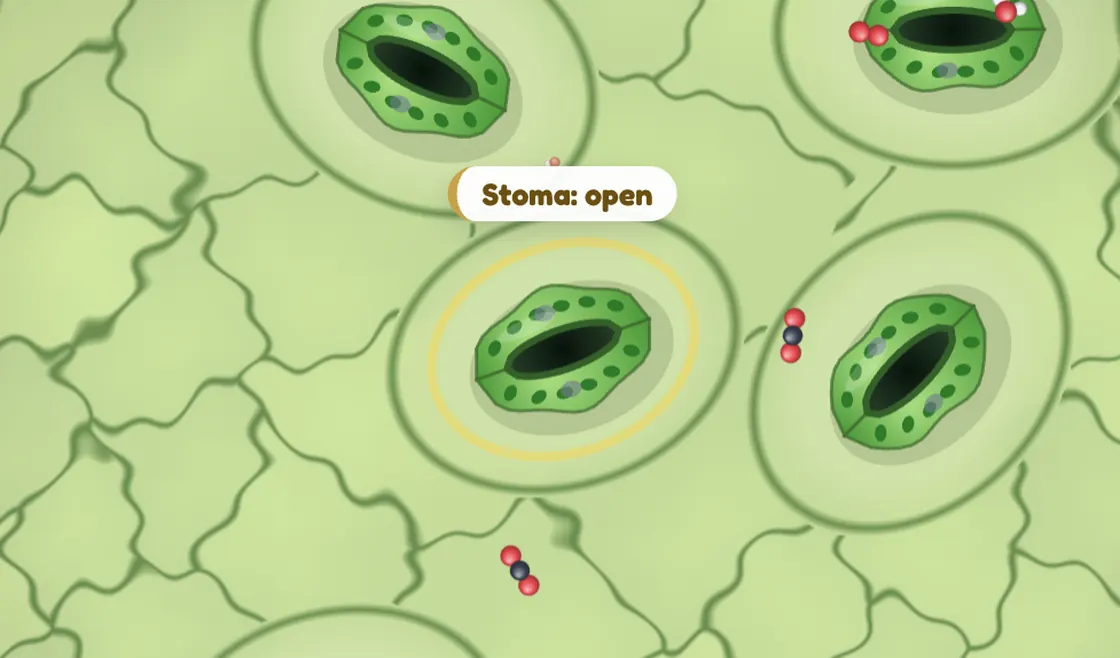
On most broad-leaved plants, the majority of stomata are on the underside of the leaf, where it's shadier and cooler, so less water is lost. Water lilies are a well-known exception: their leaves float, so their stomata are on top.
The grease test
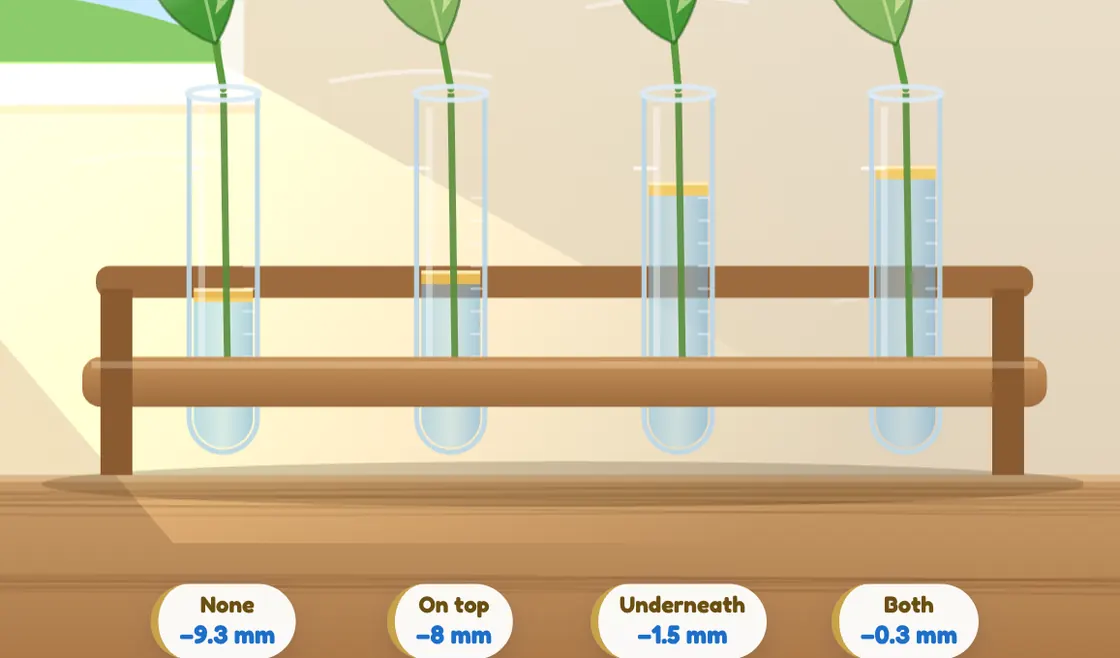
You can test this at home with petroleum jelly, which blocks the pores. Take four similar leaves with their stalks, from a plant you know is safe:
- Leaf A: no grease.
- Leaf B: grease on top.
- Leaf C: grease underneath.
- Leaf D: grease on both sides.
Stand each stalk in its own narrow glass or test tube of water, with a few drops of cooking oil floating on top so that water can't evaporate from the surface. Mark the water levels, and leave them in a bright place for a few days. The leaves with grease underneath should lose far less water than the one with grease on top.
Why do plants lose water at all?
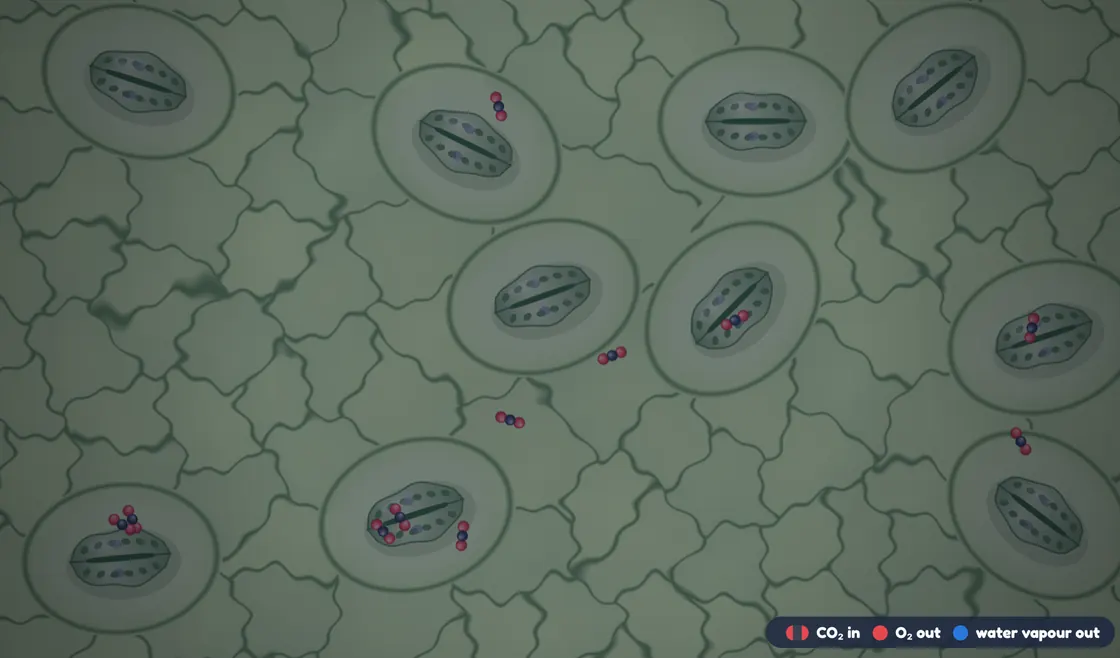
Plants lose water because the pores that let carbon dioxide in also let water out. A leaf needs carbon dioxide for photosynthesis, and while its stomata are open, water vapour escapes. For every molecule of carbon dioxide it takes in, a leaf typically loses a few hundred molecules of water.
That sounds like a terrible deal, but the water loss does useful work too:
- It pulls water up. As water evaporates from the leaves, it draws more up through thin tubes from the roots, a bit like sipping through a straw. Here's how water moves up a plant, and you can follow that journey in the Transport in Plants quest.
- It carries minerals. Minerals dissolved in the water travel up from the soil with it.
- It cools the leaves. Evaporation takes heat away, much as sweat cools your skin.
Too much water loss is a real problem, though. On a hot, windy afternoon a plant can droop even when its soil is damp, because its leaves are losing water faster than its roots can take it up. When water runs short, the guard cells go limp and close the pores. Most plants also close them in the dark, when there's no light for photosynthesis. Many cacti do the opposite, opening theirs at night to save water.
Make it a fair test: sun against shade
To turn the bag into a real experiment, change one thing and keep everything else the same. The classic question is whether a branch in the sun loses more water than one in the shade.
- Change: where the branch is, in sun or in shade.
- Keep the same: the kind of plant, the number and size of leaves, the size of bag, the start time and how long you leave it.
- Measure: the water collected. Pour it into a measuring syringe, or weigh each bag before and after on kitchen scales (1 g of water is 1 ml).
- Repeat: use at least two branches for each condition, because one branch could just be unusual.
- Predict first: write down what you expect before you start.
The sunny branch usually collects more, because light opens the stomata and warmth speeds up evaporation. If your two branches aren't the same size, divide the water by the number of leaves so the comparison stays fair. Our guide to fair tests has more on this, and it would make a good entry on our list of science fair project ideas.
You can ask other questions in the same way: does a broad leaf lose more than a pine needle, or a morning more than an afternoon? One to leave out is wind. The plastic shields the leaves from it, and wind speeds up transpiration by sweeping away the damp air around a leaf, which is exactly what a sealed bag prevents. School labs test wind with a fan and a measuring device called a potometer instead.
The bag shows that water leaves a plant, but not the pores it leaves through. In the Stomata & Transpiration quest, you can look under a leaf, watch its stomata open in the light and close in the dark, let the soil dry out, and race four greased leaves in different weather.
In short
- Transpiration is the loss of water vapour from a plant, mostly through tiny leaf pores called stomata.
- A clear plastic bag tied round a leafy branch catches that vapour, which condenses into droplets within a few hours on a warm, sunny day.
- A second bag round a leafless stick is your control: it shows that the water came from the leaves.
- Plants lose water because the pores that let carbon dioxide in also let water out. The loss also pulls water and minerals up from the roots and cools the leaves.
- To make it a fair test, compare sun and shade, and keep everything else the same.
Questions people ask
What is transpiration in simple words?
Transpiration is how plants lose water. Water travels up from the roots to the leaves, evaporates inside them and escapes into the air as water vapour, mostly through tiny pores called stomata. You can't see the vapour, but a clear plastic bag tied round a leafy branch traps it, and it turns into droplets on the inside of the bag.
How long does the plastic bag transpiration experiment take?
On a warm, sunny day, the bag usually starts to mist up within about an hour, and droplets gather within a few hours, so two or three hours is enough for a result you can see. Cool, cloudy or humid weather takes longer and gives less water. Some school versions leave the bags on for much longer and measure the water collected.
Where does the water in the bag come from?
It comes from the soil, through the plant. Roots take up water, thin tubes carry it up the stem, and it evaporates inside the leaves. The bag traps that vapour, and it condenses on the plastic. A bag tied round a leafless stick collects little or none, which shows that the water came from the leaves and not from the air in the bag.
Will the plastic bag hurt the plant?
A few hours in a bag shouldn't harm a healthy branch. Tie the bag snugly without crushing the stem, and take it off when you finish, so that the leaves aren't left sitting in hot, wet air. Avoid plants that are small or already wilting, and only use a branch you have permission to use.
How does transpiration help a plant?
Transpiration pulls water up from the roots, carrying dissolved minerals with it, and evaporation cools the leaves on a hot day. It also has a cost, because the plant can run short of water. When that happens, guard cells close the stomata to save water, which slows photosynthesis too, since carbon dioxide can no longer get in as easily.


