
How does water move up a plant? Xylem and transpiration
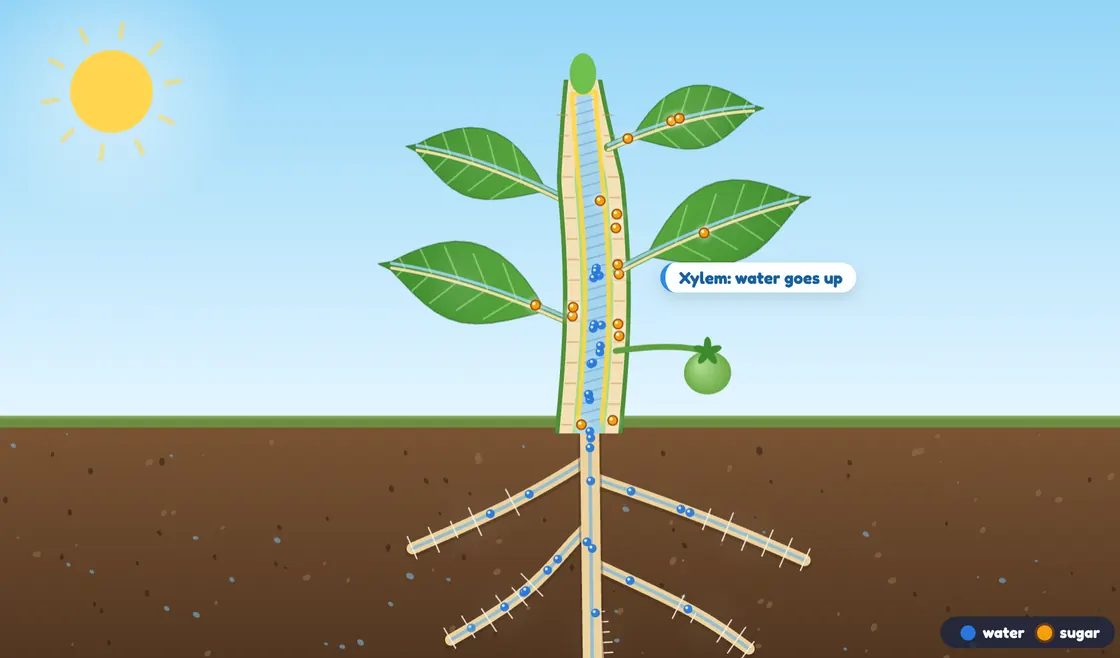
How does water move up a plant? Through thin tubes called xylem. As water evaporates from the leaves, it pulls the water below it up, like a straw.

Water moves up a plant through thin tubes called xylem, which run from the roots, up the stem and into every leaf. The pull comes from the top. As water evaporates from the leaves, it draws the water below it upwards, a bit like drinking through a straw. The roots don't pump it up: the leaves pull it.
That's how a redwood more than 110 metres tall gets water to its highest leaves. You can watch the same thing happen in a glass of coloured water on a windowsill.
How does water get into a plant?
Water gets into a plant through its roots, mostly through root hairs: tiny outgrowths just behind each root tip. Each one is a single cell, but there are so many of them that together they give the roots a huge surface touching the damp soil.
Water soaks into the root hairs by osmosis, because the liquid inside the cells is more concentrated than the water in the soil. Minerals such as nitrates come in too, dissolved in that water, and the plant uses energy to take some of them in. From the root hairs, the water passes inwards from cell to cell until it reaches the xylem in the middle of the root.
What does xylem do?
Xylem carries water and dissolved minerals up from the roots to the stem, leaves, flowers and fruit. It only goes one way: up.
Xylem tubes are made of dead cells. As they form, their end walls break down and their insides empty, leaving long, hollow pipes. Their walls are strengthened with lignin, the tough material that makes wood hard. In fact, wood is mostly xylem.
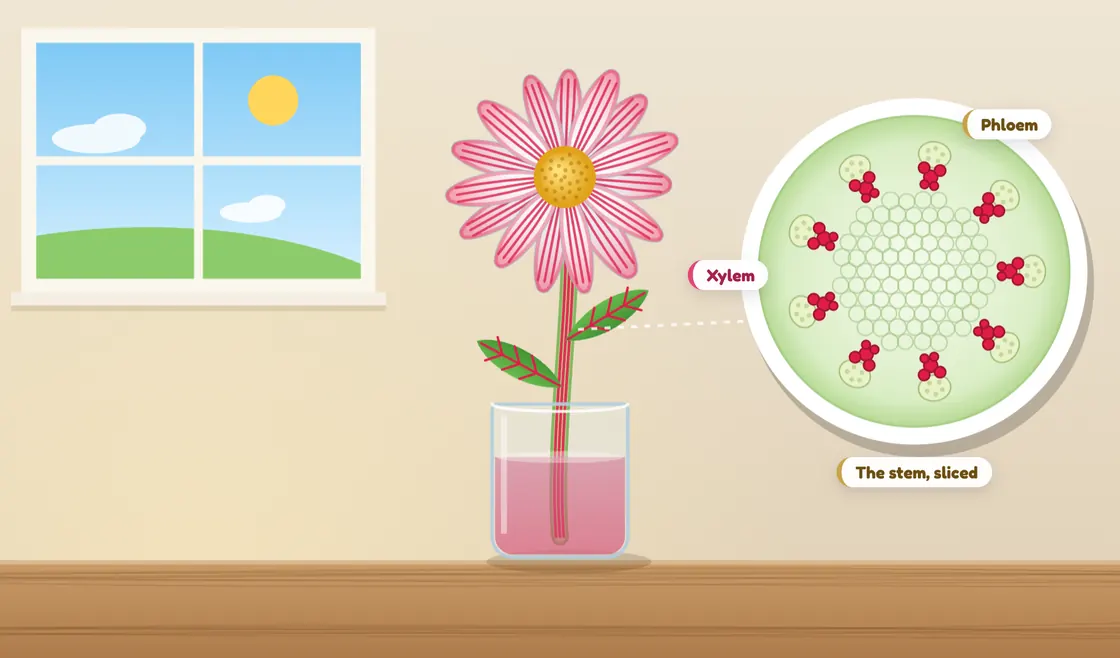
In a stem, the xylem runs in bundles, side by side with the phloem, which carries food. In many plants, such as daisies and sunflowers, the bundles form a ring near the outside of the stem.
How do leaves pull water up?
Leaves pull water up by losing it. Water evaporates inside each leaf and escapes as vapour through tiny pores called stomata. This is called transpiration. Each molecule of water that leaves is replaced by water drawn from the xylem behind it, and that pulls on the next, all the way down to the roots.
It works because water molecules cling to each other. In each narrow tube, the water behaves like one unbroken thread: pull the top and the whole thread moves. Scientists call this the cohesion-tension theory. You'll also see it called transpiration pull.
The straw comparison only goes so far, though. A straw, like any suction pump, can't lift water more than about 10 metres, because it relies on the air pressing down on the water outside to push it up. Trees go far higher because their water is pulled from above, held together under tension. The tallest known tree, a coast redwood called Hyperion, is about 116 metres tall. One 2004 study estimated that the pull can't lift water much beyond about 122 to 130 metres, which may be why no tree grows taller.
Two other things help a little, but neither can explain a tall tree. Root pressure is a gentle push from the roots, and capillary action lifts water only a short way up narrow tubes.
Because the pull comes from the leaves, anything that speeds up transpiration speeds up the flow: sunshine, warmth, wind and dry air. When the stomata close, in the dark or when water is short, the flow slows right down. You can catch the water leaving the leaves with a plastic bag over a branch.
What's the difference between xylem and phloem?
Xylem carries water and minerals up from the roots. Phloem carries food, mostly sugar made in the leaves by photosynthesis, to every part of the plant that needs it, upwards or downwards.
- What they carry: xylem carries water and dissolved minerals. Phloem carries sugars and other foods, dissolved in water.
- Which way: xylem goes up only. Phloem goes up or down, from where sugar is made to where it's used or stored, such as roots, fruits and growing tips.
- What they're made of: xylem is dead, hollow cells with tough walls. Phloem is living cells.
- What drives them: xylem is pulled by the leaves, which costs the plant no energy. Phloem's living cells use energy to move the food. Moving food through the phloem is called translocation.
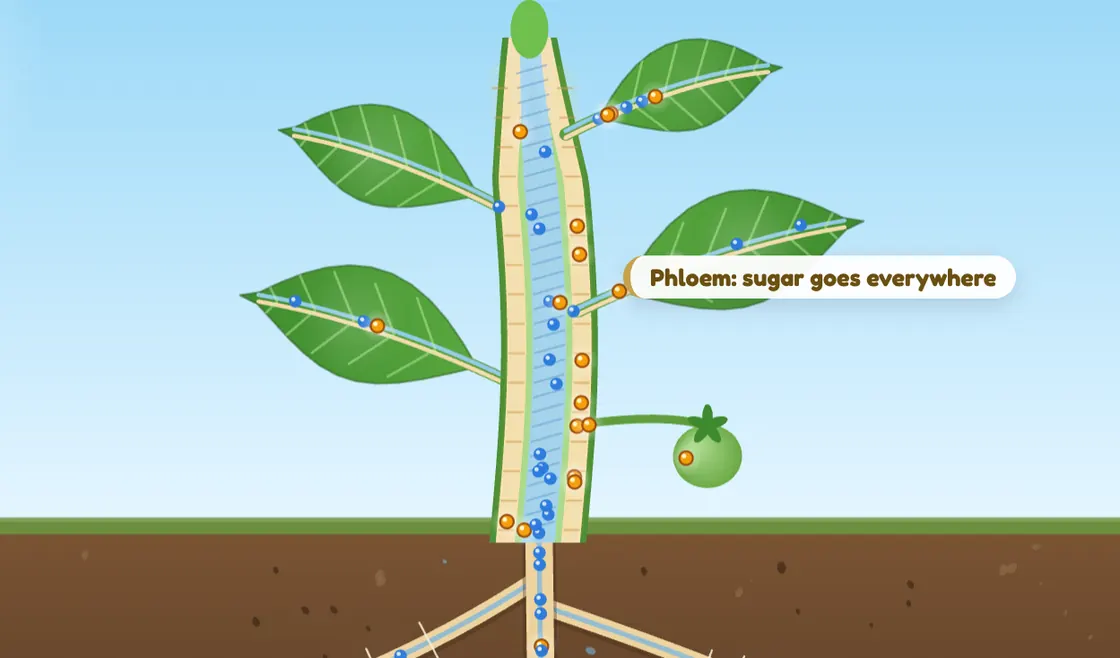
There's a neat way to tell them apart in a tree. The phloem lies just under the bark, while the xylem is in the wood. Cut away a complete ring of bark and you cut the phloem but not the xylem. Water still rises to the leaves, but sugar can no longer reach the roots, which is why a tree ringed all the way round slowly dies.
Try it: turn a white flower blue
This classic experiment shows xylem at work. You need a white flower with a fresh stem (white carnations work well), or a stick of celery with its leaves on, a glass of water and some food colouring.
- Make the water dark. Half-fill the glass and add plenty of food colouring, so that the water is deeply coloured. Blue or red show up best.
- Trim the stem. Ask an adult to cut a little off the bottom of the stem, so that the end is fresh.
- Stand it in the glass, in a bright, warm place.
- Check it after a few hours, then the next day. On a white carnation, colour often starts to show at the edges of the petals within a few hours, and keeps deepening for a day or two.
- Slice the stem. Once the petals have coloured, ask an adult to cut across the stem a few centimetres above the water. Look closely at the cut end: you should see coloured dots, usually in a ring or a row near the outside. Each dot is a bundle of xylem.
Stay safe: an adult should do the cutting. Food colouring stains skin and clothes, so cover the table.
Make it a fair test
Change one thing and keep everything else the same: the same kind of flower, the same amount of colouring and the same length of time. Two good questions to test:
- Does the weather matter? Put one flower somewhere sunny and breezy, and another in a cool, dark cupboard. Check which one colours first. Because the leaves and petals do the pulling, the sunny one usually wins.
- Do the leaves matter? Take all the leaves off one celery stick and leave them on another, then measure how far the colour has climbed after a few hours.
For a showpiece, ask an adult to split the bottom half of a stem lengthways and stand each half in a different colour. Each side of the stem has its own xylem, so each side of the flower changes to its own colour. There are more ideas like this in our guide to fair tests.
What happens when a plant runs short of water?
When a plant loses water faster than its roots can take it up, its cells go soft and it wilts. Water fills each plant cell's large vacuole and presses outwards on its wall, keeping it firm, a bit like air in a tyre. (Animal cells have no wall to push against: here's how plant and animal cells differ.) With too little water, the cells go limp, the leaves droop and soft stems bend over.
A plant has a defence: its stomata close to save water. That slows the pull up the xylem, but it also slows photosynthesis, because carbon dioxide can no longer get into the leaves as easily. Most plants recover in the cool of the evening or after a good watering. In a long drought, though, air bubbles can form in the xylem and block the tubes, and that damage is much harder to undo.
In the Transport in Plants quest, you can turn a white flower a colour of your choice, slice its stem, follow water and sugar through a living plant, close the leaf pores to see the flow slow down, and ring the bark to see what happens to the food.
In short
- Water enters a plant through its root hairs, by osmosis, and travels up through thin tubes called xylem.
- The pull comes from the leaves. As water evaporates through the stomata (transpiration), it draws the water below it upwards, all the way from the roots.
- This works because water molecules cling together, which lets trees lift water far higher than any suction pump could.
- Xylem carries water and minerals up. Phloem carries sugar from the leaves, up or down, wherever it's needed.
- A white flower in coloured water shows the xylem at work, and slicing its stem shows where the xylem runs.
Questions people ask
How do roots absorb water?
Roots absorb water mostly through root hairs, tiny outgrowths just behind each root tip. There are so many of them that they give the roots a huge surface touching the soil. Water moves into the root hair cells by osmosis, because the liquid inside them is more concentrated than the soil water. Then it passes inwards, cell by cell, to the xylem in the middle of the root.
What allows water to travel up a plant against gravity?
Evaporation from the leaves does the work. As water escapes through the stomata, it pulls on the water behind it in the xylem. Because water molecules cling together, the water in each tube moves as one unbroken thread, all the way from the roots. Root pressure and capillary action help a little, but they can't lift water to the top of a tall tree.
Does water move up or down in a plant?
In the xylem, water only moves up, from the roots to the leaves, flowers and fruit. Phloem is different: it carries sugar dissolved in water both ways, from the leaves to wherever food is needed or stored, such as the roots, fruits and growing tips. So in a living stem, there's water going up in one set of tubes and food travelling both ways in another.
How long does the white flower food colouring experiment take?
With a white carnation in strongly coloured water, colour often starts to show at the edges of the petals within a few hours. It keeps deepening for a day or two. A warm, bright place speeds it up, because faster transpiration from the leaves and petals pulls the water up faster. Celery shows coloured strands in its stalk if you slice it after a few hours.
Is xylem made of living cells?
No. Xylem tubes are made of dead cells. As they form, their end walls break down and their contents disappear, leaving long, hollow pipes with tough walls strengthened by lignin. That's why water can flow through them so easily, and why wood, which is mostly xylem, is so strong. Phloem is the opposite: it's made of living cells, which use energy to move food.


