
Do antibiotics kill viruses? How antibiotics and vaccines work
No: antibiotics kill bacteria, not viruses, so they can't cure a cold or flu. Here's how antibiotics, resistance, your immune system and vaccines really work.

No. Antibiotics kill bacteria or stop them growing, but they do nothing to viruses, so they can't cure a cold, flu or any other viral infection. Viruses are cleared by your immune system, and vaccines train that system before a germ arrives. Here's how each works, and why using antibiotics you don't need makes them weaker for everyone.
Bacteria and viruses: what's the difference?
Bacteria are tiny living cells that can feed and multiply on their own. Viruses are much smaller and simpler: a bundle of genetic instructions inside a protein coat, which can only copy itself inside the cells of another living thing.
- Bacteria are single cells with a cell wall and their own machinery for making proteins. Most are harmless, and many are useful, like the ones living in your gut. A few cause illnesses, such as strep throat and whooping cough.
- Viruses are the smallest of all microbes. They have no cell wall and no machinery of their own. A virus gets inside one of your cells and makes it build copies of the virus. Colds, flu, chickenpox, measles and COVID-19 are all caused by viruses.
You can build a bacterial cell, and see what's inside it, in our free Build a Cell quest.
How do antibiotics kill bacteria?
Antibiotics attack parts that bacterial cells have and your cells don't. That's how they can kill the germs without harming you.
Penicillin, one of the first antibiotics, was discovered by Alexander Fleming in 1928. It stops bacteria from building their tough cell wall, so they burst. Your cells don't have a cell wall, so penicillin leaves them alone. Other antibiotics jam the tiny machines, called ribosomes, that bacteria use to make proteins. Bacterial ribosomes are a different shape from ours, so the medicine can tell them apart.
Each antibiotic works on certain kinds of bacteria, so a doctor chooses which one to prescribe. Antibiotics also kill some helpful bacteria in your body, and like all medicines they can have side effects, such as diarrhoea or an allergic reaction.
Why don't antibiotics work on colds and flu?
Colds and flu are caused by viruses, and viruses don't have the parts antibiotics attack. There's no cell wall to break and there are no ribosomes of their own to jam, because a virus uses the machinery of the cell it has invaded.
So an antibiotic won't make a cold get better any faster. It can still cause side effects, and it gives bacteria elsewhere in your body a chance to become resistant. Most colds clear up on their own in about a week to ten days while your immune system does the work.
There are separate medicines called antivirals for a few viruses, such as flu, and a doctor decides when they're needed. Sometimes a bacterial infection follows a cold, and then antibiotics may help. Only a doctor can tell, so if an illness is worrying you, ask a doctor or pharmacist.
What is antibiotic resistance?
Antibiotic resistance is when bacteria change so that an antibiotic no longer kills them. It's the bacteria that become resistant, not your body.
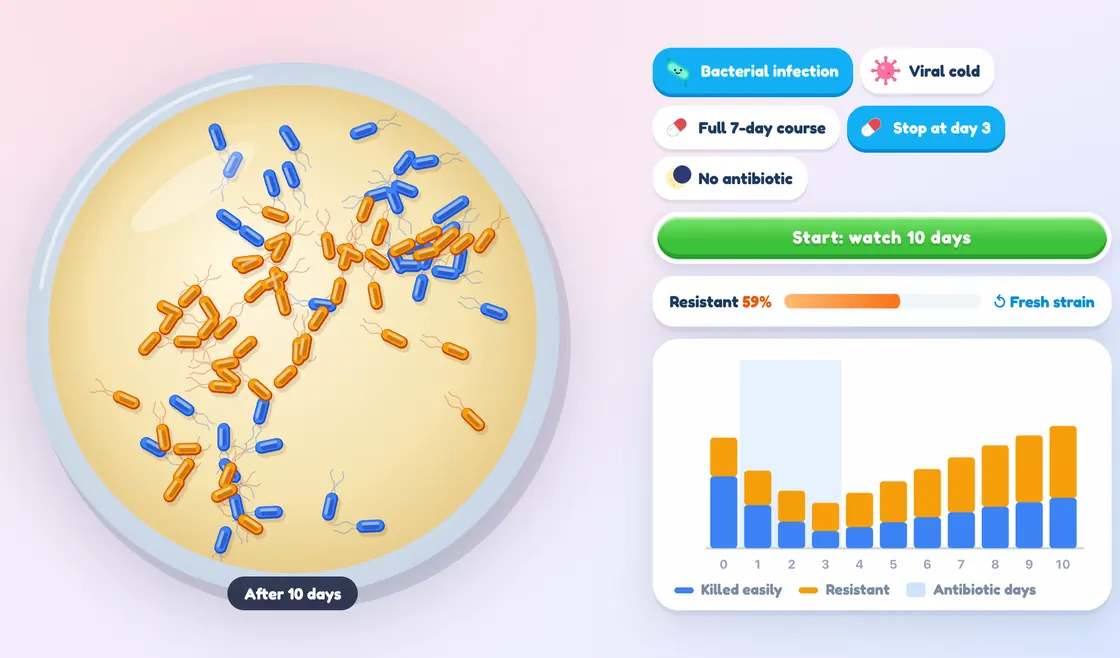
In any large group of bacteria, a few may, by chance, have a change that helps them survive a particular antibiotic. When the antibiotic kills the rest, those survivors have room to multiply, and they can even pass their resistance on to other bacteria. Every use of an antibiotic gives resistant bacteria this advantage, which is why taking antibiotics you don't need matters. The World Health Organization estimates that drug-resistant bacterial infections were linked to more than 4.7 million deaths worldwide in 2021.
Try it: a button model of resistance
You need about 20 buttons of one colour and 10 of another. (Keep them away from small children.)
- Put 18 white buttons and 2 red ones in a bowl. Each button is a bacterium. The white ones are killed easily by the antibiotic; the red ones happen to be resistant. So 2 in 20, or 10%, are resistant.
- Give a dose of antibiotic: take out all but 2 of the white buttons. The red ones all survive.
- The survivors multiply: for each button left, add one more of the same colour. Now you have 4 white and 4 red, so half are resistant.
- Repeat steps 2 and 3. You end up with 4 white and 8 red: two in every three are resistant.
The bacteria didn't learn anything. The antibiotic removed the ones it could kill, and the resistant ones took their place. That's natural selection.
Should you finish a course of antibiotics?
Take antibiotics exactly as prescribed: the right dose, at the right times, for as long as the doctor or pharmacist says. That usually means taking every dose on the label, even once you feel better, unless they tell you otherwise.
For years the slogan was simply "always finish the course". Today the CDC in the US says to take antibiotics "exactly as prescribed", and the NHS says to take them as directed on the packet or leaflet. The wording changed partly because doctors have learned that many infections can be cured with shorter courses than they used to give, and taking antibiotics for longer than needed also helps resistant bacteria. So the length on a prescription is a decision made for that infection. If you're unsure whether to stop or carry on, ask the doctor or pharmacist rather than deciding on your own.
Two more rules from the CDC and the NHS: only take antibiotics prescribed for you, and don't save leftovers for next time. A pharmacy can dispose of leftover medicine safely.
How does your immune system fight germs?
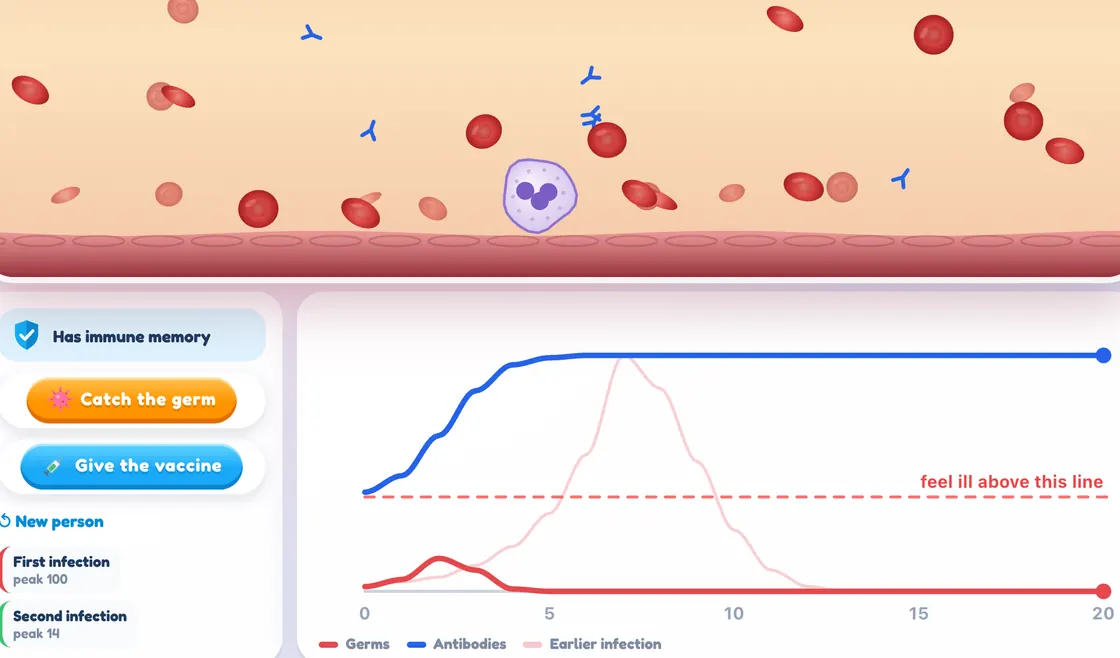
Your immune system is your body's defence force. White blood cells find and destroy germs, and some of them make antibodies: proteins that lock onto one particular germ, like a key fits one lock, and mark it for destruction.
Your skin, mucus and stomach acid stop many germs getting in at all. But the first time a new germ gets through, it takes several days to make enough of the right antibodies. Meanwhile the germ multiplies and you feel ill. Once it's beaten, your body keeps memory cells that recognise that germ. If it comes back, they respond so fast that the germ is often cleared before you feel ill at all.
That's why, for most people, one bout of chickenpox gives protection for life. Colds are different: more than 200 different viruses can cause them, so beating one doesn't protect you from the next.
How do vaccines work?
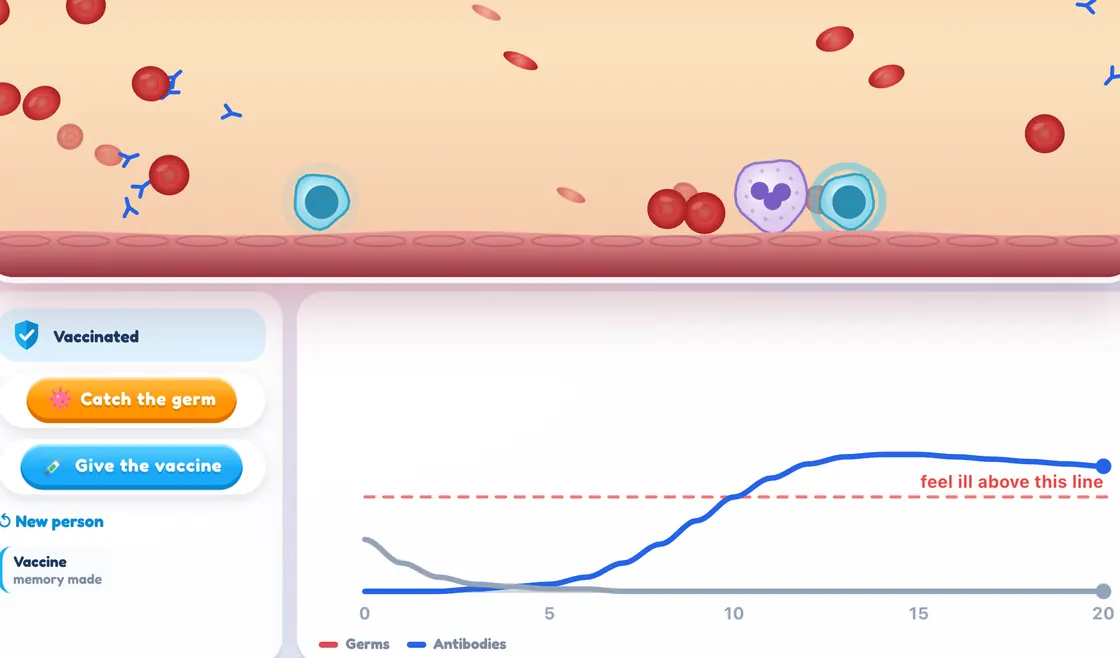
A vaccine shows your immune system a harmless version of a germ, so it can make antibodies and memory cells without you having the illness first. When the real germ arrives, your body already knows it.
According to the WHO, a vaccine contains one of these:
- a weakened or inactivated form of the germ,
- a harmless part of it, such as one of its proteins,
- or the instructions (DNA or RNA) for your own cells to make that harmless part.
Vaccines are designed so they don't cause the disease, and side effects are usually mild and short-lived, like a sore arm. Protection takes time to build: about two weeks after a flu vaccine, for example. Flu vaccines are offered every year because flu viruses keep changing and protection fades. And when enough people are vaccinated, a germ struggles to spread, which also protects people who can't have vaccines. This is called herd immunity.
Vaccines and antibiotics do different jobs. Antibiotics treat some bacterial infections after you've caught them. Vaccines prevent illness in the first place, and they protect against many viral diseases and some bacterial ones, such as whooping cough and tetanus.
See it for yourself
In the Immunity & Antibiotics quest, you catch a germ and watch 20 days of germs and antibodies on a graph, then catch it again to see memory at work. You vaccinate a new person, treat a bacterial infection with a full course, a course stopped at day 3 or no antibiotic, and watch a resistance meter climb. You can even try an antibiotic on a viral cold. For how illnesses spread, try Outbreak Detective, also in our Health & Immunity topic.
In short
- Antibiotics kill bacteria or stop them growing. They don't work on viruses, so they can't cure colds or flu.
- Antibiotic resistance is when bacteria survive and multiply despite an antibiotic. The bacteria become resistant, not you.
- Take antibiotics exactly as prescribed, and never share or save them.
- Memory cells let your body fight a germ faster the second time. Vaccines create that memory safely.
Questions people ask
Can antibiotics cure a cold or flu?
No. Colds and flu are caused by viruses, and antibiotics only work on bacteria. Taking them for a cold won't help you recover faster, can cause side effects such as diarrhoea, and adds to antibiotic resistance. Most colds clear up on their own in about a week to ten days. If you're worried that an illness isn't getting better, or might be a bacterial infection, ask a doctor or pharmacist.
Does your body become resistant to antibiotics?
No. Antibiotic resistance happens to bacteria, not people. When an antibiotic is used, any bacteria that happen to survive it can multiply and pass on their resistance, so that antibiotic stops working against them. Resistant bacteria can then spread from person to person. That's why antibiotics should only be used when a doctor says they're needed, and taken exactly as prescribed.
Should you stop taking antibiotics when you feel better?
Not on your own. Health services such as the NHS and the CDC say to take antibiotics exactly as prescribed, which usually means every dose for the number of days on the label. Doctors now often prescribe shorter courses than in the past, so the length is chosen for your infection. If you think you should stop early, or you have side effects, ask your doctor or pharmacist first.
What is the difference between a vaccine and an antibiotic?
An antibiotic is a medicine that treats some bacterial infections by killing bacteria or stopping them growing. A vaccine prevents illness: it shows your immune system a harmless form or part of a germ, so your body makes antibodies and memory cells ready for the real thing. Vaccines protect against many viruses and some bacteria. Antibiotics do nothing to viruses.
Why do people usually catch chickenpox only once but colds again and again?
After chickenpox, your immune system keeps memory cells that recognise the chickenpox virus, so for most people one infection gives protection for life. The virus can stay hidden in the body, though, and come back years later as shingles. Colds can be caused by more than 200 different viruses, so beating one cold virus doesn't protect you against all the others.


