
Red cabbage indicator: how to make it and what the colours mean
How to make red cabbage indicator at home, which kitchen liquids to test, and what each colour means, from red in acids to green in bases. With safety tips.

Red cabbage indicator is the purple juice you get by soaking chopped red cabbage in hot water. Its colour changes with how acidic a liquid is: red or pink in acids, purple in neutral liquids, and blue, then green, in bases. You need a red cabbage, a kettle, a sieve and a few cups, and it takes about 20 minutes.
What you need
- About a quarter of a red cabbage, or 4 or 5 large leaves
- A chopping board and knife (or just tear the leaves by hand)
- A heatproof jug or bowl, and a sieve
- Hot water from a kettle that has just boiled (a job for an adult)
- 6 or 7 small clear glasses or cups, standing on white paper so the colours are easy to see
- Your test liquids (see below) and a teaspoon
How to make red cabbage indicator
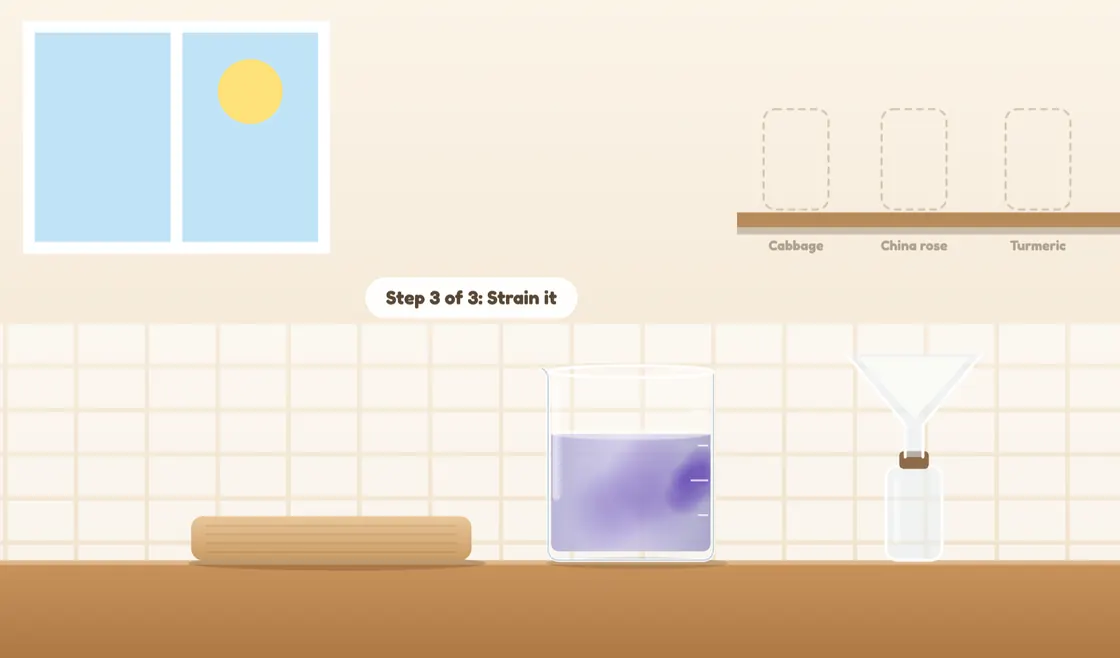
- Chop or tear the leaves into small pieces. Smaller pieces give up their colour faster.
- Put them in the heatproof jug. Ask an adult to pour on hot water from the kettle, just enough to cover the cabbage.
- Stir, then leave it for 10 to 15 minutes, until the water is deep purple and has cooled down.
- Pour it through the sieve into a clean jug. The purple liquid is your indicator. The cabbage can go in the compost.
- Pour the same amount of indicator, about 2 to 3 cm deep, into each cup. Keep one cup of plain indicator to one side as your colour reference.
Depending on your cabbage and your tap water, the juice can look anywhere from reddish-purple to blue-purple. That's fine: you compare every result with your reference cup, not with a photo online.
Stay safe: an adult should handle the boiling water and any sharp knife. Don't drink the indicator or any of the mixtures, and keep it off clothes: it stains.
Which kitchen liquids can you test?
A good starter set is lemon juice, vinegar, water, milk, baking soda solution and soap: two acids, two bases and two liquids close to neutral. Add a teaspoon of each liquid to its own cup of indicator, swirl, and compare it with your reference cup.
Here's what to expect:
- Lemon juice (an acid, around pH 2): turns red or bright pink.
- Vinegar (an acid, around pH 2.5 to 3): turns pink to red.
- Tap water (neutral): stays purple, like your reference cup.
- Milk (very slightly acidic, so close to neutral): stays purple, though it looks paler and cloudy.
- Baking soda solution (a teaspoon of bicarbonate of soda stirred into a little water; a weak base, around pH 8): turns blue or blue-green.
- Soap (a bar of ordinary soap rubbed in a little water): usually turns blue-green or green. Soaps vary a lot, though: many liquid hand soaps and washing-up liquids are close to neutral and barely change the colour.
Write each result down, then line the cups up from the reddest to the greenest. You've just made your own pH scale.
What do the red cabbage colours mean?
The colour tells you roughly where a liquid sits on the pH scale. Red and pink mean an acid, purple means neutral, and blue, green and finally yellow mean a base, getting stronger as the colour moves along.
The pH scale runs from 0 to 14. Acids are below 7, neutral is 7 and bases are above 7. (A base that dissolves in water is called an alkali.) The further a liquid is from 7, the stronger the acid or base. Here's a rough colour chart for red cabbage indicator:
- pH 1 to 3, strong acid: red
- pH 4 to 5, weaker acid: pink to reddish-purple
- pH 6 to 7, about neutral: purple
- pH 8, weak base: blue
- pH 9 to 11, base: blue-green to green
- pH 12 to 14, strong base: greenish-yellow to yellow
Every cabbage is a little different, and charts disagree by a shade or two, so treat this as a guide rather than an exact measurement.
Why does red cabbage change colour?
Red cabbage leaves are full of pigments called anthocyanins. Acids contain lots of hydrogen ions, and in an acid the pigment molecules pick some of them up; in a base, they lose them. Each change alters the shape of the molecule slightly, so it absorbs different colours of light, and we see a different colour. A cabbage holds a whole family of anthocyanins, each changing at a slightly different pH, which is why you get a rainbow and not just two colours.
Why you won't see yellow at home
Yellow only appears in very strong bases, like the caustic soda in some drain and oven cleaners. Those can burn skin and eyes, so they are never for testing at home. In the kitchen, green is as far as you should go.
Red cabbage or litmus?
Litmus paper sorts liquids into acids and bases: blue litmus turns red in an acid, and red litmus turns blue in a base. Red cabbage shows a whole range of colours, so it also hints at how strong the acid or base is, a bit like universal indicator. You can compare litmus and universal indicator with real kitchen liquids in our Acids & Bases quest.
Other natural indicators: turmeric and china rose
Red cabbage isn't the only plant that can test for acids and bases. Turmeric and china rose (hibiscus) work too, and each behaves differently.
- Turmeric is yellow and stays yellow in acids and neutral liquids, but bases turn it red-brown. Mix turmeric powder with a little water into a paste, spread it on blotting paper or kitchen paper, let it dry and cut it into strips. It can find bases but not acids. It's also why a yellow curry stain turns red when you scrub it with soap.
- China rose (hibiscus) petals soaked in warm water make a pink indicator. It turns dark pink (magenta) in acids and green in bases.
- Litmus, the classic lab indicator, is natural too: it's made from lichens.
Lots of other red, purple and blue flowers and fruits contain anthocyanins, so they're worth testing too.
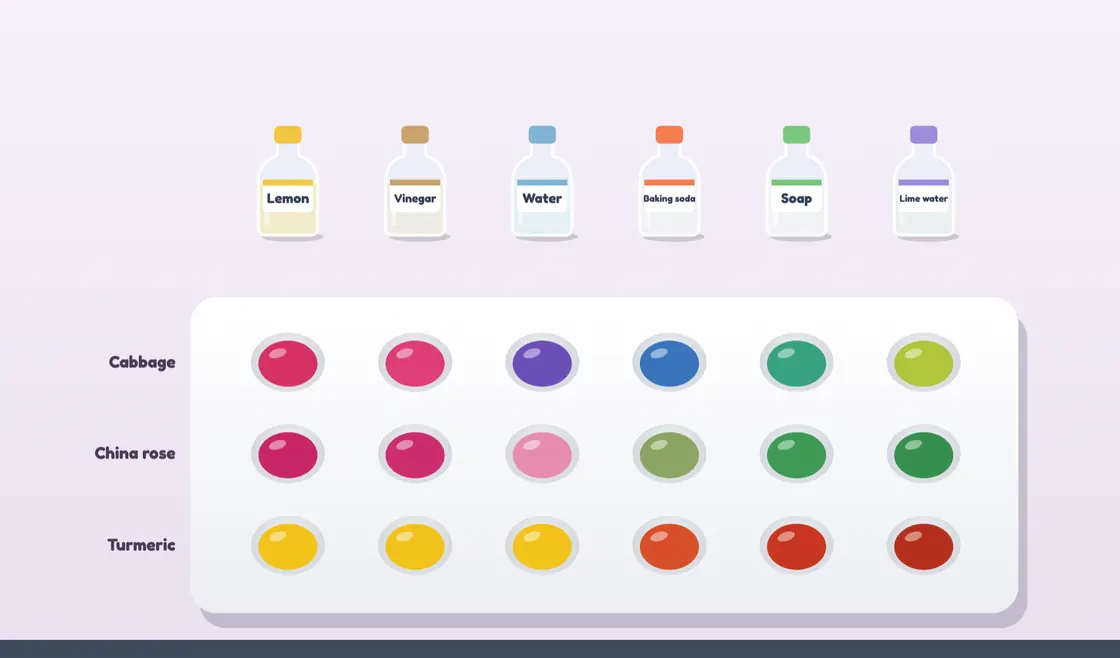
In the Natural Indicators quest, you make all three in a kitchen, test them against six liquids on a spotting tile, and then use them to read a secret message.
Try this: a secret message
- Stir a teaspoon of baking soda into a few spoonfuls of water.
- Dip a cotton bud in it and write a message on white paper. Let it dry completely, and the writing becomes almost invisible.
- Paint over the paper with red cabbage indicator. The letters appear blue or green on a purple background, because baking soda is a base.
Try a second message in lemon juice: this time the letters show up pink. Or write with baking soda solution straight onto your turmeric paper and watch the letters turn red.

Can you change the colour back?
Yes: add an acid to a base, and the colour swings back. Pour lemon juice, a few drops at a time, into your blue baking soda cup. It fizzes, and the colour slides back through purple towards pink as the acid cancels out the base. That's neutralisation, and you can watch it happen particle by particle in our Neutralisation quest.
What should you never test?
Stick to foods and mild household liquids. Never test bleach, drain cleaner, oven cleaner, toilet cleaner or anything with a hazard symbol on the label.
- Bleach reacts with acids such as vinegar and lemon juice to give off chlorine, a gas that harms your lungs, eyes and throat.
- Drain and oven cleaners are strong bases that can burn skin and eyes.
- Never taste anything to find out whether it's an acid or a base. That's exactly what indicators are for.
- Label any leftover indicator, keep it in the fridge, and wash your hands when you finish.
In short
- Red cabbage indicator is made by soaking chopped red cabbage in hot water and straining it.
- It turns red or pink in acids, stays purple when neutral, and goes blue, then green, in bases. Only very strong bases turn it yellow.
- The colour comes from anthocyanins, pigments that change shape with pH.
- Turmeric and china rose are natural indicators too, each with its own colours.
- Test only foods and mild household liquids: never bleach, drain cleaner or oven cleaner.
Questions people ask
How long does red cabbage indicator last?
Kept in a closed, labelled jar in the fridge, red cabbage indicator lasts a few days. For longer, freeze it in an ice-cube tray and thaw a cube or two when you need them. You can also soak kitchen paper or coffee filters in it, let them dry and cut them into strips, which is handy for quick tests later. Throw the juice away if it smells off or grows mould.
What colour does baking soda turn red cabbage indicator?
Baking soda (bicarbonate of soda) turns red cabbage indicator blue or blue-green. Baking soda is a weak base: dissolved in water, it has a pH of about 8, just above neutral. Stronger bases, such as washing powder in water, push the colour further, to green. If you then add vinegar or lemon juice, the mixture fizzes and the colour moves back through purple towards pink.
Why is my red cabbage juice blue instead of purple?
Cabbages vary, and so does tap water, which can be very slightly alkaline. Either can make the juice look blue-purple rather than purple. It doesn't spoil the experiment. Keep one cup of plain juice as your reference and compare every test with it: a shift towards pink or red means an acid, and a shift towards green means a base.
Can red cabbage indicator tell you the exact pH?
No. Red cabbage indicator gives a rough idea of pH, because its colours blend gradually and every batch is slightly different. It's ideal for sorting liquids into strong acids, weak acids, neutral liquids, weak bases and strong bases. For an exact number, scientists use universal indicator paper with a printed colour chart, or an electronic pH meter.


