
Atom BuilderAn interactive build an atom simulation for ages 11 to 14
Build any of the first twenty elements from protons, neutrons and electrons, make ions and isotopes, and watch unstable atoms decay.
Part of Thinkodile Plus · about 38 minutes · plays in the browser
The mystery
For centuries, alchemists tried to turn lead into gold with heat and chemicals. A lead atom has 82 protons; a gold atom has 79. What would really have to change?
Every quest starts with a prediction. Lock yours in, then run the experiments to find out who was right.
What you’ll learn
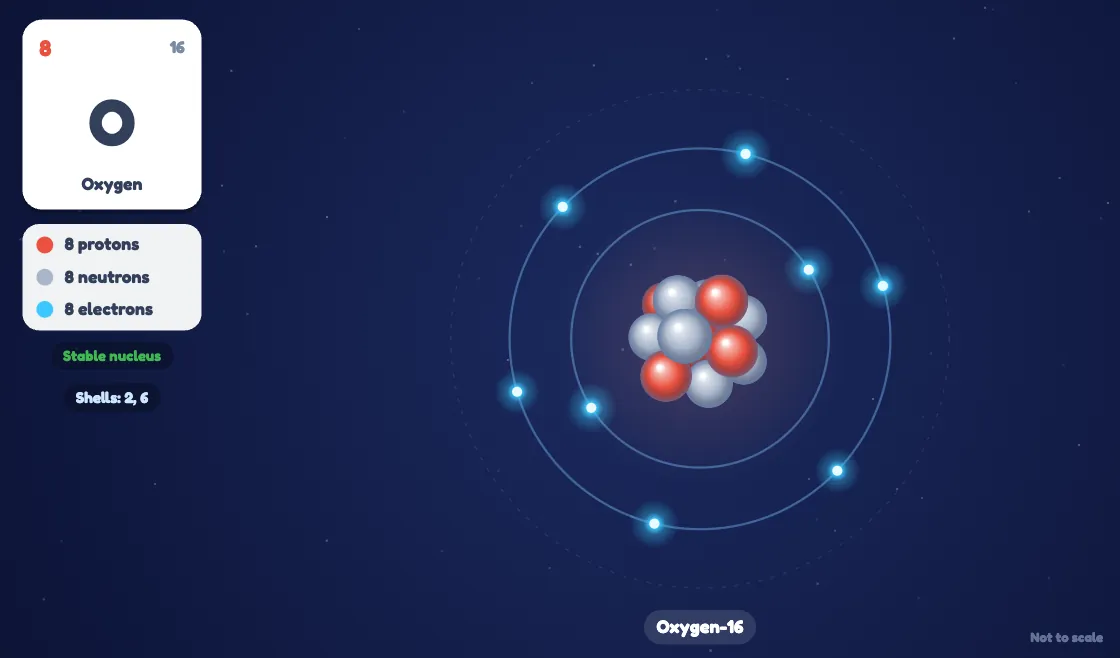
Three particles
An atom has a tiny nucleus of protons and neutrons, with electrons around it. Protons are positive, electrons negative, and neutrons have no charge. A proton and a neutron weigh about the same; an electron is about 2,000 times lighter.
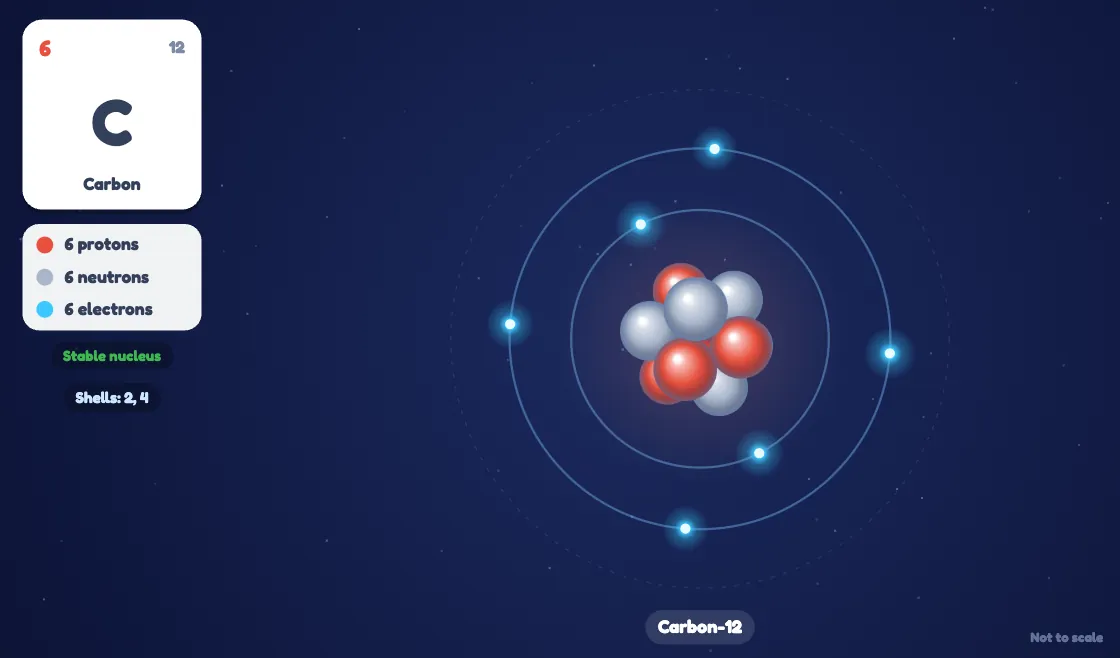
Protons decide the element
The number of protons is the atomic number, and it decides the element: every carbon atom has 6. The mass number counts the protons and neutrons together.
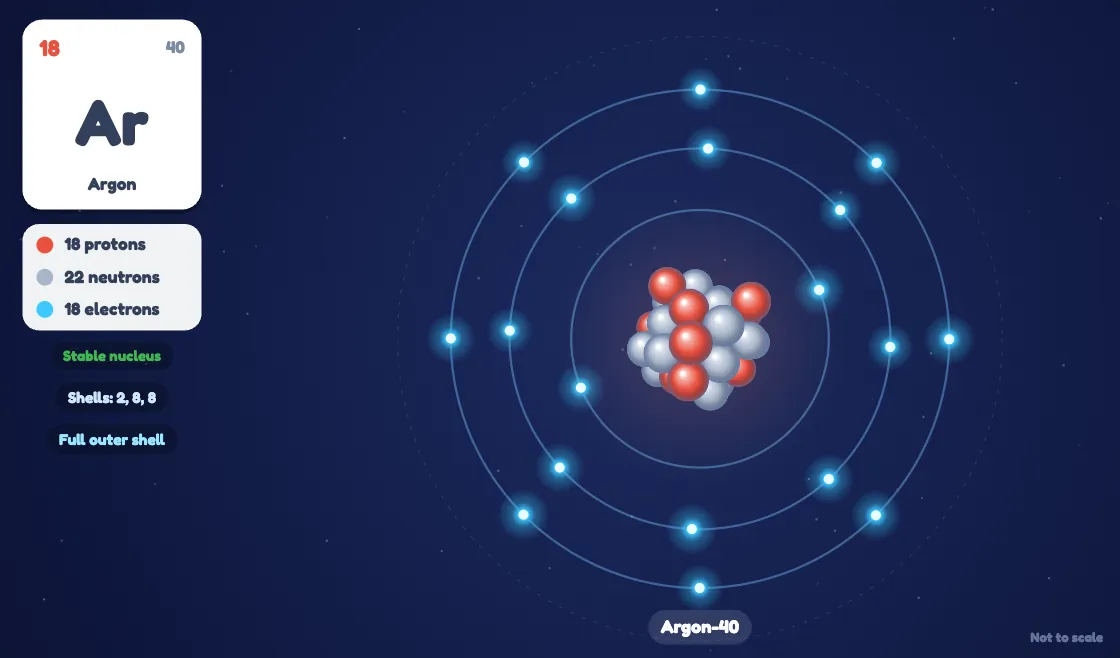
Electrons in shells
Electrons sit in shells: up to 2 in the first, then 8, then 8. In a neutral atom there are as many electrons as protons. The outer shell decides how an atom reacts: a full one, like neon's, hardly reacts at all.
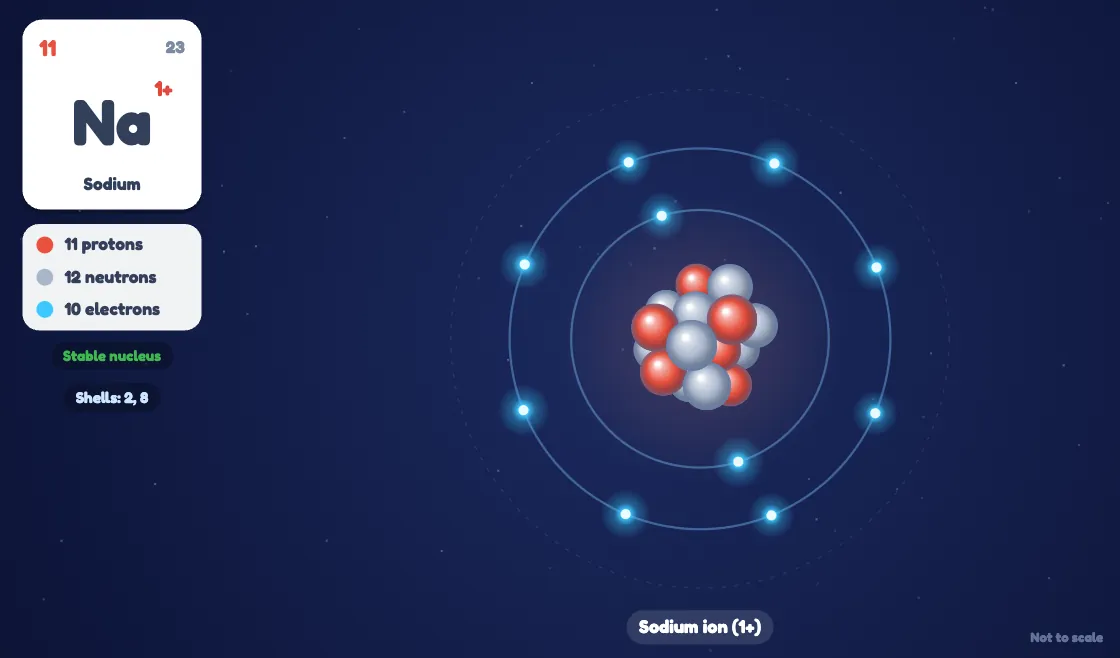
Ions
Atoms gain or lose electrons to get a full outer shell. Lose some and there are more protons than electrons: a positive ion, like Na⁺. Gain some and it's a negative ion, like Cl⁻. The protons never change in a chemical reaction.
Isotopes
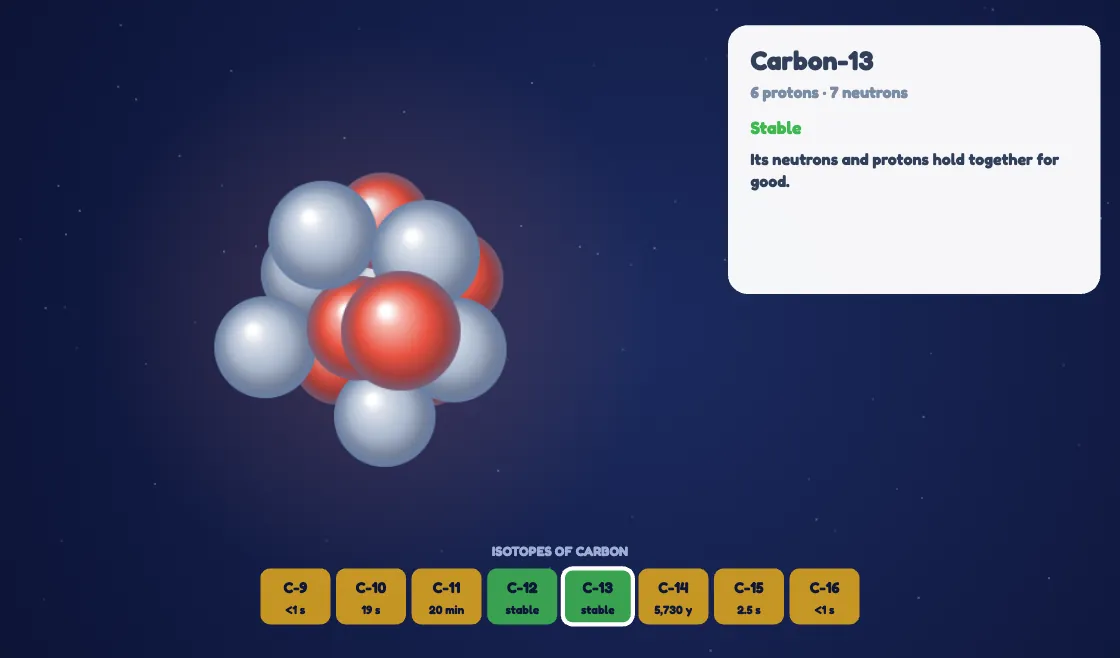
Atoms of the same element can have different numbers of neutrons: these are isotopes. Carbon-12 and carbon-13 are both stable. Carbon-14 has too many neutrons, so in time it changes.
Radioactive decay
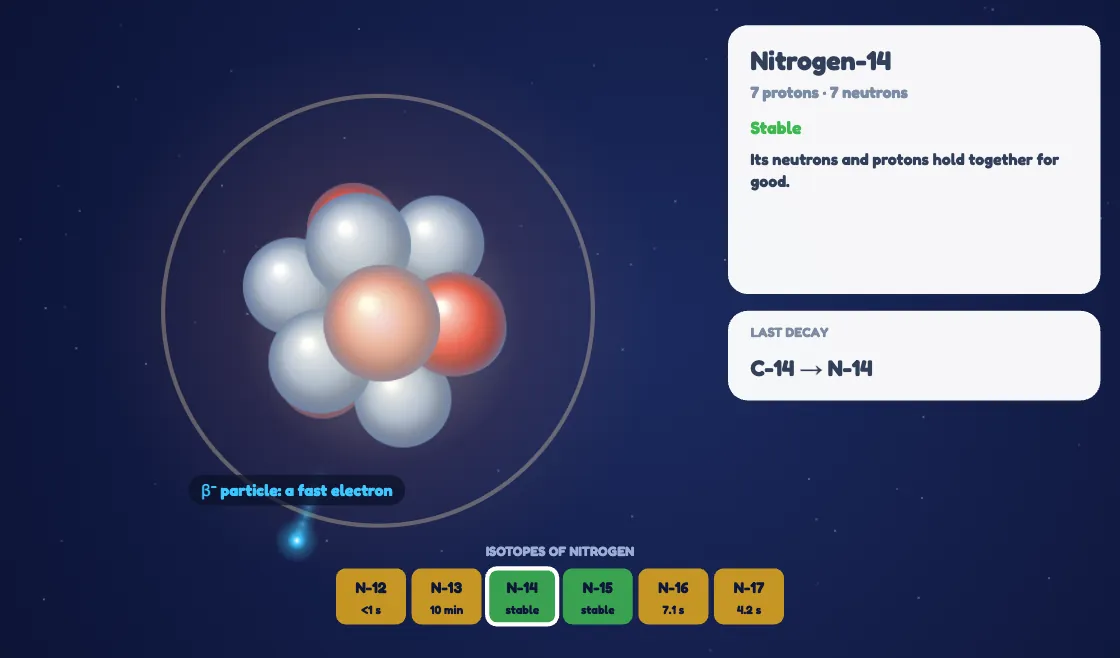
An unstable nucleus gives out radiation as it changes. In beta decay a neutron becomes a proton, so the element changes; an alpha particle is 2 protons and 2 neutrons. Half of any sample decays in a fixed time: its half-life.
Inside the lab
8 missions in 4 parts: Build an atom, The nucleus, Coco's orders, Bonus. Each one is something to try for yourself, with the science behind it once you’ve done it.
- Build carbonBuild a carbon atom: 6 protons, 6 electrons, and enough neutrons to hold it together.Every carbon atom has 6 protons: that's its atomic number. Its mass number counts protons and neutrons together, so carbon-12 has 6 neutrons.
- A new elementTurn your carbon into a different element.Changing the neutrons or electrons never changes the element. Only the number of protons does.
- Make an ionGive an atom a full outer shell by adding or taking away electrons.Atoms gain or lose electrons to get a full outer shell, like the noble gases. Losing electrons leaves more protons than electrons: a positive ion.
- IsotopesMake two stable isotopes of the same element.Isotopes are atoms of the same element with different numbers of neutrons. They react the same way, but their masses differ.
- Carbon-14Make carbon-14, then wait and watch it decay.Carbon-14 has too many neutrons. In time one turns into a proton and shoots out a fast electron, a beta particle, so the atom becomes nitrogen-14.
- Five ordersBuild and deliver 5 of Coco's orders.Chemists read atoms like this every day: the protons give the element, protons and neutrons the mass number, and the electrons the charge.
- Half-lifeWatch a hundred unstable atoms until half of them have decayed.Nobody can say when one atom will decay, but half of a big group always goes in the same time: the half-life. For carbon-14 it's 5,730 years.
- Every orderDeliver all eight of Coco's orders.You can now build any of the first twenty elements, their ions and their isotopes from scratch.
How the quest works
- Predict. Coco asks the mystery and you lock in an answer.
- Learn. A short, picture-led story of the big ideas (6 slides).
- Experiment. 8 missions in the lab, each one yours to try.
- Final Challenge. 8 questions that check you can use what you found, then the mystery’s answer.
For teachers
Present it live on the board while your class follows on their own screens. It fits one class period: about 7 minutes of Learn, 24 in the lab and 7 for the Final Challenge.
Students can
- describe the structure of an atom: a nucleus of protons and neutrons, with electrons in shells around it, and give each particle's charge and relative mass.
- use the atomic number and mass number to work out the numbers of protons, neutrons and electrons, and explain that the number of protons decides the element.
- write the electron arrangement of the first 20 elements (for example 2, 8, 1) and explain how atoms become ions by gaining or losing electrons.
- explain what isotopes are, describe alpha and beta decay as changes in the nucleus, and use a half-life to predict how much of a sample is left.
NGSS: MS-PS1-1, HS-PS1-1, HS-PS1-8.
Teacher notes for Atom BuilderQuestions people ask
What is Atom Builder?
Atom Builder is an interactive build an atom simulation from Thinkodile for ages 11 to 14. Build any of the first twenty elements from protons, neutrons and electrons, make ions and isotopes, and watch unstable atoms decay. It opens with a mystery to predict, explains the big ideas in a short Learn story, lets you run the experiments yourself in the lab, and ends with a Final Challenge.
Is Atom Builder free?
Atom Builder is part of Thinkodile Plus for families and Teacher Pro for teachers. A free account includes 6 quests: Photosynthesis, Build a Cell, Build an Electromagnet, Particles in Motion, Dissolving, Moon Phases Explorer. A parent or teacher creates the account; children never sign up themselves.
How long does Atom Builder take?
About 38 minutes for a class working through it together: around 7 minutes for the Learn story, 24 in the lab and 7 for the Final Challenge. At home you can stop and pick it up again later.
Which curriculum does Atom Builder cover?
In the US it supports the Next Generation Science Standards MS-PS1-1, HS-PS1-1, HS-PS1-8. It's organised by topic, not by grade, so it fits other syllabuses too.
Does Atom Builder work on phones, tablets and Chromebooks?
Yes. It runs in the web browser on laptops, Chromebooks, tablets and phones, with nothing to install. On a phone the lab plays sideways, so turn the phone on its side.
Keep exploring Atoms & Molecules
- Molecule Kit: Snap atoms into water, carbon dioxide and sugar, spin them in 3D, and count every bond.
- Periodic Table Explorer: Lay out Mendeleev's element cards and predict an element nobody had seen, read the shells that make the columns, then walk a living table where every atom shows its size and how it reacts.
- All of Atoms & Molecules