
Molecule KitAn interactive molecule building simulation for ages 11 to 14
Snap atoms into water, carbon dioxide and sugar, spin them in 3D, and count every bond.
Part of Thinkodile Plus · about 34 minutes · plays in the browser
The mystery
Using sunlight, a plant makes sweet, solid sugar from nothing but carbon dioxide from the air and water from the soil. How can a gas and a liquid become a sugar?
Every quest starts with a prediction. Lock yours in, then run the experiments to find out who was right.
What you’ll learn
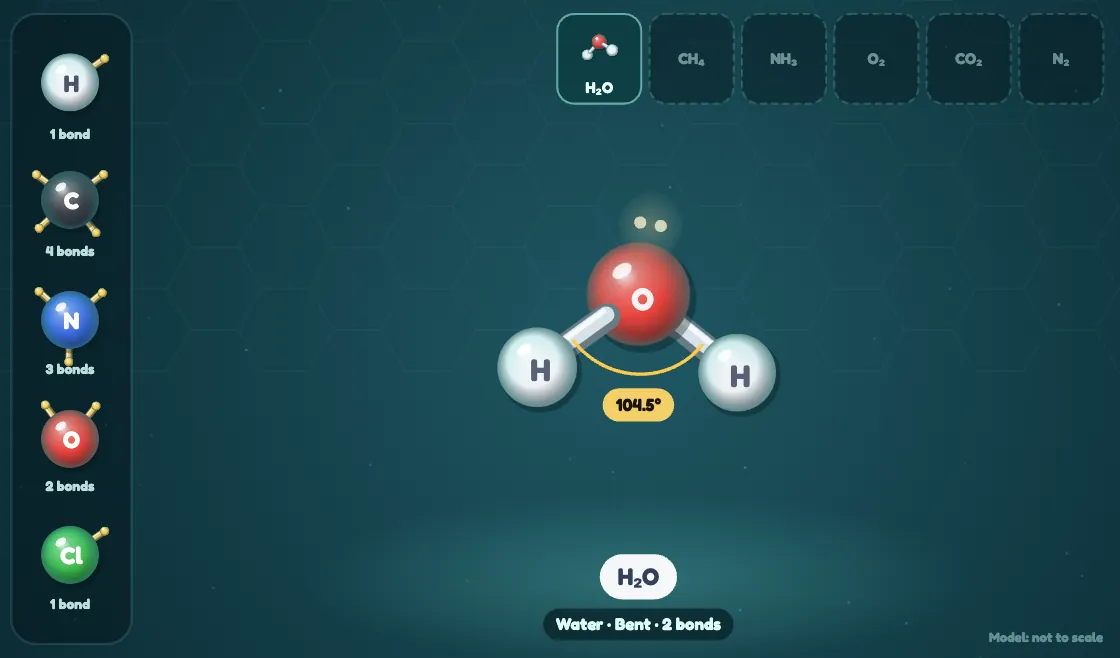
Atoms join into molecules
A molecule is a group of atoms held together by bonds. In a bond, two atoms share a pair of electrons. Water is one oxygen atom bonded to two hydrogen atoms.
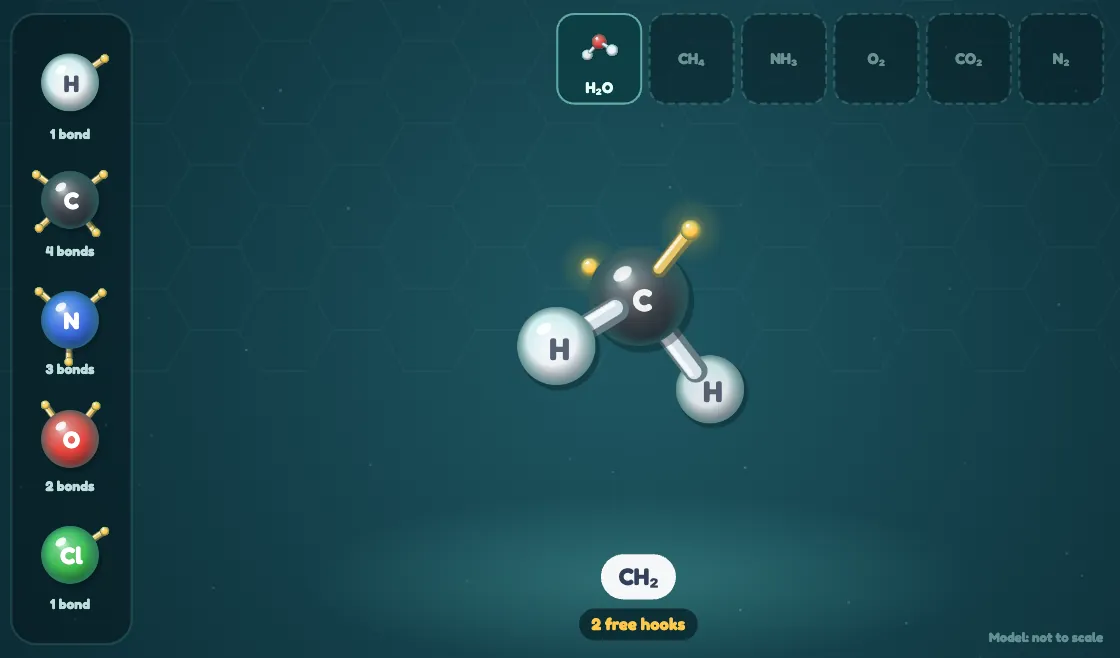
Every atom has its hooks
Each kind of atom makes a set number of bonds: its valency. A molecule is complete when every atom has used all of them.
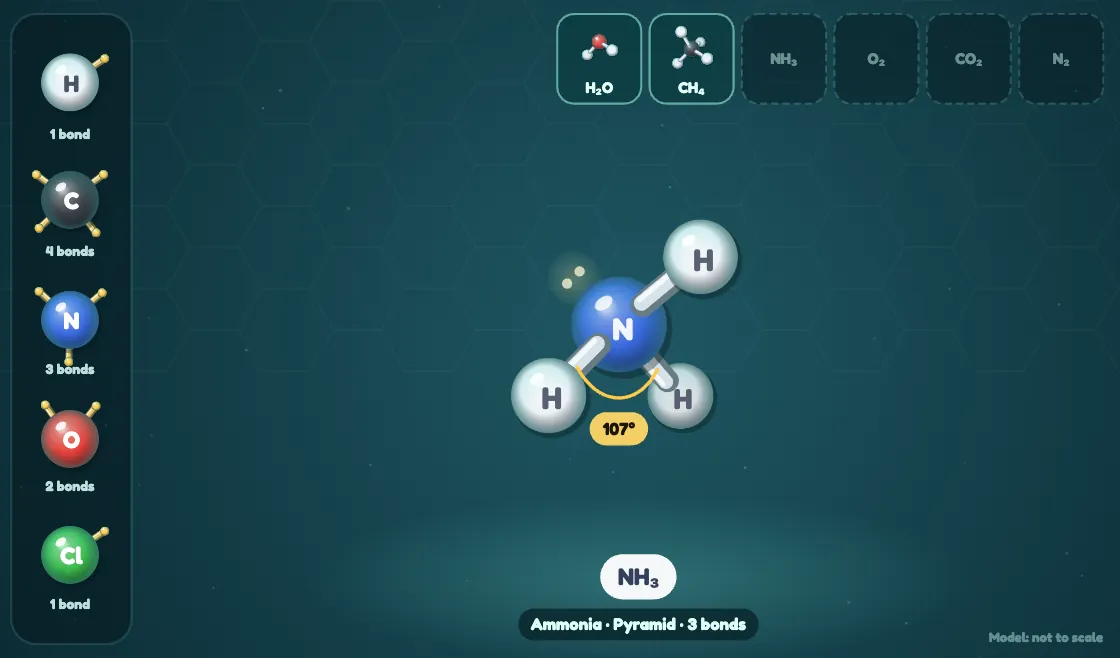
Molecules have shapes
Bonds, and pairs of electrons that aren't shared, push as far apart as they can. That makes methane a tetrahedron (109.5°), ammonia a pyramid (107°) and water bent (104.5°).
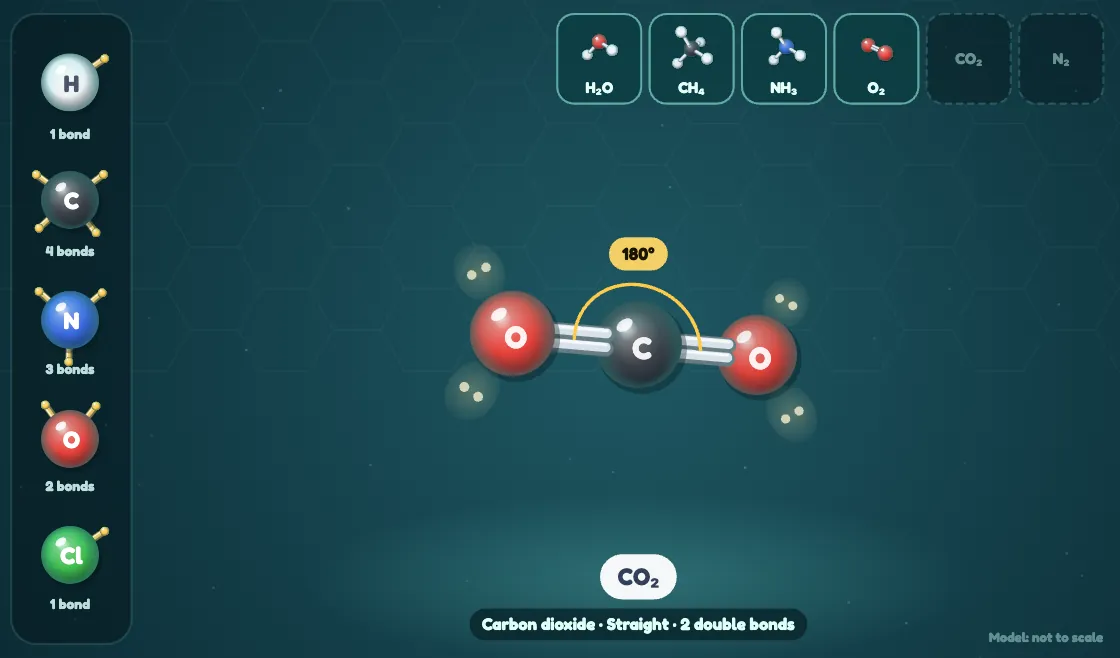
Double and triple bonds
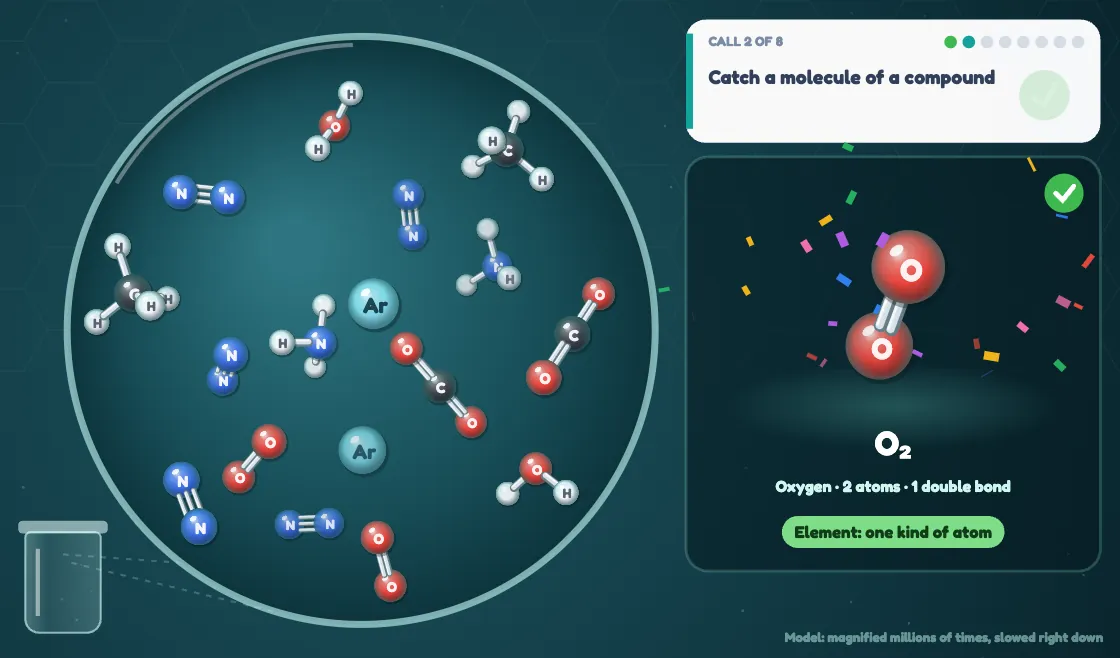
Two atoms can share two pairs of electrons, a double bond, or three, a triple bond. Oxygen is O=O and nitrogen N≡N. Carbon dioxide, O=C=O, is straight: 180°.
Elements and compounds
A molecule of an element has one kind of atom, like O₂ and N₂. A compound has two or more kinds joined together, like H₂O and CO₂. Air is a mixture: different molecules, not joined to each other.
Reading a formula
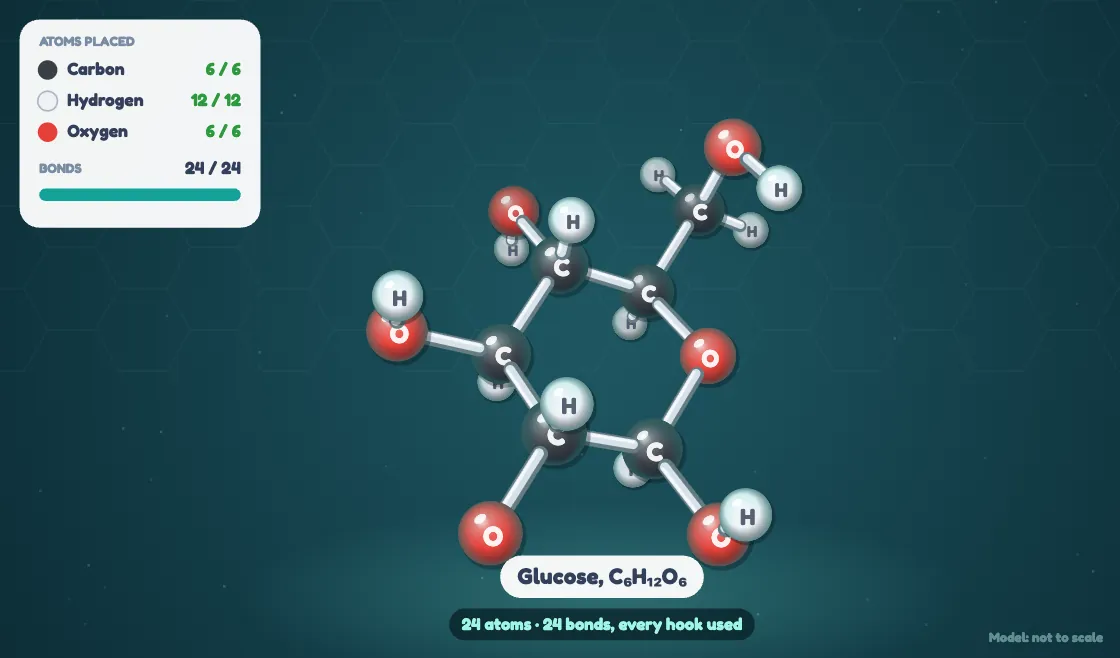
The small number after a symbol counts that atom; no number means one. Glucose, C₆H₁₂O₆, has 6 carbon, 12 hydrogen and 6 oxygen atoms: 24 atoms joined by 24 bonds.
Inside the lab
8 missions in 4 parts: The kit, The gas jar, Sugar, Bonus. Each one is something to try for yourself, with the science behind it once you’ve done it.
- Make waterSnap atoms together to make a water molecule, H₂O, with every hook used.Oxygen makes two bonds and hydrogen one, so one oxygen holds two hydrogens: H₂O. The number of bonds an atom makes is its valency.
- Methane and ammoniaBuild methane, CH₄, and ammonia, NH₃. Spin each one and look at its shape.Bonds push each other as far apart as they can. Methane's four point to the corners of a tetrahedron, 109.5° apart. Nitrogen's unshared pair pushes ammonia's three bonds closer: 107°.
- Double bondsMake oxygen, O₂, and carbon dioxide, CO₂. Tap + on a bond to share another pair.Two atoms can share two pairs of electrons: a double bond. Carbon dioxide has two, O=C=O, and it's dead straight: 180°.
- Element or compoundIn the gas jar, catch a molecule of an element, then a molecule of a compound.A molecule of an element has only one kind of atom, like O₂ or N₂. A compound's molecules have two or more kinds joined together, like H₂O and CO₂.
- Read the formulaCatch 6 particles to Coco's calls.A formula counts the atoms: the small number after a symbol says how many. NH₃ is one nitrogen and three hydrogens. No number means one.
- Build glucoseFill the ghost model of glucose, C₆H₁₂O₆, atom by atom.Glucose is the sugar plants make from carbon dioxide and water, and the sugar in your blood. 6 carbons, 12 hydrogens and 6 oxygens: 24 atoms, joined by 24 bonds.
- A triple bondMake nitrogen, N₂.Two nitrogen atoms share three pairs: a triple bond, one of the strongest bonds there is. That's why the nitrogen in the air hardly reacts.
- Same atoms, new moleculeBuild two different molecules that both have the formula C₂H₆O.Ethanol and methoxymethane have the same atoms, joined in a different order. Ethanol is a liquid that boils at 78 °C; methoxymethane is a gas that boils at −24 °C.
How the quest works
- Predict. Coco asks the mystery and you lock in an answer.
- Learn. A short, picture-led story of the big ideas (6 slides).
- Experiment. 8 missions in the lab, each one yours to try.
- Final Challenge. 8 questions that check you can use what you found, then the mystery’s answer.
For teachers
Present it live on the board while your class follows on their own screens. It fits one class period: about 7 minutes of Learn, 22 in the lab and 5 for the Final Challenge.
Students can
- build models of simple molecules (H₂O, CH₄, NH₃, O₂, CO₂, N₂) from each atom's valency: hydrogen 1, oxygen 2, nitrogen 3, carbon 4.
- describe the 3D shapes of methane, ammonia, water and carbon dioxide, and explain that bonds and lone pairs push as far apart as they can.
- tell a molecule of an element from a molecule of a compound, and explain why air is a mixture.
- read a chemical formula to count the atoms of each element, and work out the number of bonds from the atoms' valencies (glucose: 48 hooks ÷ 2 = 24 bonds).
NGSS: MS-PS1-1. NCERT: Class 8, ch. 8 Nature of Matter: Elements, Compounds, and Mixtures.
Teacher notes for Molecule KitQuestions people ask
What is Molecule Kit?
Molecule Kit is an interactive molecule building simulation from Thinkodile for ages 11 to 14. Snap atoms into water, carbon dioxide and sugar, spin them in 3D, and count every bond. It opens with a mystery to predict, explains the big ideas in a short Learn story, lets you run the experiments yourself in the lab, and ends with a Final Challenge.
Is Molecule Kit free?
Molecule Kit is part of Thinkodile Plus for families and Teacher Pro for teachers. A free account includes 6 quests: Photosynthesis, Build a Cell, Build an Electromagnet, Particles in Motion, Dissolving, Moon Phases Explorer. A parent or teacher creates the account; children never sign up themselves.
How long does Molecule Kit take?
About 34 minutes for a class working through it together: around 7 minutes for the Learn story, 22 in the lab and 5 for the Final Challenge. At home you can stop and pick it up again later.
Which curriculum does Molecule Kit cover?
In the US it supports the Next Generation Science Standards MS-PS1-1. In India it matches NCERT Class 8 Science, chapter 8: Nature of Matter: Elements, Compounds, and Mixtures. It's organised by topic, not by grade, so it fits other syllabuses too.
Does Molecule Kit work on phones, tablets and Chromebooks?
Yes. It runs in the web browser on laptops, Chromebooks, tablets and phones, with nothing to install. On a phone the lab plays sideways, so turn the phone on its side.
Keep exploring Atoms & Molecules
- Atom Builder: Build any of the first twenty elements from protons, neutrons and electrons, make ions and isotopes, and watch unstable atoms decay.
- Periodic Table Explorer: Lay out Mendeleev's element cards and predict an element nobody had seen, read the shells that make the columns, then walk a living table where every atom shows its size and how it reacts.
- All of Atoms & Molecules