
Periodic Table ExplorerAn interactive periodic table simulation for ages 11 to 14
Lay out Mendeleev's element cards and predict an element nobody had seen, read the shells that make the columns, then walk a living table where every atom shows its size and how it reacts.
Part of Thinkodile Plus · about 39 minutes · plays in the browser
The mystery
In 1871 Mendeleev pointed to a gap in his table: an element nobody had ever seen goes here, with a mass of about 72. In 1886 it was found, with a mass of 72.6. How could he know?
Every quest starts with a prediction. Lock yours in, then run the experiments to find out who was right.
What you’ll learn
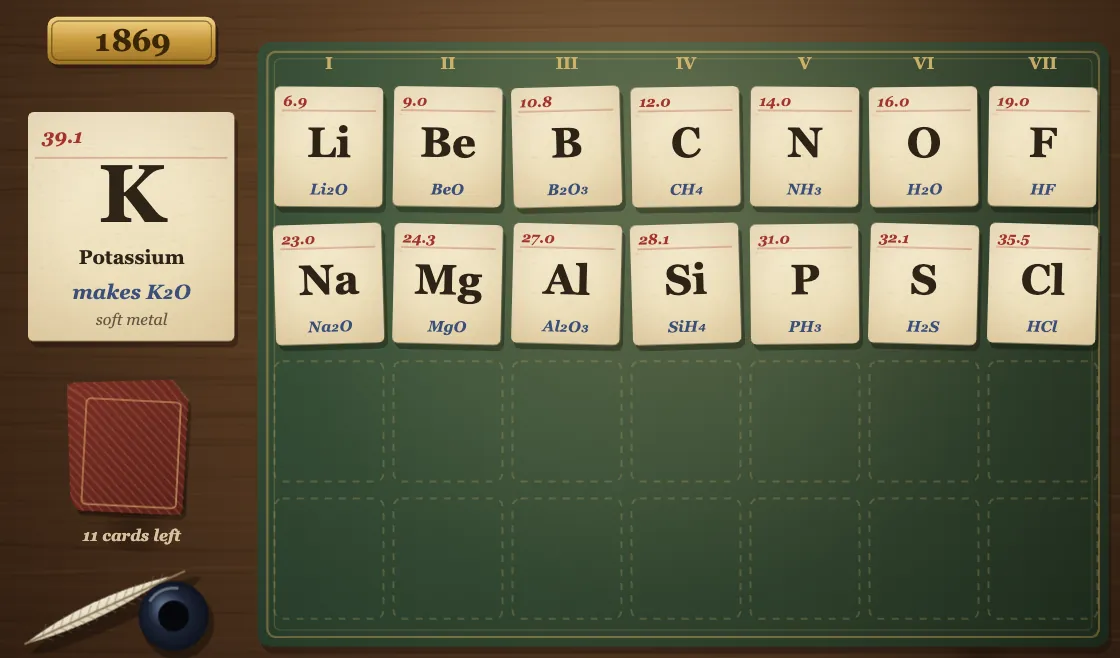
Mendeleev's cards
In 1869 Mendeleev put the elements in order of atomic mass, and started a new row whenever the properties began to repeat. Elements that behave alike ended up in the same column: lithium, sodium and potassium all make an oxide like Li₂O.
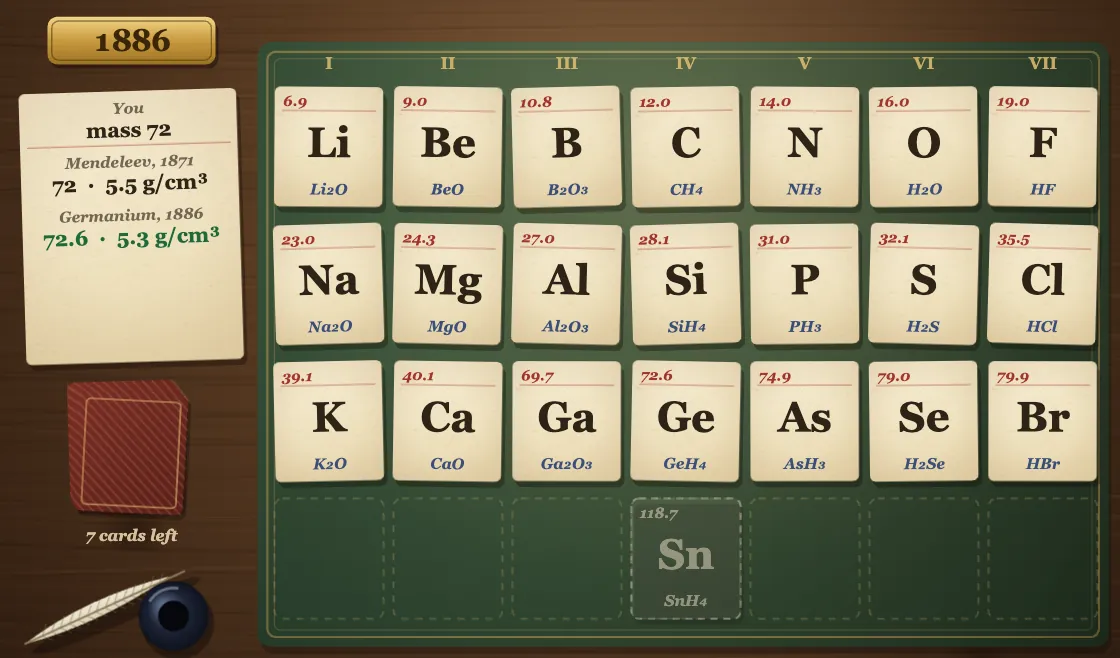
Gaps and predictions
Where no known element fitted, he left a gap and predicted what would fill it. Gallium filled one gap in 1875 and germanium another in 1886, almost exactly as he said.
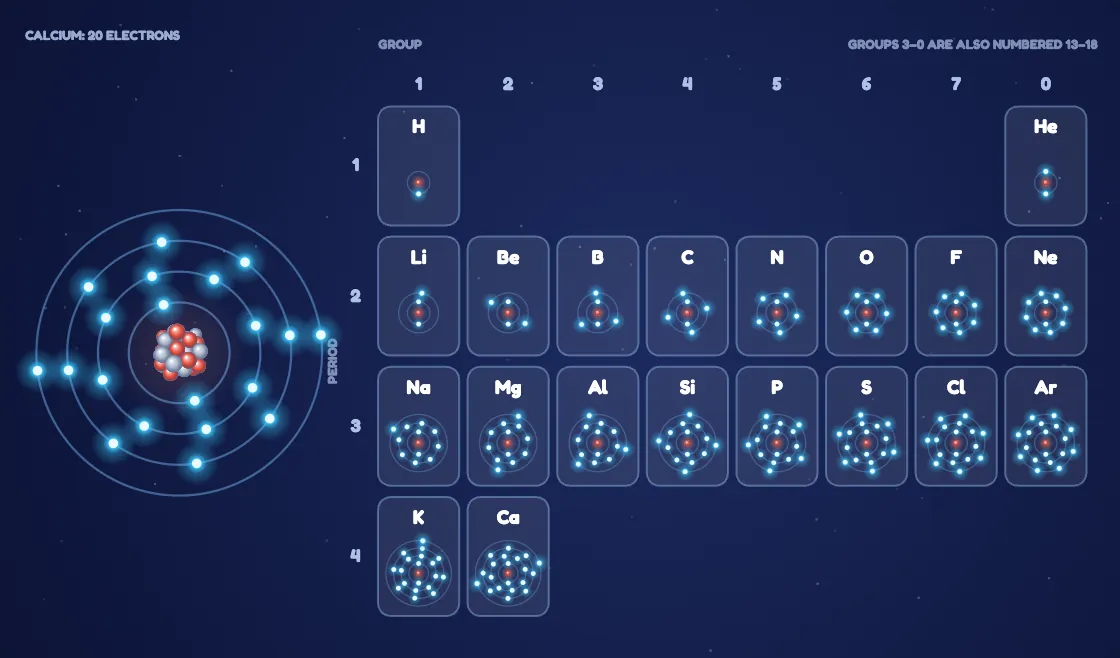
Groups and periods
Today's table is in order of atomic number, the number of protons. That fixed the few places where Mendeleev had to swap cards: tellurium is heavier than iodine, but it has fewer protons. The columns are groups and the rows are periods.
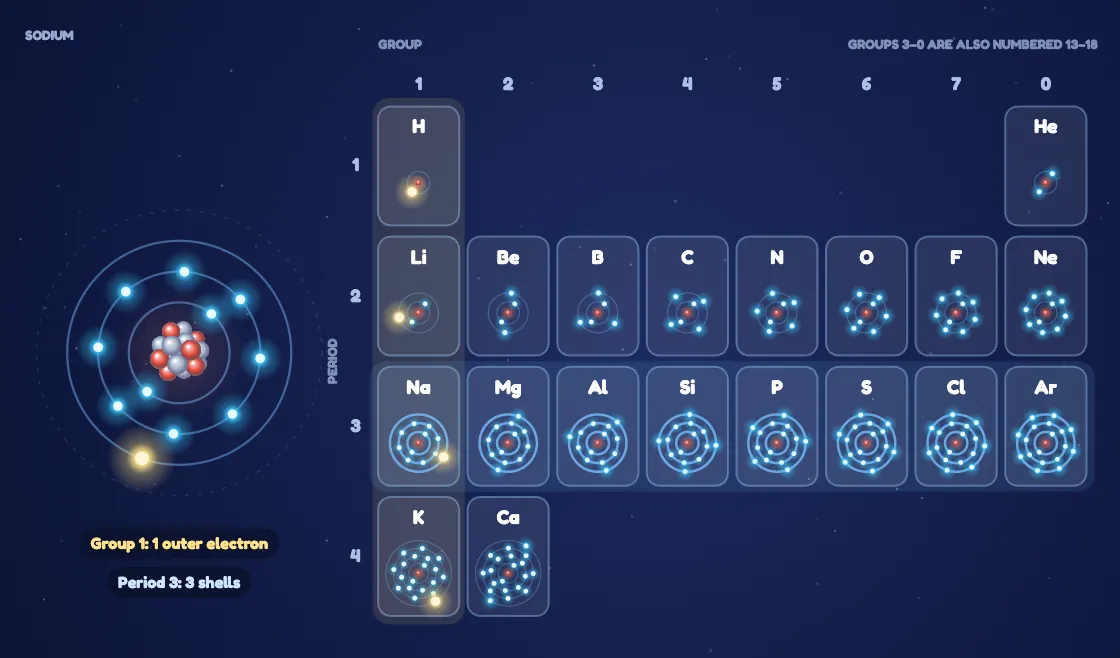
Shells make the pattern
For the first 20 elements, the number of shells gives the period and the electrons in the outer shell give the group. Elements in a group react alike because they have the same number of outer electrons. A full outer shell means group 0.
Bigger and smaller
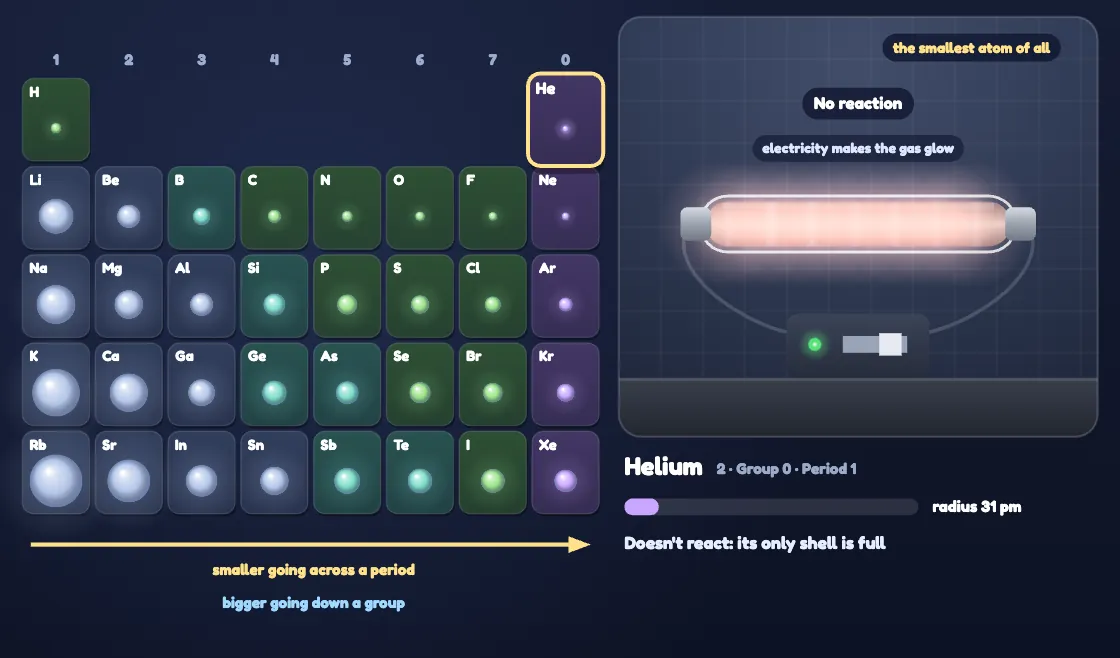
Atoms get bigger going down a group, because each row adds a shell. They get smaller going across a period: more protons pull the same shells in tighter. The sizes here are calculated radii, a model, since an atom has no hard edge.
Reactions down a group
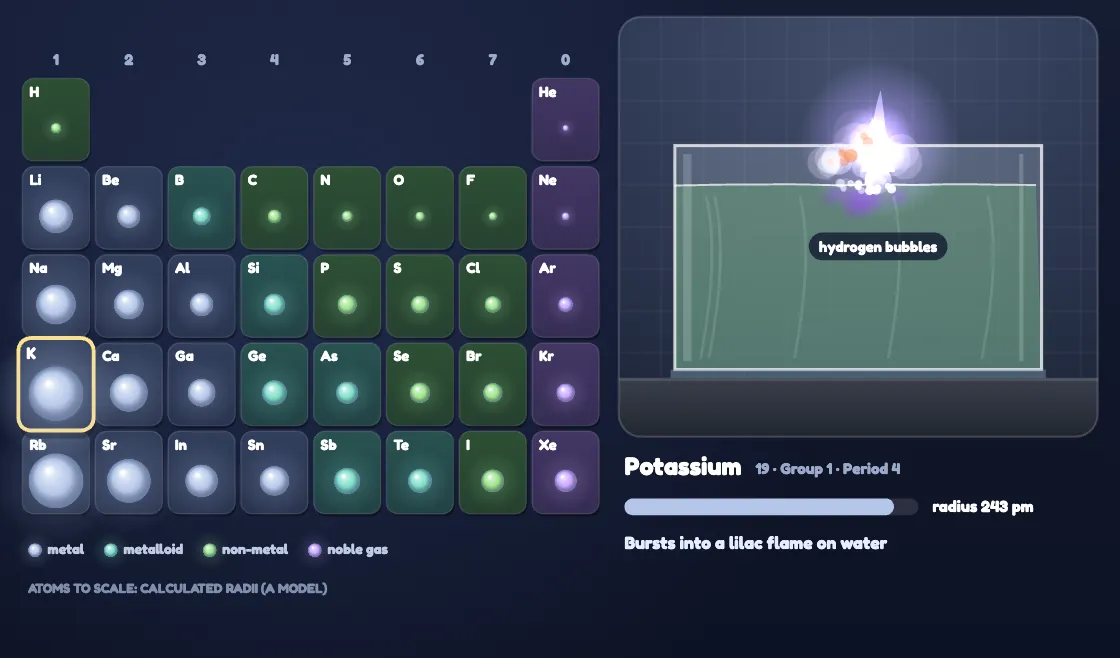
Group 1 metals lose their outer electron to react, and it gets easier going down: potassium is far more violent in water than lithium. Group 7 atoms gain an electron, which gets harder going down. Group 0 hardly reacts at all.
Inside the lab
8 missions in 4 parts: Mendeleev's desk, Why the columns work, The living table, Bonus. Each one is something to try for yourself, with the science behind it once you’ve done it.
- The pattern repeatsLay out the next row of cards, sodium to chlorine, where each one fits best.Sodium behaves like lithium, so it starts a new row under it. Properties repeat every few elements: that's why the table is called periodic.
- Mind the gapsKeep dealing by mass, and put arsenic where it really fits.Arsenic makes AsH₃, like PH₃ and NH₃, so it belongs under phosphorus. Mendeleev left the two places before it empty, for elements nobody had found yet.
- Predict an elementPredict the atomic mass of the missing element under silicon.Mendeleev called it eka-silicon and predicted a mass of about 72 and a density of about 5.5 g/cm³. Germanium, found in 1886, has a mass of 72.6 and a density of 5.3 g/cm³.
- Read the shellsPut six mystery atoms in their places in today's table.The number of shells gives an element's period (its row), and the electrons in its outer shell give its group (its column). Helium's only shell is full, so it sits with the other full-shell atoms in group 0.
- Down group 1Watch lithium, sodium and potassium react with water.Group 1 metals get more reactive going down. Lithium fizzes, sodium whizzes round, potassium bursts into a lilac flame. Each makes hydrogen gas and an alkali.
- Down group 7Watch chlorine, bromine and iodine react with hot iron wool.Group 7 gets less reactive going down: the opposite of group 1. A halogen reacts by pulling in one more electron, and a bigger atom pulls less strongly.
- Heavier, but firstLay out the last row of cards, rubidium to tellurium.Iodine (126.9) is lighter than tellurium (127.6) but behaves like bromine, so Mendeleev trusted the pattern and put it after tellurium. Today's table goes by protons: tellurium has 52, iodine 53.
- Biggest and smallestFind the biggest and the smallest atom on the living table.Rubidium is the biggest here and helium the smallest. Atoms grow going down a group, as each row adds a shell, and shrink going across, as more protons pull the shells in tighter.
How the quest works
- Predict. Coco asks the mystery and you lock in an answer.
- Learn. A short, picture-led story of the big ideas (6 slides).
- Experiment. 8 missions in the lab, each one yours to try.
- Final Challenge. 8 questions that check you can use what you found, then the mystery’s answer.
For teachers
Present it live on the board while your class follows on their own screens. It fits one class period: about 7 minutes of Learn, 25 in the lab and 7 for the Final Challenge.
Students can
- describe how Mendeleev arranged the elements in 1869: in order of atomic mass, with elements that behave alike in the same column, and gaps left for elements not yet discovered.
- explain how Mendeleev's table predicted new elements, using eka-silicon and germanium as the example, and why today's table is in order of atomic number (tellurium and iodine).
- use the electron arrangement of the first 20 elements to place them: the number of shells gives the period, the outer electrons give the group, and a full outer shell means group 0.
- describe the trends in atomic size (bigger down a group, smaller across a period) and in reactivity down groups 1 and 7, and explain why group 0 hardly reacts.
NGSS: HS-PS1-1, HS-PS1-2.
Teacher notes for Periodic Table ExplorerQuestions people ask
What is Periodic Table Explorer?
Periodic Table Explorer is an interactive periodic table simulation from Thinkodile for ages 11 to 14. Lay out Mendeleev's element cards and predict an element nobody had seen, read the shells that make the columns, then walk a living table where every atom shows its size and how it reacts. It opens with a mystery to predict, explains the big ideas in a short Learn story, lets you run the experiments yourself in the lab, and ends with a Final Challenge.
Is Periodic Table Explorer free?
Periodic Table Explorer is part of Thinkodile Plus for families and Teacher Pro for teachers. A free account includes 6 quests: Photosynthesis, Build a Cell, Build an Electromagnet, Particles in Motion, Dissolving, Moon Phases Explorer. A parent or teacher creates the account; children never sign up themselves.
How long does Periodic Table Explorer take?
About 39 minutes for a class working through it together: around 7 minutes for the Learn story, 25 in the lab and 7 for the Final Challenge. At home you can stop and pick it up again later.
Which curriculum does Periodic Table Explorer cover?
In the US it supports the Next Generation Science Standards HS-PS1-1, HS-PS1-2. It's organised by topic, not by grade, so it fits other syllabuses too.
Does Periodic Table Explorer work on phones, tablets and Chromebooks?
Yes. It runs in the web browser on laptops, Chromebooks, tablets and phones, with nothing to install. On a phone the lab plays sideways, so turn the phone on its side.
Keep exploring Atoms & Molecules
- Atom Builder: Build any of the first twenty elements from protons, neutrons and electrons, make ions and isotopes, and watch unstable atoms decay.
- Molecule Kit: Snap atoms into water, carbon dioxide and sugar, spin them in 3D, and count every bond.
- All of Atoms & Molecules