
Predator–Prey IslandAn interactive predator-prey population simulation for ages 11 to 14
Let deer loose on an empty island, bring in the wolves, then keep them all alive for 50 years.
Part of Thinkodile Plus · about 38 minutes · plays in the browser
The mystery
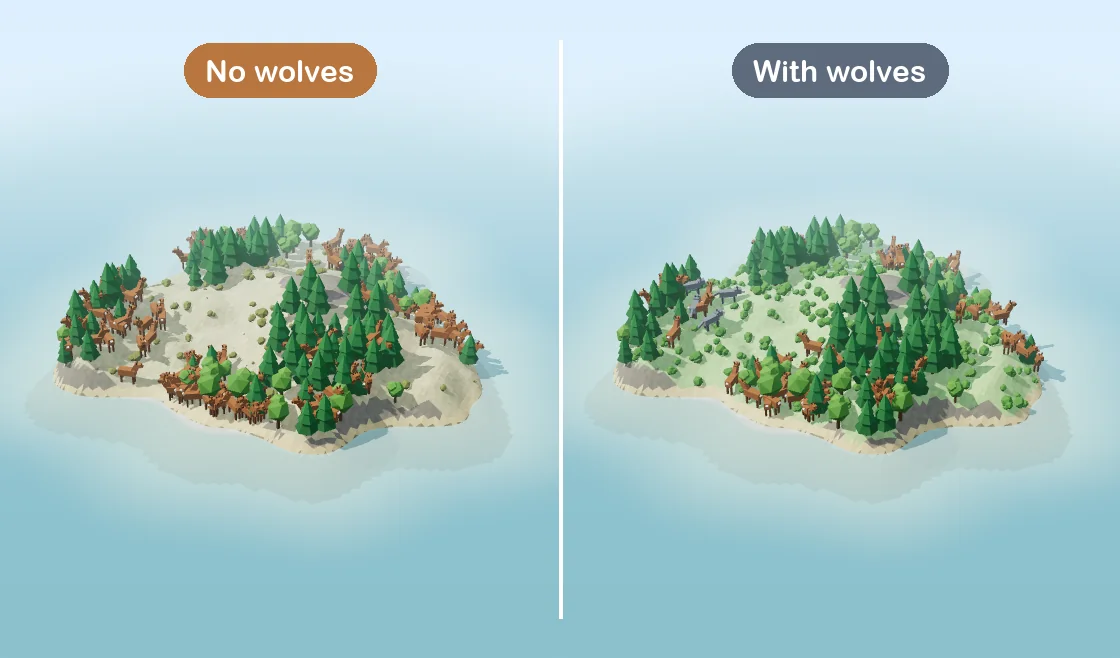
An island has wolves, deer, and thick woods. One year, all the wolves are taken away. What happens to the island's plants over the next 20 years?
Every quest starts with a prediction. Lock yours in, then run the experiments to find out who was right.
What you’ll learn
Populations
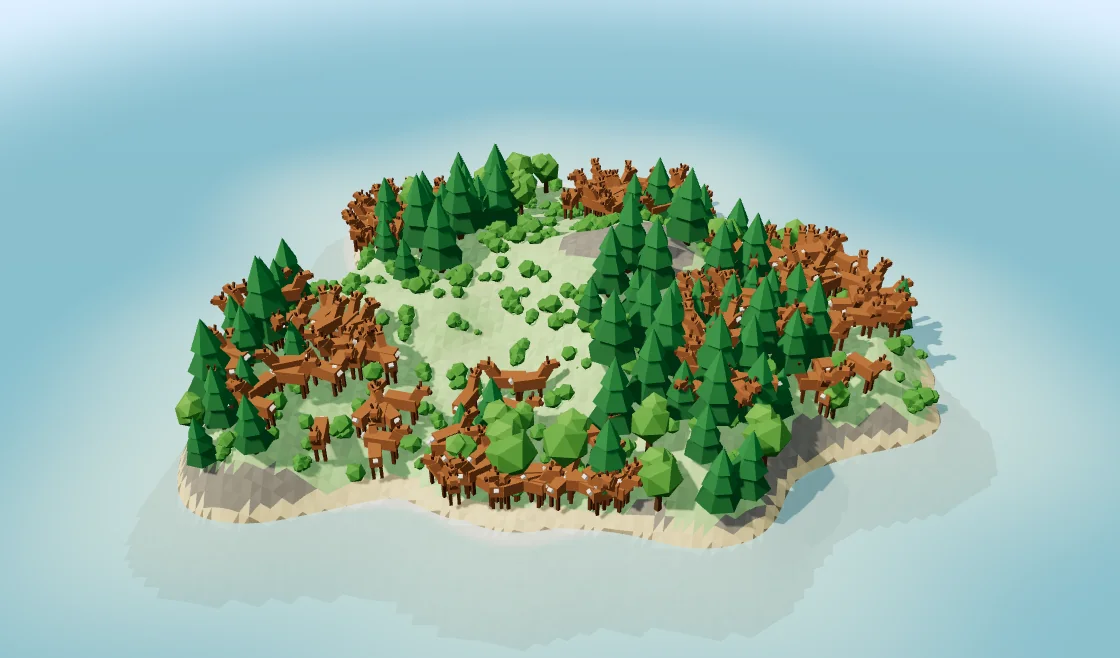
A population is all the animals of one kind living in one place: all the deer on an island, say. It grows when more are born than die, and shrinks when more die than are born.
How many can it feed?
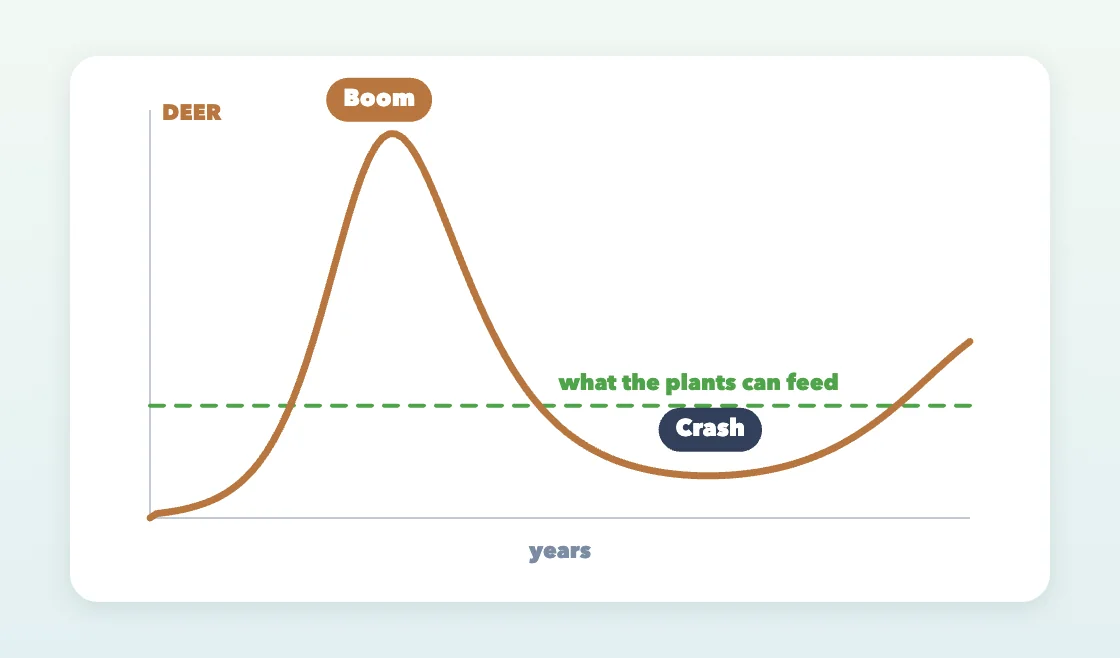
Every place can only feed so many animals. That limit is its carrying capacity. A population that shoots past it eats its food faster than the food grows back, and then many starve.
Predator and prey
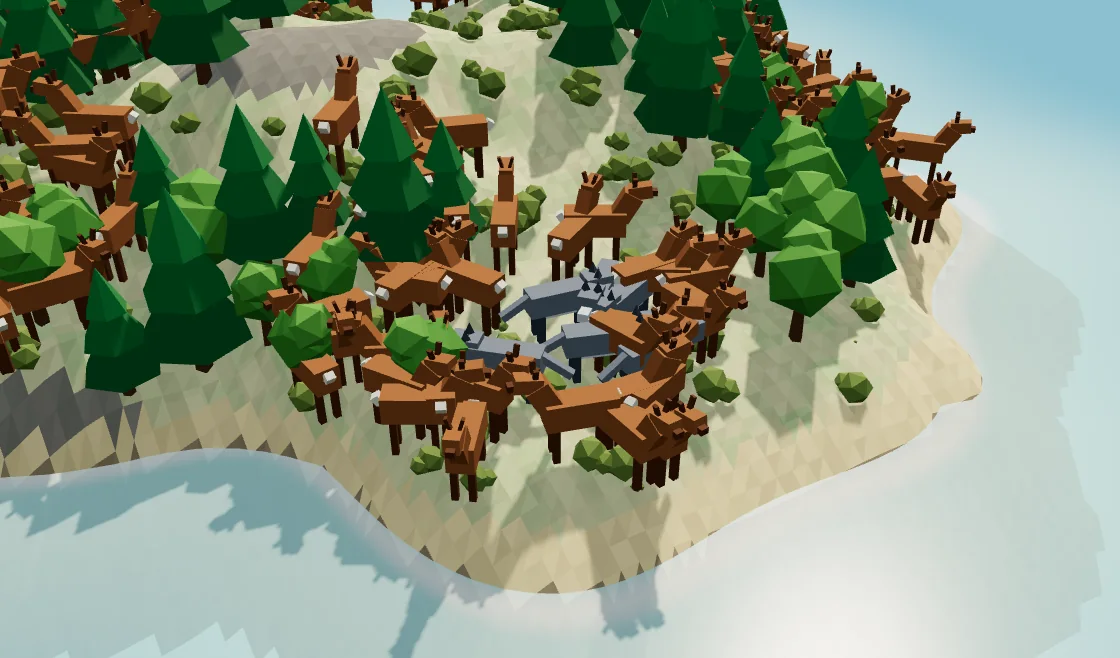
A predator hunts and eats other animals, its prey. Wolves are predators and deer are their prey. The more deer there are, the easier it is for wolves to feed their pups.
Rise and fall
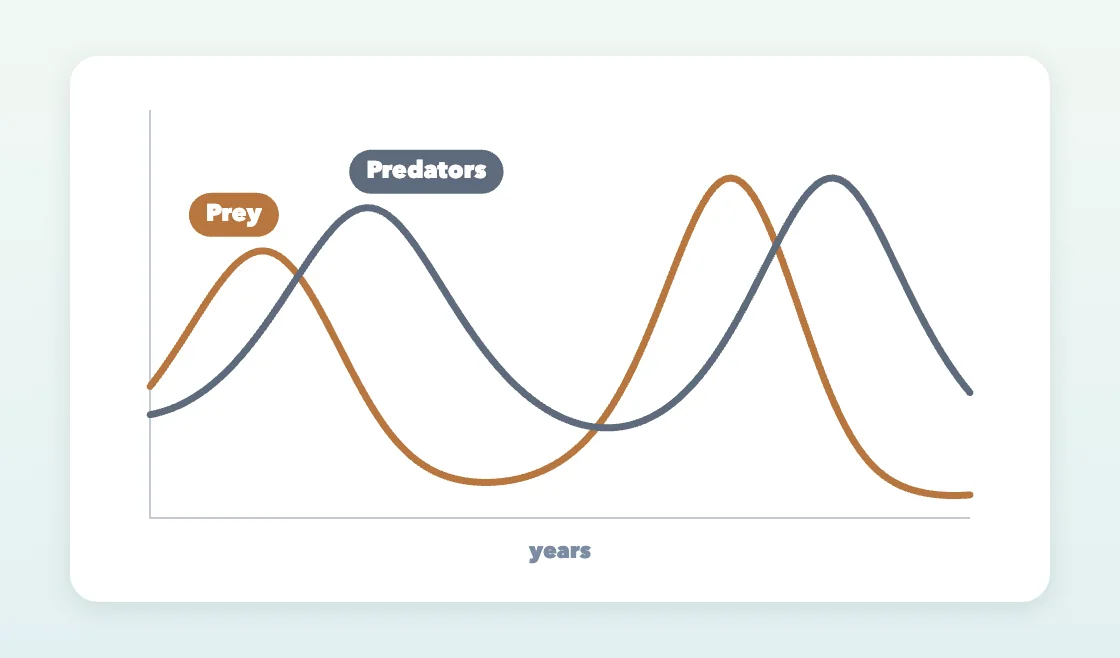
Fur traders in Canada kept records for nearly 100 years. Lynx and snowshoe hares rose and fell about every ten years, with the lynx just behind the hares. More hares fed more lynx, until the lynx ate the hares down.
Ripples
Predators change more than their prey. After wolves returned to Yellowstone in 1995, scientists found young willows and aspens recovering in some places elk had browsed hard. A ripple down a food chain like this is a trophic cascade.
A real island
On Isle Royale, in Lake Superior, the prey are moose. Wolves crossed the winter ice in the late 1940s, and scientists have counted both every year since 1958. By 2016, only two related wolves were left, and the moose boomed. New wolves were brought in in 2018 and 2019.
Inside the lab
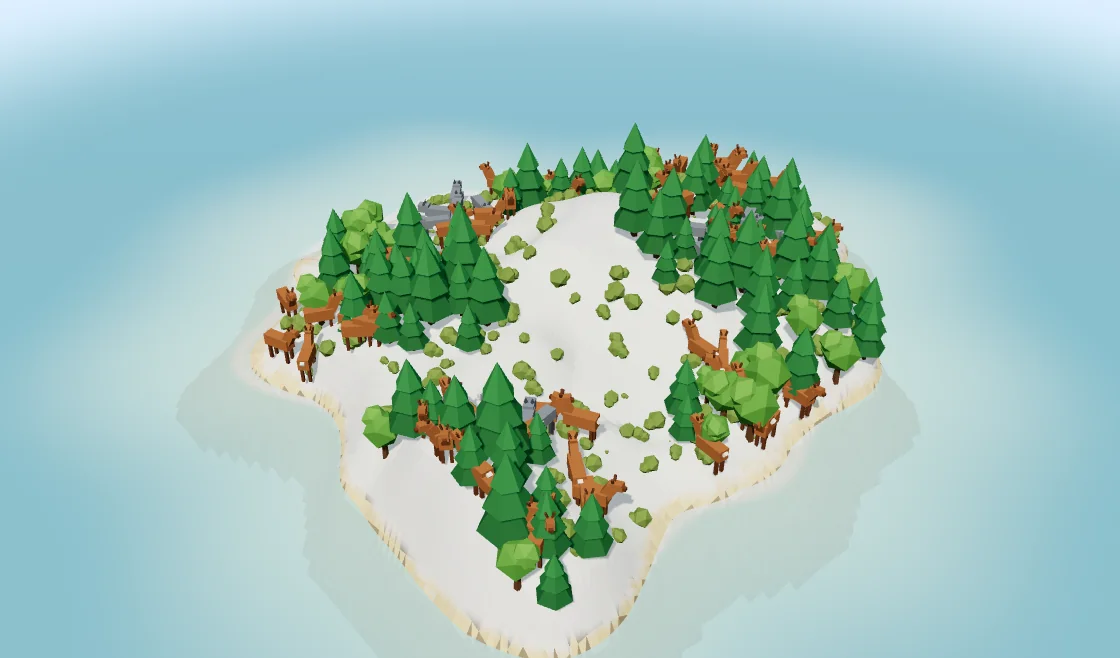
7 missions in 4 parts: Deer alone, Enter the wolves, Save the island, Bonus. Each one is something to try for yourself, with the science behind it once you’ve done it.
- Room to growLet 20 deer loose, and watch until the herd stops growing.With plenty of food and nothing hunting them, nearly every fawn survives to have fawns of its own. So the herd doesn't just grow, it grows faster and faster.
- Boom and crashKeep watching until the herd crashes.Every place can only feed so many animals: its carrying capacity. The herd shot past it, ate the plants faster than they could grow back, and then many deer starved.
- Rise and fallLet the wolves loose, and watch until the wolves reach a peak.Predator and prey take turns. Lots of deer feed lots of wolf pups. Then the wolves eat the deer down, go hungry, and fewer pups survive. With fewer wolves, the deer recover, and round it goes.
- Greener againKeep watching until the plants grow back past 65%.Wolves never eat a single leaf, yet they help the plants. Fewer deer means less is eaten, so young trees and shrubs can grow. A change at the top of a food chain that ripples down to the bottom is called a trophic cascade.
- Save the islandKeep deer and wolves alive for 50 years, with the plants at half or more on average.Real wildlife managers face just this: too many deer can wreck a forest, and a tiny, inbred group of predators can die out. Bringing in new animals, and sometimes hunting, are tools they use, with care.
- New bloodBring in new wolves while the pack is down to 4 or fewer.In a tiny pack every wolf is related, and few pups survive. That happened on Isle Royale, a real island in Lake Superior. In 2018 and 2019, new wolves were brought in from the mainland.
- Wolves do the workSave the island without a single hunting season.Healthy predators can keep prey in check on their own. They tend to catch the young, the old and the sick, so the herd that's left is often healthier.
How the quest works
- Predict. Coco asks the mystery and you lock in an answer.
- Learn. A short, picture-led story of the big ideas (6 slides).
- Experiment. 7 missions in the lab, each one yours to try.
- Final Challenge. 8 questions that check you can use what you found, then the mystery’s answer.
For teachers
Present it live on the board while your class follows on their own screens. It fits one class period: about 7 minutes of Learn, 24 in the lab and 7 for the Final Challenge.
Students can
- explain why a population with plenty of food and no predators grows faster and faster, then overshoots its food supply and crashes.
- describe carrying capacity as the most animals a place can feed, and use it to explain a boom and a crash.
- read a two-line population graph and explain why the predator's peaks come a few years after the prey's.
- explain how a predator can help plants it never eats, by keeping its prey's numbers down (a trophic cascade).
- choose and justify actions that keep predators, prey and plants in balance, and explain why a tiny, related group of predators is at risk.
NGSS: MS-LS2-1, MS-LS2-4. NCERT: Class 8, ch. 12 How Nature Works in Harmony.
Teacher notes for Predator–Prey IslandQuestions people ask
What is Predator–Prey Island?
Predator–Prey Island is an interactive predator-prey population simulation from Thinkodile for ages 11 to 14. Let deer loose on an empty island, bring in the wolves, then keep them all alive for 50 years. It opens with a mystery to predict, explains the big ideas in a short Learn story, lets you run the experiments yourself in the lab, and ends with a Final Challenge.
Is Predator–Prey Island free?
Predator–Prey Island is part of Thinkodile Plus for families and Teacher Pro for teachers. A free account includes 6 quests: Photosynthesis, Build a Cell, Build an Electromagnet, Particles in Motion, Dissolving, Moon Phases Explorer. A parent or teacher creates the account; children never sign up themselves.
How long does Predator–Prey Island take?
About 38 minutes for a class working through it together: around 7 minutes for the Learn story, 24 in the lab and 7 for the Final Challenge. At home you can stop and pick it up again later.
Which curriculum does Predator–Prey Island cover?
In the US it supports the Next Generation Science Standards MS-LS2-1, MS-LS2-4. In India it matches NCERT Class 8 Science, chapter 12: How Nature Works in Harmony. It's organised by topic, not by grade, so it fits other syllabuses too.
Does Predator–Prey Island work on phones, tablets and Chromebooks?
Yes. It runs in the web browser on laptops, Chromebooks, tablets and phones, with nothing to install. On a phone the lab plays sideways, so turn the phone on its side.
Keep exploring Ecosystems & Food Webs
- Build an Ecosystem: Bring a dry pond back to life. What does an ecosystem need to keep going?
- Food Web Challenge: Link who eats whom, then remove a species and watch the whole web react.
- Ecosystem Balance: Follow the chain of changes in a forest valley, then restore it.
- Rot Lab: Bury an apple, a leaf and a crisp packet, then fast-forward a year with the fungi and worms.
- Invasion!: A species escapes a ship into a lake. Track it, predict the damage, and choose how to fight back.
- All of Ecosystems & Food Webs