
Rot LabAn interactive decomposition and decomposers simulation for ages 11 to 14
Bury an apple, a leaf and a crisp packet, then fast-forward a year with the fungi and worms.
Part of Thinkodile Plus · about 38 minutes · plays in the browser
The mystery
A big tree can drop hundreds of thousands of leaves every autumn, and woods have done this for millions of years. So why isn't the ground buried deep in old leaves?
Every quest starts with a prediction. Lock yours in, then run the experiments to find out who was right.
What you’ll learn
The decomposers
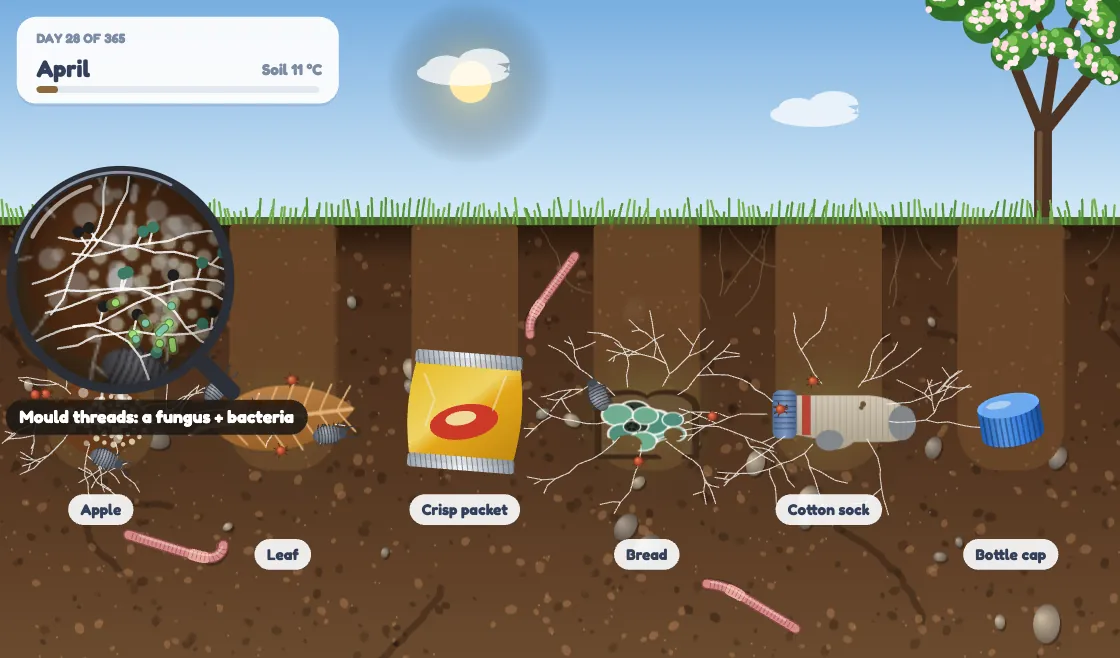
Fungi and bacteria break down dead plants and animals. They can't swallow food, so they release enzymes onto it, digest it from the outside and soak up what dissolves. Mould is a fungus: a web of fine threads.
Helpers with legs
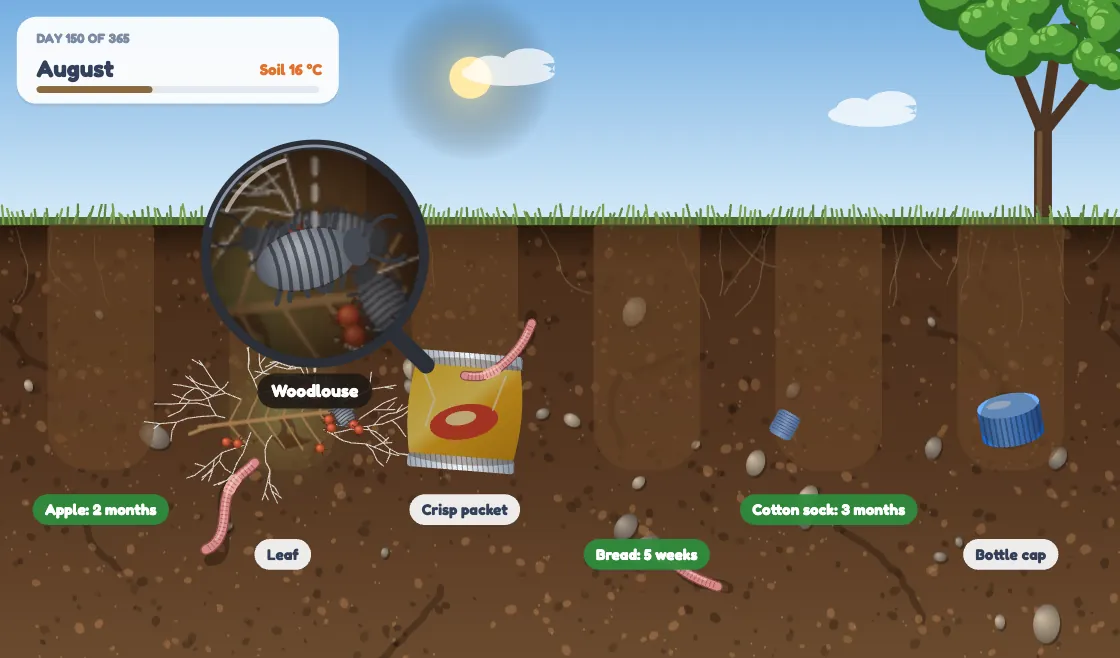
Earthworms, woodlice, millipedes and mites eat dead leaves and break them into tiny bits. That gives the decomposers far more surface to work on. A gram of garden soil can hold up to a billion bacteria.
Biodegradable, or not
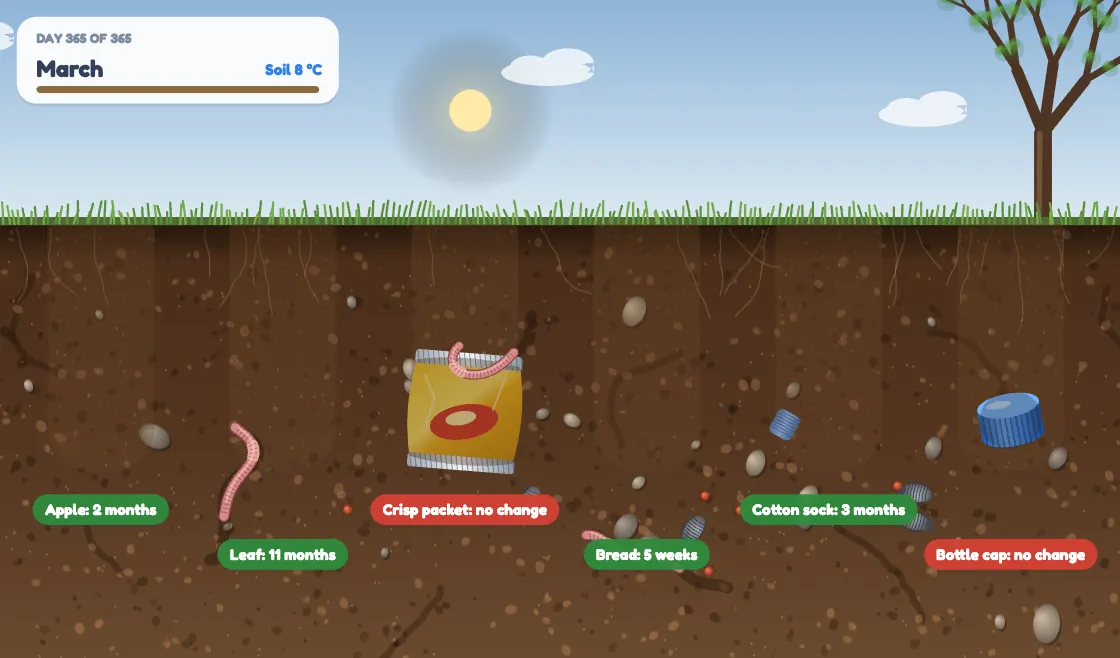
Anything made by living things, like food, leaves, paper and cotton, can be digested by decomposers: it's biodegradable. Most plastics aren't. They last for hundreds of years, slowly breaking into tiny pieces.
Warm, damp and airy
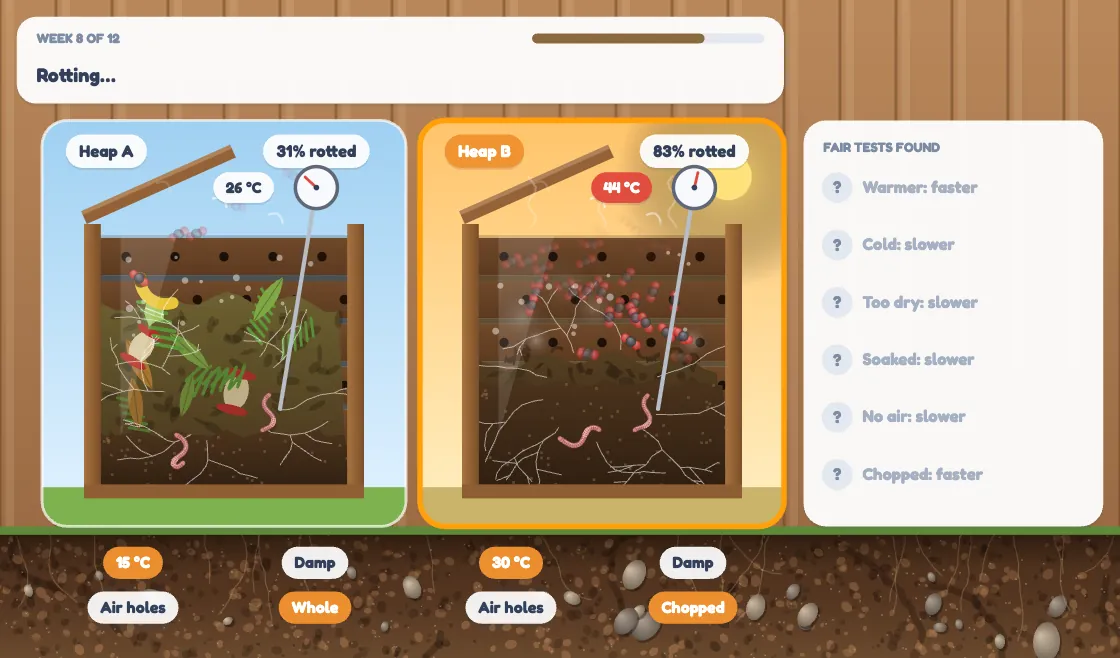
Decomposers are alive, so they need warmth, water and oxygen. Warmth speeds them up; chopping things small gives them more surface. A good compost heap gets so busy it warms itself to about 60 °C.
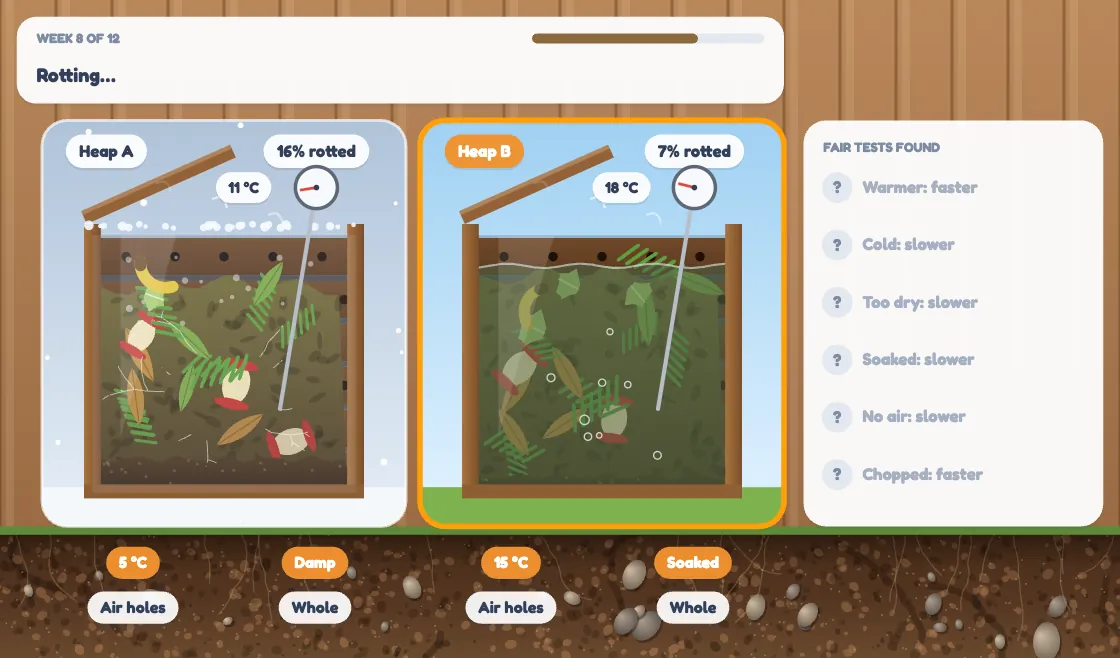
How to stop the rot
Take away what decomposers need and food keeps. Cold slows them (fridges), drying stops them (raisins, dried fish, mummies), and no oxygen holds them back (sealed packs, waterlogged peat bogs).
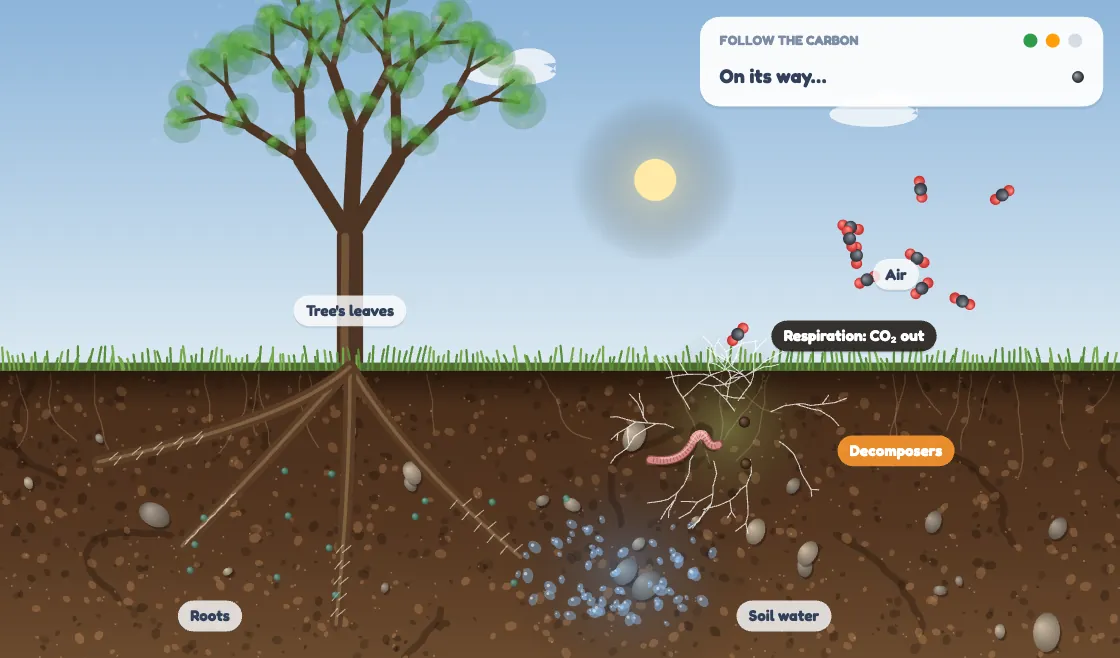
Round and round
Decomposers respire, breathing out the dead thing's carbon as carbon dioxide; plants take it back in for photosynthesis. The minerals go back into the soil water, and roots take them up. Without rotting, the cycle would stop.
Inside the lab
8 missions in 4 parts: A year underground, Rot it faster, Back to the soil, Bonus. Each one is something to try for yourself, with the science behind it once you’ve done it.
- A year undergroundBury the six things and fast-forward a whole year.Things made by living things are biodegradable: decomposers can digest them. In the model the bread went in about 5 weeks and the leaf took most of the year. Plastic has no decomposers that can digest it, so it lasts for hundreds of years.
- Meet the rottersTap the soil to look through the lens. Find 4 kinds of living thing that break things down.Fungi and bacteria are the decomposers: they digest dead things from the outside and soak up what dissolves. Worms, woodlice and mites eat dead stuff and break it into tiny pieces, which gives the decomposers more to work on.
- Warm or cold?Run a fair test that changes only the temperature of one heap.Decomposers are living things. In the warmth they grow and feed faster, so rotting speeds up; in the cold they slow right down. That's why a fridge keeps food fresh for longer.
- Too dry, too wetFair-test a dry heap against a damp one, and a soaked heap against a damp one.Decomposers need water, so dry things hardly rot: think of raisins, dried fish and mummies. But a soaked heap rots slowly too: water fills the air spaces, and most decomposers need oxygen. That's why peat bogs keep things for thousands of years.
- Follow the carbonFollow a fallen leaf's carbon until it's back in a new leaf.Decomposers respire, like you: they break down the dead leaf's sugars and breathe out carbon dioxide. Plants take carbon dioxide in through their leaves for photosynthesis, so the carbon ends up in a new leaf. A little stays in the soil as dark humus.
- Follow the mineralsFollow the fallen leaf's minerals back into the tree.Rotting frees the minerals in dead things, like nitrogen in nitrates. They dissolve in the soil water, roots take them in, and the tree uses them to grow new leaves.
- Compost in 12 weeksMake a heap that's at least 90% rotted after 12 weeks.Warm, damp, airy and chopped: the decomposers have everything they need. A heap like that warms itself to 50 or 60 °C, because the decomposers give out heat as they respire.
- A wood with no rottersRun three years in a wood with no decomposers.With nothing to rot them, dead leaves pile up year after year, and the minerals in them never get back to the soil. Without decomposers, life would run out of the things it's made of.
How the quest works
- Predict. Coco asks the mystery and you lock in an answer.
- Learn. A short, picture-led story of the big ideas (6 slides).
- Experiment. 8 missions in the lab, each one yours to try.
- Final Challenge. 8 questions that check you can use what you found, then the mystery’s answer.
For teachers
Present it live on the board while your class follows on their own screens. It fits one class period: about 7 minutes of Learn, 23 in the lab and 8 for the Final Challenge.
Students can
- name bacteria and fungi as decomposers, describe how they digest dead material from the outside, and name animals (earthworms, woodlice, mites) that break it into smaller pieces.
- sort materials into biodegradable and non-biodegradable, using what was left after a year underground as evidence.
- plan a fair test that changes one thing, and explain how warmth, water, oxygen and chopping change how fast things rot.
- trace a dead leaf's carbon (respiration, carbon dioxide, photosynthesis) and minerals (soil water, roots) back into a living plant.
NGSS: MS-LS2-3, 5-LS2-1, HS-LS2-3. NCERT: Class 8, ch. 12 How Nature Works in Harmony.
Teacher notes for Rot LabQuestions people ask
What is Rot Lab?
Rot Lab is an interactive decomposition and decomposers simulation from Thinkodile for ages 11 to 14. Bury an apple, a leaf and a crisp packet, then fast-forward a year with the fungi and worms. It opens with a mystery to predict, explains the big ideas in a short Learn story, lets you run the experiments yourself in the lab, and ends with a Final Challenge.
Is Rot Lab free?
Rot Lab is part of Thinkodile Plus for families and Teacher Pro for teachers. A free account includes 6 quests: Photosynthesis, Build a Cell, Build an Electromagnet, Particles in Motion, Dissolving, Moon Phases Explorer. A parent or teacher creates the account; children never sign up themselves.
How long does Rot Lab take?
About 38 minutes for a class working through it together: around 7 minutes for the Learn story, 23 in the lab and 8 for the Final Challenge. At home you can stop and pick it up again later.
Which curriculum does Rot Lab cover?
In the US it supports the Next Generation Science Standards MS-LS2-3, 5-LS2-1, HS-LS2-3. In India it matches NCERT Class 8 Science, chapter 12: How Nature Works in Harmony. It's organised by topic, not by grade, so it fits other syllabuses too.
Does Rot Lab work on phones, tablets and Chromebooks?
Yes. It runs in the web browser on laptops, Chromebooks, tablets and phones, with nothing to install. On a phone the lab plays sideways, so turn the phone on its side.
Keep exploring Ecosystems & Food Webs
- Build an Ecosystem: Bring a dry pond back to life. What does an ecosystem need to keep going?
- Food Web Challenge: Link who eats whom, then remove a species and watch the whole web react.
- Ecosystem Balance: Follow the chain of changes in a forest valley, then restore it.
- Predator–Prey Island: Let deer loose on an empty island, bring in the wolves, then keep them all alive for 50 years.
- Invasion!: A species escapes a ship into a lake. Track it, predict the damage, and choose how to fight back.
- All of Ecosystems & Food Webs