
Food chains and food webs explained: what's the difference?
Food chain vs food web: a chain is one path of who eats whom, a web links many. Producers, consumers, decomposers, arrows, energy loss and a real example.

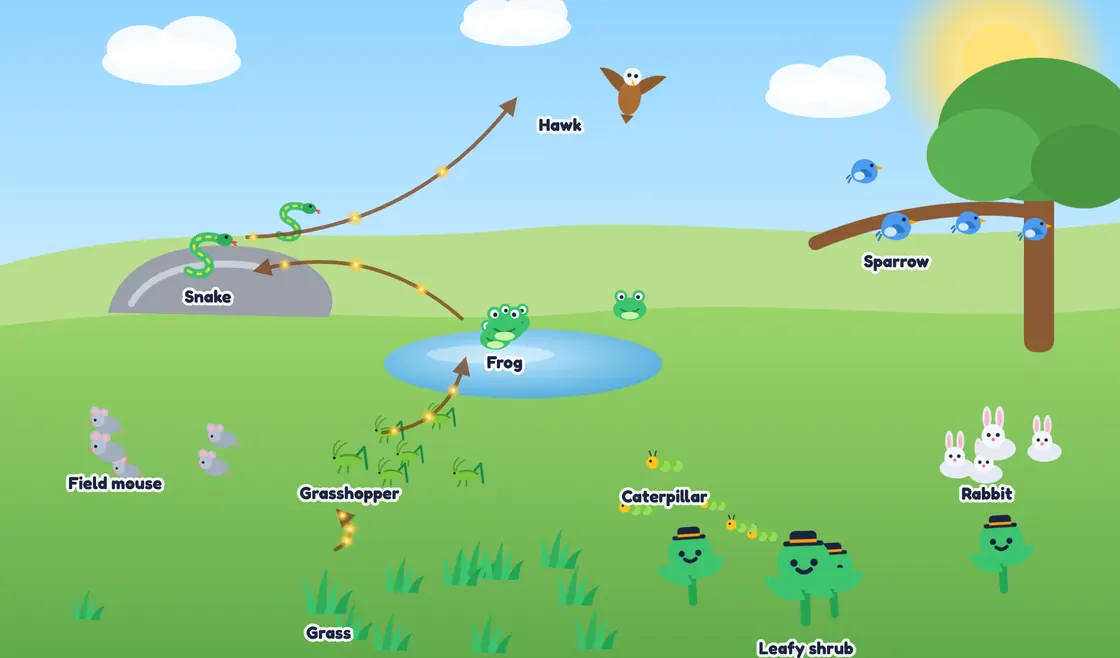
A food chain shows one path of who eats whom: grass → grasshopper → frog → snake → hawk. A food web joins many food chains together, because most living things eat more than one kind of food and are eaten by more than one predator. In both, the arrows point from the food to the eater, showing which way energy flows.
What is a food chain?
A food chain is a single line of feeding links that shows how energy passes from one living thing to the next. It almost always starts with a producer, usually a green plant.
Here's a chain from a grassland:
grass → grasshopper → frog → snake → hawk
Read each arrow as "is eaten by" or "gives energy to". The grass is eaten by the grasshopper, the grasshopper by the frog, and so on up to the hawk.
Common mistake: drawing the arrows the other way, from the eater to its food. The arrow shows where the energy goes, so it always points to the one doing the eating.
Producers, consumers and decomposers
Every food chain and web is built from three kinds of living things: producers that make food, consumers that eat it, and decomposers that break down what's left.
- Producers make their own food by photosynthesis, using energy from sunlight. Plants and algae are producers.
- Primary consumers eat producers. They're herbivores, like grasshoppers, caterpillars and rabbits.
- Secondary consumers eat primary consumers, like a frog that eats grasshoppers.
- Tertiary consumers eat secondary consumers, like a snake that eats frogs.
- Top predators, like the hawk, come at the end of a chain: nothing in the chain eats them.
- Decomposers, such as bacteria and fungi, break down dead plants, dead animals and waste. They return nutrients to the soil and water, where producers use them again.
Animals that eat both plants and animals, like sparrows that eat seeds and insects, are omnivores. Scientists call each step in a chain a trophic level, which simply means feeding level.
One animal, several levels
A feeding level belongs to a chain, not to an animal. In the chain grass → mouse → hawk, the hawk is a secondary consumer. In grass → grasshopper → frog → snake → hawk, the same hawk is a fourth-level consumer. A single chain can't show both, which is one reason scientists use webs.
What is a food web?
A food web is many food chains joined together, showing all the feeding links in one place. It's more realistic than a single chain, because real animals rarely depend on just one food.
In a grassland, rabbits eat both grass and leafy shrubs. Frogs eat grasshoppers and caterpillars. Hawks hunt mice, rabbits, sparrows and snakes. Join all of these up and the ten species in the quest's grassland share 16 feeding links.
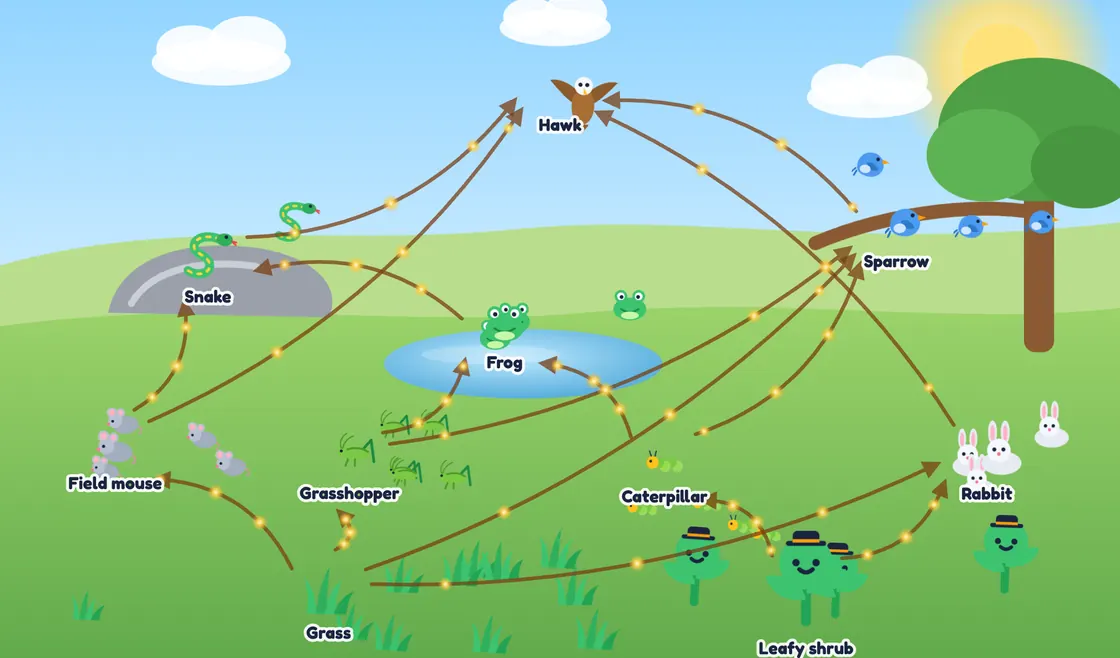
A web also shows what a chain hides. If a hawk had only snakes to eat, losing the snakes would leave it with nothing. Because it also eats mice, rabbits and sparrows, it can eat more of those instead.
Decomposers are often left out of food web diagrams, because almost everything would need an arrow to them. If you add them, draw arrows from dead plants, dead animals and waste to the decomposers. You can see what a whole pond needs, decomposers included, in Build an Ecosystem.
What happens if one species is removed from a food web?
When a species disappears, the animals that ate it lose a food, and the living things it ate are no longer being eaten. Those changes then ripple along the arrows to other species.
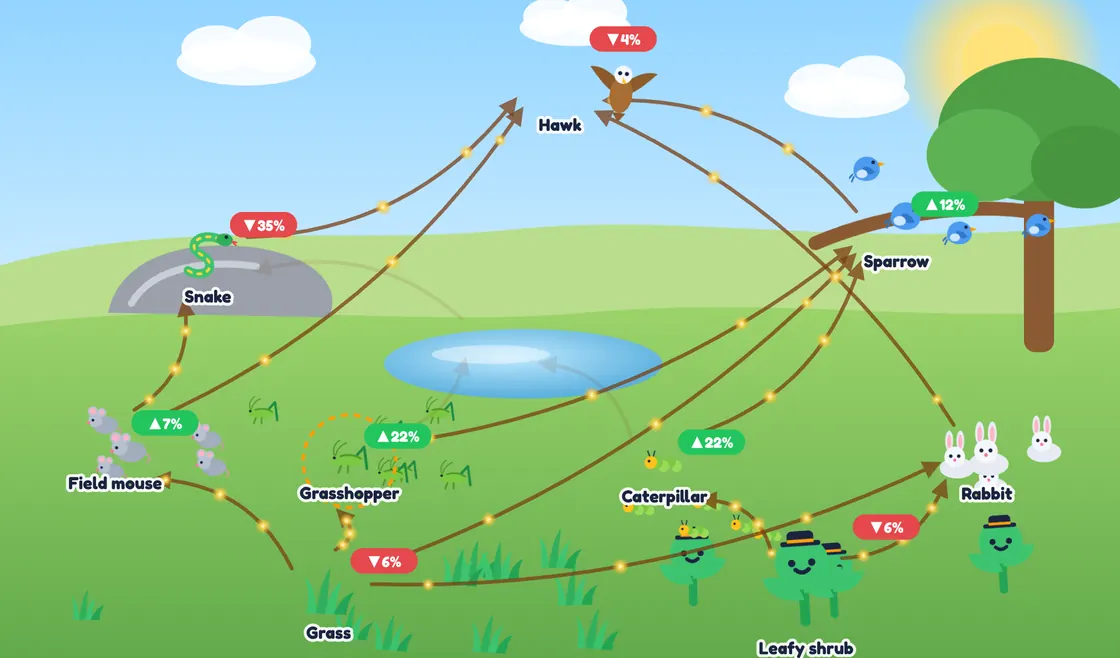
In the quest's grassland, take away the frogs. Grasshoppers and caterpillars, no longer eaten by frogs, increase. Snakes lose one of their foods and decline. Sparrows, which eat the same insects, do better. The hawk at the top feels a smaller knock-on effect. Following the arrows lets you predict all of this before you watch it happen.
A real example: sea otters, sea urchins and kelp
Along North Pacific coasts, sea otters eat sea urchins, and sea urchins graze on kelp, a giant seaweed that grows in underwater forests. From the 1700s until the early 1900s, hunters killed sea otters for their fur until only a few small groups were left. Where the otters vanished, urchins multiplied and ate the kelp, leaving bare stretches of seabed known as urchin barrens.
In the 1970s, scientists compared islands in Alaska's Aleutian chain with and without sea otters. Where otters lived, there were few urchins and plenty of kelp. Where they were missing, urchins covered the seabed and there was little kelp. Since an international treaty protected them in 1911, otters have returned to many coasts, and where they come back, urchin numbers fall and kelp can recover. Because one predator shapes so much of the community, sea otters are called a keystone species.
What about the wolves of Yellowstone?
In 1995 and 1996, 31 wolves from Canada were released into Yellowstone National Park in the US, where wolves had been missing for most of the 20th century. A popular story says the wolves cut elk numbers and kept elk away from rivers, so willow and aspen trees grew back.
Scientists still argue about how much of that was down to the wolves. Others point to elk hunting outside the park, more cougars and bears, the earlier loss of beavers, and how much water reaches the plants. The US National Park Service describes it as an unsettled scientific debate. It's a good reminder that testing a food web idea in the wild is much harder than on paper. For a valley where you can test changes yourself, including what happens when tigers are hunted, try Ecosystem Balance.
Why is there less energy at each level of a food chain?
At each step, only about 10% of the energy is passed on to the next level. The rest is used up in staying alive, moving and keeping warm, and much of it escapes as heat. Some is in parts that don't get eaten, or leaves as undigested waste.
Ten per cent is a rule of thumb, not an exact law: real figures vary from one ecosystem to another. But it shows how quickly energy runs out. Here's a worked example:
- The grass stores 10,000 units of energy from sunlight.
- The grasshoppers that eat it get about 1,000 units.
- The frogs get about 100.
- The snakes get about 10.
- A hawk eating those snakes gets about 1.
So a top predator needs a lot of prey beneath it. That's why there are far fewer hawks than grasshoppers, and why most food chains have only four or five levels.
Energy and nutrients behave differently. Decomposers recycle nutrients back to the plants, but energy isn't recycled: it flows one way through the web and is lost as heat. New energy keeps arriving from the Sun.
Try it: map a food web in a garden or park
- Spend 15 minutes in a garden, park or school field and list every living thing you find: plants, insects, birds, worms and fungi. Look under a log or stone, then put it back gently.
- For each animal, find out what it eats. A field guide or a quick search helps.
- Write the names on a big sheet of paper and draw arrows from each food to its eater. Then add the recyclers: fungi, earthworms and woodlice all help break down dead material.
- Pick one species and predict: if it vanished, which populations would rise and which would fall? Follow the arrows.
Stay safe: wash your hands afterwards, don't touch or eat any fungi, watch animals without picking them up, and have an adult with you near water.
In short
- A food chain is one path of energy, from a producer to a top predator. A food web links many chains together.
- Arrows point from the food to the eater: the direction energy flows.
- Producers make food, consumers eat it, and decomposers recycle the nutrients.
- Remove one species and the effects ripple through the web, as sea otters and kelp show.
- Only about 10% of the energy passes to each next level, so there are few top predators.
Questions people ask
What is the difference between a food chain and a food web?
A food chain is one straight path of feeding links, such as grass → rabbit → hawk. A food web shows many food chains joined together, because most animals eat several foods and have several predators. A web gives a more realistic picture of an ecosystem and helps you predict what happens if one species disappears. Both use arrows that point from the food to the eater.
Which way do the arrows go in a food chain?
The arrows point from the food to the living thing that eats it, for example grass → grasshopper. They show the direction energy flows: from the grass into the grasshopper. A good way to read an arrow is "is eaten by". Drawing the arrows the other way round, from the eater to its food, is one of the most common mistakes in tests.
Are decomposers part of a food web?
Yes, although they're often left out of diagrams to keep them simple. Decomposers such as bacteria and fungi feed on dead plants, dead animals and waste from every level of the web. They release nutrients back into the soil and water, where producers take them up again. Without decomposers, those nutrients would stay locked up in dead material.
Why are there fewer animals at the top of a food chain?
Because energy is lost at every step. Only about 10% of the energy in one feeding level is passed on to the next; the rest is used for living and lost as heat, or leaves as waste. By the top of a chain, little energy is left, so an area can only support a few top predators, such as hawks or tigers.
What is a keystone species?
A keystone species has a much bigger effect on its ecosystem than its numbers suggest, so removing it changes the whole community. Sea otters are a classic example: they eat sea urchins, which graze on kelp. Where otters were hunted out, urchins multiplied and stripped the kelp forests. Where otters have returned, urchin numbers fall and kelp can recover.


